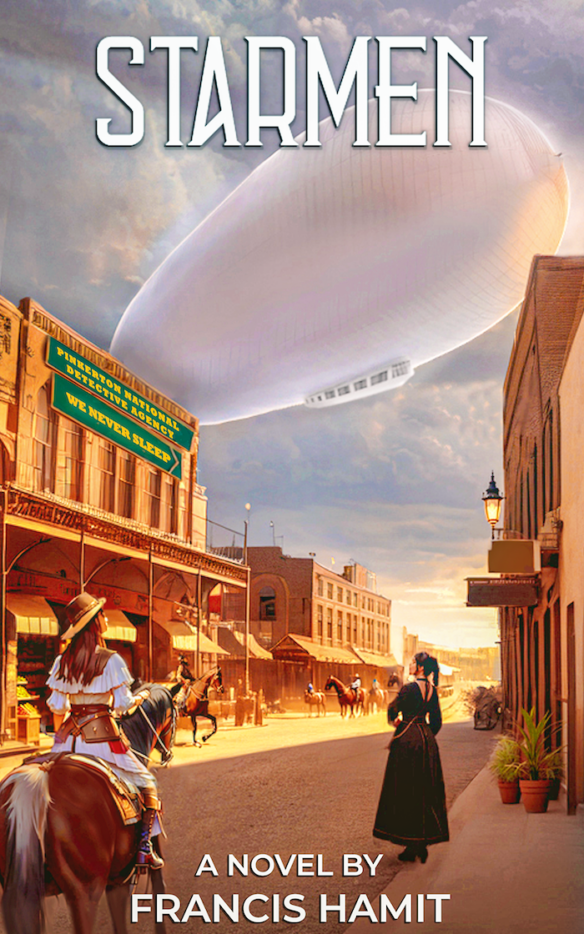
[Introduction: There are three days left to go in Francis Hamit’s Kickstarter to fund publication of Starmen: A Novel. Donors of $1 or more get a copy of the ebook as a reward. The following post first appeared as one of his campaign updates and is reprinted with permission.]
By Francis Hamit: One of the privileges of writing fiction, even fact-based historical fiction is the right to make up improbable coincidences. You can slide with perfect confidence into Alternative History because Real Life has outdone you at every turn. Hence the phrase “you can’t make this stuff up”.
But you can try. And here I have. One of the characters in Starmen is borrowed from my novel The Shenandoah Spy — Sir Percy Wyndham, the Irish “wild goose” mercenary recruited to lead the 1st New Jersey Cavalry during the early part of the American Civil War. He developed a rivalry with 7th Virginia Cavalry leader Turner Ashby, derided him as a dirt farmer amateur only to have his entire unit trapped and captured soon thereafter by Ashby.
The same day Ashby was killed by friendly fire. Belle Boyd’s birthday as well. While I know the exterior circumstances I have little idea of how those people felt, reacted, or what they said to each other. One of the revelations of my Civil War Research is that the so-called Official Records were usually written months after the actual events by staff officers who were not there. What shreds of truth there are can be used to support an otherwise bald lie. Diaries as and letters are more reliable but even there some people lie.
And lie I also must to create creditable dialog about and between my characters. To that end Sir Percy Wyndham must stay in character as a flawed, egotistical and suicidally brave soldier willing to die in battle. With a strong moral center. In real life, once he knew that he was surrounded, he jumped down off his horse and indulged himself in a rather childish tantrum. Then he surrendered. He might have been willing to fight Ashby to the death (although that was not how they did things in Europe) but his men came first. They were able and willing to fight. He would not let them be slaughtered.
Wyndham goes through a number of transformations is an alternative timeline that depends a great deal on my layman’s understanding of quantum physics. In it he is critical to the ending I currently plan. At no time does he fall out of character or lose that strong moral center every professional soldier must have.
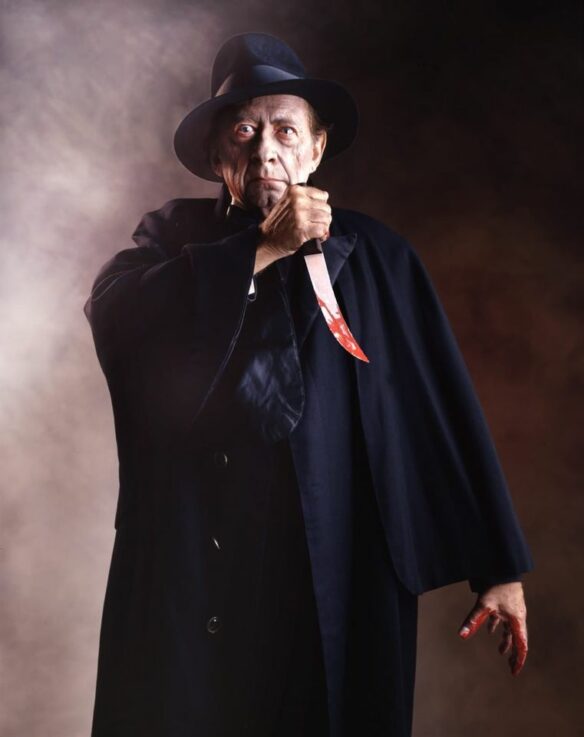
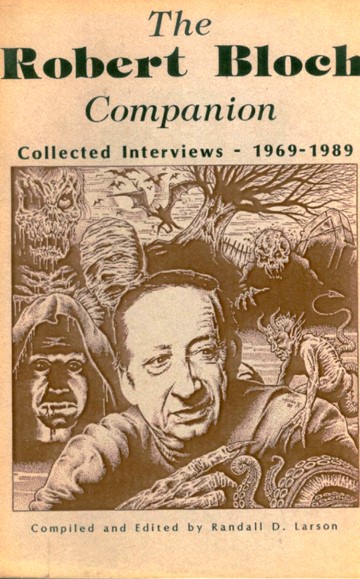
By Steve Vertlieb: Across a sea of stars and time lies a horror too terrible to endure…an evil Hell-Bound Train riding to infinity upon tracks immersed in darkness, careening toward midnight, consumed by madness…a terrible Opener of The Way to flights of fancy and depravity lost in translation, yet rediscovered in endless pages of classic fantasy rendered by one of the greatest, most enduring writers of the genre, Robert Bloch. One of the original circle of authors and students inspired by the eloquent lunacy of H.P. Lovecraft, Robert Bloch began his writing career in 1935 with a series of frightening short stories that soon assumed a poetic eloquence that rivaled Lovecraft in horrific intensity and originality. The crumbling pages of Weird Tales entertained these imaginative stories of witchcraft, mayhem and tales that witnessed madness. With fables such as “The Hungry House,” “The Cheaters,” “Yours Truly Jack The Ripper,” “I Kiss Your Shadow,” “The Dark Demon,” “The Faceless God,” “Beetles,” and “The Shambler From The Stars,” Robert Bloch quickly and effectively established himself as a master of the macabre, setting a standard of writing unequalled by any writer before or since.
Born in Chicago on April 5, 1917 to Jewish parents, Robert Bloch became an avid reader of pulp magazines and, in his teenage years, began a life transforming correspondence with Lovecraft who became his mentor, encouraging the young fan to write and develop his own fantastic fiction. At age seventeen he sold his first professional stories to Weird Tales and, with such lurid titles as “The Feast In The Abbey,” and “The Secret In The Tomb,” began to carefully establish his own fictional identity and style. In tribute to his young disciple, Lovecraft paid incomparable homage to the teenager by writing him into the text of his novel “The Haunter Of The Dark” as Robert Blake. After Lovecraft’s untimely death in 1937, Bloch continued to write for Weird Tales, as well as the science fiction themed Amazing Stories Magazine, quickly becoming one of the most widely read and popular authors of the genre.
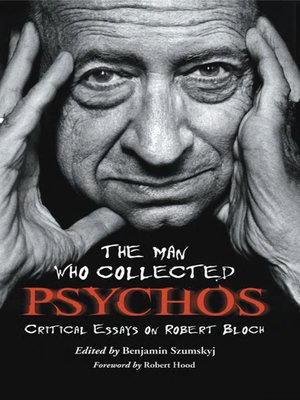
In his private persona, Bloch was a gentle soul with a huge heart who delighted in regaling audiences and friends with jokes and vaudevillian one liners. A student of motion pictures and the arts, he entered a hidden chamber within his soul when setting about creating the terrifying stories that solidified his reputation and career. A Mr. Hyde to the softer reflection of Henry Jekyll, the writer rarely shared his darker inspiration with his adored and adoring wife, Elly, who preferred to gloss over and forgive his celebrity, finding solace instead in his culture and humanity. For millions of readers of traditional horror fiction, however, Robert Bloch was the master of the macabre, a superb story teller whose hauntingly fanciful tales became the standard by which others were judged. His fertile imagination sired the stuff that unsettling dreams and nightmares are made of.
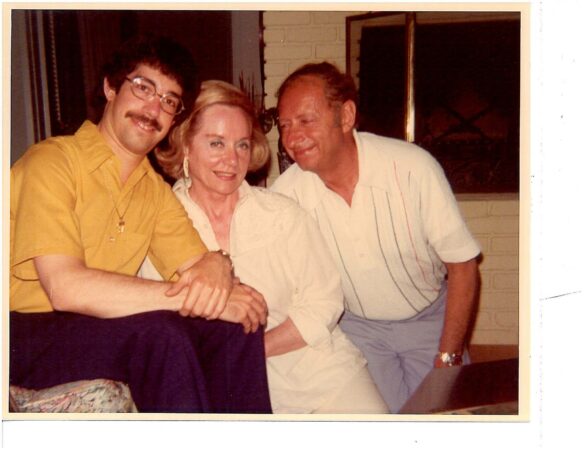
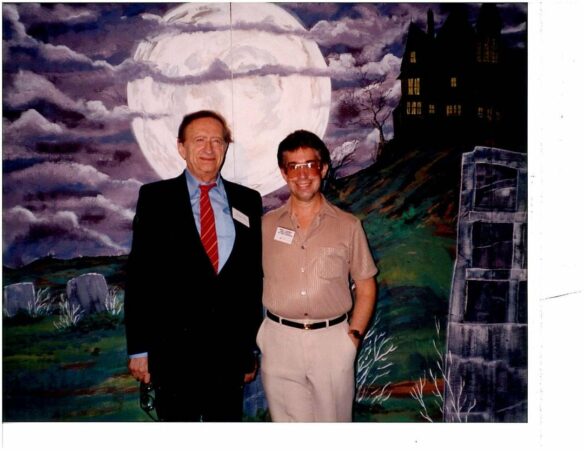
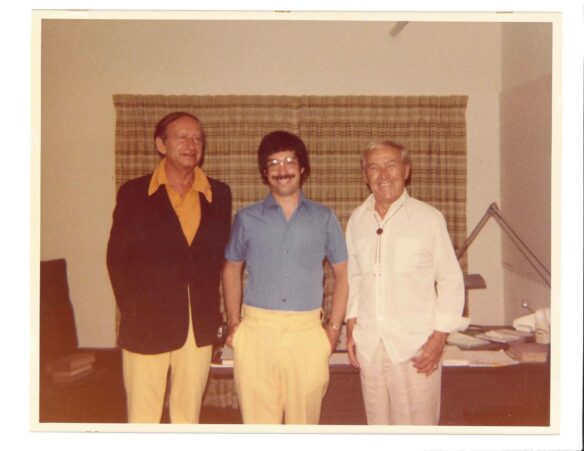
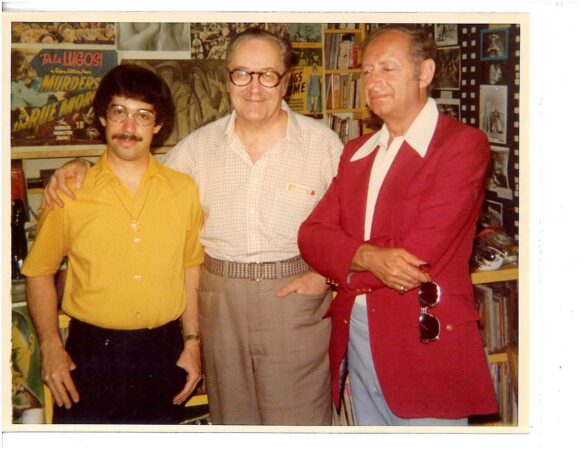
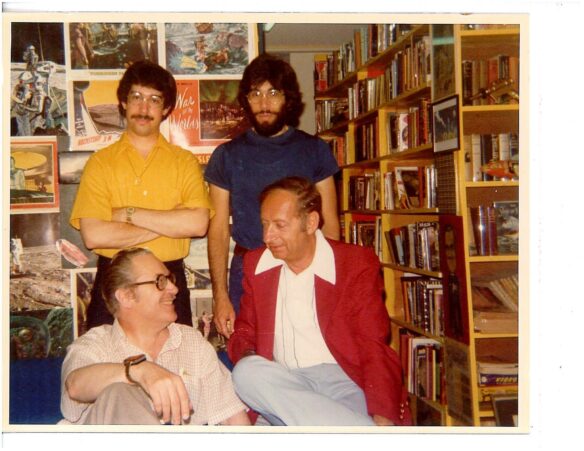
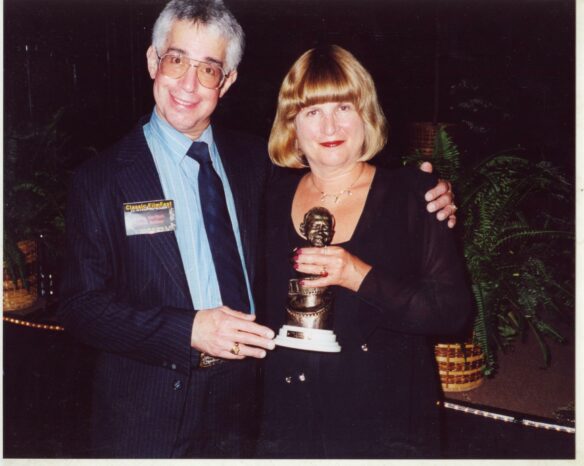
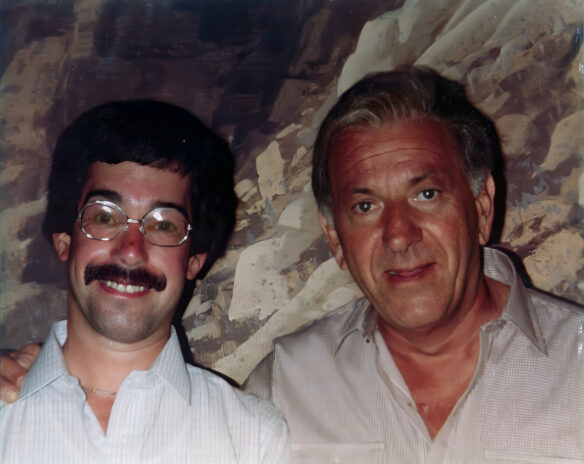
Steve Vertlieb, Elly, and Robert Bloch.Bloch and Steve Vertlieb
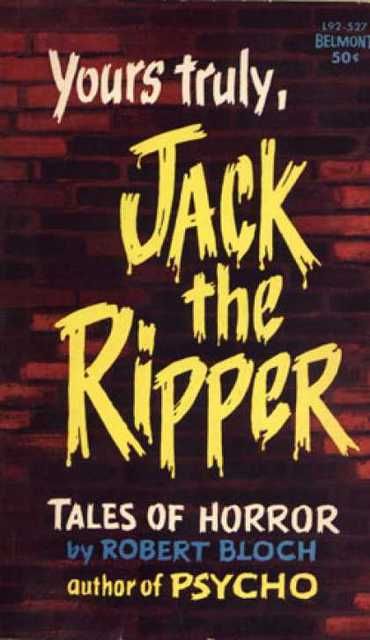
Admittedly an armchair psychologist, Bloch found the human psyche endlessly fascinating, infusing his characters with complex, disturbing behavioral patterns he could only imagine. An enthusiastic student of bizarre human behavior, he carefully crafted each characterization with dangerously woven personality flaws that lifted mere single dimensional protagonists from the printed page to uncomfortable realization. In his introduction to a paperback anthology, Yours Truly, Jack The Ripper, published by Belmont Books in January 1962, Bloch writes: ”My life as Jekyll has been commonplace in the extreme. I have a home, a family, a regular occupation, friends; a normal schedule of hobbies and amusements. Yet, Mr. Hyde is active, nonetheless. It is a partnership which has proved both pleasant and profitable — and it would ingratitude indeed if I allowed Dr. Jekyll to take the credit without proper acknowledgement to his alter ego. But the inspiration comes from Mr. Hyde. I fear, however, that Mr. Hyde must also share the blame for errors of taste and judgement. In his haste to affect some particular ghastly revelation, he has ignored many literary niceties. I can only submit that this is matter beyond my control.”
Bloch, along with the reader, has given away both his rational reasoning and will power, consciously sacrificing his higher instincts for the greater good of his imagination. As an actor of gentle or docile spirit studiously packs away his better nature in order to mine the trenches of his hidden demons, and more accurately capture the ugliness he must portray, either on screen or in the theater, the writer’s imagination floods his more spiritual sanctuary in search of the characters and stories lurking just beyond the fragile threshold of sanity. He must unleash Hyde at the expense of Jekyll, sleepwalking vicariously through the dungeons of depravity.
Sensitive to the duality of human nature, Bloch’s essay on “The Clown At Midnight” remains a classic of extraordinary perception. He asks the reader to visualize a circus clown performing within the restricted confines of a three ring tent. The surroundings are familiar, and the imagery comforting. Children of all ages laugh at the frantic behavior of the jolly clown adorned in frilly, loose fitting costuming. The circus performer cavorts with blackened teeth, his face pale and unrecognizable beneath the theatrical makeup that deftly conceals his identity. Now, as Bloch suggests, what would happen if you lifted that very same clown out of the familiar surroundings of a circus sideshow, and placed him alone on a deserted corner, standing solitary beneath a dimly lit street light? There, motionless and grinning beneath a soul less mask, he assumes the persona of a demonic and terrifying escapee from either an asylum for the criminally insane, or from the bowels of Hell. Sanity grasps tentatively at the bonds holding together reason as the veil that witnessed madness crumbles in horrifying confusion.
In his short story “The Hungry House,” (1951) a psychologically vulnerable couple move into an old mansion priced just a little too inexpensively. They quietly congratulate themselves on their shrewd negotiating skills, little realizing that the realtor was a bit too anxious to let the property go at such an unrealistic cost. It isn’t long before they begin to suspect that they aren’t alone in the property, for this is a troubled house, a disturbed structure whose malevolence conspires to consume them. It had never occurred to the couple that an alarming absence of mirrors within the dark walls of their new home might have been a forboding suggestion of danger to come. Reflections caught out of the corners of their eyes suggest a shadowy presence hidden just beyond recognition. Shaving mirrors shudder in vague, unholy perception, multiple and uninvited images shimmering in faded twilight. The house had once been inhabited by a vain, beautiful belle of the ball whose self adoration had all but consumed her. Mirrors adorned every corner of the house so that she could observe her own perfect loveliness. The years had finally passed her by but, for the mad and lonely soul who danced solitary within its walls, time had stood mercifully still. She danced into the very mirrors that had once caressed her, an old embittered hag whose frail skin had been torn to ribbons by the jagged daggers smashing about her. They said that her spirit still lived, and danced within those mirrors, mirrors discovered in a locked attic upon investigation of the shadowy house. For now, unleashed from her imprisonment, the tortured reflection of the haggard crone, withered and cruel, reached out from beyond the grave to invite others to join her…others who might come to worship her beauty, frozen in Hell.
“The Cheaters” (1947) portrayed the terrible consequences of greed and distrust as the bewitched spectacles of an infamous sorcerer are discovered hidden in the secret drawer of some antique furniture. The ancient eye glasses reveal the naked truth and soul of anyone encountered by the wearer, exposing in unimagined honesty, the inner thoughts and heart of their focus. Little is left to the imagination as, one by one, its victims wear the accursed “cheaters,” falling victim to dirty truths that might better have been left unspoken. As secrets unravel in unwitting candor, betrayal and revenge all but destroy the inquisitive inheritors of the deadly spectacles until, at last, the ugliness of one’s own soul drives the final owner to madness and suicide. As in Hitchcock’s cinematic morality play Rear Window (1954), there is little reward for even the most selfless peeping tom. Bloch’s characters draw noble, self serving parameters for themselves in which the hypocrisy of their mental eavesdropping achieves intellectual justification and moral outrage but, in the end, the lines between veracity and deception become as blurred as the distorted lens of the “cheaters.”
Most, if not all, of Bloch’s stories involve damaged people. They are misfits living beneath societal radar, outcasts from the mainstream living lives of quiet desperation. Some are overweight and slovenly, while others are isolated and lonely. They are abandoned by their world, left to find solace in unsavory redemption. There is little tolerance for the unattractive or unintelligent in a world of uniformity, and so these discarded souls must reach out in directions normally shunned by polite society. Abnormality attracts its own, and so humanity’s refuse finds value in the darker corridors of exploration. Bloch’s protagonists have degenerated to the deepest refuge of the inhuman psyche, finding comfort and delusional grandeur in satanic ritual and supernatural depravity. Their decadence offers respite from the outer storm of derision, and seeming unity in leprous colonization. Often, their rebellious rage threatens the very balance of sanity and reason, as miscreants and misfits discover validation in psychological deformity and demonic possession.
Bloch, like Lovecraft before him, was able to vividly illustrate a vast nether land in which deformity threatens to overcome the waking world, while night consumes the sun. Lovecraft’s terrifying Cthulhu Mythos found new, if fetid, breath in a continuing sequence of tales based upon the demented writings of the “Mad Arab,” Abdul Alhazred, in the fabled book of the damned, the “Necronomicon.” Anyone in possession of this hellish tome might summon the “great old ones” from their slumber, causing a tear in the fragile fabric of time and space in which the lumbering elder gods might rupture the Earth once more, achieving infinity in terrifying abandon. After Lovecraft’s death in 1937, Bloch expanded the mythological library of literature sought by sorcerers with such infamous texts as “De Vermis Mysteriis,” and “Cultes des Goules,” each offering unholy access to monstrous damnation.
In 1945, Bloch was asked to write exclusively for a new syndicated radio program called Stay Tuned For Terror. Broadcast and produced from Chicago, the series presented a full season of thirty-nine episodes showcasing the work of the author, which he adapted for air from his own short stories. In addition to writing for print and for radio, Bloch held down regular weekly employment as a copywriter for the Gustav Marx advertising agency, a position he maintained for eleven years.
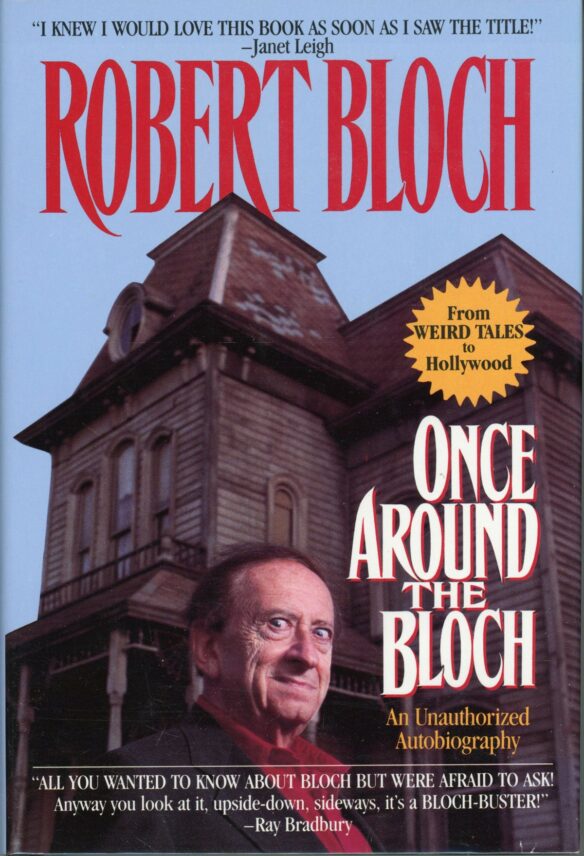
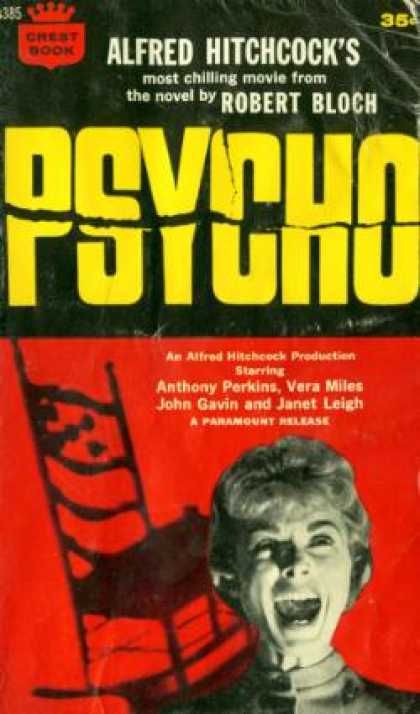
Although maintaining a respectable income and reputation during the forties and fifties, and winning the coveted Hugo for his short story “That Hellbound Train” (1958), Bloch continued to reside in the Midwest and worked in an advertising position in order to remain economically afloat. That changed in 1959 when the writer published his new novel…the story of a boy, his mom, and a motel. The work, which he titled “Psycho,” based somewhat loosely upon the real life exploits of notorious Wisconsin mass murderer Ed Gein (as was the somewhat less subtle Texas Chainsaw Massacre), changed Bloch’s life forever. The book was purchased by blind agents for Alfred Hitchcock and the rest, as they say, is history. Having literally no idea who was purchasing his book, Bloch sold the film rights for something in the neighborhood of two thousand dollars. Had the identity of the purchaser been revealed, the author might have been entitled to a far grander sum. While Outer Limits writer/producer Joseph Stefano penned the screenplay for the controversial motion picture, Hitchcock commented in print that “Psycho was ninety percent Robert Bloch’s book.”
Psycho will forever remain Robert Bloch’s most popular and identifiable work based largely, of course, upon the success and legacy of the motion picture. To begin with, Hitchcock was one of the most respected and enduring directors on the world stage, and so his decision to make a film of the author’s work was one of considerable importance to Bloch. Much has been said about the director’s decision to do away with the star of the picture roughly half way through the film, and how daring and provocative that remarkable creative decision actually was. To his credit, Hitchcock wisely chose a major actress to play the tragic Marion Crane, enabling her shocking early demise to attain near operatic surprise and dramatic crescendo. However, it must be remembered that Marion was killed quite early on in Bloch’s novel, as well, insuring calculated shock by the unprepared reader. Hitchcock merely embellished the calculation by casting the biggest star in the film as the doomed heroine.
Hitchcock’s other masterly decision was to cast Anthony Perkins in the role of Norman Bates. Unlike Bloch’s sleazier depiction of Norman, Hitchcock chose to portray Norman as the boy next door, an outwardly shy sexual innocent, brilliantly camouflaging his Jekyll and Hyde persona. Hence, the revelation of his inner demons became more effectively disturbing. In some ways, Norman Bates was a projection of Robert Bloch’s own literary personality. As stated earlier, Bloch was himself a gentle, sensitive soul with an appreciation for the arts, and a broad, infectious sense of humor. When he chose to don the cape of creativity, however, he transformed himself into a far darker, Freudian evocation of his personal complexity and shadowy identity. It may truthfully be stated that each of us masks our own inner demons with smiles and banal pleasantry. If Robert Bloch, during his waking hours, was his own Henry Jekyll then, surely, his Mr. Hyde would take center stage when immersed in the twilight zone inhabited by Norman Bates.
The genius of Bloch’s Psycho is, of course, that the supposed main character of the novel isn’t revealed as merely a “red herring” until well into the story’s progression. The groundwork for Marion Crane’s moral dilemma and near redemption is laid out meticulously. She has abandoned her integrity out of thoughtless greed, never fully comprehending the circumstances of her fall from grace or its ultimate consequence. She has been entrusted with depositing forty thousand dollars by her boss and his client, deciding instead to steal the money and join her lover in an idealized dream of financial security and sexual domesticity. The reader’s concern, then, is that she has come to her senses in time to redeem her fortunes and return to her life, virtually unscathed by a momentary decline into criminality. It is only then that we learn that the story isn’t about Marion Crane at all but, rather, a recently introduced proprietor of a seedy motel in which she quite innocently decides to spend the night, while en route to her destiny. Tragically, the motel IS her destiny as she is gruesomely slaughtered by Norman Bates, the true focus of the novel. All that has transpired up to this point is merely the expository groundwork that serves to introduce the reader to the real thrust of both the story, and Norman’s knife. Marion is expendable. She is a fragile, flawed individual who can be sacrificed for the greater good of the novel. Bloch has carefully led the reader into a sheltered sense of complacency, travelling down a calculated detour to a climactic intersection in which the proverbial rug is unceremoniously pulled out from under him. Marion’s world, as well as our own, has been turned inside and out. The bathroom door has closed, and there is no turning back.
On the basis of the novel’s huge success, Bloch moved his family to Los Angeles, leaving his day job behind and settling into the film community as a full time, working author. Any acrimony with Hitchcock was washed away by the muddy waters of success, and the opportunity to write stories for the director’s popular television series, Alfred Hitchcock Presents. Bloch became one of the program’s most prolific writers, contributing some seventeen teleplays including “The Greatest Monster Of Them All” (1961), “The Sorcerer’s Apprentice” (1962), and “The Sign Of Satan” (1964) guest starring Christopher Lee.
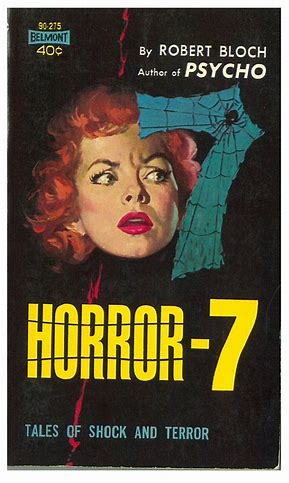
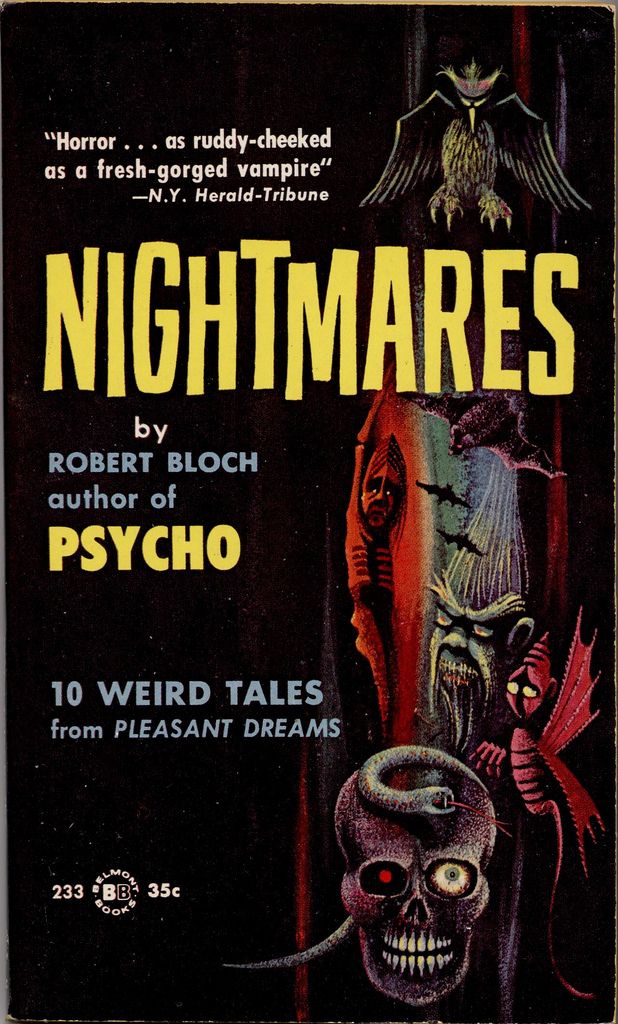
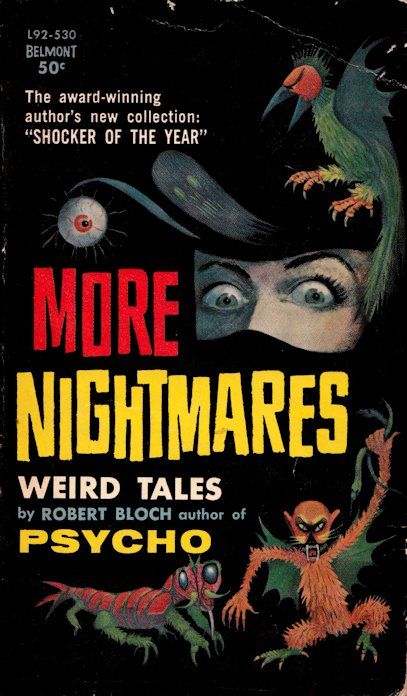
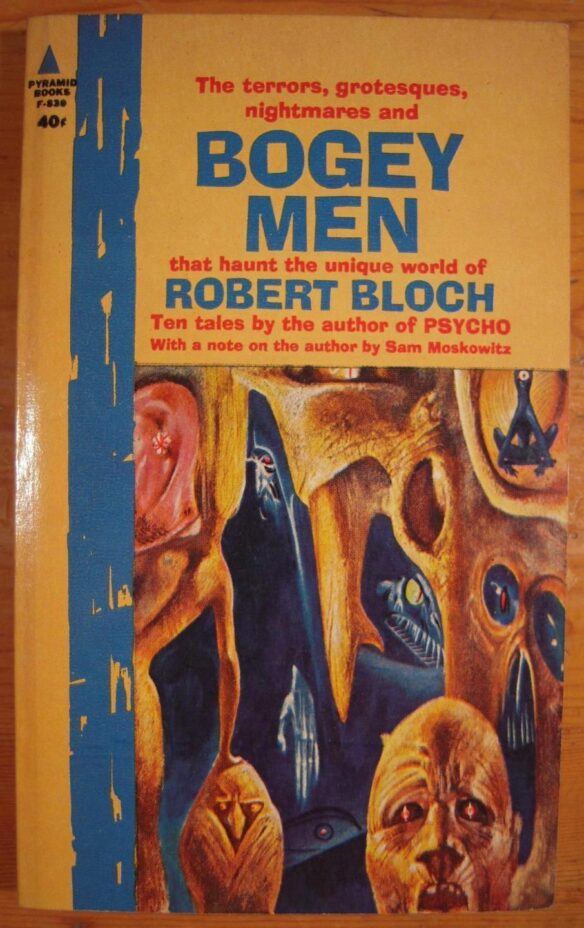
Collections of short stories by the celebrated writer began appearing both in hard and paperback editions with luridly commercial titles such as Nightmares, More Nightmares, Even More Nightmares, Pleasant Dreams, Mysteries of the Worm, and Yours Truly, Jack The Ripper.
It was about this time that NBC television producer, Hubbell Robinson, began developing a new series for the network to star horror actor Boris Karloff. Airing over the network in prime time from 1960 until 1962, Boris Karloff’s Thriller remains the most frightening, potent and atmospheric series in the troubled history of horror television. The series presented some of the most disturbing and nightmarishly visual hours of the past fifty years and many of its most memorable, haunting episodes were written for the program by Robert Bloch. These included “The Cheaters” (the story of a deadly pair of Victorian spectacles that delved into the truth of every soul it perceived), “The Grim Reaper” (featuring young William Shatner as the greedy heir to a writer’s fortune who conspires to frighten the elderly woman to death with stories of a terrible painting coming to life) and, perhaps, the program’s defining moment. Based upon Bloch’s short story, “The Hungry House,” William Shatner was featured once again in “The Hungry Glass” as a recovering victim of a nervous breakdown who purchases a house with a terrible secret, and strangely devoid of any mirrors. Rarely has the medium of film so chillingly captured the gothic temperament and nightmarish language of horror as effectively, or as reverently, as in this uncompromisingly graphic, black and white television series. If Psycho brought Robert Bloch’s name and reputation into the cinematic consciousness of theater goers, Boris Karloff’s Thriller brought the author lasting fame and recognition in captive living rooms across the country. It was fitting, then, that the decadent domicile used by NBC and Universal for the “Hungry Glass” episode was, in fact, the very same structure utilized by Hitchcock to house Norman Bates and his skeletal mother. Despite the apparent popularity and success of the literate young series, however, it was surprisingly cancelled by the network after only two years, reportedly at the urging of Alfred Hitchcock who felt that its early suspense oriented stories constituted direct competition to his own half hour anthology program on NBC.
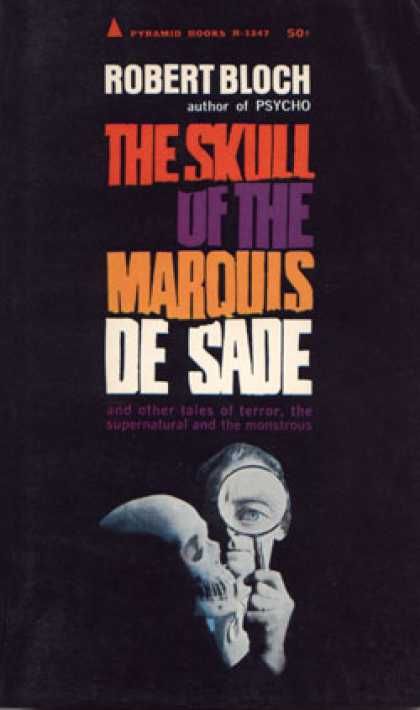
Assignments for both television and theaters continued with screenplays for The Cabinet Of Caligari (1962), “The Couch” (1962), Strait-Jacket (1964) (starring Joan Crawford as an ax murderess), The Night Walker (with the former husband and wife team of Barbara Stanwyck and Robert Taylor in 1964) The Skull (1965) with Peter Cushing (adapted from Bloch’s short story, “The Skull Of The Marquis De Sade”) (1966), The Psychopath (1966), Torture Garden (1967), The Deadly Bees (1967), The House That Dripped Blood (1971), Asylum (1972) (once again starring Peter Cushing), The Cat Creature (1973) for ABC television, three episodes of the original Star Trek (“What Are Little Girls Made Of,” “Wolf In The Fold,” and “Catspaw”). Star Trek’s “Wolf In The Fold” offered a futuristic variation of his earlier take on the White Chapel slasher, “Yours Truly Jack The Ripper.” Bloch had been working on a massive teleplay for CBS television in 1980, an adaptation of H.G. Wells’ “In The Days of the Comet” produced by the legendary George Pal, when the fantasy film pioneer died of a sudden heart attack. The ambitious collaboration, sadly, was not to be. Among Bloch’s most curious projects for television aired as the final episode of the ABC series, Bus Stop. Based upon the popular 20th Century Fox classic starring Marilyn Monroe, this all out horror tale became the final episode of the short lived series, with actor Alfred Ryder in a frightening adaptation of Bloch’s short story, “I Kiss Your Shadow.”
Robert Bloch, Steve Vertlieb, and George Pal.
Bloch was never entirely satisfied with his screen work, for neither the direction or the theatricality of these final picturizations ever truly captured the genuine dread portrayed by his written word. Only Hitchcock’s Psycho ever realized the black and white simplicity of the writer’s psychology of horror. Bloch wrote in black and white or, to put it more succinctly, from a darkened perspective devoid of color. The visualization of horror must be stripped of comfort with the familiar. While colors enrich the waking realm in which we work and interact, their very reassurance serves to erase the frighteningly primordial recollection of a world immersed in dreams. Bloch’s stories were essentially driven by his, and our, deepest fears. As we struggle to awaken from night’s journey through shadows, it is the first light of day in which we must find solace. Bloch understood that nightmares are derived from darkness, for it is there that familiarity is lost. One cannot understand what he cannot see. Rationalization is clarified by light. We can attempt to define what lies before us. It has definition and color. Strip away that color, however, and the horizons before us become dreamlike, or surreal. Drained of color, the world degenerates into a simplistic panorama in which monstrous apparitions can co-exist comfortably with reality. It is here, in a world stripped of pretense and calming reassurance, that we walk naked through the night. Alone in the darkness, we become vulnerable to emotional assault, and prey to the denizens of darkness. The simplicity of black and white has now prepared our emergence, or descent, into the nether world of dreams and nightmares. It is for this reason, perhaps, that Bloch’s most successful work on screen remains the quintessential horror anthology hosted by Boris Karloff for NBC Television.
Bloch lent distinction to his name whether adapting one of his own short stories for the screen, or reworking the efforts of another writer. Asked to adapt a short story written by Harold Lawlor for the Thriller series, the author composed one of his most terrifying confections, entirely re-structuring the thread of the original tale and turning it into modern horror classic. “The Grim Reaper” aired during the 1961 television season, becoming one of the earliest efforts in the fledgling series’ subtle transformation from suspense to outright horror. The greedy nephew of an Agatha Christie styled mystery writer attempts to frighten his wealthy aunt to death with the gift of an accursed portrait of a skeletal avenger brandishing a razor like scythe. The tale is, of course, a lurid fabrication concocted by Paul Graves (William Shatner) to drive his elderly aunt either to madness or to death so that he might inherit her fortune. His plan works all too well, for the normally grounded writer (Natalie Schafer) sits before the awful portrait, drinking herself into an hallucinatory stupor in which she imagines that the evil figure in the picture has stepped down from its bloody perch to stalk her. The alcohol induced delusion convinces her that Paul’s wicked stories of a cursed creature are, indeed, true and she succumbs to the sum of her fears while frightened to death. Paul has woven his insidious tale a little too well, however, for as he prepares his departure from the house, he senses something not quite right about the portrait. The hideous image upon the bloody canvas has disappeared from its ornate frame. As Paul clutches the opening of his mouth in mortal fear, barely stifling a heart shattering gasp, he hears the rhythmic swish of the deadly blade from somewhere in the room. Nothing is seen but Paul’s mask of terror as the sounds grow closer to his body, frozen in paralyzing fear. An awful scream is heard from beyond the locked door to the library, as frantic relatives and friends of the late writer try unsuccessfully to pry open the lock. Paul’s own vivid imagination has conspired to consume his weak and greedy psyche, and he is torn to shreds by the monstrous aberration he conceived. The Reaper has returned to its menacing lair within the canvas as though it had never left its position on the wall…and yet…there is fresh blood glistening on the painted scythe.
Both honored and treasured in his later years, Bloch received a Life Achievement Award at the first World Fantasy Convention in 1975, a Big Heart Award presented at the World Science Fiction Convention, the Bram Stoker Life Achievement Award, and the World Horror Convention’s “Grand Master Award.” A respected and gifted writer of mystery, as well as horror fiction, he served a term as President of The Mystery Writers Of America. During his lifetime, Bloch wrote twenty-five novels, four hundred short stories, an infinite number of collections, radio programs, screenplays and teleplays.
In his personal life, despite his public persona, Robert Bloch was a quiet, gentle man with a robust, self-effacing sense of humor and a love of the arts. Cancer consumed his sensitive soul in 1994 at age 77. The Grim Reaper of his imagination had returned to claim just one more victim, as endless night descended in Pleasant Dreams.
++ Steve Vertlieb, 2008
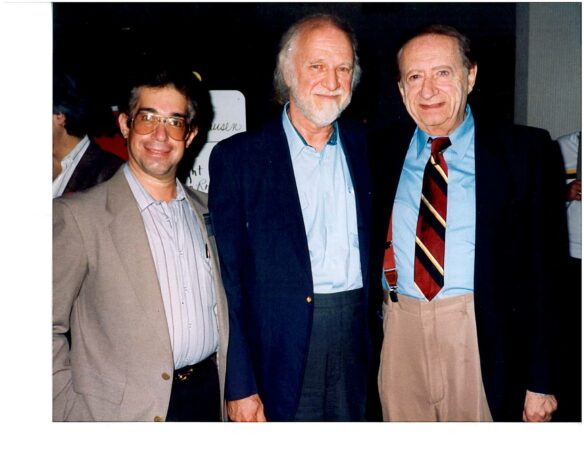
Steve Vertlien, Forrest J Ackerman, and Robert BlochSteve and Erwin Vertlieb, Forrest J Ackerman and Robert Bloch.Steve Vertlieb, Richard Matheson, and Robert Bloch.
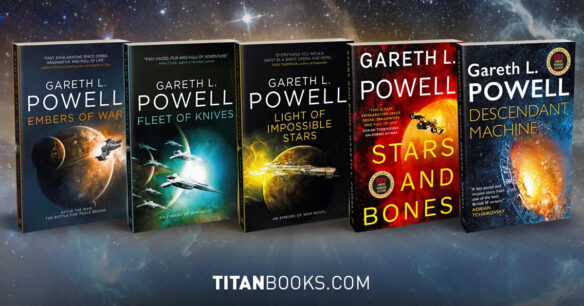
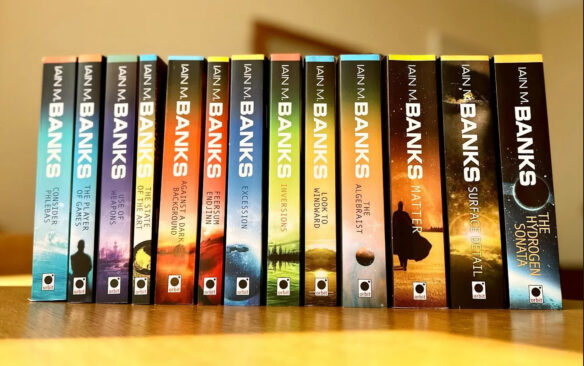
[Editor’s Note: Gareth Powell is a British SF writer who has written three series, to wit the Ack-Ack Macaque series with airships and cigar-smoking-monkey fighter pilots, and the Embers of War with ships akin to those in Iain M. Banks’ Culture series. Powell’s latest series is The Continuance in which all of humanity has been exiled from Earth and is wandering the galaxy in vast ark ships. The latest novel in that series, Descendant Machine, came out in May. Both the Ack-Ack Macaque and Embers of War series had novels in them that won British Science Fiction Society Awards. Keep up with Gareth L. Powell’s Twitter, Instagram, and Facebook via Linktree. And at his Substack: Gareth’s Newsletter. Cat Eldridge says, “You, Ian McDonald and Iain M. Banks are the best writers of space opera that there has ever been.”]
“I was attracted to science fiction because it was so wide open. I was able to do anything and there were no walls to hem you in and there was no human condition that you were stopped from examining.”
Octavia Butler
While I have been known to write other types of science fiction, there’s something about space opera that keeps drawing me back.
The term ‘space opera’ has been around since the heyday of the pulp magazines in the 1930s and 1940s. Initially the term was one of derision, likening the genre to tacky ‘horse opera’ westerns. However, just as the hippies and punks of the 1960s and 1970s took their derogatory labels and wore them with pride, so the term ‘space opera’ eventually became a byword for action-packed stories featuring big spaceships and weighty themes.
To date, I’ve written eleven novels, from Silversands (2010) through to Future’s Edge (coming 2025), and at least seven of them can be described as space opera. What is it that keeps bringing me back to the sub-genre?
At its best, space opera contrasts the personal with the cosmic. Human characters struggle against the backdrops of infinite space and deep time, wrestling to uncover the reasons why we’re here and what it all means. It gives us a vast canvas on which to make our points. As storytellers, we’re no longer confined to one world or one society. If we want to say something meaningful about the world of today, we can let our tales leap from culture to culture, shining a light on our real life existence by showcasing worlds that are very different in almost every respect.
When George Lucas wanted to write about a great democracy falling to fascism, he wrote Star Wars to dramatise his concerns; similarly, Iain M. Banks invented the Culture, a spacefaring, post-scarcity civilisation with utopian ideals in order to write a counterpoint to the politics of 1970s Britain; and Ursula K. Le Guin wrote her classic novel The Dispossessed to examine her feelings regarding the Vietnam War and the contrast between anarchy and capitalism.
Not all space operas are primarily political, of course, but there is that old maxim about all books being essentially about the time in which they’re written, and the very act of imagining societies different than our own cannot help but invite comparison. I certainly used books like Embers of War and Stars and Bones to comment on what I see as some of the absurdities of our current set-up in ways I possibly couldn’t have articulated in a more contemporary setting.
More than that, I think the appeal of space opera is that by placing relatable characters outside of the contexts with which we’re familiar, and contrasting them with non-human intelligences, you can really unpack what it means to be human in the unspeakable vastness of the universe.
As an author, it gives you the freedom to write whatever you want, in a cosmos where almost anything is possible.
But maybe what really appeals is the sense that in space opera, we’re all masters of our own destiny. We’re not bound by anything, save the need to keep our ship flying and stay one step ahead of our enemies and creditors. We go where we want and we do what we have to in order to survive. And we’ve seen things you people wouldn’t believe. We’ve left footprints in the multi-coloured sands of a thousand deserts. Our faces have been tanned by the light of stars so far from here their light won’t reach this part of space for another hundred years. And we’re still questing outwards, still searching for adventure—for an alien invasion to repel or a repressive regime to overthrow. And, at the end of the day, we get to sit in our ships and look out the windows at the cold, distant stars and somehow make our peace with our place in the unending wonder of it all.
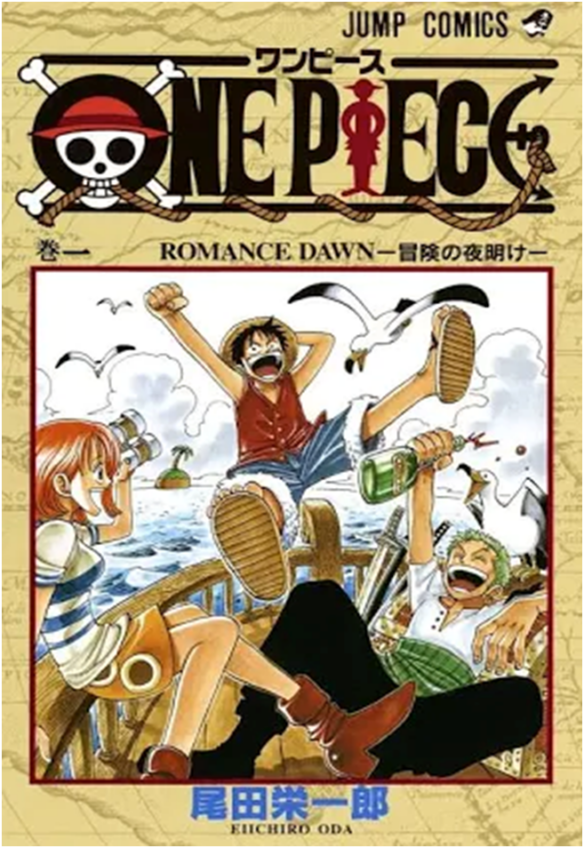
By Michaele Jordan: Let me tell you about One Piece! ALL about it! There’s a story in that. Naturally, I always start my reviews with the production credits. Fair is fair. The production team made it. They get to put their name on it. But in the case of One Piece, the production credits are tangled in years of production history, a tale almost as convoluted as the production it describes.
And it all started with a comic book! (Excuse me – a manga) by Eiichiro Oda. Which is STILL available on Amazon!
The Japanese manga series was written and illustrated by Eiichiro Oda. It has been serialized in Shueisha’s shōnen manga magazine Weekly Shōnen Jump since July 22, 1997. (The English publisher is AUS Madman EntertainmentNA/UK Viz Media.) The manga is still running, although it is expected to come to an end in 2024 or 2025. Its individual chapters have been compiled into 106 tankōbon volumes.
Rights to the manga were taken up by Toei Animation, and the Japanese anime television series premiered on Fuji TV in October 1999. Since then, 1,087 episodes have been aired in the course of 20 seasons, and later exported to various countries around the world.
There was some kerfuffle about the crossing to the US. 4Kids Entertainment acquired the distribution license, and created an English version which premiered in September, 2004 on FoxBox before moving on to Cartoon Networks’ Toonami. 143 episodes aired.
Problem was: they hadn’t fully screened the material. Apparently something in episode 143 “was not appropriate for their intended demographic.” I’m having trouble figuring out what the problem was. I’ve read the episode’s summary, and don’t see anything wrong. I guess I’ll have to go back and watch the whole series again. (It’s not a story you can just casually jump into). Whatever it was, it caused a scandal. There was talk of re-editing it, but Mark Kirk, senior vice-president of digital media, said that producing One Piece had “ruined the company’s reputation”. So they didn’t.
It wasn’t until April 13, 2007, that Funimation (now Crunchyroll, LLC) licensed the series and started production on an English-language release of One Piece which included redubbing the episodes previously dubbed by 4Kids. It premiered on September 29, 2007. And it’s never gone away. It’s still out there, currently playing on Netflix – right next to the brand new live-action One Piece!
It’s difficult to explain the enduring fascination for this show, except perhaps to say that is so endlessly convoluted that you can never get tired of it. There is never a time or a place where you can guess what’s coming next, or figure out how the merry band of the Straw Hat Pirates can possibly get out of this one.
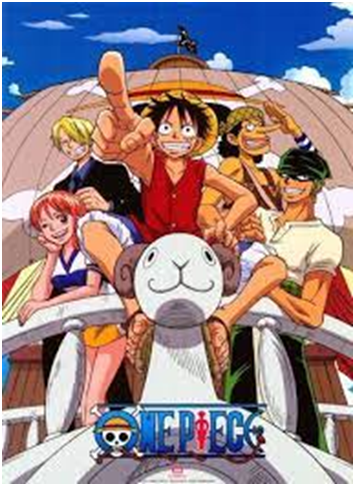
To those who are just embarking on this psychedelic adventure, the official synopsis reads: the story follows the adventures of Monkey D. Luffy, a boy whose body gained the properties of rubber after unintentionally eating a Devil Fruit. With his crew, named the Straw Hat Pirates, Luffy explores the Grand Line in search of the world’s ultimate treasure known as the “One Piece” in order to become the next Pirate King.
No, there’s no explanation (in the original) of what the Grand Line is (just painted on the ocean, perhaps?) the new live action gives it a wave, suggesting it’s some kind of world encircling equatorial current. Nor do we know what the One Piece is, or why it would make anyone king of anything. Most of all, we don’t understand why Luffy wants to be a pirate – he has no conception what they are; he seems to think they’re some sort of seafaring angels of mercy, seeking adventure.
So don’t waste your time trying to solve its issues logically — can’t be done! Will the new live action version live up to its glorious forbears? I can hardly wait to see!
It starts out with some excellent casting choices, starting with Iñaki Godoy as Monkey D. Luffy. (Rhymes with goofy.) As the synopsis warned, Luffy has been transformed by devil fruit. (The story is littered with adventurers who have eaten this fruit, and each has been rewarded with peculiar powers. Unique peculiar powers – you never see the same power twice.) Luffy turned into Elastic Boy (rubber, in the vernacular of the show). Every episode will show him reaching for something up on the roof, or punching a bad guy from the opposite side of the room.
Iñaki Godoy moves as if he really were made of rubber. He leans around things instead of walking past them, he rolls where most people would run. And he smiles with his entire face.
Many of the characters have been slightly changed. This did not disturb Eiichiro Oda, who argued: “A live-action adaptation of a manga doesn’t simply re-enact the source material on a one-to-one basis: It involves really thinking about what fans love about the characters, the dynamics among them — and being faithful to those elements.”
After all, no merely human actress would be as busty as Nami, the beautiful navigator. Emily Rudd introduces a dark note to the part. Although the character was always smart, the live action version is more pensive, more suspicious, even a touch haunted. She doesn’t smile much. She also wears more clothes. But she still has orange hair. One character even calls her, “the girl with orange hair.”
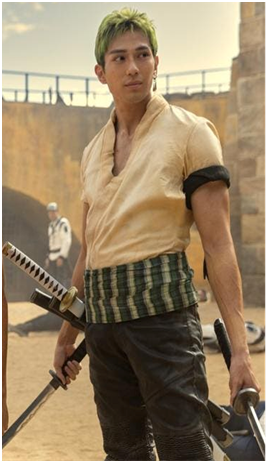
I was extremely curious how they would handle the live action version of swordsman Roronoa Zorro, who in the anime is famed for his inimitable three-sword technique. (And was sometimes shown holding the third sword in his teeth). The actor, Mackenyu, does not carry the sword in his teeth, but he always has his swords with him, even when he’s climbing out of a well. The live action gives us a touching back story about his acquisition of that third sword and what it means to him. Although his sword play is excellent, what we notice most about him is his grim determination. He never smiles. The anime smiles a lot — a dangerous smile.
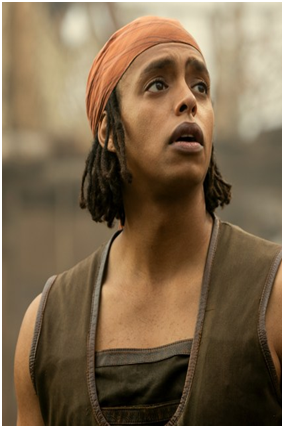
Usopp (played by Jacob Romero Gibson ) is the most changed of the characters. In the anime, he’s a major jerk (you can tell right away because he’s ugly) and famed as a notorious liar. But in the live action version, he is positively charming. Yes, he lies. When he was a child, he ran through the streets, crying, “The pirates are coming!” No pirates came – he was just frightened, and reliving a nightmare from the past. But the townsfolk called it lying. Now he tells glorious tales of his adventures to his beloved bedridden friend, and the evil butler says he’s lying. He’s also bad news with a sling shot.
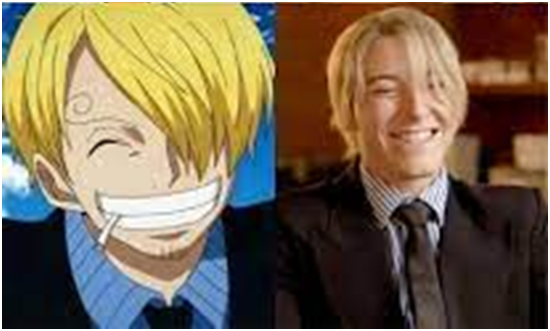
I’ve only seen the first few episodes, so I haven’t yet spotted my favorite character, Sanji, (Taz Skylar). But I can see from the pictures that he’s lost that ever-present, dangling cigarette. And I’ve read that he trained hard to master Sanji’s style of fighting – standing on his head, and spinning his feet, like a pinwheel. I’m looking forward to that!
Friends, this is a wonderful show! Watch it! Tell Netflix you’re watching it! Tell all your fan friends to watch it! This show is all things skiffy! Heroes and villains! Nearly naked goddesses! Weird super powers! Glorious fight scenes! Strange alien worlds! (Actually, they’re all supposed to be islands on the same planet, but once you get to the Grand Line, you go places that are nothing like the real world.) It doesn’t matter if you’re a gamer, or a comics fan, a devotee of costumes, magical amulets, lords and ladies, pirates or wizards, or just a seeker of adventure, this show has something for everybody.
[It’s hard to believe King Kong could sneak up on anyone. But in a way that happened to Steve Vertlieb.]
By Steve Vertlieb: Merian C. Cooper’s celebrated gorilla was born in the mind of his creator, perhaps, as early as 1927 when his friend W. Douglas Burden, a Director of The Museum of Natural History in New York City, published his book “The Dragon Lizards of Komodo.” Burden’s historical volume on the nine foot, carnivorous lizards occupying Komodo Island in the East Indies set the film director’s fertile imagination ablaze with thoughts of giant, prehistoric creatures marauding through a lost island, set apart from the rest of the world, unchanged since the beginning of time. Cooper and his partners, Ernest B. Schoedsack and Marguerite Harrison, had been filming acclaimed documentary features concerning primitive cultures and civilizations for “silent” cinema. Grass, released in 1925 and Chang, released two years later in 1927 recounted their encounters with prehistoric tribal customs passed from generation to generation, untouched by societal evolution. Purchasing two cameras and fifty thousand feet of film, the adventurous trio ventured courageously to the Persian Gulf where they filmed the annual migration of the Bakhtiari people. Upon completion of the “shoot,” Cooper, Schoedsack, and Harrison returned to Paris where they processed the footage by themselves. Jesse L. Lasky purchased the finished print for his Paramount Studios, and the film, now titled Grass, enjoyed a successful run both in The United States and abroad. Excited by their success, Lasky dispatched the team to Siam to film a scripted action/adventure yarn in the deep jungles of the region. Released in 1927 by Paramount, Chang again drew huge audiences and probably inspired later features and serials featuring the jungle exploits of both Frank Buck and Clyde Beatty, as well as MGM’s decision to green light Trader Horn, and its enduring series of “Tarzan” films.
Not content to rest on their collective laurels, Cooper and Schoedsack once again journeyed to the “dark continent” in order to film “location” footage for their big budget film version of Four Feathers. Billed by Paramount as “The last of the big silent films,” the adventure classic tale of cowardice under fire, released in 1929, featured Richard Arlen and Fay Wray as war time lovers torn apart by false accusation and bravado. Cooper’s growing experience as a film producer would inevitably lead him to more fertile fields of live action production and storytelling, and so he embarked upon a most dangerous game of chance. Working from a premise involving the turning of tables in which the hunter might now become the hunted, the cinematic adventurers decided to produce a film based upon Richard Connell’s classic tale of role reversal. Published as a short story in 1924 as “The Hounds of Zaroff, The Most Dangerous Game was a natural progression for the maturing wildlife film makers. Man would become the prey, while a crazed big game hunter, bored by matching wits with four-legged predators, might now trap and destroy “the most dangerous game of all,” his own species. Directed by Irving Pichel along with Ernest B. Schoedsack, and released by Radio Pictures in 1932, The Most Dangerous Game Starred Joel McCrea as a celebrated big game hunter deliberately shipwrecked at sea in order to lure him to a private island owned by the mad Count Zaroff. Leslie Banks as the demented recluse welcomes “guests” to his deserted island in order to hunt them down by dawn, and add their heads to the walls of his hidden trophy room. Fay Wray once again was the object of mutual desire, while Robert Armstrong as her often inebriated brother, provided Banks with his less than satisfactory prey. With a thrilling score by Max Steiner, as well as a cast and crew that would soon become family, The Most Dangerous Game was setting the sound stage for its sister production, being filmed simultaneously on those most dangerous sets.
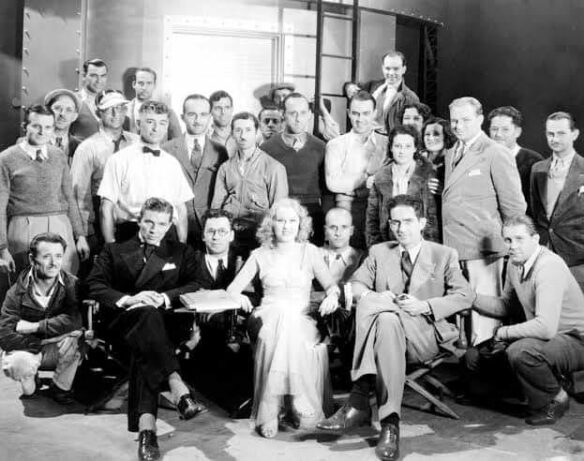
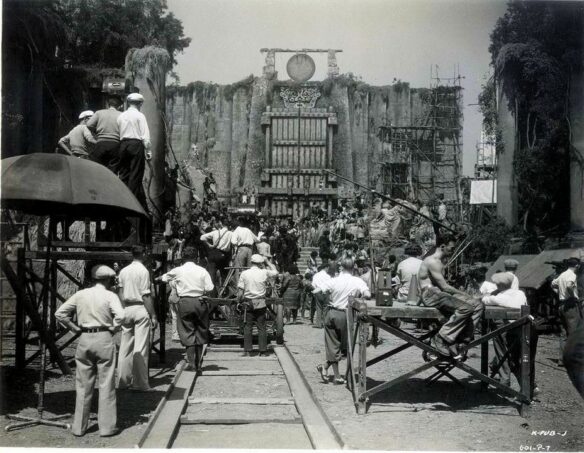
Cast and crew of King Kong
King Kong related the remarkable tale of a giant beast, an impossible ape-like creature whose imposing, horrifying shadow would follow the intrepid explorers whose heroic exploits had led them to its discovery. Released by RKO Studios during the winter of 1933, the picture reunited Fay Wray and Robert Armstrong with Merian C. Cooper and Ernest B. Schoedsack for yet another thrilling adventure in the lurid jungles of a primordial world. They were joined by Bruce Cabot in, perhaps, the pivotal performance of his career. Filmed and released during the height of America’s great depression, the film followed a crew of shipwrecked survivors as they valiantly struggle to escape overpowering odds, caught in the crosshairs of economic upheaval. Adrift at sea amidst the mocking skyscrapers of a bankrupt metropolis, a documentary film producer (patterned after Cooper himself) flees the merciless boredom of repetition in search of new worlds. A conqueror at heart, Carl Denham yearns for new challenges, new discovery, and new opportunities to break through the molding memories of his own worn career. He is given a map of a strange, prehistoric island in which creatures from the dawn of time still exist, exalting a towering monstrosity who reigns supremely in a lost corner of a shrinking planet. Their aged freighter, crashed cruelly against marauding waves, sends a cautious expedition to the uncharted island, barely escaping the wrath of the native inhabitants of Skull Island, a terrifying precipice on the wretched edge of treacherous seas.
There, amidst ravenous swamps and savage tribes, live the remnants of man devouring dinosaurs and a fierce monolithic gorilla whom the natives call…”Kong.” He was a king and a god in the world he knew, a triumphant titan rampaging majestically through savage jungles, a towering prince among lost horizons. Fearless and unchallenged, either by gods or by men, Kong is ultimately defeated by the technological slings and arrows of outrageous fortune. Wielded by Lilliputian invaders, gas bombs transposed from another reality ultimately devour this courageous denizen from the beginning of time, bringing him to his knees in choking slumber. Mighty Kong is transported by tramp steamer to the unforgiving jungles of New York where he is displayed, a fallen angel cursed by the stars, exhibited in chains against a burning cross. He is a noble figure, a Christ-like martyr suffering for the sins of humanity. The purity of his primordial existence has been betrayed. He is a tortured innocent, imprisoned in a world beyond his conception or forgiveness. His final redemption, breaking free from the shallow bonds of captivity, leads him irretrievably to his fate amongst the stars from which he came. In raging fury, Kong lords over the steel canyons of “civilization,” perched valiantly atop the highest mountainous peak in the city. The tower of the Empire State Building, its cratered caverns shuddering beneath the roars of her unwelcome captor, becomes the last tragic refuge of this embattled slave. Slaughtered by unforgiving machine gun bullets, Kong topples to his death miles below upon the ferociously mean streets of the cruel, naked city.
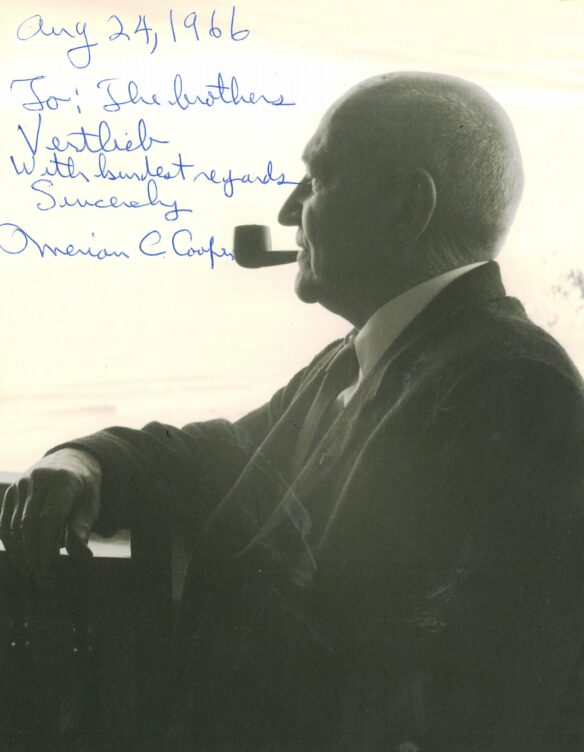
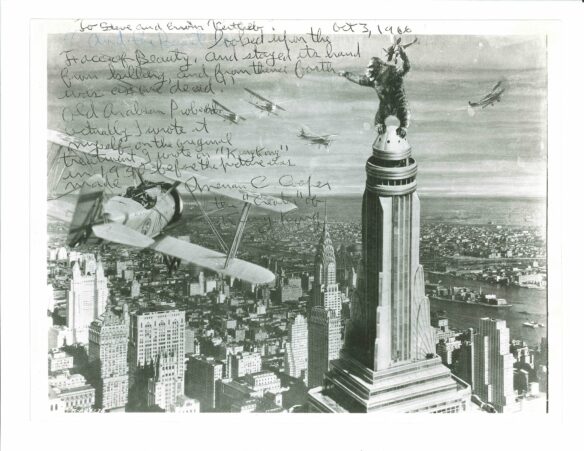
Kong still autographed to Steve Vertlieb by Merian C. Cooper.
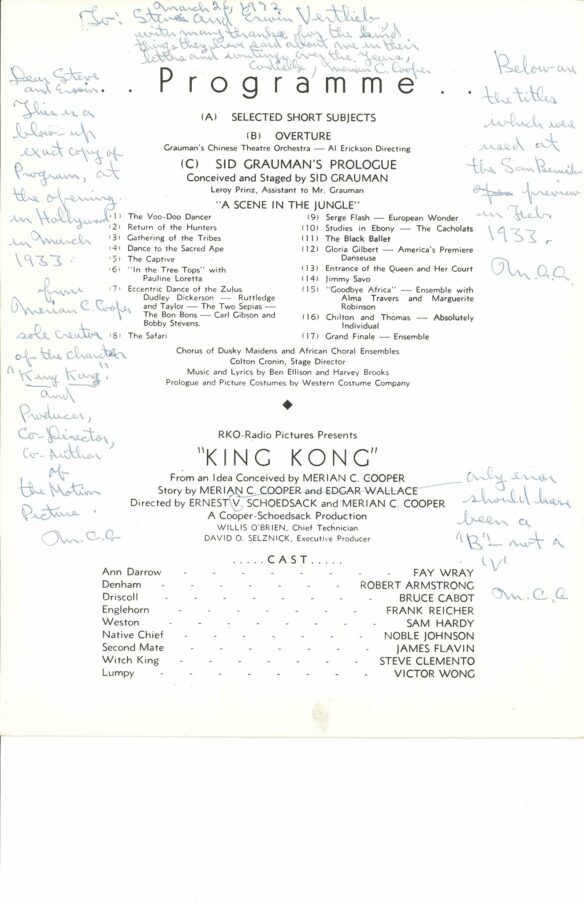
Copy of Grauman Theatre debut program annotated for Steve Vertlieb by Merian C. Cooper. (Click for larger image.)
Merian C. Cooper’s classic fantasy adventure remains, perhaps, the most celebrated retelling of “Beauty and the Beast.” Its martyred protagonist, an antihero for the ages, profoundly influenced generations of film makers and fans, charting the career choices of Ray Harryhausen, Ray Bradbury, Peter Jackson, George Lucas, and Steven Spielberg among so many others. Kong’s strangely passionate love for Ann Darrow, the symbolically virginal heroine played by Fay Wray, creates an open wound of masculine loneliness that leads unrelentingly to his slavery and demise. Its rich violent symphonic themes, created by Max Steiner, contributed to one of the first important film scores of the sound era, a landmark musical achievement that would set the standard for all subsequent Hollywood soundtracks. King Kong was, in its time, a marvel of visual, special effects technology. Willis H O’Brien, who created the stop-motion effects that so effectively brought Kong to life, virtually invented the craft, illustrating the original silent version of Arthur Conan’s Doyle’s The Lost World (1925). He would pass the torch to Ray Harryhausen during the filming of Merian C. Cooper’s Mighty Joe Young some sixteen years later. The story of King Kong has endured a lasting cultural significance in the years since its original release, and has found a home in the deepest recesses of our collective culture, dreams and nightmares.
Perhaps, it should have come then as no surprise when in 1976 not one, but two motion picture studios were competing for the chance to bring Kong back to the big screen. Universal was planning a large-scale remake of the venerable tale with stop motion cinematography by animator Jim Danforth who had worked with George Pal on The Seven Faces of Dr. Lao, as well as creating many of the effects for ABC Television’s The Outer Limits series. Meanwhile, Paramount Pictures was plodding ahead with their own big screen remake of the cherished screen fable, under the auspices of producer Dino De Laurentiis. De Laurentiis mounted an enormous publicity campaign which, sadly, ruled the day. Universal backed off of their more ambitious filming, and Paramount found itself the only player on a creatively diminished field.
Unlike Universal, whose own scenario might have been truer to the integrity of the original production, Paramount decided upon a less costly proposal. Whereas Universal, along with animator Jim Danforth, would have utilized Willis O’Brien’s cherished, though laborious, methodology of stop motion animation, Paramount’s production team decided to populate Skull Island with elaborate puppets and men in rubber suits. De Laurentiis both angered and alienated the fan community by belittling the achievements of Willis O’Brien, proclaiming sanctimoniously that the visual effects in the original picture might have been adequate for their time, but that technological advancements by 1976 had far surpassed the primitive stop motion effects of 1933. When Paramount’s version of King Kong was finally released in 1976, both the picture and its highly touted visual technology became the laughingstock of the industry, and an embarrassment to the studio. De Laurentiis had constructed an enormous mechanical gorilla that barely moved or functioned. It was used, ultimately, only for longshots in the completed film and, during its well publicized unveiling for the press, leaked motor oil all over itself. A primordial diaper might have saved the day.
Directed by John Guillerman, and written by Lorenzo Semple, Jr., who rose to prominence writing ABC Television’s campy Batman series, the film featured a cast that included Jeff Bridges, Charles Grodin and, in her very first screen appearance, Jessica Lange. Lange would, of course, overcome this inadequate debut with numerous brilliant performances in the years that followed…but everyone has to start somewhere. The script for the film was decidedly “Semple” minded. Jack Kroll in his review for Newsweek noted the Kong’s roar sounded like “the flushing of a thousand industrial toilets. The sole creature besides Kong residing on the once lushly inhabited island was a laughably inadequate “serpent” whose guarded movements were pulled by marionette strings worthy of Howdy Doody. Rick Baker performed valiantly inside the human-scaled King Kong suit, but his performance was ultimately marred by the mediocrity of the production’s budget and script. The one memorable aspect of an otherwise ludicrous attempt to surpass a fantasy masterpiece was John Barry’s eloquent, if somber, musical score which seemed written for something other than the ill-fated atrocity in which it appeared. In the end, to paraphrase Merian Cooper’s poetic finality, “Twas Was Dino Killed The Beast.”
THE ONCE AND FUTURE KONG
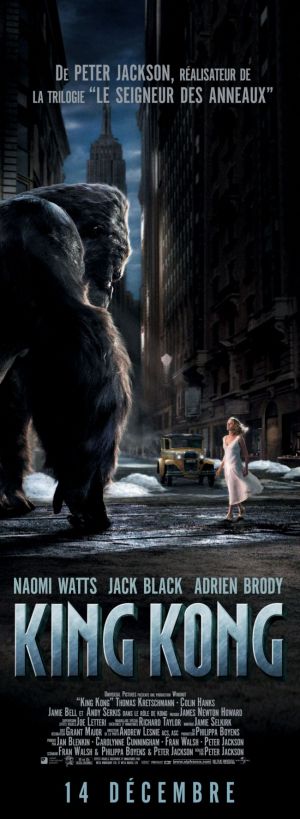
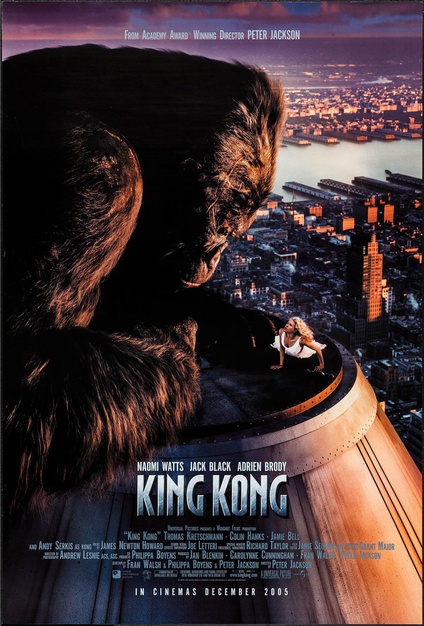
Despite well-intentioned proclamations by the New Zealand monarchy, a carefully positioned ascension to the throne has come unraveled by a tainted blood line. The ape who would be king, however noble, remains relegated to a lesser chamber in which countless pretenders share unfulfilled delusions and dreams of grandeur. After years of plotting and grand design, Peter Jackson’s Richelieu has failed his King. The years of promise have ultimately worn thin with expectation, and the director’s creative pregnancy has yielded a stillborn creation. King Kong is classic in its betrayal of the seed that inspired its birth. Upon completion of the greatest fantasy film trilogy ever made, The Lord of the Rings, it appeared that Peter Jackson was the perfect candidate to direct a modern re-telling of Merian C. Cooper’s exquisite fable of beauty and her beast. After all, he was a consummate, passionate filmmaker whose creative inspiration matured in the profound shadow of a masterwork. Who better than Jackson, then, to return the legendary gorilla full circle to his rightful place among the technological marvels of digital supremacy? And yet something went horribly wrong. Somewhere along the yellow brick road, purity of purpose surrendered to commercial sensibility, while humility and childhood wonder expired cruelly within the depths of an artificially conceived Depression. Expressing a life-long desire to re-imagine and recreate the masterpiece that gave birth to his own artistic dreams, Jackson at last had the economic clout to bring his boyhood vision to the screen…a limitless expansion of prehistoric wonder. That he failed is a tragedy, both for the millions of fans who placed their hopes so earnestly in his care, and for the beleaguered film industry whose faith and economic carte blanche lay ravished and torn in the spider pit of arrogance and deception.
Signs of trouble loomed late in production when, defiantly defending his significant alteration of the story, Jackson proclaimed that the original screenplay wasn’t so great to begin with. Now the director, like Dino De Laurentiis before him, was going to improve upon a masterpiece with another Semple-minded revision of the text. Nagging questions remained, however. If the original film inspired and ultimately sired Peter Jackson’s love of movies, leading to his burning ambition to bring his favorite motion picture back to its original glory with a new and reverent visualization, when did his respect for its sublime simplicity fall so callously from the cliffs? When De Laurentiis assumed godlike pretensions, asserting that a simple man in a gorilla suit would surpass the technological innovations of Willis O’Brien’s Stop Motion creations, Twas Dino Killed The Beast. When Jackson decided that the magic which so pervasively enchanted his childhood dreams was corny and imperfect, he burned the very structure he would build upon…leaving a flimsy fortress adrift in weightless clouds. That these revisions and supposed improvements would ultimately collapse beneath the weight of their own self importance was as certain as Kong’s fall from the silver dome of the Empire State Building. Only a blind man could miss the inevitable signs of danger…or a filmmaker blinded by righteous self deceit and stubbornness of heart.
Peter Jackson’s King Kong opened on December 14, 2005 to thunderous critical response and disappointing audience participation. Perhaps the critics who so slavishly praised the spectacle of the Universal release were so intimidated by the grim reality of diminished box office returns and attendance that they feared for their pensions and job security. Blinded by studio subsidies and their own imagined importance to the struggling film industry, perhaps they truly never entertained the terrifying notion that the King had no clothes…that the single motion picture upon which Hollywood had placed its dreams of economic recovery was left naked and prone upon the barren streets of 1930’s New York.
Divided into three separate sections, as was the original film, Jackson’s King Kong begins appropriately on the East Coast where a carnivorous film director is fighting for his future with his usual assortment of lies, half truths and infectious bravado. Better than expected, yet still woefully miscast as Carl Denham, Jack Black is an unscrupulous and nefarious incarnation of the vibrant, exciting and joyous persona enacted by Robert Armstrong in the original. His Denham is neither passionate, nor attractive. Armstrong’s Denham was proud and profane, enthusiastic and exuberant, a leader one might follow into the gaping jaw of a hungry lion. His Denham inspired loyalty and courage in the blood of his crew. The new and improved Denham is more ruthless, a single dimensioned stereotype more likely to attract attorneys and bill collectors than respect and obedience. He is a thoroughly despicable character, lacking charm or magnetism. He is, however, a charming persona compared to the unfortunate casting of Kyle Chandler as leading man Bruce Baxter in what must surely be the most significant miscalculation since George Lucas invented Jar Jar Binks for Star Wars: The Phantom Menace. The decision to write in so buffoonish a comic stereotype in the midst of a classic romantic tragedy is beyond comprehension, forcing one to wonder seriously what devilish impulse possessed Jackson to so consciously sabotage this supposed homage to his favorite film. Imagine, if you will, Bruce Baxter’s namesake, Ted, emerging from the newsroom of the Mary Tyler Moore program to join the intrepid adventurers of Skull Island. Consequently, much of the film’s first hour is virtually intolerable, creating a burlesque atmosphere that severely cripples a third of the film.
Astonishingly, the picture takes a dramatic turn for the better when the Venture and her crew reach the island shaped liked a skull. Striking camera work and artistic design illuminate a strange, brooding terrain seemingly lost in time. There is much to admire in the center sequence occupying the next hour of Jackson’s vision, although the great wall separating the frightened natives from their prehistoric neighbors is disturbingly reminiscent of a similarly funky structure in the Dino De Laurentiis atrocity of 1976. Additionally, the perfectly-synchronized apparatus delivering the sacrificial maiden to her captor seems well beyond the conceptual imagination of the inhabitants of the massive island. Jackson’s reasoning in transforming his protagonist from a frightening, mythological creature to a more accessible silver back gorilla is similarly confusing, as Kong was described in the original screenplay he so admired as “neither beast, nor man.” Still, the primordial occupants of this Jurassic Park remain fearsome reminders of the vanishing separation between savagery and the mannered pretense of civilized society. Kong’s battle with a ferocious Tyrannosaurus is an exhilarating showpiece, thrillingly restoring the original conception to a new, spectacular plateau. Re-conceptualizing the infamous, ultimately deleted Spider Crab sequence from the original picture presents a ghastly, blood chilling representation of what the stranded crew might have encountered after being hurled from the log into the ravine far below. It is a wonderfully realized sequence, not intended for squeamish theatre goers.
If Jack Black presents an unflattering portrait of the adventurer patterned in reality after Merian C. Cooper, then Oscar-winning actor Adrien Brody as a more sensitive Jack Driscoll literally flounders under the enormous weight of Jackson’s overbearing plot contrivances and special visual effects. His characterization and performance, though no fault of his own, are largely consumed by the more urgent demands of rampaging dinosaurs and throbbing primordial libidos. If there is an outstanding performance by a terrestrial performer, it is most certainly given by the lovely, gifted Naomi Watts as heroic Ann Darrow, the romantic illusion tempting the noble beast from his lonely lair. Their affection for one another is genuinely touching, although one wonders with fascination which is the canine and which is the master. They appear at times interchangeable in this ultimate pet movie. Watts is effervescent and delightful as the unemployed actress who finds love in all the wrong places. Jackson’s sense of humor seems ill at ease, however, amidst terrain in which he should have felt supremely confident. In a sequence ill advised and conceived, Ann recalls her background in burlesque, performing acrobatic somersaults and dance routines for Kong’s amusement. It is awkward at best…embarrassing at worst. Similarly confounding is Jackson’s decision to house Driscoll in a cage aboard ship as he types his dialogue for the picture within a picture… an unfortunate development intended, perhaps, as lowbrow humor.
Kong himself is a majestic conception, as performed and enacted by the gifted Andy Serkis who so wondrously brought Gollum to life in The Lord of the Rings trilogy. He is a great, lonely creature inhabiting a world devoid of his kind, a noble remnant of a time long forgotten…a King and a God pathetically adrift in the world he knew. Lured from comparative security by forbidden love, he is captured and imprisoned amidst a shining corridor of glass and steel to face a more sophisticated savagery than he encountered on the island. Returned to New York as a captive to gratify human curiosity, he becomes once more a Christ-like figure sacrificed upon the altar of mortal greed and jealousy. Yet again, however, Jackson chooses to bow to his inner demons, rather than retain the enormous integrity of an earlier vision. Whereas Kong found redemption and escape within the walls of the great Shrine Auditorium in the first film, his New York debut here is relegated to the stage of a minor music hall. In his own puzzling film debut, frequent Jackson musical collaborator Howard Shore portrays the conductor leading the tacky ensemble on stage in a bizarre performance echoing the staggering native dance and sacrifice on Skull Island from the original masterpiece. Jackson considered Shore’s score for the new film inadequate, firing him after the completion of his work. While James Newton Howard strove nobly to orchestrate a new symphonic accompaniment after the severing of Shore’s association with the director, there simply wasn’t enough time remaining to create a more significant work, leaving the final composition merely competent. The most memorable musical scoring in the picture is left to the remarkable ghost of Max Steiner whose impressive themes from the dawn of sound echo triumphantly in the final moments of this ponderous fantasy.
Among the more troubling omissions from Jackson’s homage is the legendary attack upon an elevated train, transporting exhausted commuters from their jobs to home and hearth they would never see again. Inexplicably, with the limitless financial resources available to his crew, the director chose instead to occupy the marauding ape with the paltry rewards of a careening bus on the streets of Times Square. Despite its provocative flaws, both King Kong and its controversial director have managed to elevate the final classic sequence to a moment of rare and exquisite beauty, magically transforming an adventure fantasy to glorious visions of incomparable nobility and tortured romanticism, reaching toward ethereal heights of the Empire State Tower, wondrously re-imagining one of the most glorious sequences in film history. In retaining sacred fidelity to the final tragic consequence of KONG and his ethereal quest for fruition of an impossible love, Jackson has recreated with consummate artistry the heartbreaking resolution of a timeless fable. Would that the rest of his journey had been as satisfying. As for The Once and Future Kong…the King is Dead…Long Live his immortal, poetic soul.
++ Steve Vertlieb — December, 2005
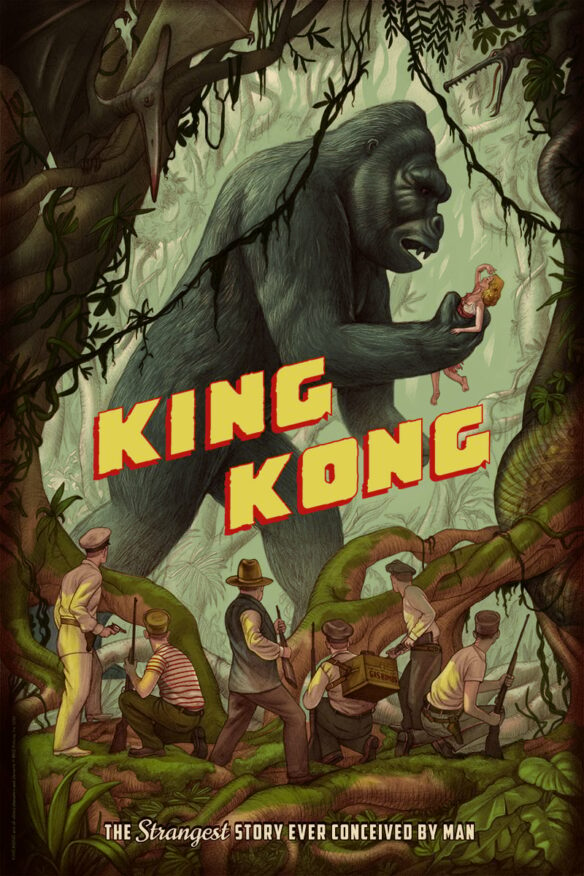
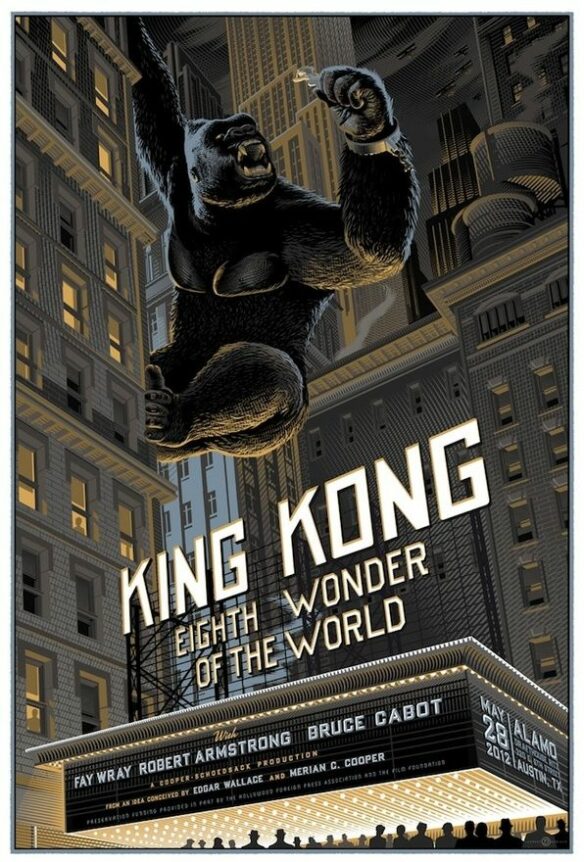
Poster for a 2012 revival showing.
KING KONG TRIUMPHANT
Nearly twenty years have passed since Universal re-entered the simian playing field, releasing Peter Jackson’s much anticipated remake of King Kong in 2005. I was among those both excited and apprehensive about this second remake. Merian C. Cooper’s 1933 masterpiece remains my all time favorite film. I would guess that I’ve seen it over two hundred times over the past sixty odd years. I was fortunate to have known Merian C. Cooper through intensive correspondence for the last eight years of his life, and spent two wonderful afternoons with Fay Wray at her Century City apartment in Los Angeles after his passing. During the Summer of 1980, I was privileged to visit the home of this visionary filmmaker, enjoying several hours of conversation with his widow, actress Dorothy Jordan (who bore more than a passing resemblance to Fay Wray), and son, Richard Cooper who arrived to chaperone the meeting. I held Cooper’s original bound script for “Kong” (with his handwritten annotations delightfully populating its pages) in my hands, and stood excruciatingly near the infamous, framed portrait of Cooper drawn in caricature, yelling “Make It Bigger,” given the director during Christmas, 1932, by Kong’s cast and crew. No other motion picture has continued to mesmerize me the way that King Kong has, and I jealously guard its reverence in my life. When Dino De Laurentiis produced his 1976 atrocity, I was enraged. I managed to compose a sarcastic diatribe for George Stover’s Black Oracle Magazine which I laughingly labeled “Twas Dino Killed The Beast.” After that despicable debacle, I had little interest in seeing yet another remake of the fantasy classic…until, that is, it was announced that Peter Jackson would film his own loving tribute to Cooper’s masterwork.
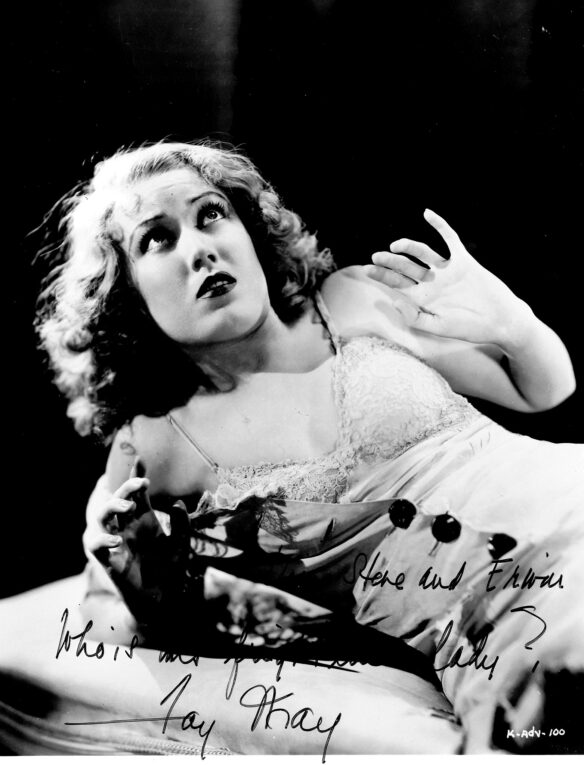
Fay Wray
Having seen all of the Lord of the Rings films, I became convinced that if anyone on the planet could bring Kong convincingly back to the screen, it would be Peter Jackson. His towering reign over modern fantasy films established his reputation as their preeminent interpreter. Add to that his stated reverence and respect for the original Kong, and the fact that it was the picture that inspired him to become a director in the first place. This was going to be a King Kong for the ages, I believed. The fact that the picture was scheduled to premiere the night before my sixtieth birthday added a mystic touch to an already exultant anticipation of the long-awaited unveiling.
I suppose that, in reality, not even Citizen Kane could have withstood the intensity of expectation surrounding the finality of completion of this deliriously anticipated remake. I walked into the theatre with stars in my eyes, only to exit three hours later deeply angered and insulted by what I regarded as an arrogant betrayal of the faith I had naively placed in Mr. Jackson’s integrity. I was actually quite horrified by the inanity of sequences flashing by me in numbing profusion. Jackson, I felt, had taken one of the screen’s most colorful, courageous characterizations, and turned it into buffoonish parody befitting the vaudeville theatrics so shabbily re-created in the film’s early scenes. No longer a fearless adventurer, director, and explorer, so enthusiastically patterned after Merian C. Cooper’s own heroic persona, Carl Denham (in the person of John Belushi wannabe Jack Black) had inexplicably been rendered impotent by the calculated degeneracy and burlesque simplicity of Black’s insultingly exaggerated comedic mediocrity. As if this wasn’t bad enough, Jack Driscoll…the hero of the original motion picture…had been reduced to a joke, a one-dimensional caricature reminiscent of newsman Ted Baxter on the Mary Tyler Moore television show. Jackson’s apparent dislike for actor Bruce Cabot, who portrayed Driscoll in the first film version of “Kong,” seemed exacerbated by his refusal to acknowledge Cabot in the final screen credit honoring everyone in the film other than the actor.
I wrote a scathing attack of Jackson’s production for a popular science fiction website during Christmas, 2005 promptly, if improperly, dismissing the entire film as an embarrassment to everyone concerned. After my review appeared, I began receiving a barrage of criticism from longtime friends around the country, roundly challenging my observations. The thrust of the observations concluded that I had been too hard on the film, unfair in my expectations, and blinded to its many charms. Even my own brother telephoned me upon leaving a Los Angeles theatre, raving about the spectacle and commending Jackson’s directorial brilliance. Most of the country’s major film critics, including Roger Ebert, praised its incomparable artistry and imagination. I thought, perhaps, I’d seen a different film than everyone else. Most of my friends urged me to wait a week or two, and go back to the theatre with a more open and, perhaps, generous mind. Maybe, now that I knew what was wrong with the film, I might be better prepared to sit back, relax, and enjoy what was right with the picture. About ten days later I did revisit the film and, in all candor, found that there were enough genuinely impressive set pieces to take the edge off of my initial resentment. Upon a second viewing, I composed a not entirely enthusiastic retraction of my earlier comments and, while unable to accept the new representations of Denham and Driscoll entirely, found that I had begun to like, if not love, the Jackson production.
When the film found its initial entry to the DVD market some years ago, I found myself watching it a third time. To my consternation, I discovered that I was really beginning to enjoy the movie. The Jack Black introduction, which had seemed interminably long upon its first viewing, had inexplicably grown less offensive and even shorter than I had remembered it. By time the Venture had run aground on Skull Island, the excitement and pacing of the film had increased dramatically and I found myself caught up in the breathtaking grandeur of the animals and visual effects. Some of the original silliness remained, unfortunately, in the later New York sequences once the cast and crew had returned for Kong’s exhibition on Broadway, and yet the touching poetry of Ann’s reunion with Kong atop an icy lake in Central Park, a sweet, somehow fragile wintry ballet, struck me as remarkably lovely in retrospect. However, the single element that had always impressed me was the final scene atop the Empire State Building in which the humbled denizen of a prehistoric era meets an excruciating assassination, his body riddled with stinging machine gun bullets, falling from nobility and grace to the littered streets below a stunning Manhattan skyline. Jackson had gotten this right from the outset…a sublime recreation of Kong’s final moments of tenderness within the gaze of Ann Darrow at the top of the world.
Upon a fourth viewing, this time on cable, I found myself…somewhat astonishingly… starting to love the film. Still later, Universal released an extended director’s cut of Jackson’s dream film, a three and a half hour restoration which incorporated some breathtaking sequences that should never have been eliminated from the film in the first place. I sat down in my living room at the time, cleared my mind of any misgivings or preconceptions, and watched Jackson’s King Kong for the fifth time. It was in many inexplicable ways, however, the “first time” that I had really seen it. My mind and heart raced back to December 14, 2005. I turned down the lights and felt the exhilaration I initially felt on opening night when the theatre lights first dimmed, and the Universal logo lit up the screen. Among the restored sequences was an exciting homage to the original production in which a malevolent stegosaurus crashes through the jungle brush to attack the intrepid explorers. As they fell the beast with rifle fire and gas bombs, the creature’s spiked tail rises and falls thunderously onto the jungle floor in poignant conquest, for this was, after all, a dinosaur…a prehistoric beast, a paleolithic echo from an earlier film.
However, the real treasure unearthed by the studio for this handsome, extended edition is, unequivocally, a lengthy and terrifying sequence in which fanged sea creatures from beneath the depths come flying out of the primordial mist to devour the defenseless sailors on a hastily constructed raft adrift upon the murky moat. It is a brilliantly realized scene and one of the most dazzling show pieces in the entire film. The new footage does much to flesh out an already impressive production, offering Kong what it might have subtly lacked in its original inception and release. A joyous revelation during subsequent viewings has also been a deeper appreciation of, and reverence for, James Newton Howard’s heart wrenching score for the film. While neither as bombastic as Max Steiner’s original composition, or John Barry’s somber requiem for the second film, Howard’s romantic tenderness, and poetic eloquence stand among the finest achievements of his deservedly respected career. In retrospect, Peter Jackson’s King Kong is an astonishing achievement, a breathtaking exploration of a world lost and hidden from the beginning of time. The deluxe DVD edition includes a handsome sculpture of the beloved simian climbing his final, tragic refuge in the clouds…the majestic Empire State Tower…a haunting remembrance of an unforgettable fable and finale.
While the casting of Jack Black in the pivotal role of Carl Denham remains mystifying, as does the ultimate trashing of Jack Driscoll, whose singular origins and portrayal by Bruce Cabot stand alone as the only major original cast member pointedly excluded from the loving acknowledgements in the final credits, this film grows more profoundly impressive with each successive viewing, and is a powerful and exhilarating re-imagining of a beloved fantasy classic from film making’s own primordial past.
By Michaele Jordan: I watched a wonderful movie last night, and just had to share my delight! We’ll start, of course, with the credits.
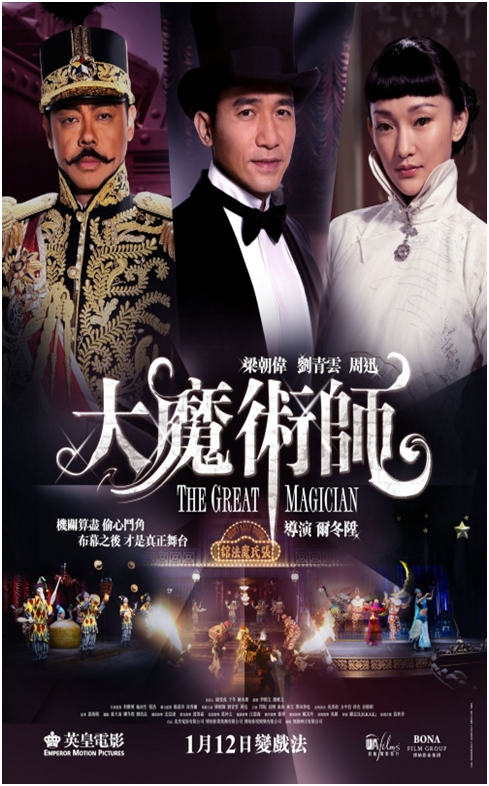
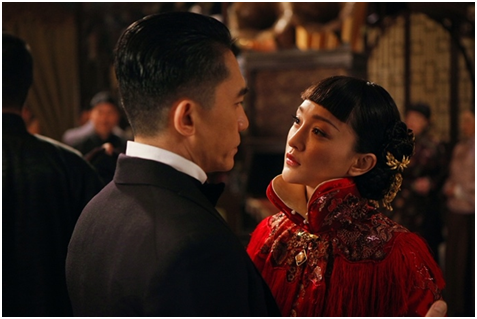
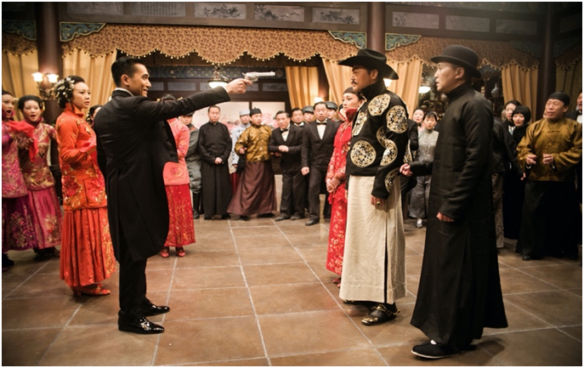
The Great Magician is a 2011 Hong Kong action fantasy comedy film, based on a 2009 novel by Zhang Haifan. It was directed by Derek Yee, who also wrote it, along with Chun Tin-nam and Lau Ho-leung. It stars Tony Leung as Chang Hsien, Sean Lau as Lei Bully (Lei Da-niu) and Zhou Xun as Liu Yin
The film is set in Beijing in the 1920s during the Warlord Era, after the fall of the Qing dynasty. The political situation is chaotic, to say the least. The city is packed with royalists, Japanese agents, politicians, warlords, military recruiters, refugees, and a wide variety of money-grubbers. Yet life in the city goes on, in something surprisingly like normal, with noncombatants taking care to remain inconspicuous, and schemers trying to look innocent.
Take Lei Bully. He’s a warlord and doing pretty well for himself. Got six gorgeous wives – and one spare. Spare? Liu Yin is his beautiful prisoner. She’s widely referred to as his seventh wife, but she insists they’re not married. Bully believes she’s being faithful to her missing fiancé and is apparently so infatuated with her that he has hesitated to use force. And she has not attempted to escape him. Because she is afraid for her father who is in prison – she says.
When not agonizing over his love life, Bully stages recruitment drives, in which his butler performs magic tricks to scare convicts into signing up. (Either the local prisons have been emptied in the confusion, or the translators are using the word ‘convict’ as a synonym for riffraff.)
The magic shows attract Chang Hsien. But not as a recruit. Chang is a much better magician than Bully’s butler. Soon he has taken over the local theater to stage his own magic shows.
His magic shows are astounding. (Trust me on this — even if you don’t want to watch the whole movie, try to catch a clip of one of Chang Hsien’s’ magic shows. You will remember it forever!) Of course, he isn’t in it just for the magic, either. He too has a political agenda. And the first time he and Liu Yin meet, we see sparks that have nothing to do with politics. Or magic.
After so much talk of magic and politics and magic, let me to reassure you there’s plenty of action, too. But not like the action you see in an action film, where big guys start throwing punches at every opportunity, with no apparent expectation of resolving anything, just because they’re so manly.
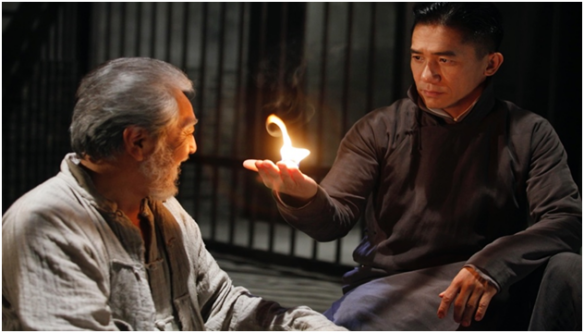
This movie is about clever people, and they don’t invite trouble casually. They always have a reason. Another clever person is Liu Yin’s father who is imprisoned of his own free will – prison being the safest place he can find. He’s discovered a wonderful, dangerous treasure. It’s a manuscript, explaining the techniques for the real magic which has been lurking under the stage magic all along.
I’ll stop here, but not for fear of spoilers. This film is so kaleidoscopic that spoilers are not really possible. You have to see the whole mandala. And it’s on Netflix.
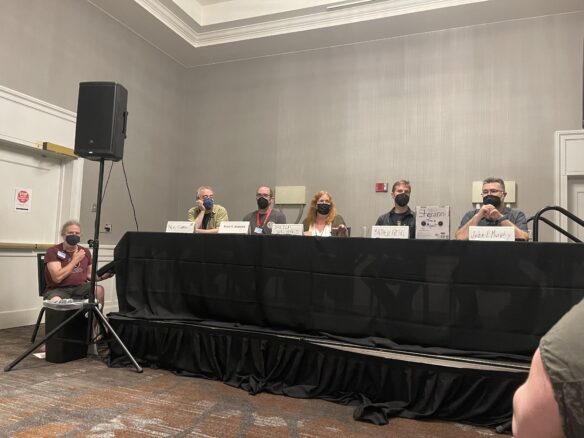
The DDOS Panel at Readercon expressed caution and reassurance, while circling the heart of what Story is, and whether AI could ever do it well.
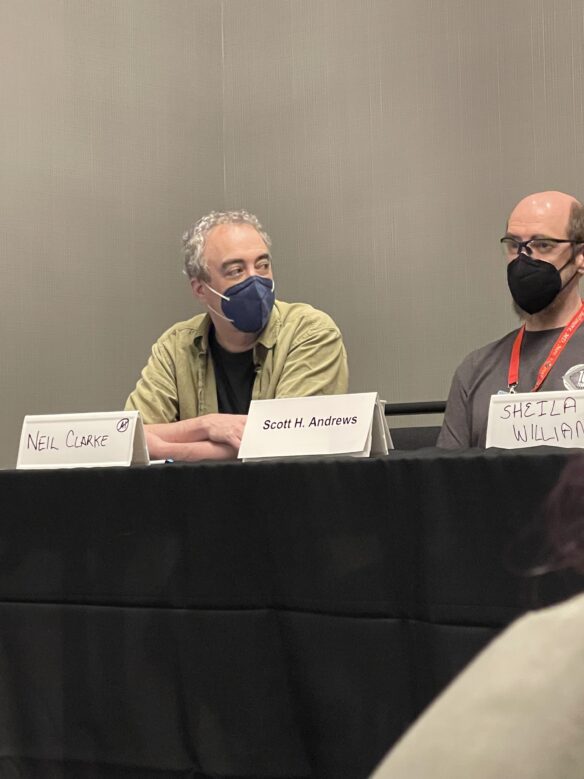
By Melanie Stormm: On Saturday, July 15, 2023, a panel of SFF editors, writers, and experts convened to discuss the current situation and approaches used to address the waves of AI spam submissions. The participants were John P. Murphy, current SFWA vice president; Matthew Kressel, author of King of Shards and creator of the Moksha system; Scott H. Andrews, editor of Beneath Ceaseless Skies; Sheila Williams, editor of Asimov’s, and the editor for Clarkesworld, Neil Clarke.
The panel expressed both uncertainty and reassurance. Writers looking to sell their short fiction to the genre’s most celebrated publications need not worry that months of painstaking labor can be outdone by an AI submission cooked up with the click of a mouse. Yet. AI fiction offerings are just plain terrible and terrible in new and innovative ways not yet discovered by humans. That’s the good news.
Particularly inspiring were the alacritous approaches that award-winning editor Neil Clarke (As Seen On TV), and award-nominated writer, editor, and creator of the Moksha submissions system, Matthew Kressel, have developed to address the crisis that the burst of AI spam submissions has created. Stretching over all of this, a pall of uncertainty.
Maybe pall isn’t the right word. Maybe describing the uncertainty as an ocean through which we all move would be more apt. Or perhaps it would be better to say the fish themselves are the sources of uncertainty.
If you’ve been hiding under a subaquatic rock or writing a book—two acts that produce similar outcomes—forget the fish for now and let’s catch you up on things.
Neil Clarke, Scott H. Andrews, Sheila Williams, Matthew Kressel, and John P. Murphy at Readercon.
The Swarm
In February 2023, one of the highest-paying markets for short speculative fiction closed to submissions for a then undetermined period for the first time since opening in 2006. Spoilers: it was Clarkesworld magazine. A swarm of five hundred-plus AI-written stories overwhelmed a system that necessarily relies on reading to discover new stories.
Clarkesworld was not alone. Sheila Williams experienced an onslaught of AI subs. Asimov’s uses the same submission system designed by Neil Clarke. Instead of slush readers digging through the seven hundred or more story submissions Asimov’s receives monthly, Williams personally handles each story.
In April, AI submissions initially peaked for Asimov’s. Things improved in May, but by June, the submissions shot up again; over 235 were AI spam submissions. When the media interviewed Williams in early spring, she reflected that she still had a sense of humor about the whole thing. But later, when the Wall Street Journal knocked on her door, she had run out of jokes. “It isn’t as time consuming [for me] as it would be for someone who isn’t an expert, but it is awful…By the time the WSJ interviewed me, I was so annoyed. I had no humor. I want to spend that time looking for new writers.”
Editor of the award-winning online fantasy magazine Beneath Ceaseless Skies, Scott H. Andrews, has similar struggles. However, due to the uniquely narrow submission guidelines, Beneath Ceaseless Skies has been spared the mass swarm of AI spam submissions at the time of the panel. Instead, writers of AI-assisted stories targeted the publisher of literary adventure fantasy, a kind of submission on a level all its own.
Firefighters
Before detailing the responses editors and developers are creating to respond to the AI spam crisis, it’s advantageous to describe how the SFF short fiction donuts get made and the toll such submissions have on the process. One of the best descriptions of how human slush readers handle volume is in a viral Twitter thread by Matthew Kressel. The thread was written in October 2022, just one month before ChatGPT became popular.
The Moksha submissions system is used by over forty publishers to receive, reject, and accept fiction, non-fiction, and poetry from writers around the world.
In the thread, Kressel writes:
“Assuming a modest submission rate of 50 stories per day (which is pretty average for Moksha publishers), and an average length of 5,000 words, that’s 250,000 words per day, or approximately 2 novels per day…
Yes, most publishers hire slush readers to help them sift through incoming submissions, so let’s assume they have 10 readers total (which is more than average), that means each reader needs to read 25,000 words per day.
That slush reader, who is most likely an unpaid volunteer, has to read ~175,000 words per week, because people submit on weekends too (often more),
This while keeping their day job and trying not to estrange their significant other and hopefully having some time to eat and sleep and maybe even a moment to relax and unwind.”
For the record, the original prompt for Kressel’s post was explaining to new writers why publishers must issue many story rejections without comment. The moral is there isn’t enough time in the day, and slush readers and editors don’t necessarily read your entire story.
One of the first replies to this thread was that the answer to these swift and impersonal rejections was that AI should be fed previous submissions to sort and manage the volume of human submissions. As it turns out, Story is far more complex than many people know, and current AI can only do so much so well. It stands to reason that if AI can’t write a good story, it can’t recognize one.
During the panel, Sheila Williams illustrated such a point. “Twenty-five percent of submissions in June were AI. We had 935. I try to get rid of these very fast. Neil [Clarke] has designed something that helps me and has shared places with me to help me identify those submissions, but I’m faster than those places.”
For others, relying solely on human expertise to identify and extract AI submissions quickly became impossible.
By the numbers, Clarkesworld was slammed. According to Neil Clarke, Clarkesworld receives an average of 1100 monthly submissions. In December, after ChatGPT first achieved widespread use, Clarkesworld identified fifty AI spam submissions.
“These were unusual stories showing up,” Clarke said. “Bad in ways no human was bad before.”
In January, this number doubled to one hundred. By February 20, 2023, five hundred submissions hit Clarkesworld’s system. Fifty new AI submissions arrived the morning Clarkesworld announced its closure.
First, Neil Clarke, who has a professional background in computer science and designed the Clarkesworld submissions system used by several publications, made adjustments to the firewall and the software. “That was far more effective than we thought it would be,” Clarke said. By March, Clarkesworld reduced AI spam submissions down to about two hundred.
SFF stories have diligently shown us that the Empire Strikes Back, and so did the AI submissions. Neil Clarke concluded, “By May, they had figured out what we had done, and we were then up to seven hundred.”
That is seven hundred surplus AI spam submissions, not including the submissions blocked by the firewall and software defenses.
The Second Wave
Spammers in the second wave were no longer flying in the dark. They had Clarkesworld in their sites, and the internet became rich with posts guiding people on using science fiction prompts to send AI stories to Clarkesworld.
Other experts in network security, credit card fraud, and spam contacted Clarkesworld, giving tips and further advice on reducing attacks that have doubled Clarkesworld’s already high submission volume.
Clarke spoke to the nature of the submissions. “And that’s how I would qualify these. These are spam.” And yet Clarkesworld, Asimov’s, and other publications are reluctant to rely entirely on firewalls, software, and AI tools to identify and automatically ban suspicious submissions.
Suspicious submissions are now relegated to the bottom of the pile so that editors can quickly read and release or accept submissions from human authors. After all, many of these publications don’t accept simultaneous submissions. This means that when an author submits a work for consideration, they must either wait for the editor to respond before submitting it elsewhere or withdraw the piece if time goes on too long. This practice works, and in the wider writing world, genre magazines have some of the fastest and most considerate turnaround times in the business (and are among the highest-paying, too.)
The careful ways in which each panelist identifies and considers suspicious content speaks to how passionate they are about giving new authors a chance, but also how little AI tools can be trusted to identify AI. Detectors have falsely flagged authors for whom English is a second language as AI-generated content.
Another takeaway was how considerate editors are of their slush readers, frequently working to ensure first readers are spared having to wade through spam.
Neil Clarke (Clarkesworld) and Scott H. Andrews (Beneath Ceaseless Skies).
It’s no secret that more spam comes from a handful of geographical regions than anywhere else. While some have suggested banning submissions originating in those locales in the interest of the greater good, no editor on the panel wants solutions like this. For Sheila Williams, the chance to bring exciting new SFF stories from unknown writers worldwide is too important. She reads each suspicious entry first and bans only once she’s positive it’s AI.
Neil Clarke described the human toll. “This is a constantly evolving state; we’re in this never-ending battle. It’s a lot of extra work. It would be great if these were legit stories, but it’s very frustrating. I found [reading spam] was beginning to interfere with the way I was reading submissions. Being irritated is not a good state of mind to be in when evaluating someone’s work.”
In describing the specifics of his approaches, Clarke was decisively vague. Matthew Kressel echoed the same strategy of playing cards close to the vest. One thing is clear: the sources of the AI spam don’t want to write good SFF stories; they want to trick genre editors into handing over their wallets.
The Ceaseless Submissions at Beneath Ceaseless Skies
As seen at Beneath Ceaseless Skies, AI submissions pose a threat on more than one front. Beneath Ceaseless Skies is among the most respected and coveted publication credits in the genre today—a status that puts a target on its back for AI spammers. Still, within a niche genre, it occupies an ultra-niche space.
A writer with a few years of practice may quickly identify a character-driven story from a plot-driven one. Still, in a world where genre lovers cut their eye teeth on film and TV as much as on the written form, many readers and young writers aren’t aware of the difference.
BCS qualifies what it will publish in almost every category. BCS only publishes (1) character-driven (2) adventure stories that (3) take place in secondary world (4) fantasy settings that (5) exhibit technologies no more advanced than those available during the 1930s. Furthermore, (6) the stories must be literary in craft. This craft is characterized by an intentionality and awareness within the prose that takes years to master.
And editor Scott H. Andrews has to like it (7).
Beneath Ceaseless Skies receives an average of three hundred submissions each month. They currently have five first readers, but Andrews reads the first page or so of every submission before assigning them to first readers. Once ChatGPT became more mainstream, Andrews started seeing an influx of submissions with cover letter mentions that the stories had been written with the assistance of AI. Andrews’ stance on AI submissions, assisted or otherwise, is informed by ethical and legal grounds. None of these submissions could ever be seriously considered for publication. Still, with curiosity and prudence, Andrews took a closer look at these new offerings.
Andrews explained there are many ways an author might use AI to “assist” a story; some are less harmful. Spellcheck is one, Grammarly is another. He and Matthew Kressel both warned against over-reliance on apps like Grammarly, which in the wrong hands, can flatten a writer’s voice and turn strong writing into hollow, mediocre text. These AI-assisted submissions weren’t specific as to how authors used AI in creating the story, but it was quickly apparent to Andrews that it went beyond Grammarly.
“Even though at BCS I’m not seeing the spam ones so much, I’m seeing the assisted ones, I still felt a sheen in those that was like nothing I’ve ever read from a human writer,” says Andrews.
By his description, AI-assisted stories sound slightly better than those that qualify as spam but also present different ethical and legal questions.
Andrews says: “I had to think of what exactly I should say. Different folks have different views so I fumbled around a bit and saw some things that Neil [Clarke] had written. I went with the definition that the US Copyright office put out this spring. Their quote was something to the effect that ‘the traditional elements of authorship can’t be done by a language model.’”
An AI approach to “writing” that relies on Language Learning Models is not copyrightable. The author doesn’t own the story and hence cannot license it to a publisher.
Legality feels like a firm foundation on which to build a stance for or against AI-assisted work, but even here, the ocean injects uncertainty.
“Some zines in our field are publishing LLM-created fiction anyway; it’s unclear how they’re handling the legal side of things,” Andrews points out. “The legal status would change if courts or laws deemed these LLMs’ use a legal fair use or deemed LLM-created works copyrightable.” The decisions of the Supreme Court or US Copyright Office are beyond any SFF publisher’s control.
Beneath Ceaseless Skies updated submission guidelines in March to reflect that AI-assisted works were unwelcome. Moksha also offers users an option that requires writers to declare if the stories they’re submitting are created using AI, and BCS avails itself of a similar tool.
The result? Cover letters stopped declaring AI assistance while stories containing that unnatural sheen continued to flow in. At the time of this writing, BCS has also seen an uptick in spam submissions.
Uncertain Fish
AI spam and AI-assisted submissions have threatened our publication communities in multiple ways, and all involved agree this is far from over. But it’s not the AI that poses a threat; it’s the humans involved at nearly every level that makes it so malignant. Enter the uncertain fish from earlier.
LLMs are fed copyrighted material at the developer level without authors’ permission. Regardless of legality, taking and using something without someone’s permission is stealing.
On Saturday, July 22nd, Matthew Kressel tweeted:
“None of the so-called commitments by the seven AI companies addresses illegal scraping and theft of copyrighted content. Why? Because their business models would collapse if they had to pay people for the terabytes of content they are stealing.”
Most SFF writers shudder at thinking of LLMs illegally scraping their published work to populate AI stories, crappy or otherwise. But published work isn’t all that’s exposed to scraping.
When interviewing Kressel for this post, he highlighted the following: “The issue we have now…is that data is forever. Previously, when you submitted a paper manuscript in the mail to a publisher, it is most likely going in the dump when they’re done…But now, it’s easy to keep stuff around forever.”
In other words, Kressel had to take specific strides on behalf of Moksha to protect unpublished and rejected submissions from illegal scraping. Who scrapes what is an ethical call by developers who often have their own best interests at heart. Writers should not assume the content of their Google Doc files are safe, although Kressel hasn’t personally stopped using Google Docs just yet. “Moksha’s manuscripts are locked behind an encrypted firewall, only accessible by the publisher, but even then, we need to have firm safeguards.”
Who scrapes what threatens emerging writers and SFF readers, too. Many writers make their name writing short fiction. Getting publication in top mags is a path to attracting agents and publishing longer works either independently or traditionally. But agents and publishers are only part of a writer’s career path—readers are the most essential. Publishing short fiction, especially in publications that make work available eternally online, can allow writers to build readership quickly. A reader who discovers a writer could access several of their stories with a mouse click and become a dedicated fan.
SFF is experiencing a new golden age created partly by online publication opening doors to a global readership. Global readership speaks not only of previously unreached audiences on the Asian and African continents but also of reaching more readers on continents that SFF already enjoys community. Rural and remote areas often lack bookstores offering copies of the Magazine of Fantasy & Science Fiction or Clarkesworld. Online presses have carried some of our most loved stories to excited new fans who would not otherwise have access to them.
Several SFF editors and writers have expressed worry over the future of online SFF publications if authors don’t feel sufficiently protected. If authors start preferring print-only models or having stories locked behind bullet-proof paywalls, the inroads our community has created could crumble quickly. Whatever our disputes, this community exists because there are enough positive, trusting relationships between writers, readers, and publishers.
So what about all the bad AI-generated stories? Who are they, and where do they get off? The SFF ocean is flooded with schools of spammers who don’t come from the global SFF community.
“They have no idea there’s a community,” said Sheila Williams. “This is not their dream. They just found a way to make some money.” Some submissions address Williams with notes saying, “I heard about your side hustle. Please send money to my Western Union.”
The source of AI-assisted work is more challenging to parse. Undoubtedly, outsiders who care as much for the genre as they do the firewalls they’re trying to evade are responsible for some, but not all.
Combing subreddits and SFF discord servers yields a surplus of discussions on how to use AI to do some of the hard work of writing a story, but yelling at these writers isn’t the right approach either. It takes a long time to learn how to write stories and even longer to do it reliably. Writers don’t get to pause life, and some are understandably tempted by the lure of making this easier. AI aside, the internet is chockfull of cobbled-together courses, books, and free eGuides that promise to make the road to publication fast and easy. Some of them are even good, but those don’t promise to make it easy, just clearer.
Some see LLMs as a way of teaching themselves how to write better science fiction. Clarke asked: “Do you really want to learn from something that stole other writers’ work?”
The ethics of AI assistance needs to be more explicit in other areas. Screenwriters with the Writers Guild of America stipulated that they would allow for the use of AI only as it assisted them with their original work but drew a line against machine-generated storylines or dialogue qualifying as “literary material.”
AI is no small issue in the current writer’s strike. In 2017, the average full time writer made a yearly salary of just $20,000. A world where writers must share a byline with AI is terrifying as writers are isolated further from benefiting from their own trade. My Saponi mother would call this being put on a reservation.
The technological battle is ongoing, the legal one may take years to play out in courts and could reverse at any time, but the ethical issues are within our power to address.
Speaking outside of Readercon, some editors have suggested that the answer to this ethical attack on our community is more community.
Kressel says, “What I’d like to see is the SFF community coalesce around a set of core values, similar if not identical to Neil’s statement on AI. And I’d like to see SFWA and others release draft language, similar to how they offer boilerplate contracts, to (a) protect authors, (b) protect publishers, and recognize that both are necessary for a healthy community going forward. I understand the situation is rapidly evolving, but that doesn’t mean we can’t affirm our values now.”
Just a day after Kressel made that (yet unpublished) statement, SFWA encouraged members to read and sign the Author’s Guild open letter. This development was a promising community response. The current SFWA vice president and author, John P. Murphy, served as the moderator for this panel. Salient fact: he holds a doctorate in Machine Learning.
In all of this uncertainty, it’s clear that we must stick our necks out and protect the relationships that make our community possible, even if the immediate threat is the growing amount of spam that continues to overwhelm our publications. AI assistance is not a threat from outside our community but comes from within; it’s a longer-term issue.
Can AI Tell Good Stories?
In 1972, George R.R. Martin published an essay about chess-playing computers in Analog. It was titled “The Computer Was A Fish,” and Sheila Williams referenced it during the panel. The moral of the essay was that chess-playing computers were terrible. In the last year, we’ve seen the chess world rocked by the illegal use of AI that gave players unfair advantages in tournaments. Leaders developed better ways to identify cheating and more severe repercussions for violations to protect the integrity of the game.
It is still unclear whether Language Learning Models and the other AI forms that will replace them will become incredible at telling stories that fascinate human readers. Most editors doubt AI can develop the capacity, yet SFF readers and writers never get tired of asking, “What if?”
One attendee at the DDOS panel posed a hypothetical question to the panelists: “What if a developer takes it as a challenge to create AI that writes a story that wins a Hugo?”
“That’s a wonderful story,” Neil Clarke mused.
Sheila Williams interjected, “—That a human being came up with.”
Thanks to the DDOS panelists, John P. Murphy, Matthew Kressel, Scott H. Andrews, Sheila Williams, and Neil Clarke. Thanks also to Bernard Steen for providing photos and to PJ T. de Barros for providing an audio recording of the panel as reference.
[Editor’s Note: Gareth Powell is a British SF writer who has written three series, to wit the Ack-Ack Macaque series with airships and cigar-smoking-monkey fighter pilots, and the Embers of War with ships akin to those in Iain M. Banks’ Culture series. Powell’s latest series is The Continuance in which all of humanity has been exiled from Earth and is wandering the galaxy in vast ark ships. The latest novel in that series, Descendant Machine, came out in May. Both the Ack-Ack Macaque and Embers of War series had novels in them that won British Science Fiction Society Awards. Keep up with Gareth L. Powell’s Twitter, Instagram, and Facebook via Linktree. And at his Substack: Gareth’s Newsletter.]
What he taught me, and where to start with his work
By Gareth L. Powell:
My collection of Iain M. Banks books:
Iain [Menzies] Banks (16 February 1954 – 9 June 2013) was born in Fife and was educated at Stirling University, where he studied English Literature, Philosophy and Psychology. Banks came to widespread and controversial public notice with the publication of his first novel, The Wasp Factory, in 1984. His first science fiction novel, Consider Phlebas, was published in 1987. He continued to write both mainstream fiction (as Iain Banks) and science fiction (as Iain M. Banks). He is acclaimed as one of the most powerful, innovative and exciting writers of his generation: The Guardian called him “the standard by which the rest of SF is judged” and the New York Times-bestselling William Gibson described Banks as a “phenomenon”.
I only met the late Scottish author Iain M. Banks a couple of times before his untimely passing. On the first occasion, the organisers of Eastercon seated me beside him for a mass signing event. My novel, The Recollection had just come out and I had around ten people come to visit me during the course of the hour-long session. Iain, on the other hand, had at least a hundred—with some people rejoining the queue multiple times because they’d brought so many books for him to sign. A few of them glanced my way after securing his signature, and then moved on, unimpressed. It was a humbling, somewhat chastening experience for a new author, but at the end of the hour, Iain turned to me and said, “Don’t worry about it. One time, I had to sit next to Pratchett!”
Since my novel Embers of War first came out in 2018—and especially since the release this year of Descendant Machine—readers and reviewers have been comparing my work with Iain’s, so I wanted to write something about him.
Although William Gibson inspired me to start writing in earnest, it was Iain M. Banks who really opened my eyes to the possibilities of the genre and reignited my love for space opera. My first exposure to his science fiction came with Consider Phlebas. It was a gift from a friend, and it absolutely blew me away. After that, I read the others as they were published, savouring each one—and especially those set in Iain’s post-scarcity utopia, ‘The Culture’—as a rare treasure.
Iain taught me it was okay to think big and have fun, as long as you told a good story about complex, relatable characters—something I’ve been trying to do in my last five novels from Titan Books. Because of this, and because both our books feature sassy talking spaceships and tend to be set against huge cosmic canvases, many reviewers have drawn comparisons between us. As a huge fan of his work, these comparisons are extremely flattering, and I’m obviously very pleased if my books appeal to fans of his work. I am happy to continue flying the flag of literate, character driven space adventure, but I do think we have very different writing styles. I absolutely adore his books, but I’d never try to write like him; it wouldn’t ring true. I have my own voice, and I’m very happy using it.
The second time I met him, he was signing copies of his novel Surface Detail at a bookstore. For some reason, the signing had been scheduled for lunchtime on a weekday, so there were very few people there. Maybe half a dozen. When it was my turn to get my book signed, I reminded him of the “I once sat next to Pratchett” quote and he cackled.
Ian M. Banks left a profound influence not only on me, but on the science fiction genre as a whole. He wrote with compassion, wit, and anger, and the world is a poorer place for his passing.
If I’m ever sat next to a fledgling author who’s getting fewer requests for signings than I am, I’m going to turn to them and say, “Don’t worry about it. One time, I had to sit next to Banks!”
An Introduction to Iain M. Banks
I read his science fiction novels in the order they were published, and recommend doing so. But if that seems too much of an investment of time, here’s my list of his top 5 essential books.
The Player of Games.
Everybody says this is the best one to start with. It’s a straightforward, highly political, witty, and involves a story about a prominent game player sent halfway across the galaxy to topple an oppressive regime by beating its emperor at a fiendishly complex board game.
Use of Weapons.
This episodic novel about a mercenary employed by The Culture moves backwards and forwards in time, with some amazing set pieces and a stunning reveal.
The State of the Art.
A short story collection that’s mostly worth it for the title novella, which follows the misadventures of a Culture starship that stumbles across the Earth in the 1970s.
Excession.
Probably the most challenging and enjoyable of his novels, this one follows an “Outside Context Problem” from the perspective of the Culture’s hyper-intelligent ship Minds. It can be hard to keep track of which ship is saying what, but if you stick with it, you might find why it’s my favourite of his books.
The Hydrogen Sonata.
My second favourite of Banks’ Culture novels, and sadly his last. This tells the story of the last days of a civilisation adjacent to the Culture as it prepares to ‘Sublime’ to another form of existence.
By Steve Vertlieb: Rod Serling’s iconic, landmark television series The Twilight Zone, premiered over the CBS Television Network on Friday night, October 2, 1959. The program featured the brilliant literary poetry of its creator, as well as the writings of Richard Matheson, Charles Beaumont and Ray Bradbury. Its science fiction/fantasy premise often camouflaged Serling’s own deeply sensitive social commentary, and profound pleas for understanding and tolerance.
The program broke new ground with its reverent, often haunting, sometimes heartbreaking allegories, and remains one of the most eloquent and influential network television series in the history of the medium. For its sixtieth anniversary, the city of Binghamton, New York, which cradled the author’s birthplace, scheduled a celebration of the acclaimed TV show, commemorating the anniversary of the premiere of this wondrous television anthology series.
“The Twilight Zone: An Element Of Time” is my published 2009 celebration of the fiftieth anniversary of the classic Rod Serling television series. With original teleplays by Richard Matheson, Charles Beaumont, Ray Bradbury, George Clayton Johnson, and the visionary pen of host Rod Serling, along with accompanying scores by Bernard Herrmann, Jerry Goldsmith, Franz Waxman and Fred Steiner, among others, this tender recollection of the iconic sci-fi/fantasy anthology series is dedicated to the memory of its beloved creator, Rod Serling, who left us far too soon on June 28, 1975 at age 50.
His legendary television series, and his revered memory, live on beyond “shadow and substance.” “That’s the signpost up ahead.” Be swept away into another dimension with this sweet remembrance, adrift upon rippling currents of time and space, only to be found in…”The Twilight Zone.”
THE TWILIGHT ZONE: AN ELEMENT OF TIME
There is an obscure Air Force term relating to a moment when a plane is coming down on approach and a pilot cannot see the horizon. It’s called The Twilight Zone. For a writer searching for his voice in the midst of corporate conservatism during the late 1950’s, the creative horizon seemed elusive at best. Television, although still a youthful medium, had begun to stumble and fall, succumbing to the pressures of financial backing and sponsorship in order to survive its early growing pains. Navigating a successful career through a cloak of fear and indecision became problematic for a young writer struggling to remain relevant. Rod Serling had penned several landmark teleplays for the Columbia Broadcasting System, including “Patterns,” and “Requiem For A Heavyweight,” but the perils of network censorship were beginning to take a toll on the idealistic author. As his artistic voice and moral integrity became increasingly challenged by network cowardice, Serling found his search for lost horizons alarmingly elusive. Searching for new avenues of expression, and freedom from scrutiny, Serling explored provocative issues cloaked in the guise of science fiction and fantasy, firing his sphere of social commentary significantly over the heads of most network executives and censors. Social commentary and journalistic heroism were no longer being courted by the three television networks. The most original and daring literary treatments were becoming alarmingly watered down in the wake of the McCarthy era, while networks pursued innocuous pabulum appealing to only the lowest common denominator. Sponsors, eager to sell their products to millions of television viewers, were adamant about playing it safe, rather than running the risk of offending anybody.
Rod Serling and Jack Palance at the 1957 Emmy Awards.
Serling’s plan was to continue challenging the censors with provocative adult teleplays camouflaged as harmless science fiction and fantasy. Searching for a suitable, if nonconfrontational story, he submitted a script to the Westinghouse Desilu Playhouse entitled “The Time Element” concerning a man whose dreams of re-living the Japanese attack on Pearl Harbor torment him every night. William Bendix was cast as the hapless bartender who inexplicably visits Honolulu on December 6, 1941 every night in his dreams. His attempts at warning the locals of an impending attack by the Japanese fall, understandably, on deaf ears. He consults a psychiatrist, explaining that he’s never even visited Hawaii. In the midst of his analysis, Pete Jenson (Bendix) falls asleep on the couch, returning to Pearl Harbor in his dreams one last time. The doctor, seemingly asleep himself, awakens with a start to find his office empty of patients. Shaken, he goes to a local bar where he recognizes an old photo of his patient hanging on the wall. Inquiring about the familiar man in the photo, he learns that Pete Jenson had tended bar there years ago before the war. He was killed at Pearl Harbor on December 7, 1941.
On November 24, 1958, CBS aired “The Time Element” as part of the Desilu anthology series. The episode received positive recognition by the critics, and generated more mail than any other episode of the series. Still skeptical of long range appeal for fantasy programming, CBS nonetheless commissioned a pilot episode for a new series to be called The Twilight Zone. The premiere episode, “Where Is Everybody” aired on October 2, 1959. Composer Bernard Herrmann’s ethereal theme for the infant program’s first season eerily set the parameters and direction of subsequent episodes in which lost, lonely people eaten up by frustration might find ultimate happiness on planes of existence beyond the realm of man. Serling patterned many of his characters and situations on The Twilight Zone after his own weary search for meaning and value within the unforgiving corridors of corporate America. He was a writer who, at least in these early years of his artistry, refused to compromise his integrity or beliefs. Two of the series most poignant episodes, “Walking Distance,” and “A Stop At Willoughby” were painfully illustrative of the writer’s own search for peace of mind and of heart in an ever changing, increasingly cynical world.
“Walking Distance,” generally considered the show’s most significant episode, aired on October 30, 1959. Written by Serling, sensitively directed by Robert Stevens, with an exquisite original musical score by Bernard Herrmann, “Walking Distance” remains the quintessential heart of the series. Witness Martin Sloan, an emotionally exhausted New York City advertising executive whose psychological scars have nearly destroyed his humanity, and left him impotent. He is a haunted soul…weary…embittered…a skeletal marionette dancing on tattered strings. Racing from the frenzied madness of Madison Avenue toward salvation, he is mercifully enveloped within a tender accident of time. At a rural gas station, Sloan leaves his battered car for repairs as he returns to the little town in which he spent his youth. Homewood is a mere mile and a half away…walking distance. Nothing has changed as he returns to his childhood. The town appears the same. In his idyllic dreams, innocence recaptured is simply a stone’s throw across a pond. It is Summer, and the purity of sacred memory is within his reach. Twenty-five years have evaporated in a wistful moment. He is home once more and there is, after all, “no place like home.” Mom and Dad are alive as they were in his childhood. Even Martin himself is transformed into the sweet boy that he was. As if hurled through a miraculous mirror in time, the reflection of forgotten purity brings comfort and aching solace to the faded specter of his wounded heart. Martin is a lonely stranger in a strange land, and he yearns for the peace and tranquility he left behind so many forgotten years ago.
But none of this real. It is simply a reminder that life is not to be wasted on the frenzied highway of imagined success. Each moment is a precious gift to be savored, and lovingly remembered with the passage of time. Martin must return to his own time and place, for he does not belong here. As “pop” gently reminds him as he points to the little boy left behind…”This is his time…his Summer. Don’t make him share it.” His eyes opened, perhaps, for the first time in his adult life, Martin must learn to cherish the memory of the child he was and carry the sublime serenity of innocence in his heart forever. Gig Young who played the adult Martin Sloan seemed to harbor an innate understanding of, and sensitivity to, the inner longing of this tortured characterization, for his own primal hunger for acceptance and affection led inevitably to his own personal tragedy so many years later. Yet, if the winding road had ended for the actor portraying Serling’s troubled character, there may still have been salvation offered to his fictional Martin Sloan…for in the closing narration there is redemption. “Martin Sloan, age thirty-six. Vice President in charge of media. Successful in most things, but not in the one effort that all men try at some times in their lives – trying to go home again – and also like all men perhaps there’ll be an occasion, maybe a Summer night sometime, when he’ll look up from what he’s doing and listen to the distant music of a calliope-and hear the voices and the laughter of the people and the places of his past. And perhaps across his mind there’ll flit a little errant wish-that a man might not have to become old, never outgrow the parks and the merry-go-rounds of his youth. And he’ll smile then too because he’ll know it is just an errant wish. Some wisp of memory not too important really. Some laughing ghosts that cross a man’s mind…that are a part of The Twilight Zone.”
In “A Stop At Willoughby,” which aired later that season on May 5, 1960, Serling composed another heartbreaking scenario in which an emotionally fragile advertising executive crosses the lonely border between sanity and psychological escape. James Daly plays Gart Williams, an ulce-ridden slave to his wife’s economic demands and expectations. On the brink of mental collapse, Williams takes the commuter train each day from New York back to his home in Connecticut. On this particular day, however, his commute will be interrupted by an unscheduled stop at Willoughby, “a place where a man can slow down to a walk, and live his life full measure.” It’s Summer. Willoughby is a small, uncomplicated town, like many such towns across America at the turn of the last century. There are band concerts, and creeks where boys can tell tall tales and go fishing. Gart longs to find peace in the gentle obscurity he observes beyond the wintry reflection of the train’s frozen windows. As he leaves his briefcase behind on the seat he will never occupy again, Gart walks off the platform of a moving train, falling instantly to his death in a blanket of icy snow beside the silver track. His body is transported by hearse to the undertaker whose name clearly adorns the side of the waiting vehicle…Willoughby Funeral Home. But Gart is unaware of the tragedy unfolding in the cold night air beside the silent train, for he is walking happily with the children toward a day of fishing at the waiting pond, and the heat of the noon day sun.
Romantic melancholia was a searing presence in the stories of the fantasy series. Sad, frustrated children in grown up bodies searched yearningly for an escape from the cynical madness sealing their hearts in cruel isolation from the wonder and magic of youth and comparative innocence. Among The Twilight Zone’s loveliest moments was the airing of a bittersweet segment concerning the elderly residents of a county nursing home. “Kick The Can,” written by George Clayton Johnson, told the tender story of a charming pied piper who, like Peter Pan, vows never to succumb to the emotional boundaries of old age. Charles Whitley (Ernest Truex) is confined by his son to Sunnyvale Rest, an arthritic waking coffin inhabited by lifeless zombies waiting in lonely succession to pass from seemingly pointless mortality. Whitley attempts to convince his hapless neighbors that by thinking young, one can remain forever vital and young. To return to the sweet purity of childlike games will restore withered minds and hearts to renewal and physical regeneration. Gathered about the sprawling grass surrounding Sunnyvale Rest, frail residents cavort as if time had frozen still, joyfully playing Kick The Can until, one by one, the starched voices and bodies of lifeless emotional cadavers disappear as little children into the waiting bushes, giggling in utterly infectious enthusiasm at the wondrous discovery of the fountain of youth. Only a shadow remains, crying in lonely despair to be taken along with his chums. For Ben Conroy (Russell Collins), the time has passed. Embittered and cynical, he is left behind to suffer in isolation and bewilderment, for he was unwilling to dream. “Come back…come back, Charley…take me with you…I want to come.” But it is too late now, and he is left alone in the empty night with only his bitterness in which to find respite.
In “The Sixteen-Millimeter Shrine,” written by Rod Serling and airing on October 23, 1959, time becomes a virtual prison for Barbara Jean Trenton, played by Ida Lupino. Trenton is a pathetic remnant of an era long ago extinguished by talking pictures. A former star of the silent screen, Trenton channels Norma Desmond in a heartbreaking performance as she clasps ineffectually at forgotten memories that come alive only in her parlor, lit by the flickering imagery of a sixteen millimeter film projector. Her beloved co-stars, still handsome and alluring on the faded screen, appear elderly and embarrassingly balding when attempting to jolt her back to reality. In the end, she fades from reality into the projected shadows of her own films, there to spend eternity in the light of celluloid dreams.
Arthur Curtis (Howard Duff) experienced “A World Of Difference” on March 11, 1960, as an actor who comes to believe that the simple, uncomplicated domesticity scripted for him by Richard Matheson is his sheltered reality, rather than the high powered, stress induced world of film sets, greedy agents, and shallow wives proliferating the ulcer ridden nightmare he calls home. As a sordid cloak of psychological repression descends upon his life upon completion of shooting, Curtis retreats in lonely desperation to the imagined camouflage of film sets and props being dismantled before his eyes. At the last, he finds redemption and spiritual salvation, becoming lost within the invisible confines of his own imagination. Caligari’s cabinet has opened and closed in sublime invitation, as Arthur Curtis survives only in whispered imaginings.
Steve Vertlieb, Richard Matheson and Robert Bloch.
For “The Trouble With Templeton,” which aired on December 9, 1960, former matinee idol Brian Aherne was cast as a distinguished elderly actor longing for the romantic recollection of an idealized past. World weary, frightened, and no longer certain of his abilities, Booth Templeton yearns wistfully for simpler times and the secure serenity of his prime. Through a fragile portal in time he returns to the acclaim and respect offered him as a younger man. To his utter despair, however, he discovers that memories are rarely faithful interpretations of literal experience. The idealized reverie of love and faithful marriage seem ill used as his once beloved Laura ignores and mocks him before their friends, leaving him bewildered and hurt, betrayed by a false perception of time and history. He returns to the present wiser for the experience, better able to confront reality and survive in the moment. Laura faces her act of sacrifice with resignation and sadness, knowing that time will deliver her beloved husband back into her arms soon enough. For the moment, however, she has sent Booth back to his own life…better able to cope with the present, rather than drown helplessly in melancholy reflections of the past.
In “Static,” first broadcast on March 10, 1961 and written by Charles Beaumont, a disgruntled cynic ridicules the fast paced society he feels has passed him by. Living in a safe, sanitary, homogenized replica of the world he once knew, Ed Lindsay (Dean Jagger) abandons the saccharine company of his boring, one dimensional neighbors and longs for the more colorful legacy of his youth. Finding an old antique radio in the basement of the boarding house he lives in, Lindsay is astounded to tune into live presentations of Tommy Dorsey and Jack Benny on the faded dial. No one believes him, of course, until…through a gentle miracle of time and space…he returns to a magical realm of wonder and perceived innocence he recalled as a young man, finding restorative happiness and escape in the enchanted invitation of a forgotten radio.
As merciful an escape as such bedeviled characters might have enjoyed, poetic repose was not to be for the survivors of the X-20, and experimental space craft that should never have come back to Earth after its ill fated flight. Rod Serling based his nightmarish teleplay on a short story by Richard Matheson titled “Disappearing Act.” Among the most disturbing half hours ever produced for television, “And When The Sky Was Opened” premiered on December 11, 1959, and starred Rod Taylor with Jim Hutton and Charles Aidman as triumphant astronauts who begin to suspect that they were never meant to return home. Mirror images offer no reflection as the doomed flyers begin, one by one, to disappear from memory and sight, their families retaining no recollection of their ever having existed. In the end, not even their craft remains in this fragile dimension of time and space. “And if any of you have any questions concerning an aircraft and three men who flew her, speak softly of them…and only in The Twilight Zone.”
Rod Serling encouraged his small stable of writers, directors, actors, and composers to let their imaginations soar. Stories by Serling, along with Ray Bradbury, Richard Matheson, Charles Beaumont, George Clayton Johnson and other distinguished science fiction and fantasy poets helped bring the five year run of this cherished CBS anthology series to enduring life and success. Composers Bernard Herrmann, Jerry Goldsmith, Franz Waxman and Fred Steiner contributed some of the most expressively original scoring of their respective careers to the cherished program…with Herrmann’s music for “Walking Distance” among the tenderest and most exquisite ever written for television
Rod Serling with cigarette.
As for the visionary face, voice, and legend behind the transformational series, Rod Serling’s reputation and legend remain forever encased in both bravado and tragedy. A workaholic and prolific chain smoker, Serling died prematurely on the slab of a surgical table of a massive, fatal heart attack, occurring during ten hours of coronary surgery, on June 28, 1975 in Rochester, New York. He had long ago relinquished all rights to the series he had created, and would never again achieve the fame and celebrity he derived as the on camera personification and sultry vocal inflection of these twilight excursions into the unknown. Rod Serling was fifty years old. Perhaps he succumbed to the beckoning imagery of a simpler, less complicated landscape in which frustration and regret might be tenderly enveloped by hope and infinite promise. This tantalizing scenario is respectfully submitted for your approval, for his legacy grows undiminished with the misty passage of time, and echo’s in scarlet reverberations to be found only in…The Twilight Zone.
++Steve Vertlieb
Murray Hamilton, Ed Wynn, and Rod Serling.
POST SCRIPT
THE BERNARD HERRMANN WALL REMEMBRANCE. “There is a fifth dimension beyond that which is known to man. It is a dimension as vast as space and as timeless as infinity. It is the middle ground between light and shadow, between science and superstition, and it lies between the pit of man’s fears and the summit of his knowledge. This is the dimension of imagination. It is an area which we call the Twilight Zone.”
Rod Serling’s classic opening monologue, which shall forever preface the original “Twilight Zone,” may also provide a clue to the inspiration for a remarkable chapter in the annals of outdoor graffiti for, along a busy stretch of highway where Route 73 meets Skippack Pike, and where Flourtown meets Blue Bell in Pennsylvania, there is a large handwritten scrawl that has decorated this brick wall for many decades. It is a seemingly ageless tribute to Oscar winning composer Bernard Herrmann which simply states the obvious…”Bernard Herrmann Lives.”
The cultural graffiti has been there for some forty eight years, and is cunningly refreshed by its artists periodically as the writing begins to fade. It appeared initially in heavy black spray paint that, over the years, may either have faded or been deliberately eradicated…and yet…it lives on throughout the years (now in a bright yellow or green representation) as a profoundly inspiring, and loving tribute to one of the twentieth century’s most cherished composers.
Born June 29, 1911, Bernard Herrmann would have turned 112 years old in 2023. In celebration of this cherished composer whose iconic screen collaborations with such revered luminaries as Alfred Hitchcock, Ray Harryhausen, and Orson Welles immortalized the sound of Music For The Movies.
Bernard Herrmann wall.
ON DOROTHY HERRMANN. It was in 2000 that I was honored to present a posthumous life achievement award to Maestro Herrmann. I’d traveled to Crystal City, Virginia to appear on stage with the Oscar winning composer’s daughter, author Dorothy Herrmann.
I was introduced on stage by Hammer Films’ actresses Veronica Carlson and Yvonne Monlaur. As I offered my personal tribute to Bernard Herrmann, a film clip was projected behind me on the great auditorium screen. There was Maestro Herrmann in his prime, conducting the orchestra at Royal Albert Hall in a sequence from Alfred Hitchcock’s “The Man Who Knew Too Much.”
Hours earlier, I’d sat next to Patricia Hitchcock while participating in a panel discussion of her father’s films. At the conclusion of the panel, Dorothy Herrmann came over to me, and introduced herself. There I was standing between Pat Hitchcock and Dorothy Herrmann. I feared for a moment that these two delightful ladies might reignite their fathers famous feud. Happily, they laughed about it, and got along famously.
That evening, Dorothy Herrmann joined me on the film conference stage, along with her two nephews, gratefully accepting the trophy that I was so deeply privileged to present to her.
Steve Vertlieb with Dorothy Herrmann.
REMEMBERING JACK KLUGMAN. I grew up with television in the 1950s. The little box sitting in my living room, brightly lit from within, became a lifelong companion. During those most impressionable years, I came to recognize a variety of character actors and actresses who, in my private adolescent world, became trusted friends. Their faces were comforting affirmations of my youthful belief in the ultimate goodness of mankind. Among the most reassuring of these, both then and now, belonged to Jack Klugman.
While he later established a delightful persona as Oscar Madison (opposite Tony Randall) in television’s adaptation of “The Odd Couple,” I will always regard Jack Klugman as one of the most vulnerable, deeply honest, and passionate actors in television history. He was “everyman” … a poor, simple “Joe,” trying to lift himself out of the gutter and become a “Mentsch.”
Klugman, along with Burgess Meredith, was particularly cherished by Rod Serling, who utilized their talents in four separate episodes each of his classic Twilight Zone series on CBS. Two of those episodes in particular affected me deeply during my formative years. In “A Passage For Trumpet,” Klugman played Joey Crown, a sad, lonely man with an affinity for his horn. In a world filled with strangers, his trumpet seemed his only friend … an instrument of beauty that alone elevated his soul.
In a later episode of the classic series, Klugman was an inconsequential gambler (Max Phillips) whose sole meaning and value in life seemed the future of his only son, wounded in Vietnam. He sacrifices his own shabby life in order to save his boy … a selfless act “In Praise of Pip.”
In 1957, Jack Klugman co-starred with, perhaps, the most startling ensemble of young actors ever assembled in a single motion picture. Alongside Henry Fonda, Lee J Cobb, Martin Balsam, Edward Binns, Jack Warden, Ed Begley, Robert Webber, and George Voskovic as “Juror No. 5” in Sidney Lumet’s landmark courtroom drama, Twelve Angry Men, Klugman delivered an impassioned performance as a loner struggling to voice his humanity in a sea of cynicism. He was always the common man, the quiet, dignified soul yearning to find expression in a world that often had no time for him.
His powerful guest starring role in the CBS dramatic series The Defenders in 1964 (“The Blacklist”) won him a well deserved Emmy Award. Klugman could always be counted on to deliver a strong, moralistic performance as he did opposite Jack Lemmon, as Jim Hungerford, in Blake Edwards tragic study of alcoholism, The Days of Wine and Roses (1962). He created the role of Ethel Merman’s friend and companion in the original production of Gypsy on Broadway (later re-created by Karl Malden in the motion picture version opposite Rosalind Russell). He delivered comforting support to Frank Sinatra in a strong performance as a loyal police officer in The Detective.
I was running the film department at WTAF TV 29 in Philadelphia during the late seventies and early eighties, and had become friendly with Dan Silverman, the head of publicity at Universal, who would take my brother and I on private walking tours of the studio’s back lot. On one such occasion, we visited the set of the popular Quincy series during filming and had a lovely meeting with the superb Jack Klugman whose heart melted upon learning that we had come from his favorite city, Philadelphia. I’d always wanted to meet him, and so this visit to the studio lot provided a rare opportunity to do so.
Together with Jack Klugman on the set of TV’s “Quincy” somewhere around the Summer of 1979.
I’d been warned that the actor could be somewhat temperamental, and so I made sure that he knew right from the start that I had journeyed to Hollywood from The City of Brotherly Love. He was very warm, and threw his arms around me immediately.
After chatting for a few moments, Jack asked if my brother Erwin and I might like to return to the set after lunch to watch them film an episode of the weekly NBC series. “Would you boys like to come back after lunch, and watch us shoot,” he asked. I watched him walk over to his director. Pointing to us, he said “These gentlemen are going to come back after lunch and watch us “shoot.” “They’re from Philadelphia … Ya know … PHILADELPHIA!” He was very cute.
Jack Klugman remains one of my favorite actors, both on the small and large screens. His charm and self effacing humor when I met him on the set of Quincy is a memory that I’ll cherish always … as I will his profound body of work both in film and television.
ON WILLIAM SHATNER. After interviewing William Shatner for the British magazine L’Incroyable Cinema during the torrid Summer of 1969 at “The Playhouse In The Park,” just outside of Philadelphia, while Star Trek was still in the final days of its original network run on NBC, my old friend Allan Asherman, who joined my brother Erwin and I for this once-in-a-lifetime meeting with Captain James Tiberius Kirk, astutely commented that I had now met and befriended all three of our legendary boyhood “Captains,” which included Jim Kirk (William Shatner), Flash Gordon/Buck Rogers (Larry “Buster” Crabbe), and Buzz Corry (Edward Kemmer), Commander of the Space Patrol. It’s marvelous how an ordinary life can include real life friendships with childhood heroes.
Our interview with the beloved William Shatner for this Star Trek-themed issue is perhaps the first fan interview with Shatner ever published. My printed conversation with the iconic actor was conducted in July, 1969, while Star Trek was still airing Thursday nights in re-runs over the NBC television network. I gave Erwin and Allan a credit in the original piece. However, I wrote most of the questions for the actor, and conducted ninety percent of the in person interview.
Steve Vertlieb, William Shatner, and Erwin Vertlieb.
The interview would be re-published three years later by America’s first and only bi-weekly “Monster Movie” tabloid, The Monster Times for their second issue in 1972, and inserted into Allan Asherman’s landmark book The Star Trek Compendium shortly after that. To reflect the transitory name value of a more established writer in those later publications, my original byline was altered in order to more prominently favor Allan’s deservedly popular reputation. He maintained that perception when he re-published the interview yet again in his own book, The Star Trek Compendium a few years later.
I arranged for the interview when Shatner appeared at “The Playhouse in the Park” in a production of There’s A Girl In My Soup, co- starring Jill Hayworth. We spent an hour with Captain Kirk in his dressing room. When the interview ended, Bill invited the three of us to come and see the show. When the performance ended and Bill was preparing to leave the stage, he turned once more to his youthful interviewers, seated in the crowded audience, and waved a very personal goodbye. I was deeply touched by his most gracious gesture.
James Bacon: Anton, can you tell us a bit about yourself for our readers, please.
Anton Marks
Anton Marks: Hey, I’m Anton Marks, a black speculative fiction author from London but originally from the beautiful island of Jamaica. I grew up reading, writing, and drawing, but my first love has always been words. I infuse my stories with wonder, fear, adventure, and history. My books offer a unique blend of high-concept ideas woven through sci-fi, horror, and action genres with an unapologetic diverse and black perspective. I’m an avid reader, film enthusiast, and a timeless Marvel and DC Comics fan. I love travelling, and I’m a dab hand in the kitchen.
JB: Anton, you’ve just released the third part of your Bad II the Bone series; this is your 13th book. Can you share with readers a run-down of the series?
Anton Marks: I absolutely love this series. My pride and joy! It spans three thrilling books but will continue until the girls are done with me. In this electrifying urban fantasy tale, you’ll follow the courageous journey of Yvonne’ Y’ Sinclair, Suzanne’ Suzy Wong’ Young, and Cleo’ Patra’ Jones. These three ordinary women are given supernatural gifts, powers bestowed to them by Anancy, the Spider God, to maintain the balance between good and evil in the city of London. They are the gatekeepers to prevent an irreversible breach between this world and the Hell Realms. Different antagonists will appear in the books, mainly taken from traditional European folklore but adapted with an Afrocentric twist. Prepare for a rollercoaster ride of ghetto charm, real characters in extraordinary circumstances, and enough horror to make your spine tingle!
JB: Would you recommend that readers start with Bad II the Bone and why?
Anton Marks: While each book can be enjoyed independently, but I highly recommend starting with Bad II the Bone. It sets the stage for our fearless trio’s journey, introduces their unique gifts and aspirations, and lays the foundation for the thrilling supernatural world they inhabit. I would want to join them from the beginning of their adventures to fully immerse myself in the action, suspense, and character development that unfolds throughout the series.
JB: How did this series come about?
Anton Marks: One of my earliest memories of my dad was sitting on his lap, beyond my bedtime and watching Lon Chaney Junior as the Wolfman. My passion genre film and fiction began from there. The Bad II the Bone series was born from a blend of my Caribbean roots love for horror fiction and movies, and a desire to create strong, relatable, diverse characters who navigate the realms of magic and darkness. I wanted to tell stories resonating with my experiences while bringing a fresh and exciting perspective to the genre. The concept of three ordinary women with extraordinary gifts fighting supernatural threats felt like the perfect vehicle to explore these themes and entertain readers.
JB: What do you love about these characters you have created?
Anton Marks: What I find most compelling about Yvonne, Suzy Wong, and Patra is their resilience, courage, and unwavering determination in the face of unimaginable challenges. They never lose their sense of self even when the incomprehensible is exploding around them. They embody the strength and spirit of everyday people who rise to become heroes. I wanted to create characters who defy stereotypes, breaking barriers as they take on the responsibility of protecting their community and the world. Their flaws, fears, and triumphs make them relatable and engaging, drawing readers into their extraordinary world.
JB: Please share the cultural aspects you bring to the stories that readers may find interesting.
Anton Marks: One of the most profound cultural influences in my stories was through the work of Jamaican Icon, poet and performer Miss Louise Bennett. Affectionately called Miss Lou, her tales of Jamaican folklore characters like Anancy have imprinted on me. Her mastery of Jamaican Patois, her vibrant storytelling, and her ability to capture the essence of Jamaican culture have left an indelible mark on my work. I was adamant that I wanted to incorporate characters from this world, such as Anancy, into my tales to add a rich layer of authenticity and cultural significance. Many first heard of Anancy from Neil Gaiman’s bestselling novel and TV series American Gods. But I grew up reading about the cunning and mischievous spider trickster, a beloved figure in Jamaican folklore known for his cunning wit and ability to outsmart his opponents. By incorporating Anancy and other folklore characters into my stories, I pay homage to the oral traditions that have been passed down through generations in Jamaica. Readers can expect glimpses into that world, its spirituality, and the traditions that have shaped Caribbean culture. These elements provide a unique flavour to the narrative, adding depth and authenticity. From the vibrant music and reggae influences, connections with spiritual beliefs and the struggle against adversity, these cultural aspects enrich the storytelling and create a captivating backdrop for their supernatural adventures.
JB: Your fiction resonates with London, the real London. How do you try to bring to your fiction that sense of place?
Anton Marks: One of my objectives has been to provide a perspective of London unfamiliar in fictional circles. In the Bad II the Bone series, London is a melting pot of cultures where different ethnicities, languages, and traditions coexist. This inclusivity can be reflected in the interactions between characters from diverse backgrounds, highlighting the unity and strength that comes from embracing cultural differences. It allows for a more nuanced representation of the city, where the characters draw upon their unique cultural perspectives and experiences to tackle supernatural threats and protect their communities. The 75th anniversary of the Empire Windrush’s arrival in the UK holds immense significance for me because my portrayal of London is shaped by that. The arrival of the Windrush generation, consisting of Caribbean migrants – including my parents, who sought new opportunities in post-war Britain, brought with it a wave of cultural diversity and contributed to shaping the multicultural fabric of London. This fabric has been tested many times over the decades but still holds firm. This is the London I am writing about. I want readers to feel like they are walking alongside the characters, breathing in the city’s essence. I paint a vivid picture of London’s neighbourhoods, capturing their unique Flavors, sounds, and textures. From the bustling markets of Brixton to the historic charm of Notting Hill, the vibrant streets of Shoreditch to the hidden corners of Camden, I aim to transport readers into the city’s heart, allowing them to feel its pulse and energy.
JB: A detective in the story has suffered racism in the police force, and while cynical, this is not Crime noir. There is optimism from the protagonists. How do you balance that real-life experience being brought to the pages?
Anton Marks: Detective Inspector Winstone ‘Shaft’ McFarlane’s character has experienced racism within the police force. Still, instead of holding him back, he has been singled out as the only senior police officer willing and able to handle the upsurge in paranormal incidents in the city. While I touch upon the harsh realities of racism, I strive to strike a balance between acknowledging real-life experiences and infusing the story with a sense of optimism. The protagonists, Y, Suzy Wong, and Patra, serve as beacons of hope and resilience, showing that even in the face of adversity, one can rise above and make a difference. Their unwavering determination and unity reflect the strength of the community and the power of standing together against injustice. While the themes may touch on the darkness of reality, the series’ overall tone carries a sense of optimism and empowerment.
JB: How are sales, are you at a place you need to be, or where is that?
Anton Marks: Sales, the never-ending quest for success! It was tough in the beginning as I was an unknown quantity. I’m grateful that sales have been steadily growing and gaining momentum, but I still feel the stories need to reach more readers. The Bad II the Bone series has garnered a dedicated and enthusiastic readership, which fills my heart with joy, but I know it can do much better. While there’s always room for growth and reaching new audiences, I’m thankful for the reception thus far. It’s a journey, and I’m excited to see where it leads me.
JB: What else are you working on now?
Anton Marks: Currently, I’ve begun working on the third in my YA Sci-Fi/Fantasy series Joshua N’Gon and the Trial on Gorilla Mountain. I’m reintroducing myself to the cast of characters and pouring my passion and imagination into that vast world. I have a genuinely original novella written in the Bad II the Bone Universe, called Headhunters, that will be available at the end of 2023. Additionally, I’m exploring opportunities to bring the Bad II the Bone series to other mediums, such as television or film adaptations. The possibilities are endless, and I’m excited to continue crafting stories that entertain and resonate with readers.
JB: Do you have any final thoughts to share?
Anton Marks: Lastly, I’d like to express my gratitude to all the readers and supporters who have embarked on this journey with me. Your enthusiasm and engagement mean the world to me. I’m committed to delivering stories that challenge norms, celebrate diversity, and provide an exhilarating escape into the realms of the extraordinary. Stay tuned for more thrilling adventures, heart-pounding suspense, and characters who defy conventions. Thank you for your continued support, and I can’t wait to share more tales of wonder with you all.