(1) IF YOU WANT TO KEEP ON TREKKIN’. — Here’s George Takei’s advice:
(2) UPSTAIRS, DOWNSTAIRS, NO STAIRS. Variety invites fans to “Watch: ‘Star Trek: Lower Decks’ Trailer Shows First Look at Animated Comedy”. (Some characters seem to have trouble keeping their redshirts on.)
The official trailer for CBS All Access’ new half-hour animated comedy “Star Trek: Lower Decks” has arrived, and it’s putting an irreverent spin on the beloved franchise.
“We’re not really elite — we’re more like the cool, scrappy underdogs,” explains lower-deck Ensign Mariner in the trailer.
“We live on a spaceship, nobody is dying from a spear wound!” she exclaims in the midst of some onboard mayhem.
The 10-episode series, which has already been renewed for a second season, is the first animated “Star Trek” series in more than 45 years. “Star Trek: The Animated Series” had a brief run starting in 1973.
CBS All Access subscribers can watch the show each week on Thursdays starting Aug. 6 on the digital subscription video on-demand and live streaming service,
(3) ANOTHER SITTING. Gal Beckerman tells New York Times readers “The Baby-Sitters Club Taught Me Everything I Needed to Know About Literary Fiction”.
A confession: As a 9-year-old boy, I loved the Baby-Sitters Club books.
So deep is my remembered shame that even now, sitting at my keyboard at the age of 43, I’m blushing. I know that times have changed, that today boys can like whatever they like, are even applauded for it. But in the 1980s, when it seemed the only real options for me were “The Hobbit” or the Hardy Boys or Choose Your Own Adventure books, stories that as I recall all involved dragons and trap doors and motorcycle chases, sneaking home one of Ann Martin’s books about a group of 12-year-old girls from fictional Stoneybrook, Conn., felt like a crime. I mean, all of the covers were pastel.
It was a moment. I think I read the first 15 books in the series over the course of fourth grade; whatever was in my school’s library — and I certainly didn’t share my enthusiasm then with another soul.
My great immersion in the friendship of Kristy Thomas, Mary Anne Spier, Claudia Kishi and Stacey McGill (and Dawn, Mallory and Jessi — you know I couldn’t forget the later additions) is something I’ve had reason to revisit lately. That’s because my two daughters, 10 and 7, are now obsessives of the Sitter-verse. They have read the books, tracking down the out-of-print ones as e-books. They have devoured — like torn at each other’s hair to get at — Raina Telgemeier’s graphic novel reboot of the series, which debuted in color in 2015. And for the past year their bedtime routine involves listening to audio versions of the books, all 131 of which were recently produced by Audible. As if that weren’t enough, they have been counting down the days to a television adaptation streaming on Netflix beginning July 3 that will offer a modern-day update. Basically, I should have bought real estate in Stoneybrook….
(4) ON DECK. “Horror Has Become Normal: An Interview with Gish Jen” at LA Review of Books.
Baseball, the national pastime.
As Walt Whitman put it, baseball has always had the “snap, go, fling” of the American atmosphere. And it has so many democratic ideas built into it. We take the idea of a level playing field for granted, as well as the idea that everyone should have a turn at bat. But as the daughter of Chinese immigrants, I’m aware of how strange these ideas can seem to people from other countries.
When you first decided to create this dystopian world, did you realize how much detailed imagining it would require? Did you already know a ton about AI and baseball, or did you learn a ton to write the book?
Do we ever know how much work a novel is going to be? Luckily, I like investigation of every sort, and I was able to study up on both technology and baseball as I wrote. Luckily, too, I live in Cambridge, Massachusetts, where I’m surrounded by expertise. The MIT Technology Review very generously allowed me to sit in on their EmTech conference twice. And I was able to consult with people like Ted Williams’s biographer, Bill Nowlin.
(5) #COMICBOOKTOO. “Inside the Comic Book Industry’s Sexual Misconduct Crisis—and the Ugly, Exploitative History That Got It Here” in the Daily Beast.
…The month of June saw the comics industry rocked by successive waves of predatory conduct allegations, amid similar reckonings around sexual harassment in the affiliated worlds of video games, twitch streaming, tabletop games, professional wrestling, and professional illustration. Some of the allegations, as with superstar writer Warren Ellis, were new. Others brought renewed scrutiny to lingering problems like the allegations against Dark Horse editor Scott Allie and DC writer Scott Lobdell. Most of the stories came from marginalized creators who’d previously been silent for fear of being blacklisted. In June, that wall of silence cracked, and what showed beneath was red and raw and deeply, viscerally angry.
“A huge reason why abusive, predatory, and discriminatory practices go unchecked in the comics industry is this: the impetus is always put on the victims to come forward,” Maï wrote in an email to The Daily Beast. “Victims are expected to speak out at great personal cost—at risk of losing jobs and damaging their financial livelihood, at detriment to their mental health and threats to their personal safety… For every story you hear, there is also an unimaginable amount more that are not heard.” (Stewart did not respond to The Daily Beast’s request for comment.)
(6) MEDIA BIRTHDAY.
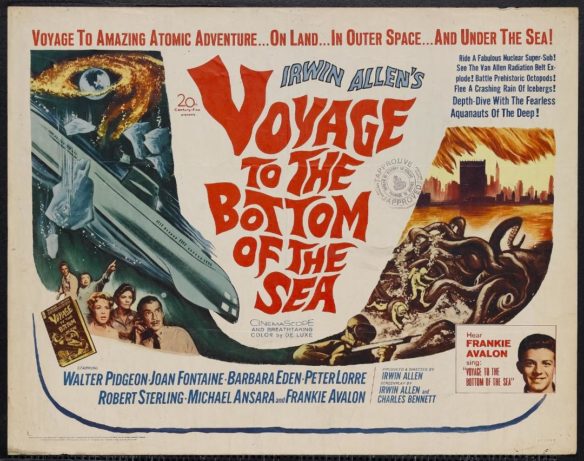
- July 12, 1961 — Voyage to the Bottom of the Sea premiered. It was produced and directed by Irwin Allen off the screenplay by him and Charles Bennett. It starred Walter Pidgeon and Robert Sterling with a supporting cast of Peter Lorre, Joan Fontaine, Barbara Eden, Michael Ansara, and Frankie Avalon. It was produced for about one and a half million dollars, and certainly made its costs back at the box office. Critics weren’t terribly fond of it but audiences really liked as it made over eight million dollars over its summer and early autumn run. Audience reviewers at Rotten Tomatoes currently give it an anemic 39% rating.
(7) TODAY’S BIRTHDAYS.
[Compiled by Cat Eldridge and John Hertz.]
- Born July 12, 1865 – Lucy Perkins. Best known as author of children’s books, e.g. Dutch Twins and two dozen sequels; sold 2 million copies all told. Illustrated Aesop, Anderson, Grimm, Robin Hood; here is her cover for Edith Harrison’s Moon Princess; here for Julia Brown’s Enchanted Peacock; here (line drawing and text) is her own “Queen of Spring”. (Died 1937) [JH]
- Born July 12, 1912 – Joseph Mugnaini. Thirty covers, twenty interiors, particularly for Bradbury. Here and here are two versions of his cover for Fahrenheit 451. Here is a Bradbury issue of The Magazine of Fantasy and Science Fiction. Here is an etching for The Martian Chronicles. Here is a cover for Hal Clement’s Mission of Gravity. Five artbooks. (Died 1992) [JH]
- Born July 12, 1923 — James Gunn, 97. Writer, editor, scholar, and anthologist. Winner at ConStellation of a Hugo for Best Related Work for Isaac Asimov: The Foundations of Science Fiction. His New Encyclopedia of Science Fiction Is quite excellent from an historical context now. I’ve not read his SF novel, The Immortals, so would be interested in knowing how it is. And let’s not overlook The Road to Science Fiction, his series of rather excellent anthologies covering all of SF. (CE)
- Born July 12, 1933 — Donald E. Westlake. Though he specialized in crime fiction, he did dip into the genre on occasion such as with Transylvania Station which you think as a Clue-style novel he wrote with his wife Abby. On the horror end of things was Anarchaos. And he wrote a lot of genre short fiction, some fifty pieces by my count. (Died 2008.) (CE)
- Born July 12, 1939 – Mike Hodel. Host for a decade and a half of Hour 25 on radio, locally on Station KPFK. Harlan Ellison, who succeeded him for a year, called it “a forum for writers and fans, publishers and readers…. he brought serious thinkers and noble madmen to the microphone”, Angry Candy p. xxi (1988). Two short stories in Fantasy Book. Reviews in Transmissions and Weird Tales. Interviewed Philip K. Dick in The Missouri Review (note Vincent Di Fate cover). (Died 1986) [JH]
- Born July 12, 1944 – Helene Flanders. Vancouver, British Columbia, fan. Edited the club’s BCSFAzine issues 57 (March 1978) to 71 (May 1979). Fancyclopedia 3 says she was found murdered in her apartment, augh. (Died 1982) [JH]
- Born July 12, 1947 – Hiroshi Amata, 73. Author, critic; translator particularly of classic fantasy, The Ship of Ishtar, The Night Land; student of natural history (Birds of the World and Fish of the World, collections of 19th Century paintings, have been translated into English). Two dozen books. So far his 12-volume Tales of the Imperial Capital, Tokyo from an occultist perspective, has not been done in English; 5 million copies sold in Japan; here is a cover for Vol. 2 by Yoshitaka Amano, Artist Guest of Honor at the 65th Worldcon. [JH]
- Born July 12, 1947 — Carl Lundgren, 73. He co-founded ASFA (Association of Science Fiction & Fantasy Artists of America), and won 4 Chesleys, including Artistic Achievement. At the tender age of eighteen, he was co-chairman of the first media SF convention, The Detroit Triple Fan Fair which featured comics, movies and various things of a SF nature. At Chicon IV, he was nominated for Best Professional Artist but lost out to Michael Whelan. (CE)
- Born July 12, 1961 — Scott Nimerfro. He had an impressive production list of genre films and series, to wit Tales From The Crypt, Trekkies, X-Men, Perversions Of Science, The Gates, Pushing Daisies, and the Once Upon A Time series which he produced three seasons of. He has one genre acting credit in “Let the Punishment Fit the Crime“ story of Tales From The Crypt in which he was Fouser. (Died 2016.) (CE)
- Born July 12, 1968 — Sara Griffiths, 52. She appeared as Ray in the Seventh Doctor story “Delta and the Bannermen”. She was being considered as a companion to the Doctor, a role however taken by Sophie Aldred as Ace. (CE)
- Born July 12, 1971 – Michelle Welch, 49. Five novels and a collection of flash fiction introducing her Gbahn characters; four novels of elementals (one each) under another name. Editor of two podcast anthologies. Collects stringed instruments, which she sometimes plays. Still working on a Big Fat Historical Fantasy set during the English Civil War; last year’s NaNoWriMo (nat’l novel writing month) helped some. Website here. [JH]
- Born July 12, 1976 — Gwenda Bond, 44. Writer, critic, editor. She’s written a prequel to the Stranger Things series, Suspicious Minds, and I’m very fond of the two novels (The Lost Legacy and The Sphinx’s Secret) so far in her Supernormal Sleuthing Service which she wrote with her husband Christopher Rowe. And she penned the Dear Aunt Gwenda section of Lady Churchill’s Rosebud Wristlet that Small Beer Press published in the early part of this millennium. (CE)
(8) COMICS SECTION.
- Saturday Morning Breakfast Cereal’s ”Teleporter” — Is it a joke?
- Non Sequitur gets nostalgic.
(9) IS ANYBODY THERE? DOES ANYBODY CARE? Connie Willis draws parallels to the present day in “Independence Day And 1776 (The Movie)”.
… Not only is America in dire straits–“I do believe you’ve laid a curse on North America,” John Adams says, “a second flood, a simple famine, plagues of locusts everywhere,”–they’re dealing with many of the same problems we are right now.
They’re plagued with diseases (“The children all have dysentery, and little Tom keeps turning blue,” Abigail says. “Little Abbey has the measles, and I’m coming down with flu…they say we may get smallpox”) and shortages (sewing pins and saltpeter instead of toilet paper and PPE.)
There are lines that could have been spoken today, like Benjamin Franklin’s saying, “Never has a nation been more recklessly mismanaged,” and there are parallels in the people. We have Ruth Bader Ginsburg, whose health we’re praying for, and they had Caesar Rodney, a Congressman from Delaware who was dragged back to Congress from his deathbed to provide a deciding vote.
In 1776, they’re also dealing with critical issues of what they want their country to be and issues of racial justice that are threatening to tear the country apart and may even stop America from being born: “Now you’re calling our black slaves Americans?” the delegate from North Carolina asks John Adams, and Adams replies, “They’re people and they’re here. If there’s any other requirement, I never heard it.”
“They are not people,” North Carolina says. “They are property.”
“No, sir,” Jefferson says, “they are people who are being treated as property.”And here we are, 244 years later, having that same conversation. On the Fourth two people painted over a “Black Lives Matter” sign on a street, proclaiming, “The narrative of police brutality, the narrative of oppression, the narrative of racism, it’s a lie,” and two days ago when Joe Biden said in his Fourth of July message that all people are created equal, the spokesman for the Republican Party accused him of trying to destroy the Declaration of Independence. “It says ‘All MEN are created equal,’” she said huffily….
(10) DOOM PATROL! [Item by Daniel Dern.] Five episodes in (out of a listed nine), Season Two of DC’s live-action Doom Patrol is (for me) one of the best comics-based TV series ever, with plot and character elements spanning the source comic series’ decades and creators. This season we’ve had (more) episodes including both Flex Mentallo and Danny The Street.
The show will make more sense if you’ve seen the first season.
If you want to be frugal, and can shim in modest binging, wait until Season 2 Episode 9 comes out — new episodes drop each Thursday, so, mmm, (according to IMDB), August 6, and try the DCUniverse 1-week free trial, or a month for $7.99, or HBO Max, a free week or a $14.99 month.
Note: DCUniverse is available via the web, and as an Android and iOS app. I watched DP Season 1 on my iPad; having (finally) added the app to my Amazon Fire Stick, I’ve been watching Season 2 on the TV — even more fun!
(11) MY MOUNT TBR HAS A PECULIAR PERIL. [Item by Daniel Dern.] The first few paragraphs of Laird Hunt’s review of Jeff Vandermeer’s A Peculiar Peril — “Jeff VanderMeer’s Young Adult Novel Is a Madcap Magical Mash-Up” – (if you can’t get to it, here’s Ian Mond’s review from Locus Online) were so compelling that I stopped reading the review … and have online-reserved a copy from my local public library, which, thankfully, re-opened about two weeks ago for by-appointment contactless pick-ups of reserve requests. (Items are in paper bags. Yes, brown, but not delivered in the dead of night 🙂
Picture a 200-foot-long death machine built to crush everything in its path — powered by pulped earthworms, defended by demi-mages and captained by the gently stoned 19th-century French novelist Jules Verne — and you will have glimpsed just the tiniest portion of the madcap magical mash-up that is Jeff VanderMeer’s first full-throated sally into epic young adult fiction, for readers 12 and up. Overuse has made combinatory comparisons risible, but VanderMeer’s highly allusive maximalist tome requires them. So: “A Peculiar Peril” is equal parts “The Lion, the Witch and the Wardrobe,” “Harry Potter and the Order of the Phoenix,” “Jonathan Strange & Mr. Norrell,” Matt Groening’s “Futurama,” “Mary Poppins” (or is it “Chitty Chitty Bang Bang”?), “Curse of Chucky,” “Alice in Wonderland” and David Lynch’s hallucinatory adaptation of “Dune.”…
(12) DOLITTLE DOES ENOUGH. [Item by Daniel Dern.] Between advance reviews and the “has dragon” reveal, I declined to pay’n’go to see the recent (Dr.) Dolittle live-action (well, presumably lotsa CGI and other animation) movie (with Robert Downey Jr as the good doctor, Tom Holland voicing Jip the Dog, Emma Thompson voicing Polynesia the parrot, along with other well-known names), but this was one of the first items on my library reserve list to make it to my brown paper bag pickup, and, having watched it, I enjoyed it enough that I don’t regret it, but don’t feel that if you haven’t yet seen it, you need to.
I like that this was not done as an “origin” movie. I liked the Rube Goldberg steampunk gadgetry (or should that be steampunk Rube Goldberg gadgetry) and various other flourishes. The dragon was legitimized as a plot element, but (thankfully) didn’t go all Game-of-Thrones-firestormy. And could easily enough been something other or less than a dragon. At least they didn’t try to shimmy in some dragon-with-the-flagon patter, although perhaps that would have been a nice touch, although, admittedly, lost or going right by 99% of the audience. (Here, perhaps only past a modest 25%?)
(13) BIRDS DO IT, BEES DO IT. Even things with chitin do it: “What Lobsters And Ants Can Teach Us About Social Distancing”.
Ants do it. Lobsters do it. Even equatorial mandrills do it. Why don’t many Americans do it: Wear masks and keep a wise social distance from each other?
Scientific American reports this week how several animals seem to know how to take precautions and keep their distance so they’re less likely to be infected by a peer.
Spiny lobsters, for example — and really, aren’t they all? — can apparently sniff out infection in the urine of another lobster, and don’t get too close to them.
University of Florida researchers discovered this when a virus spread among spiny lobsters in the Florida Keys. As Dana M. Hawley and Julia C. Buck write in Scientific American, “Despite how unnatural it may feel to us, social distancing is very much a part of the natural world.”
A 2018 study at the University of Bristol found that when ant colonies are exposed to a virus, ants keep their distance. Forager ants, who are out and about to scrounge up plant saps and insect eggs, stay outside of the colony, so they don’t risk infecting the queen ant and her nurses. Reproduction can safely proceed.
(14) FAN ART ASSESSMENT. “Exploring the Hugo Awards: The 2020 Finalists for Best Fan Artist” by Constanze Hofmann on the Glasgow in 2024 website.
Fandom is generous, and that includes its artists. The Fan categories of the Hugo Awards celebrate the generosity that goes along with an incredible amount of work, just for the fun of it. In the past, I haven’t looked closely at the Fan categories, because who has time to look at everything? Turns out I’ve missed a lot of interesting things, so this year I’m making sure to look at those often-overlooked categories and cast my vote…
[Thanks to Cat Eldridge, Andrew Porter, JJ, Daniel Dern, John Hertz, Michael Toman, Chip Hitchcock, Martin Morse Wooster, John King Tarpinian, Lise Andreasen, and Mike Kennedy for some of these stories. Title credit goes to File 770 contributing editor of the day Kip W.]