Jiang Bo also mentioned on Weibo that he’d been interviewed by a TV station in Chengdu, but I’ve not come across any online copy of it.
Robert J. Sawyer speaking at Shanghai bookshop
Per his Facebook, post-Worldcon Robert J. Sawyer embarked on a short signing tour of China. From Bilibili, here’s a short clip from an event at a Shanghai bookshop, where the aforementioned Hugo finalist Jiang Bo also spoke.
Con reports and commentary
(All of the following quotes/extracts are via Google Translate, with minor manual edits.)
In fact, I think this science fiction conference is very similar to Chinese society at this moment, really. Officials are trying to use high-tech digitization and high costs and manpower to create a beautiful, orderly, lively and technologically advanced conference that can bring business benefits and long-term development. However, when it is actually held, various unexpected events and problems will always occur…
But can I put it it? My thoughts are very similar to those of many science fiction writers. No matter how many shortcomings this World Science Fiction Convention has, and how many things are worthy of repeated complaints, after it is over, you will still feel like it was a grand and fantastical event when you think about it again. It’s a sweet dream that you still want to relive over and over again. You still hope that China will have the opportunity to do it again, and you firmly believe that it will be better than this time next time.
(Including La Zi [aka Hugo finalist Latssep], who complained to me during the convention that he was too tired and never wants to hold it again. I believe he must be thinking about this convention again and again. Of course, I also believe that he will not want to be an organizer next time it is held. He just wants to be a guest.)
SF Light Year’s Weibo posts, covered in detail in yesterday’s Scroll, prompted a number of replies, including:
In a “quote tweet”, Baoshu, writer of a Three-Body Problem sequel, and also translator of Olaf Stapledon’s Star Maker, talked about the hotel situation
In fact, if you can’t [get all con attendees] in one hotel, it’s normal to split it between several hotels. You would need to split it up anywhere. But the problem was the location. There was only one hotel nearby, and the others were seven or eight kilometers away. The round-trip time difference was one hour.
It is reasonable to say that as this was the first time to hold this convention, so some problems were inevitable, but the problems were so deep that they are indeed a little more than “inevitable”… [laughing and crying emoji]
As one of the finalists for this year’s Hugo Awards I did not receive any active invitation from the organizers until September 21st this year, after I had asked the relevant people for help to inform the organizers.
When I came back from Chengdu on the 22nd, I went directly from the airport to my workplace, and stayed in the office. I took my first bath in six days today. When the hot water soaked my body, I felt that I was alive. I couldn’t help but be pleasantly surprised. This past week has been intense, even thrilling. And I also had a premonition that I didn’t dare to go home. As a science fiction writer, I see history happening in the future, and as a journalist, I witness history happening now. Here lies the humbleness of human beings and the fragility of life. Reading Jiang Bo’s new work “Sky Sail” and Mo Xiong’s new work “Sequence of Destiny”, I lament the mystery of the universe and the elusiveness of the truth. Last night I dreamed that the science fiction convention was held again, and I gave a speech at the opening ceremony, but I couldn’t remember the content. After waking up, I couldn’t tell which one was more science fictional, reality or science fiction.
Han Song and RiverFlow at the opening ceremony, photo from RiverFlow’s con report
The Puppies controversy mentioned in a news item about the Hugos
A Chinese-language video compiling a variety of news stories posted to Weibo on Saturday 28th included as its final item a piece on the Hugos (from around 10:00 onwards). It initially covers Hai Ya, but goes on to talk about Cixin Liu’s win for The Three-Body Problem, and then the background with the Sad and Rabid Puppies, and Marko Kloos recusing himself, opening up a slot for Three-Body Problem to become a Hugo finalist and then a winner.
An evil pizzeria mascot, Freddy Fazbear, became a surprise box office sensation over the weekend, reinforcing a message that moviegoers have been sending to Hollywood all year: Give us something new.
“Five Nights at Freddy’s” sold an estimated $78 million in tickets at theaters in the United States and Canada from Thursday night to Sunday — a total that prompted double-takes in Hollywood because the movie did not play exclusively in theaters. “Five Nights at Freddy’s,” which was based on a popular horror-survival video game, also arrived on the Peacock streaming service on Thursday.
“This is more confirmation that moviegoers are looking for something new or, to be precise, getting the chance to see something they love already appear in a movie theater for the first time,” said Bruce Nash, founder of the Numbers, a box office tracking and analytics site.
In contrast, “The Exorcist: Believer,” an effort to revive a 50-year-old horror franchise, flopped in exclusive release in theaters earlier this month, collecting just $26.5 million over its first three days….
Nautilus tells the origin story of Captain Nemo: an Indian Prince robbed of his birthright and family, a prisoner of the East India Mercantile Company and a man bent on revenge against the forces that have taken everything from him….
…Among her ardent fans, though, she remains revered as the Queen of Regency Romance, a subgenre she essentially created and popularized. Her intricately researched historical narratives are still widely read nearly 50 years after her death; Julia Quinn, whose Regency romance series “Bridgerton” spawned the hit Netflix series, called her “the original.”
To date, Heyer’s books have sold around 20 million copies. But some readers have questioned her enduring popularity in light of offensive ethnic and antisemitic stereotypes that occasionally appeared in her work.
Most troubling to readers is her 1950 Regency romance “The Grand Sophy.” In a pivotal scene, the novel’s heroine confronts a greedy, villainous moneylender named Goldhanger, who is described as a “swarthy individual, with long, greasy curls, a semitic nose, and an ingratiating leer.”
“It’s not a stray comment, it’s a whole antisemitic scene,” said the romance novelist Cat Sebastian, who has read all of Heyer’s romances. “If I recommend her books, it’s with a lot of caveats.”
When Heyer’s American publisher, Sourcebooks, decided to release new editions of her romances this year, they had to strike a precarious balance. Leaving the original scene could repel some readers. But changing it risked provoking a backlash from fans and scholars who see posthumous revisions as a form of literary reputation laundering, or censorship.
After a lengthy back and forth with the Heyer estate, Sourcebooks made small but significant changes to “The Grand Sophy.” In the new version, the moneylender’s name has been changed to Grimpstone. References to his Jewish identity and appearance have been deleted, along with other negative generalizations about Jews.
Acknowledgment of the changes appears on the copyright page, which says “this edition has been edited from the original with permission of the Georgette Heyer Estate.”…
…Today, worries about an attack from the sky reach beyond fiction. No less than physicist Stephen Hawking has warned against humans advertising our presence in the cosmos because our messages could alert hostile beings. The U.S. government now takes seriously reports of UFOs or, in current parlance, “unidentified anomalous phenomena.” (In a twist, some say that if sightings of fast-moving, physics-defying objects are real, the best case would be that they are extraterrestrial. If not, it means other governments have technology America does not.)
Since “The War of the Worlds,” we’ve taken extraterrestrial hostility for granted. We didn’t always.
Wells wrote at the tail end of what was called the “plurality of worlds” debate. Once Galileo showed that Earth’s moon was a physical place and that Jupiter had multiple moons, a theological and philosophical question emerged: Would God waste other worlds by leaving them empty of life? The answer then was probably not. Instead, the expectation was that they’d be populated by beings more intelligent and more rational than Earthlings. There were utopias in the sky! Secular angels!
Wells turned that assumption on its head and used it to convey harsh truths about colonialism and to illustrate fears of war. “The War of the Worlds” explicitly referenced how European colonists waged a near-genocidal campaign against the Indigenous inhabitants of Tasmania. The story also played off worries that a belligerent Germany, even in the late 19th century, could invade England….
President Biden will issue an executive order on Monday outlining the federal government’s first regulations on artificial intelligence systems. They include requirements that the most advanced A.I. products be tested to assure that they cannot be used to produce biological or nuclear weapons, with the findings from those tests reported to the federal government.
The testing requirements are a small but central part of what Mr. Biden, in a speech scheduled for Monday afternoon, is expected to describe as the most sweeping government action to protect Americans from the potential risks brought by the huge leaps in A.I. over the past several years.
The regulations will include recommendations, but not requirements, that photos, videos and audio developed by such systems be watermarked to make clear that they were created by A.I. That reflects a rising fear that A.I. will make it far easier to create “deep fakes” and convincing disinformation, especially as the 2024 presidential campaign accelerates….
A “Fourth Wing” TV show based on Rebecca Yarros’ best-selling fantasy book series is in the works at Amazon MGM Studios.
Amazon and Michael B. Jordan’s Outlier Society, which has an overall deal with the studio, have acquired the rights to not only “Fourth Wing,” but its follow-up “Iron Flame,” which will be released Nov. 7, and the three remaining planned books in Yarros’ “Fourth Wing”-universe, “The Empyrean” book series, from Entangled Publishing….
(8) HIROAKI IKE DIES. Translator Hiroaki Ike passed away on October 27, 2023 the Science Fiction Writers of Japan announced today.
…He was 83 years old. The genres are wide-ranging, and in science fiction, works such as J.P. Hogan’s “Star of the Giants” series (Tokyo Sogensha) and Carl Sagan’s “Contact” (Shincho Bunko) (starting with “Heir to the Stars”) It is known for.
(9) TODAY’S BIRTHDAYS.
[Compiled by Cat Eldridge.]
Born October 30, 1896 — Ruth Gordon. You’ll likely best remember her as Minnie Castevet in Rosemary’s Baby. (Trust me, you don’t need to see Look What’s Happened to Rosemary’s Baby.) She’s quite excellent as Cecilia Weiss in The Great Houdini, and that pretty much sums up her genre work save Voyage of the Rock Aliens which keeps giving me giggles. Serious giggles. (Died 1985.)
Born October 30, 1923 — William Campbell. In “The Squire of Gothos” on Trek — a proper Halloween episode even if it wasn’t broadcast then — he was Trelane, and in “The Trouble With Tribbles” he played the Klingon Koloth, a role revisited on Deep Space Nine in “Blood Oath”. He appeared in several horror films including Blood Bath, Night of Evil, and Dementia 13. He started a fan convention which ran for several years, Fantasticon, which celebrated the achievements of production staffers in genre films and TV shows and raised funds for the Motion Picture & Television Fund, a charitable organization which provides assistance and care to those in the motion picture industry with limited or no resources, when struck with infirmity and/or in retirement age. (Died 2011.)
Born October 30, 1939 — Grace Slick, 84. Initially performing with the Great Society, Slick achieved fame as the lead singer and front woman of Jefferson Airplane and then with Jefferson. “Hyperdrive” off their Dragonfly album was used at the MidAmeriCon opening ceremonies. And Blows Against the Empire was nominated for Best Dramatic Presentation at Noreascon 1, a year that had no winner.
Born October 30, 1947 — Tim Kirk, 76. His senior thesis would be mostly published by Ballantine Books as the 1975 Tolkien Calendar. Impressive. Even more impressive, he won Hugo Awards for Best Fan Artist at Heicon ’70, L.A. Con I, Torcon II, Discon II and again at MidAmeriCon. With Ken Keller, he co-designed the first cold-cast resin base used at MidAmeriCon. He also won a Balrog and was nominated for a World Fantasy Award as well.
Born October 30, 1951 — Harry Hamlin, 72. His first role of genre interest was Perseus on Clash of The Titans. He plays himself in Maxie, and briefly shows up in Harper’s Island. He also has two choice voice roles in Batman: the Animated Series, Cameron Kaiser in “Joker’s Wild” and even more impressive as the voice of werewolf Anthony “Tony” Romulus in “Moon of the Wolf”. Since I know a lot of you like the series, I’ll note he plays Aaron Echolls in Veronica Mars. It isn’t genre, is it?
Born October 30, 1951 — P. Craig Russell, 71. Illustrator whose work has won multiple Harvey and Eisner Awards. His work on Killraven, a future version of H. G. Wells’ The War of the Worlds, collaborating with writer Don McGregor, was lauded by readers and critics alike. (Yes, that a page from it below.) Next up was mainstream work at DC with I think his work on Batman, particularly with Jim Starlin. He also inked Mike Mignola’s pencils on the Phantom Stranger series. He would segue into working on several Moorcock’s Elric of Melniboné projects. Worth noting is his work on a number of Gaiman projects including a Coraline graphic novel. Wayne Alan Harold Productions published the P. Craig Russell Sketchbook Archives, a 250+-page hardcover art book featuring the best of his personal sketchbooks.
Born October 30, 1958 — Max McCoy, 65. Here for a quartet of novels (Indiana Jones and the Secret of the Sphinx, Indiana Jones and the Hollow Earth, Indiana Jones and the Dinosaur Eggs and Indiana Jones and the Philosopher’s Stone) which flesh out the back story and immerse him in a pulp reality. He’s also writing Wylde’s West, a paranormal mystery series.
Born October 30, 1972 — Jessica Hynes, 51. Playing Joan Redfern, she shows up on two of the very best Tenth Doctor stories, “Human Nuture” and “The Family of Blood”. She’d play another character, Verity Newman in a meeting of the Tenth and Eleventh Doctors, “The End of Time, Part Two”. Her other genre role was as Felia Siderova on Randall & Hopkirk (Deceased) in the “Mental Apparition Disorder” and “Drop Dead” episodes. Her last genre adjacent role is Sofie Dahl in Roald & Beatrix: The Tail of the Curious Mouse.
(10) A MEETING OF MANLY MEN. Bill Higgins told X readers: “Perhaps the night before Halloween is a good time to retweet the story of The Weirdest Thing That Happened To Me At The American Library Association Conference. A bit spooky, but it has a very happy ending.” The thread starts here.
I mean, if there are Appalachian Folk Monsters, surely there are also benign Appalachian entities as well.
Might one of them, though far from home, reached out to influence our paths?
21/n
— Bill Higgins— Beam Jockey (@MrBeamJockey) June 28, 2023
Does this sound familiar? Mid-October, buy Halloween candy. Mid-October, begin eating Halloween candy. October 30, buy more Halloween candy. The holiday is now a multibillion-dollar industry, but Halloween traces its roots back about 2,000 years to the Irish countryside and a spiritual celebration known as Samhain. So how did Halloween get so commercial? We turn to the hosts of NPR’s history podcast, Throughline, Rund Abdelfatah and Ramtin Arablouei.
RAMTIN ARABLOUEI, BYLINE: Halloween in early 20th-century America was a holiday just for kids, a night all about mischief and pranks.
LISA MORTON: These pranks are perpetrated mainly by young boys. And the pranks start kind of innocent.
RUND ABDELFATAH, HOST:
That’s Lisa Morton, author of three books on the history of Halloween….
…Once Lugosi was 18 years old (in 1900) he knew he was going to pursue a life in the arts. He began his stage work in the early 1900s and found steady work traveling theater companies. This gave him opportunities to take part in plays, operas, and operettas.
But it was in 1913 that he caught his big break at the Budapest-based National Theater of Hungary. The company cast him in over 30 of their shows, in which he played parts like Rosencrantz in Hamlet and Sir Walter Herbert in Richard III. This humble beginning would later take the actor on much bigger career paths….
[Thanks to Mike Kennedy, Andrew Porter, Ersatz Culture, John King Tarpinian, Chris Barkley, Cat Eldridge, and SF Concatenation’s Jonathan Cowie for some of these stories. Title credit belongs to File 770 contributing editor of the day Daniel Dern.]
The Dungeons & Dragons role-playing game franchise says it won’t allow artists to use artificial intelligence technology to draw its cast of sorcerers, druids and other characters and scenery.
D&D art is supposed to be fanciful. But at least one ax-wielding giant seemed too weird for some fans, leading them to take to social media to question if it was human-made.
Hasbro-owned D&D Beyond, which makes online tools and other companion content for the franchise, said it didn’t know until Saturday that an illustrator it has worked with for nearly a decade used AI to create commissioned artwork for an upcoming book. The franchise, run by the Hasbro subsidiary Wizards of the Coast, said in a statement that it has talked to that artist and is clarifying its rules.
“He will not use AI for Wizards’ work moving forward,” said a post from D&D Beyond’s account on X, formerly Twitter. “We are revising our process and updating our artist guidelines to make clear that artists must refrain from using AI art generation as part of their art creation process for developing D&D.”…
(2) WALK RIGHT IN, FALL RIGHT DOWN. Cora Buhlert’s new Masters-of-the-Universe-Piece Theatre story is “The Uninvited Guest”.
YouTube trumps TikTok as the most popular online platform for young people to discover new books, according to a report by Nielsen BookData.
Nielsen, which provides data for the Bookseller’s UK Bestsellers chart, conducted a survey in November 2022 that revealed 34% of people aged between 14 and 25 find new reads using the video platform YouTube.
TikTok and Instagram were used by 32% and 27% of participants respectively, and online book retailer websites were visited by 33% of respondents. This data comes after reports that “BookTok” – the corner of TikTok in which creators share book recommendations – is driving sales of particular authors and genres that are popular on the platform. Its YouTube counterpart, BookTube, similarly features videos of users discussing their favourite titles and “hauls” of books they have recently bought….
(4) BEST EVER. ScreenRant picked the “10 Greatest Anthology TV Shows Of All Time, Ranked” and despite the list not being restricted to genre, there are seven sff and horror shows on it. The Twilight Zone is ranked number one.
Although most television series follow a single story over the course of several seasons, there are some shows called anthologies that change up the plot from episode to episode or season to season, and these can be some of the most successful series to date. Anthologies may not be the most popular form of television, but they certainly stand out for their distinct format and ever-changing stories. In fact, some of the most popular and lauded television series from the past to now are anthology series.
The following list offers ten of the best anthology television series to ever appear on-screen. This is a particularly diverse bunch of shows that range in release date, genre, and form. Though they each have the anthology structure in common, each show offers their own unique take on the concept, and more than that, their own important story. Whether it’s a silly comedy, a gruesome horror, or peek into true crime, each of these anthology series is popular in its own right and for good reason. For those interested in diving into anthologies, this is the ultimate place to start.
Working for the BBC in the early 70s, I made a Junior Points of View episode in which kids said they thought most BBC children’s programmes were patronising rubbish. Soon after I was at a get-together for TV people where Monica Sims, the head of BBC children’s programmes, challenged me to do better. I said: “Give me a time slot and budget, and I will.” Lewis Rudd, the Independent Television equivalent, overheard and asked: “Did you mean that?”
We had lunch and he said: “We need an answer to Doctor Who.” Twenty years earlier, I’d been enrolled at a boarding school full of German kids. We were all the best of friends, and knowing that only seven or eight years earlier our fathers would have been trying to kill each other in the second world war made me think that we must be the next stage of human evolution. That was the inspiration for the idea I pitched to Lewis – kids who had special powers, but who were unable to use them to kill or do harm.
These “Tomorrow People” were telepathic and telekinetic, and could teleport or “jaunt” from one place to another via hyperspace. They became aware of their abilities after “breaking out” – deliberate shorthand for puberty. I wanted kids watching at home to feel that they too might be a Tomorrow Person, and that it was OK to feel different….
Nicholas Young, played John
…Some of the spacecraft looked quite good even though they were built out of plastic cups from the canteen painted silver. But the aliens were often ridiculous. It’s difficult to act with a straight face against a puppet with an aerial on its head or something that looked like a Dalek on Viagra.
In the early days, when Tomorrow People were seen floating in hyperspace, we’d be standing on one foot in front of a yellow screen – then the yellow would be electronically overlaid with a star field or psychedelic effects. Later, we were hung on wires which could clearly be seen on TV. We looked like Thunderbirds puppets. I said: “Why don’t you paint the wires yellow?” Someone covered them with yellow gaffer tape and bingo! They disappeared….
(6) BOARDGAME OF THE YEAR. [Item by Cora Buhlert.] Spiel des Jahres (Boardgame of the Year) is a huge deal in the boardgame world and the 2023 winners were just announced.
The 2023 Spiel des Jahres is Dorfromantik: Das Brettspiel (Romantic village: The boardgame) by Lukas Zach and Michael Palm, published by Pegasus Spiele.
The 2023 Kinderspiel des Jahres (Children’s Boardgame of the Year) is Mysterium Kids by Antonin Boccara and Yves Hirschfeld.
Radio Bremen interviews of one the winners, Lukas Zach who is a local. (They were not interested in interviewing Germany’s first ever Hugo winner, who also happens to be a local…)
(7) ROBERT OSBAND DIES. The American Space museum announced that long-time volunteer Robert “Ozzie” Osband, a fixture at Space View Park rocket launches for four decades, died August 6 at the age of 72.
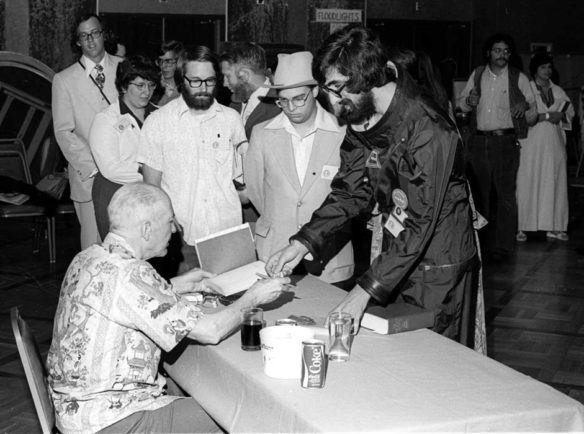
…In 1976, when one of his favorite authors, Robert A. Heinlein, was going to be Guest of Honor at a World Science Fiction Convention, Mr. Osband journeyed to Kansas City.
In his suitcase was his copy of Heinlein’s Have Space Suit, Will Travel—a novel about a teenager who wins a secondhand space suit in a contest—and his ILC Dover suit.
Because if you wanted to get your copy of Have Space Suit, Will Travel autographed, and you happened to own a secondhand space suit, it would be a shame NOT to wear it, right?…
(8) WILLIAM FRIEDKIN (1935-2023). [Item by Dann.] William Friedkin died August 7 of heart failure and pneumonia. He was 87. The director’s most noteworthy genre work was The Exorcist. Other works include an episode of The Alfred Hitchcock Hour, an episode of The Twilight Zone, an episode of Tales from the Crypt, and horror movies The Guardian and Bug. Friedkin also directed The French Connection for which he won an Oscar.
(9) TODAY’S BIRTHDAYS.
[Compiled by Cat Eldridge.]
Born August 7, 1933 — Jerry Pournelle, 1933 – 2017. Some years ago, I got an email from a J. R. Pournelle about an SF novel they wanted Green Man to review. I of course thought it was that Pournelle. No, it was his daughter, Jennifer. And that’s how I came to find out there was a third Motie novel called, errrr, Moties. It’s much better than The Gripping Hand was. His best novel is of course The Mote in God’s Eye which he wrote with Niven. And yes, I’ve read a lot of his military space opera when I was a lot younger. At that age, I liked it. I expect the Suck Fairy with her steel toe boots wouldn’t be kind to it now if I read any of it, so I won’t. He had a number of Hugo nominations starting at Torcon II for “The Mercenary” novella followed by a nomination at DisCon II for his “He Fell into a Dark Hole” novelette. The next year at the first Aussiecon, The Mote in God’s Eye got nominated and his Extreme Prejudice novel also got a nod. MidAmericaCon saw Inferno by him and Niven get nominated and his “Tinker” novelette also was on the ballot. Lucifer’s Hammer with Niven got on the ballot at IgunaCon II and his final nomination was at ConFederation for Footfall with Niven. Oh and at MidAmericaCon II, he got a nomination for Best Editor, Short Form. And yes, I was a devoted reader of his Byte column. (Died 2017.)
Born August 7, 1936 — Richard L. Tierney. A Lovecraftian scholar. Coauthored with David C. Smith, a series of Red Sonja novels which have Boris Vallejo cover art. Some of his standalone novels riff off the Cthulhu Mythos. Unless you read German like Cora does, he’s not available digitally on at the usual suspects. (Died 2022.)
Born August 7, 1957 — Paul Dini, 66. First, he is largely responsible for the existence of Batman: The Animated Series, Superman: The Animated Series, The New Batman/Superman Adventures, Batman Beyond, and yes Duck Dodgers And Tiny Toons as well. He’s recently been writing for the Ultimate Spider-Man series which is quite good. He co-authored with Pat Cadigan, Harley Quinn: Mad Love. He’s responsible for the single best animated Batman film, Batman Beyond: Return of the Joker, as he wrote it. If you see it, see the R rated version.
Born August 7, 1957 — Lis Carey, 66. A prolific reader whose reviews fill the shelves at Lis Carey’s Library. She is also a frequent Filer, contributor of numerous cat photos and even more book reviews. She is a longtime member of NESFA, and chaired Boskone 46 in 2009. (OGH)
Born August 7, 1960 — Melissa Scott, 63. I think the first work I read by her was Trouble and Her Friends which holds up well even now. I’m also fond of Night Sky Mine and The Jazz. I see that she has an entire series set in the Stargate Atlantis universe. She won the Astounding Award for Best New Writer, and four Lambda Awards, the first for Trouble and Her Friends, a second for Shadow Man, a third for Point of Dreams and a fourth for Death by Silver.
(10) COMICS SECTION.
Eek!shows an unexpected fan of a well known sff movie franchise.
Speed Bump is there when a librarian fields a controversial request.
(11) MASS QUANTITIES. The New York Times looks into “The Complicated Estates of Obsessive Collectors”. “When collectors die, their families face a lot of decisions, including what to do with a hundred Superman figurines.” Some familiar names quoted here.
“More times than I can remember, a spouse or child has said to me, ‘If he wasn’t dead, I’d kill him all over again for leaving me with this mess,’” said Greg Rohan, the president of Heritage Auctions.
Most people tend to know what to do with traditional investments after someone dies, he said, but when it comes to baseball cards, first-edition books, coins and other collectibles, the loved ones dealing with the estate can be stumped (and annoyed).
If some collectors of, say, vinyl figurines, seem to have a gene that spurs them to dedicate entire rooms of their home to inanimate rubbery friends, they are also, in many ways, just like everyone else. “People don’t want to think about dying,” said Maggie Thompson, 80, a former senior editor of Comic Buyer’s Guide, which was a newsmagazine that covered the comic book industry. “I realize as I look around my rooms, my family is not going to know what things are.”…
(12) FREE READ. Cora Buhlert has a story called “Rest My Weary Bones” in the July 2023 issue of Swords and Sorcery Magazine.
It seems I’ve barely rested at all when the call comes… again.
Rise and shine, sunshine. Time for battle, time for war, time to smite the enemy and hear the lamentations of their women… if I could still hear properly, that is. ‘Cause hearing doesn’t work very well, when you’re essentially a skeleton.
For that’s exactly what I am these days: A skeleton….
(13) IT’S IN THE BAG. Geek Grind Coffee is another outfit that tempts fans to buy its products on the strength of its clever and intriguing genre packaging. But that’s not the only recommendation:
…More than 600 women involved in the cooperative are leaders of their own farms, heads of households or in managegment with our organiztion. Geek Grind is strongly focused on promoting women in leadership, ownership and success in coffee. We do this because of the need….
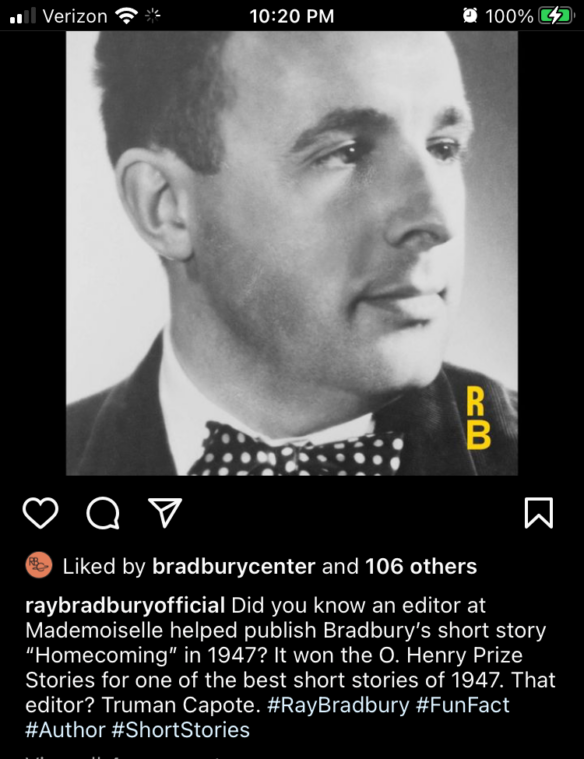
(14) TRIVIAL TRIVIA. [Item by John King Tarpinian.]
Truman Capote is at the same cemetery as Ray.
Non-genre trivia is that the crypt that Truman is in was originally for Johnny Carson. In his final years Truman Capote lived at the Malibu home of Joanne Carson who was one of Johnny’s ex-wives.
What if the original Star Trek was a comedy? Or, better yet, what if the intro for this comedy was set to the theme song to Friends? This intro re-imagines one of the world’s top science-fiction shows as one of the hottest comedies on television. Captain Kirk, Mr. Spock, and Dr. McCoy will always be there for you!
[Thanks to Chris Barkley, Michael Toman, Cat Eldridge, Daniel Dern, Dann, Peer, Bill Higgins, Cora Buhlert, SF Concatenation’s Jonathan Cowie, Mike Kennedy, Andrew Porter, and John King Tarpinian for some of these stories. Title credit belongs to File 770 contributing editor of the day Andrew (not Werdna).]
People writing about the issues they care about is what keeps this community going. It’s a gift and privilege for me to be continually allowed to publish so many entertaining posts rich in creativity, humor, and shared adventures. Thanks to all of you who contributed to File 770 in 2022!
Stormm continued her humorous series about the misdirected emails she gets from Writer X throughout 2022, braiding together comedy, horror, and the pitfalls of being a writer.
…Thinking about Jules Verne, with the new TV version of Around the World in Eighty Days about to start, I just bought the Wesleyan edition of Five Weeks in a Balloon, translated by Frederick Paul Walter – after researching what the good modern translations of Verne are. Verne has been abysmally translated into English over the years, but there’s been a push to correct that….
… It was on FaceBook where I first saw friends’ posting about Opening Ceremonies. According to what was posted, some of the musical selections performed by students from the Duke Ellington School spotlighted the religious aspects of the Christmas holiday.
My immediate reaction was that this was not an appropriate part of Opening Ceremonies, especially since, as far as I know, the religious aspect of the performance was not contained in the descriptions in any convention publication. The online description of Opening Ceremonies says, in its entirety: “Welcome to the convention. We will present the First Fandom and Big Heart awards, as well as remarks from the Chair.” The December 9, 2021, news release about the choir’s participation did not mention that there would be a religious component to the performance….
Whew! We made it. We made it to Issue 100 of the Grantville Gazette. This is an incredible feat by a large group of stakeholders. Thank you, everyone.
I don’t think Eric Flint had any idea what he’d created when he sent Jim Baen the manuscript for 1632. In the intervening two-plus decades, the book he intended to be a one-shot novel has grown like the marshmallow man in Ghostbusters to encompass books from two publishing houses, a magazine (this one, that you are holding in your metaphorical hands) and allowed over 165 new authors to see their first published story in print. The Ring of Fire Universe, or the 1632 Universe, has more than twelve million words published….
This message was written by a fan in Moscow 48 hours ago. It is unsigned but was relayed by a trustworthy source who confirms the writer is happy for it to be published by File 770. It’s a fan’s perspective, a voice we may not hear much….
Right now, when I’m sitting at my desktop and writing this text, a cannonade nearby doesn’t stop. The previous night was scary in Kyiv. Evidently, Russians are going to start demolishing Ukrainian capital like they are doing with Kharkiv, Sumy, Chernihiv, Mariupol.
The Ukrainian SFF Community joined the efforts to isolate Russia, the nazi-country of the 21st century, to force them to stop the war. The boycott by American authors we asked for is also doing the job. Many leading writers and artists of the great United States already joined the campaign.
We appealed to SFWA to also join the campaign, and here is what they replied…
Fortunately, comic-carrying newspapers are, of course, all (also or only) online these days, but even then, some require subscriptions (fair enough), and to get all the ones you want. For example, online, the Washington Post, has about 90, while the Boston Globe is just shy of a paltry one-score-and-ten. And (at least in Firefox), they don’t seem to be visible in all-on-one-page mode, much less customize-a-page-of.
So, for several years now, I’ve been going to the source — two “syndicates” that sell/redistribute many popular strips to newspapers….
There’s been a lot of excitement about Squid Game. Everybody’s talking about how clever, original, and utterly skiffy it is. I watched it, too, eagerly and faithfully. But I wasn’t as surprised by it as some. I expected it to be good. I’ve been watching Korean video for ten years, and have only grown more addicted every year. And yet I just can’t convince many people to watch it with me….
Let me tell you about my favorite building in Washington, D.C. It’s the staid old Arts and Industries Building, the second-oldest of all the Smithsonian Institution buildings, which dates back to the very early 1880s and owes its existence to the Smithsonian’s then urgent need for a place where parts of its collection could go on public display….
When we last left the Heinleins (“What the Heinleins Told the 1940 Census”), a woman answering the door at 8777 Lookout Mountain – Leslyn Heinlein, presumably — had just finished telling the 1940 census taker a breathtaking raft of misinformation. Including that her name was Sigred, her husband’s was Richard, that the couple had been born in Germany, and they had a young son named Rolf.
Ten years have passed since then, and the archives of the 1950 U.S. Census were opened to the public on April 1. There’s a new Mrs. Heinlein – Virginia. The 8777 Lookout Mountain house in L.A. has been sold. They’re living in Colorado Springs. What did the Heinleins tell the census taker this time?…
“In the future, there was a nuclear war. And because of all the radiation, cats developed the ability to shoot lasers out of their mouths.”
On this dubious premise, Laser Cats was founded. By its seventh and final episode, the great action stars and directors of the day had contributed their considerable talents to this highly entertaining, yet frankly ridiculous enterprise. From James Cameron to Lindsey Lohan, Josh Brolin to Steve Martin, Laser Cats attracted the best in the business.
Being part of Saturday Night Live undoubtedly helped….
The Emeka Walter Dinjos Memorial Award For Disability In Speculative Fiction aims to award disability in speculative fiction in two ways. One, by awarding a writer of speculative fiction for their representation or portrayal of disability in a world of speculative fiction, whatever their health status; and two, by awarding a disabled writer for a work of speculative fiction in general, whatever the focus of the work may be….
Robert Osband, Florida fan, really loves space. All his life he has been learning about spaceflight. And reading stories about spaceflight, in science fiction.
So after NASA’s Apollo program was over, the company that made Apollo space suits held a garage sale, and Ozzie showed up. He bought a “training liner” from ILC Dover, a coverall-like portion of a pressure suit, with rings at the wrists and neck to attach gloves and helmet.
And another time, in 1976, when one of his favorite authors, Robert A. Heinlein, was going to be Guest of Honor at a World Science Fiction Convention, Mr. Osband journeyed to Kansas City.
In his suitcase was his copy of Heinlein’s Have Space Suit, Will Travel—a novel about a teenager who wins a secondhand space suit in a contest—and his ILC Dover suit.
Because if you wanted to get your copy of Have Space Suit, Will Travel autographed, and you happened to own a secondhand space suit, it would be a shame NOT to wear it, right?…
… I’m sure that our first face-to-face meeting was in 1979, when my job in industry took me from Chattanooga all the way out to Los Angeles for some much-needed training in electrochemistry. I didn’t really know anybody in L.A. fandom back then but I did know the address of the LASFS clubhouse, so on my next-to-last evening in town I dropped in on a meeting. And it was there that I found Bruce mostly surrounded by other fans while they all expounded on fandom as it existed back then and what it might be like a few years down the road. It was like a jazz jam session, but all words and no music. I settled back into the periphery, enjoying all the back-and-forth, and when there eventually came a lull in the conversations I took the opportunity to introduce myself. And then Bruce said something to me that I found very surprising: “Dick Lynch! I’ve heard of you!”…
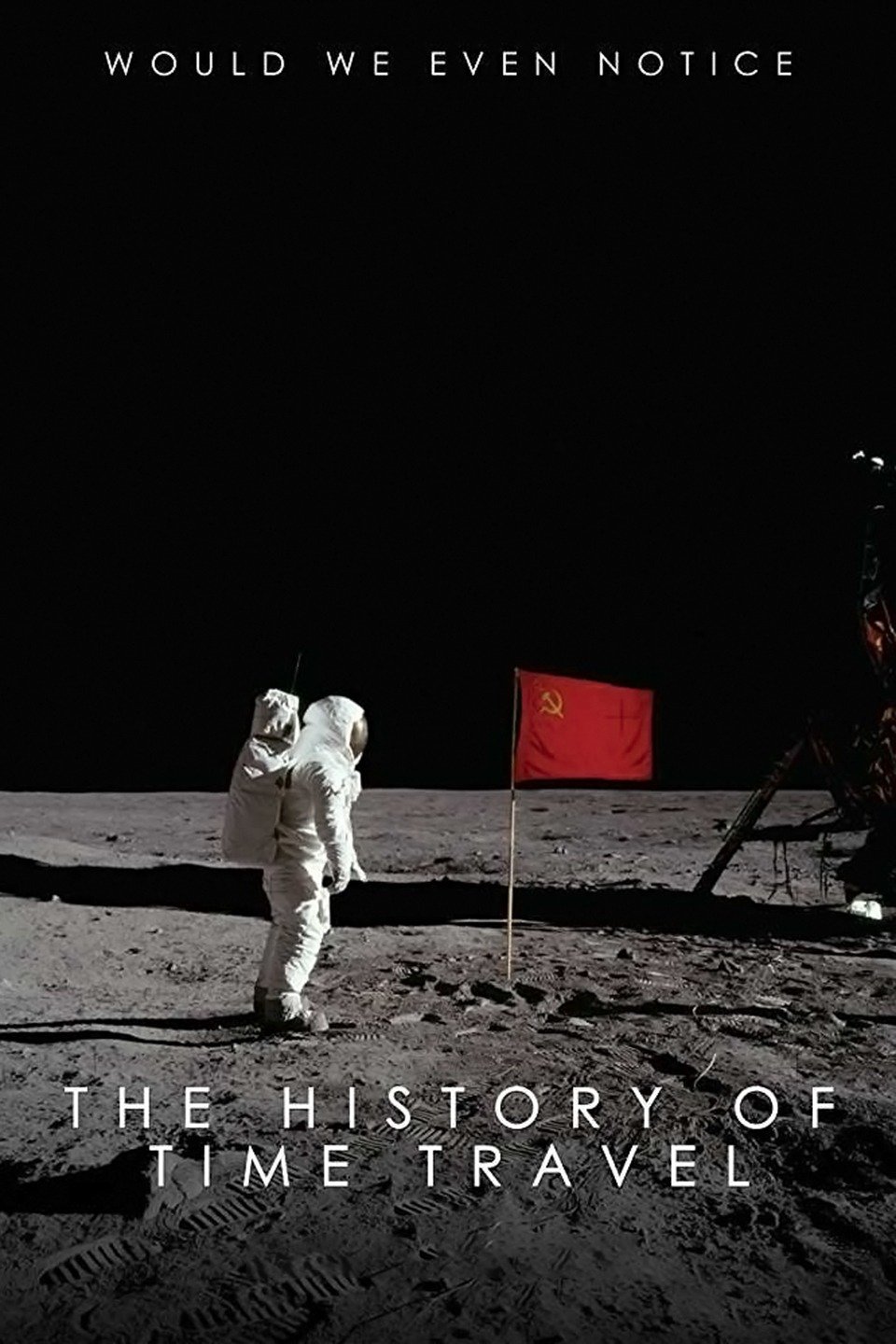
It was back in 2014 that a student filmmaker at Stephen F. Austin State University, Ricky Kennedy, created an extraordinary short movie titled The History of Time Travel. Exploration of “what ifs” is central to good storytelling in the science fiction genre and this little production is one of the better examples of how to do it the right way.
For a long time, I’ve felt the Short Form Hugo for Best Dramatic Presentation was not properly organized to give an award to the best “Television” SF of the previous year….
Lavie Tidhar’s Neom is a stunning return to his world of Central Station, twinning the fates of humans and robots alike at a futuristic city on the edge of the Red Sea….
… It is through Joy and Cassimer’s eyes we experience S.A. Tholin’s Iron Truth, a finalist of the Self-Published Science Fiction Competition. If there was ever a case of the cream rising to the top this book is one….
… A couple of odd things, though. He had $300 on him, that wasn’t stolen, and an unusual rosary, with what seems to be the wrong number of beads. It’s a puzzle….
In T. A. Bruno’s In the Orbit of Sirens, a Self-Published Science Fiction Competition finalist, the remnants of the human race have fled the solar system ahead of an alien culture that is assimilating everyone in reach. Loaded aboard a vast colony ship they’re headed for a distant refuge, prepared to pioneer a new world, but unprepared to meet new threats there to human survival that are as great as the ones they left behind.
On the morning of Carmen Grey’s sixth birthday an armed team arrives to take her from her parents and remove her to the underground facility where Clairvoyants — like her — are held captive and trained for years to access their abilities. So begins Monster of the Dark by K. T. Belt, a finalist in the Self-Published Science Fiction Competition….
G.M. Nair begins Duckett and Dyer: Dicks for Hire by making a surprising choice. His introductory scene explicitly reveals to readers the true nature of the mysterious events that the protagonists themselves uncover only very slowly throughout the first half of the book. The introduction might even be the penultimate scene in the book — which would make sense in a story that is partly about time travel loops. Good idea or bad idea?…
… What sounds like Firefly also describes the SPSFC finalist novel Captain Wu: Starship Nameless #1, a space opera by authors Patrice Fitzgerald and Jack Lyster. I love Firefly so it wasn’t a big leap to climb aboard this vessel….
…. It would be exceptionally embarrassing for a Worldcon to have to explain why a finalist would have won the Hugo except for — oops! — this bit of outdated fine print. The best course of action is to eliminate that fine print before such a circumstance arises….
The social media of the 30th century doesn’t seem so different: teenagers anonymously perform acts of civil disobedience and vandalism to score points and raise their ranking in an internet app. That’s where Aster Vale leads a secret life as the Wildflower, a street artist and tagger, in A Star Named Vega by Benjamin J. Roberts, a Self-Published Science Fiction competition finalist…..
R F Kuang’s Babel is an audacious and unrelenting look at colonialism, seen through the lens of an alternate 19th century Britain where translation is the key to magic. Kuang’s novel is as sharp and perceptive as it is well written, deep, and bears reflection upon, after reading, for today’s world….
Paul Weimer went to donate some books at Don Blyly’s new location for Uncle Hugo’s and Uncle Edgar’s bookstores. While he was inside Paul shot these photographs of the bookshelves being stocked and other work in progress.
… Another contributor to the Afrofuturist tradition is Nicole Mitchell, a noted avant-jazz composer and flutist. She chose to take on Octavia Butler’s most challenging works, the Xenogenesis Trilogy, and create the Xenogenesis Suite, a collection of dark and disturbing compositions that reflect the trilogy’s turbulent and complicated spirit….
Anna carefully arranged the necessary objects around her desktop computer into a pentagon: sharpened pencils, a legal pad, a half-empty coffee cup, and a copy of Science Without Sorcery, with the chair at the fifth point. This done, she intoned the spell that would open the channel to her muse for long enough to write the final pages of her work-in-progress. Then she could get ready for the convention….
… In the last five years, the [Hugo Awards Study Committee] [HASC] has changed precisely two words of the Constitution. (Since you asked: adding the words “or Comic” to the title of the “Best Graphic Story” category.) The HASC’s defenders will complain that we had two years of pandemic, and that the committee switched to Discord rather than email only this year, and that there are lots of proposals this year. But the fact remains that so far the practical impact has been slower than I imagined when I first proposed the Committee…..
In Michaele Jordan’s overview, she comments on the novellas by Aliette de Bodard, Becky Chambers, Alix E. Harrow, Seanan McGuire, Adrian Tchaikovsky, and Catherynne M. Valente that are up for the 2022 Hugo.
… Once we had a lot of science fiction, little fantasy; lately we’ve had a lot of fantasy; so Powers’ writing fantasy does not seem particularly defiant.
His fantasy has generally been — to use a word which may provoke defiance — rigorous. Supernatural phenomena occur, may be predicted, aroused, avoided, as meticulously — a word whose root means fear — as we in our world start an automobile engine or put up an umbrella. Some say this has made his writing distinctive….
The day of reckoning is here for E Pluribus Hugo. The change in the way Hugo Awards nominations are counted was passed in 2015 and ratified in 2016 to counter how Sad and Rabid Puppies’ slates dictated most of finalists on the Hugo ballots in those years. It came with a 2022 sunset clause attached, and E Pluribus Hugo must be re-ratified this year in order to remain part of the WSFS Constitution….
… His name is Joel Nydahl, and back about the time of that Chicon he was a 14-year-old neofan who lived with his parents on a farm near Marquette, Michigan. He was an avid science fiction reader and at some point in 1952 decided to publish a fanzine. It was a good one….
… Abigail Kamara, younger cousin of police constable and apprentice wizard Peter Grant, has been left largely unsupervised while he’s off in the sticks on a case. This leaves Abigail making her own decisions when she notices that kids roughly her age are disappearing–but not staying missing long enough for the police to care….
Friends, let me tell you about one of my favorite TV shows. But I must admit to you up front that it’s not SF/F. Extraordinary Attorney Woo is, as I assume you’ve deduced from the title, a lawyer show. But it’s a KOREAN lawyer show, which should indicate that is NOT run of the mill….
Joseph Campbell was a professor of literature at Sarah Lawrence College, and wrote extensively about comparative mythology. His “hero’s journey” theory has been extremely influential….
… The Phantom Empire, a twelve-chapter Mascot serial, was originally released in February, 1935. A strange concoction for a serial, it is at once science fiction film, a Western, and strangely enough, a musical. It was the first real science fiction sound serial and its popularity soon inspired other serials about fantastic worlds….
… I find myself explaining the changes to membership in the World Science Fiction Society (WSFS) and the conditions for attending the World Science Fiction Convention that were ratified this year in Chicago (and thus are now in effect, because this was the second vote on the changes)…
Chicon 8’s Chicago Worldcon Community Fund (CWCF) program offered both memberships and financial stipends. It was established with the goal of helping defray the expenses of attending Chicon 8 for the following groups of people:
Non-white fans or program participants • LGBTQIA+ fans or program participants • Local Chicago area fans of limited means…
The London Underground has ghosts. Well, the London Underground always has ghosts, but usually they’re gentle, sad creatures. Lately there’s been an outbreak of more aggressive ghosts….
As environmental problems caused by industrialisation and post-industrialisation continue to increase, the public is looking for ecological solutions. As pandemics, economic crises, and wars plague our society in different ways, thoughts turn to the good old times. But were they really all that good? People are escaping increasingly into fantastical stories in order to find a quantum of solace. But at what point was there a utopia in our society. If so, at what or whose cost did it exist? Whether or not we ever experience living in a utopia, the idea of finally finding one drives us to continue seeking ideal living conditions….
… Capclave appeared to be equally star-crossed in its next iteration. It was held over the weekend of October 18-20, 2002, and once again the attendees were brought closer together by an event taking place in the outside world. The word had spread quickly through all the Saturday night room parties: “There’s been another shooting.” Another victim of the D.C. Sniper….
… In Fairy Tale, his newest novel, Stephen King delivers a, cough, grimm contemporary story, explicitly incorporating horror in the, cough, spirit of Lovecraft (King also explicitly namedrops, in the text, August Derleth, and Henry Kuttner), in which high-schooler Charlie Reade becomes involved in things — and challenges — that, as the book and plot progress, stray beyond the mundane….
The idea of an anthology of science fiction and fantasy stories about the Beatles seems like a natural. I’ve been told the two editors, each unbeknownst to the other, both presented the idea to the publisher around the same time…
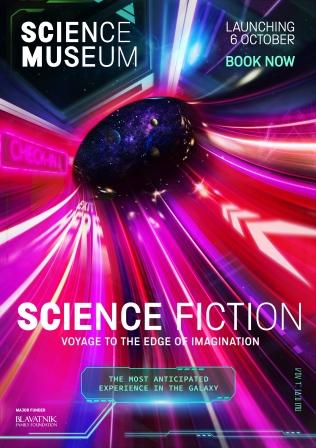
The Science Museum (that’s the world famous one in Kensington, London) has just launched a new exhibit on what Carl Sagan once mused (though not mentioned in the exhibit itself) science fiction and science’s ‘dance’. SF2 Concatenation reprographic supremo Tony Bailey and I were invited by the Museum to have a look on the exhibition’s first day. (The exhibition runs to Star Wars day 2023, May the Fourth.) Having braved Dalek extermination at the Museum’s entrance, we made our way to the exhibition’s foyer – decorated with adverts to travel to Gallifrey – to board our shuttle….
I was at the 2022 F. Scott Fitzgerald Literary Festival in Rockville, MD today. If you’re wondering why the festival is there, that’s where Fitzgerald and his wife are buried. Now, I’d never read any of Fitzgerald`s writing, so I spent the evening before reading the first three chapters of The Great Gatsby (copyright having expired last year, it’s online). So far, I’ve yet to find anyone in it that I want to spend any time with, including the narrator.
However, the reason I attended was to see Kim Stanley Robinson, who was the special guest at the Festival. The end of the morning’s big event was a conversation between Stan and Richard Powers. Then there was lunch, and a keynote speaker, then Stan introducing Powers to receive an award from the society that throws the annual Festival….
A recent possible record could be the SF2 Concatenation’s website 2012 Eurocon Award voted on by those at the European SF Society’s convention which, that year, was held in Croatia….
Snuff is our narrator, here, and he’s a smart, interesting, likable dog. He’s the friend and partner of a man called Jack, and they are preparing for a major event….
…As a child, I kept a notebook filled with my favorite quotes. (How did I not know I was going to be an author?) The first quote? “Not all who wander are lost.” There was everything from 90s rom com lines to Wordsworth poems in that notebook, but Tolkien filled the most pages….
Louis Wu is 200 years old, and he’s bored. It’s his 200th birthday, and he’s using transfer booths to extend the celebration of it for a full twenty-four hours, and he’s really bored….
How can Halloween be over already? We barely had time to watch thirty horror movies –and those mostly classics, which are less than half our (horror) collection!
There is a fundamental implausibility to easy manned interstellar (or even interplanetary) space travel that nonetheless remains a seductive idea even in our wiser and more cynical and weary 21st century. …
Alif is a young man, a “gray hat” hacker, selling his skills to provide cybersecurity to anyone who needs that protection from the government. He lives in an unnamed city-state in the Middle East, referred to throughout simply as the City. He’s nonideological; he’ll sell his services to Islamists, communists, anyone….
Journalist, author, genre historian (and fan, certainly, from the 1940s and on!) Bertil Falk is acclaimed for performing the “impossible” task of translating Finnegans Wake to Swedish, the modernist classic by James Joyce, under the title Finnegans likvaka….
The protagonist of the first short novel in this omnibus — which is in fact Eye of Cat — is William Blackhorse Singer, a Navajo born in the 20th century, and still alive, and fit and healthy, almost two centuries later….
One fine Monday morning, Peter Grant is summoned to Baker Street Station on the London Underground, to assess whether there was anything “odd,” i.e., involving magic, about the death of a young man on the tracks….
…If you’re not a fan, then there’s a real chance you have no idea how much range animé encompasses. And I’m not even talking about the entire range of kid shows, sit-coms and drama. (I’m aware there may be limits to your tolerance. I’m talking about the range within SF/F. Let’s consider just three examples….
While I subscribe to the practice that, as a rule, reviews and review-like write-ups, if not intended as a piece of critical/criticism, should stick to books the reviewer feels are worth the readers reading, sometimes (I) want to, like Jerry Pournelle’s “We makes these mistakes and do this stuff so you dont have to” techno-wrangling Chaos Manor columns, give a maybe-not-your-cup-of-paint-remover head’s-up. This is one of those….
It’s been 30 years since the passing of my friend Roger Weddall. I doubt very many of you reading this had ever met him and I wouldn’t be surprised, actually, if most of you haven’t even heard of him. Thirty years is a long time and the demographics of fandom has changed a lot. So let me tell you a little bit about him….
I expect a lot of File 770’s readers watched, as we did, as the Orion capsule returned to Terra. I’m older than some of you, and it’s been decades since I watched a capsule re-entry and landing in the ocean. What had me in tears is that finally, after fifty years, we’re planning to go back… and stay….
Poul Anderson began writing his own “future history” in the 1950s, with its starting point being that there would be a limited nuclear war at some point in the 1950s. From that point would develop a secret effort to build a new social structure that could permanently prevent war….
…As with Avatar, Avatar: The Way of Water is a visual feast. Unlike the first film, there aren’t long sweeping pans lingering over beautiful, otherworldly vistas. The “beautiful” and the “otherworldly” are still there, but we’re seeing them incorporated into the action and storytelling….
Today we celebrate what would have been the 100th birthday of Harry Warner, Jr., who was perhaps the best-known stay-at-home science fiction fan of all time….
…But having learned that she can see and talk to ghosts, and that they all have unresolved problems they want to solve, she can’t always say no when they ask her for help….
…Xich Si is a tech scavenger, living in Triệu Hoà Port, and scavenging tech to sell and support herself and her daughter, when she’s captured by pirates. ….
… When I was growing up, children like myself were taught, no, more like indoctrinated, to think the United States was the BEST place to grow up, that our country was ALWAYS in the right and that our institutions were, for the most part, unassailable and impervious to criticism from anyone, especially foreigners.
I grew up in Ohio in the 1960’s and despite what I was being taught in a parochial Catholic grade school (at great expense, I might add, by my hard-working parents), certain things I was experiencing did not add up. News of the violence and casualties during the Vietnam War was inescapable. I remember watching the evening network news broadcasts and being horrified by the number of people (on all sides of the conflict) being wounded or killed on a daily basis.
As the years went on, it became harder to reconcile all of the violence, terrorism, public assassinations and the racism I was experiencing with the education I was receiving. The Pentagon Papers and the Watergate break-ins coincided with my high school years and the beginnings of my political awakening.
When I look back on those formative days of my life, I see myself as a small child, set out upon a sea of prejudice and whiteness, in a boat of hetero-normaltity, destination unknown….
… After I introduced myself to Mr. Weir and Mr. Bell, I said, “You and I have something in common.”
“Oh really? What’s that?”
“You and I are the only 2022 Hugo Award nominees within a hundred-mile radius of this bookstore.” (I stated that because I know that our fellow nominee, Jason Sanford, lives in Columbus, Ohio, hence the reference to the mileage.)…
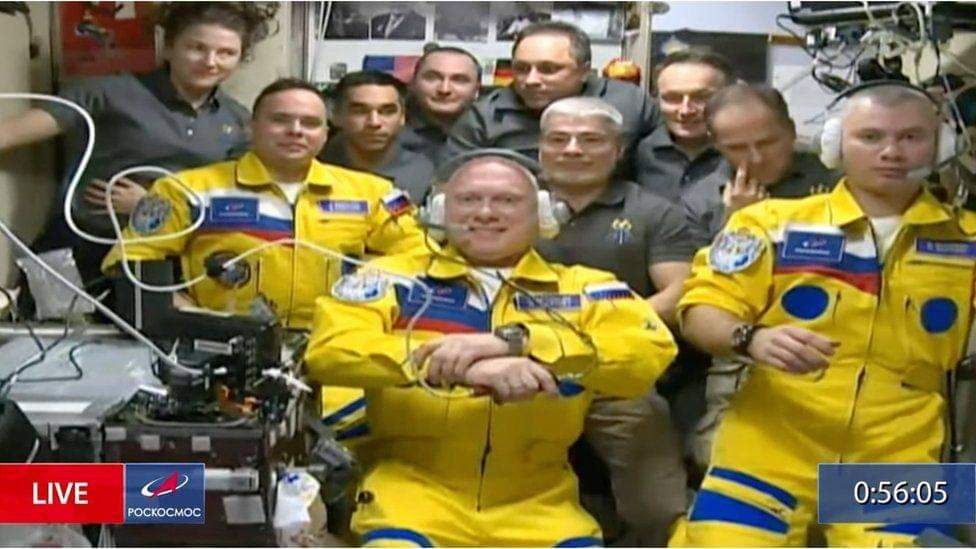
Despite some very harsh comments from Dmitry Rogozin, the director general of Roscosmos, threatening that “If you block cooperation with us, who will save the ISS from an uncontrolled deorbit and fall into the United States or Europe?” spacefarers seem to have a different perspective and understanding of the importance of international cooperation, respect and solidarity. This appears to have been demonstrated today when three cosmonauts arrived at the International Space Station….
Forty-five years ago or thereabouts, on February 26, 1977, the first ‘prog’ of 2000AD was released by IPC magazines. The second issue dated March 5 a week later saw the debut of Judge Dredd. Since then, Rogue Trooper, Nemesis the Warlock, Halo Jones, Sláine, Judge Anderson, Strontium Dog, Roxy and Skizz, The ABC Warriors, Bad Company and Proteus Vex are just some of the characters and stories that have emanated from the comic that was started by Pat Mills and John Wagner. Some have gone on to be in computer games, especially as the comic was purchased by Rebellion developments in 2000, and Judge Dredd has been brought to the silver screen twice.
Addictive and enjoyable stories of the fantastic, written and drawn by some of the greatest comic creators of the latter part of the 20th century, they often related to the current, utilizing Science Fiction to obscure issues about violence or subversiveness, but reflecting metaphorically about the now of the time….
“Fight With Art” is an exhibition of Ukrainian Contemporary Art created under exceptional circumstances taking place now in Kraków at the Manggha Museum until April 30.
We reached out to curator Artur Wabik to learn more of this topical exhibition…
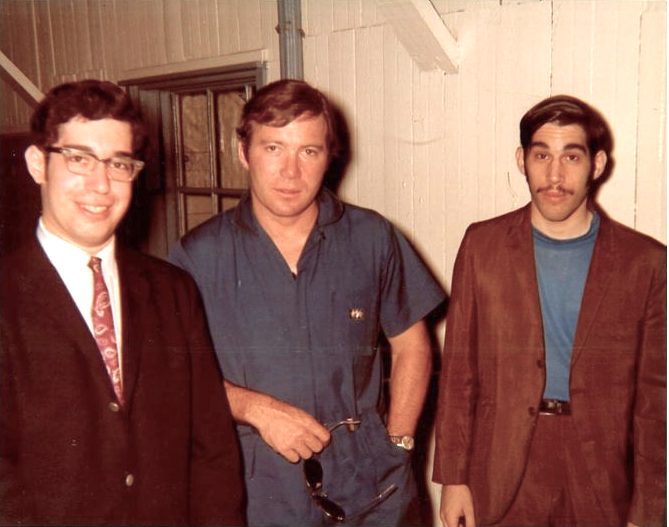
Steve Vertlieb, William Shatner, and Erwin Vertlieb.
Traditionally, the start of a new year is a time when film critics begin assembling their lists of the best films, actors, writers, composers, and directors of the past year. What follows, then, while honoring that long-held tradition, is a comprehensive compilation and deeply personal look at the finest film scores of the past nearly one hundred years….
The frenzy of joyous controversy swirling over director Adam McKay’s new film Don’t Look Up has stirred a healthy, if frenetic debate over the meaning and symbology of this bonkers dramedy. On its surface a cautionary satire about the impending destruction of the planet, Don’t Look Up is a deceptively simplistic tale of moronic leadership refusing to accept a grim, unpleasant reality smacking it in its face.
What follows is truly one of the most personally heartfelt, poignant, and heartbreaking remembrances that I’ve ever felt compelled to write.
Veronica Carlson was a dear, close, cherished friend for over thirty years. I learned just now that this dear sweet soul passed away today. I am shocked and saddened beyond words. May God rest her beautiful soul.
After interviewing William Shatner for the British magazine L’Incroyable Cinema during the torrid Summer of 1969 at “The Playhouse In The Park,” just outside of Philadelphia, while Star Trek was still in the final days of its original network run on NBC, my old friend Allan Asherman, who joined my brother Erwin and I for this once-in-a-lifetime meeting with Captain James Tiberius Kirk, astutely commented that I had now met and befriended all three of our legendary boyhood “Captains,” which included Jim Kirk (William Shatner), Flash Gordon/Buck Rogers (Larry “Buster” Crabbe), and Buzz Corry (Edward Kemmer), Commander of the Space Patrol….
… The first of the most important music modernists, however, in the post war era and “Silver Age” of film composers was Elmer Bernstein who would, had he lived, be turning one hundred years old on April 4th, 2022. Although he would subsequently prove himself as able as classic “Golden Age” composers of writing traditional big screen symphonic scores, with his gloriously triumphant music for Cecil B De Mille’s 1956 extravaganza, The Ten Commandments….
… She was just four days into her maiden voyage from Southhampton to New York City when this “Unsinkable” vessel met disaster and finality, sailing into history, unspeakable tragedy, and maritime immortality. May God Rest Her Eternal Soul … the souls of the men, women, and children who sailed and perished during those nightmarish hours, and to all those who go courageously “Down to The Sea in Ships.” This horrifying remembrance remains among the most profoundly significant of my own seventy-six years….
… It is true that Seth MacFarlane, the veteran satirist who both created and stars in the science fiction series, originally envisioned [The Orville] as a semi-comedic tribute to Gene Roddenberry’s venerable Star Trek. However, the show grew more dramatic in its second season on Fox, while it became obvious that MacFarlane wished to grow outside the satirical box and expand his dimensional horizons and ambitions….
… I was born in the closing weeks of 1945, and grasped at my tentative surroundings with uncertain hands. It wasn’t until 1950 when I was four years old that my father purchased a strange magical box that would transform and define my life. The box sat in our living room and waited to come alive. Three letters seemed to identify its persona and bring definition to its existence. Its name appeared to be RCA, and its identity was known as television….
He was a kindly, gentle soul who lived among us for a seeming eternity. But even eternity is finite. He was justifiably numbered among the most influential writers of the twentieth century. Among the limitless vistas of science fiction and fantasy he was, perhaps, second only in literary significance to H.G. Wells who briefly shared the last century with him. Ray Bradbury was, above all else, the poet laureate of speculative fiction….
On June 11, 1982, America and the world received the joyous gift of one of the screen’s most beloved fantasy film classics and, during that memorable Summer, a young aspiring television film critic reviewed a new film from director Steven Spielberg called E.T….
…Before I realized it, tables and chairs were being moved and I felt the hands of paramedics lifting me to the floor of the restaurant. Les was attempting to perform CPR on me, and I was drifting off into unconciousness. I awoke to find myself in an ambulance with assorted paramedics pounding my chest, while attempting to verbally communicate with me. I was aware of their presence, but found myself unable to speak….
After nearly dying a little more than a decade ago during and just after major open heart surgery, I fulfilled one of the major dreams of my life…meeting the man who would become my last living life long hero. I’d adored him as far back as 1959 when first hearing the dramatic strains of the theme from Checkmate on CBS Television. That feeling solidified a year later in 1960 with the rich, sweet strains of ABC Television’s Alcoa Premiere, hosted by Fred Astaire, followed by Wide Country on NBC….
…When Jack Warner was casting the film version of the smash hit, he considered performers such as Cary Grant, James Cagney, or Frank Sinatra for the lead. Meredith Willson, the show’s composer, however, demanded that Robert Preston star in the movie version of his play, or he’d withdraw the contracts and licensing. The film version of The Music Man, produced for Warner Brothers, and starring Robert Preston and Shirley Jones, opened to rave reviews on movie screens across the country in 1962. Robert Preston, like Rex Harrison in Lerner and Lowe’s My Fair Lady, had proven that older, seasoned film stars could propel both Broadway and big screen musicals to enormous artistic success….
On the evening of May 14, 1998, following the airing over NBC Television of the series finale of Seinfeld, the world and I received the terrible news of the passing of the most beloved entertainer of the twentieth century. It has been twenty-four years since he left this mortal realm, but the joy, the music, and the memories are as fresh and as vital today as when they were born….
I had the honor and distinct pleasure of both knowing and sharing correspondence with British actor Peter Cushing for several years during the late Sixties and early Seventies….
Very exciting news. The long awaited CD soundtrack release of 12 O’Clock High is now available for purchase through La-La Land Records and is a major restoration of precious original tracks from Quinn Martin’s beloved television series….
That terrible day in Dallas, Texas on November 22, 1963 remains one of the most significantly traumatic days of my life. I was just seventeen years old. I was nearing the end of my high school classes at Northeast High School in Philadelphia when word started spreading through the hallways and corridors that JFK had been shot. I listened in disbelief, praying that it wasn’t true … but it was….
I recently watched a somber new three part documentary by film maker Ken Burns that is among the most sobering, heartbreaking, and horrifying indictments of humanity that I have ever encountered. It was extremely difficult to watch but, as an American Jew, I remain struck by the similarities between the rise in Fascism in the early nineteen thirties, leading to the beginnings of Nazism in Germany, and the attempted decimation of the Jewish people in Europe and throughout the world, with the repellant echoes of both racial and religious intolerance, and the mounting hatred and suspicion of the Jewish communities and population residing presently in my own country of birth, these United States….
I’ve read with interest some of the recent discussions concerning the measure of Hugo Friedhofer’s importance as a composer, and it set my memory sailing back to another time in a musical galaxy long ago and far away. I have always considered Maestro Friedhofer among the most important, if underrated, composers of Hollywood’s golden era….
…Steven Spielberg’s reverent semi-autobiographical story of youthful dreams and aspirations is, for me, the finest, most emotionally enriching film of the year, filled with photographic memories, and indelible recollections shared both by myself and by the film maker….
These photographs are of an annual Christmas tradition at American Heritage Federal Credit Union located at Red Lion and Jamison Roads in Northeast Philadelphia….
…This was the man who brought such incalculable joy and hope to so many millions of filmgoers with his quintessential Christmas classic, It’s A Wonderful Life. …
My friend Adam Spector tells me that when Ernest Lehman was asked to write the script for North by Northwest, he tried to turn out the most “Hotchcocky” script he could, with all of Hitchcock’s obsessions in one great motion picture.
Moonfall is the most “Emmerichian” film Roland Emmerich is made. Like his earlier films, it has flatulent melodrama interlaced with completely daft science. But everything here is much more intense than his earlier work. But the only sense of wonder you’ll get from this film is wondering why the script got greenlit….
… Having a long career in Hollywood is a lot harder than in other forms of publishing; you’ve got to have the relentless drive to pursue your vision and keep making sales. To an outsider, what is astonishing about J. Michael Straczynski’s career is that it has had a third act and may well be in the middle of a fourth. His career could have faded after Babylon 5. The roars that greeted him at the 1996 Los Angeles Worldcon (where, it seemed, every conversation had to include the words, “Where’s JMS?”) would have faded and he could have scratched out a living signing autographs at media conventions….
When I read in the Financial Times about how Britain’s National Theatre was adapting Sir Philip Pullman’s La Belle Sauvage, the first volume of his Book of Dust trilogy, I told myself, “That’s a play for me! I’ll just fly over to London and see it! OGH is made of money, and he’ll happily pay my expenses!”
Fortunately, I didn’t have to go to London, because the theatre came to me, with a screening of the National Theatre Live production playing at the American Film Institute. So, I spent a pleasant Saturday afternoon seeing it….
… Stories matter more in the theatre than in film because far more of a play is in our imagination than in a film. Stripped of CGI and rewrites by multiple people, what plays offer at their best is one person’s offering us something where, if it works, we tell ourselves, “Yes, that was a good evening in the theatre,” and if it doesn’t, we gnash our teeth and feel miserable until we get home…
As Anton Ego told us in Ratatouille, the goal of a critic today is to be the first person to offer praise to a rising artist. It’s not the tenth novel that deserves our attention but the first or second. In the theatre, the people who need the most attention are the ones who are being established, not the ones that build on earlier successes.
So I’m happy to report that Matthew Aldwin McGee, author, star, and chief puppeteer of Under the Sea with Dredgie McGee is a talented guy who has a great deal of potential. You should be watching him….
I once read an article about a guy who was determined to live life in 1912. He lived in a shack in the woods, bought a lot of old clothes, a Victrola, and a slew of old books and magazines. I don’t remember how he made a living, but the article made clear that he was happy….
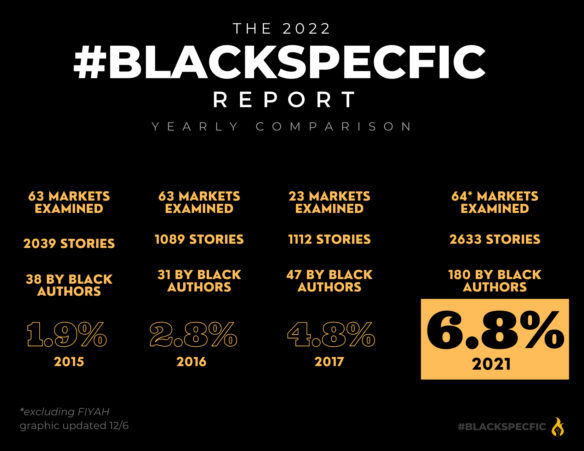
(1) 2022 #BLACKSPECFIC. FIYAH has posted the 2022 #BlackSpecFic Report, an examination of the state of representation of Black authors within the speculative short fiction market published in 2021. This report was composed by L. D. Lewis and Nelson Rolon with sponsor support from the Carl Brandon Society, Diabolical Plots, and CatStone Books.
In the report, “a market is considered “successful” with regard to its publication of Black authors if their percentages are within 2% of the U.S. census reported Black population (13.6%)” —
Highlights
Of the 23 pro and semipro markets examined in all 2015-2017 studies, 11 showed an increase in publishing works by Black authors relative to their respective outputs.
While Black editors of short speculative fiction continue to represent a small portion of the field, nearly all of the surveyed markets who host a Black owner, editor, or guest editor made the “Most Successful (without reprints)” list. And those four publications (Anathema, Fantasy Magazine, Fantasy & Science Fiction, Uncanny Magazine) are responsible for 25.4% of the entire field’s Black-authored works.
…We arrive at what we imagined would be the creative heart of an industry, but it turns out to be a room full of slot machines. Some of us are lucky enough to feed the right slot at the right time and hit jackpots of varying sizes. Others bring their own luck to the room – they can afford to feed the slots regardless of what they get in return. But what about everyone else? Who can honestly afford to stay?
The trouble with luck is that it is not a reliable foundation for a profession. Nor is it a reliable way to run an industry. Yet here we are.
When the ALCS first ran its survey of author incomes in 2006 it found that the median self-employed income of a full-time author was £12,330. In 2022 – a year in which multiple publishers have posted record profits while freelancers in all professions are still reeling from the impact of Covid-19, Brexit and rising living costs – the median full-time income has fallen to £7,000. That’s a drop of more than 60% when accounting for inflation.
There is also a more worrying, granular luck at play. The gender pay gap is getting worse – men earn 41% more than women (compared with 33% five years ago). Payment for Black and mixed-heritage authors is a full 51% lower than for white authors. Young authors earn less, as do older ones. Fewer authors than ever are receiving advances…
(3) LOCUS INDIEGOGO AT 82%. With 8 days to go, the Locus Magazine Indiegogo appeal has raised $61,790 of its $75,000 goal.
(4) AMAZING KICKSTARTER FALLS SHORT. Despite attracting contributions from 114 backers, the Amazing Stories Kickstarter failed reports publisher Kermit Woodall. Only $3,330 was pledged towards the $13,000 goal.
I’m afraid Amazing Stories failed to meet its Kickstarter goal. This means the SOL SYSTEM issue won’t be coming out as planned. Kickstarter won’t take pledge money from backers. No worries!
We do still plan to have an online convention, I can’t promise all the same writers will attend, but it will be different and possibly better! More news as that develops.
…The special SOL SYSTEM issue won’t happen.
(5) GENRE ON STRIKE. The call is out for authors and readers to join the HarperCollins picket line on December 16. (Via John Scalzi.)
Scientist Lanza conveys his theory that “the universe springs from life, not the other way around” in Observer (Story Plant, Jan.), a thriller coauthored with Kress.
How did you come to develop your theory of biocentrism?
Lanza: It goes back to when I was a young boy, when I used to explore the forests of eastern Massachusetts. I was observing nature and pondering the larger existential questions, and it occurred to me that the static objective view of reality that I was being taught just wasn’t right. The Nobel Prize was just awarded just a few months ago to three gentlemen whose experiments showed that entangled particles change behavior depending on whether you look at them or not. Why? The answer is that that reality is a process that involves our consciousness.
How did this partnership begin?
Kress: Our agent put us together, because Bob, who’s published several nonfiction books on biocentrism, wanted to embody his ideas in a novel. I was intrigued by the project from the very beginning because I have always thought that consciousness is woven into the universe. What we wanted to write together was about how these ideas might inform a possible future. And we worked until we got something we were both happy with….
(7) MEMORY LANE.
2019 — [By Cat Eldridge.] Rudyard Kipling statue
So today is we’re looking at a quite new statue, that of Rudyard Kipling which unveiled in Burwash just three years ago. Kipling as you know did The Jungle Booksand The Just Stories, plus two true pieces of SF in his Aerial Board of Control series, With the Night Mail and As Easy as A.B.C.: a Tale of 2159 A.D.
The fully life-size figure which is located on High Street shows Kipling, who lived in the village, sitting on a bench also cast in bronze. Burwash Parish Council commissioned the piece in 2018 and it was created by local sculptor Victoria Atkinson.
Atkinson researched Kipling using archives at Bateman’s, the Jacobean house which was the home of Rudyard Kipling, and the National Portrait Gallery with the Kipling Society providing details such as Kipling’s height and hat and shoe size. Of course she needed a live model to actually create the statue so she used one of her neighbors who wore a thick suit of the type favored by Kipling as a model to get the look and pose of Kipling right.
Oh the book underneath the bench? It’s The Just So Stories.
It was actually, to keep costs down, cast in Athens, Greece.
Now comes a really cool thing. The unveiling took place on February 25, 2019. So who did the unveiling? Why it was Mike Kipling, grandson of Rudyard Kipling!
(8) TODAY’S BIRTHDAYS.
[Compiled by Cat Eldridge.]
Born December 7, 1915 — Eli Wallach. I‘ve a fondness for anyone who appeared on the Sixties Batman series. He played Mr. Freeze in a two part story, the third actor to do as both George Sanders and Otto Preminger had done so in previous two part stories. He also had one-offs in Worlds Beyond, Alfred Hitchcock Presents, Veritas: The Quest and Tales of the Unexpected. (Died 2014.)
Born December 7, 1923 — Johnny Duncan. Was the Sixties Batman the first Batman series? You know better. Johnny here was Robin on Batman And Robin (1949) for Columbia Pictures Corporation. It ran for fifteen episodes of roughly fifteen or so minutes apiece. Robert Lowery was Wayne / Batman. He has only one other genre appearance, an uncredited one in Plan 9 from Outer Space as Second Stretcher Bearer. (Died 2016.)
Born December 7, 1915 — Leigh Brackett. Let’s us praise her first for her Retro Hugo for Shadow Over Mars, originally published in the Fall 1944 issue of Startling Stories. Now surely her scripts for The Big Sleep and The Long Goodbye are genre adjacent? Ok, I’m stretching it, I know. Ok, then her very pulpy Sea-Kings of Mars is? Being rhetorical there. And I love her Eric John Stark stories! (Much of these were written with her husband Edmond Hamilton.) She completed The Empire Strikes Back script for George Lucas just before she died, and although it did not become the final script many of its elements made it into the movie and she received credit along with Lawrence Kasdan. (Died 1978.)
Born December 7, 1945 — W.D. Richter, 77. As a screenwriter, he was responsible for Invasion Of The Body Snatchers, Dracula, and Big Trouble In Little China, the latter one of my favorite popcorn films. As a director, he brought Late for Dinner and Buckaroo Banzai Across The 8th Dimension to us. He was also co-writer with Stephen King on the adaptation of King’s Needful Things novel to film.
Born December 7, 1949 — Tom Waits, 73. He’s got uncredited (but obviously known) roles in Wolfen and The Fisher King. He is in Bram Stoker’s Dracula as R.M. Renfield, and he shows up in Mystery Men as Doc Heller and in Mr.Nick in The Imaginarium of Doctor Parnassus. He’s simply Engineer in The Book of Eli.
Born December 7, 1953 — Madeleine E Robins, 69. I’m very fond of her Sarah Tolerance series which starts often Point of Honour, it features a female PI in an alternate version of Georgian London. The Stone War set in a post-apocalyptic NYC is quite interesting as well, and she has quite a bit short fiction, though only three have been collected so far in Lucstones: Three Tales of Meviel. Much of her fiction is available from the usual digital suspects.
Born December 7, 1973 — Kelly Barnhill, 49. Her The Girl Who Drank the Moon novel was awarded the Newbery Medal and she was a McKnight Writing Fellow in Children’s Literature. Four years ago, her “Unlicensed Magician” novella received the World Fantasy Award for Long Fiction. Iron Hearted Violet was nominated as Andre Norton Award.
Born December 8, 1979 — Jennifer Carpenter, 43. Ok, usually I pay absolutely no attention to TV awards, but she got a nomination for her work as Emily Rose in The Exorcism of Emily Rose. It was the MTV Movie Award for Best Scared-As-Shit Performance. It later got renamed to Best Frightened Performance. She’s apparently only got two other genre credits, both voice work. One is as Black Widow in Avengers Confidential: Black Widow & Punisher which is a horridly-done anime film that I do not recommend; the other is as Selina Kyle aka Catwoman in Batman: Gotham by Gaslight, the animated version of the Mike Mignola Elseworld series which I strongly recommend. Possibly the Limitless series she was in is genre, possibly it isn’t…
(9) BRACKETT BIRTHDAY SUGGESTION. Bill Higgins— Beam Jockey – thinks this would be most appropriate.
Everyone else gets parentheses, but I feel that, of all people, Leigh Brackett's lifetime should be written:
(10) ENTERPRISING LAWYERS. This legal advertisement is making the rounds in social media.
Evidently the “Shaw-Louvois” firm name is appropriate for Trek because in the 1967 Original Series episode Court Martial Lt. Areel Shaw prosecutes Captain Kirk, and in ST:TNG Phillipa Louvois is a member of Starfleet’s Judge Advocate General branch who has to rule on the rights of Lt. Cmdr. Data in “The Measure of a Man.”
In a hasty retreat, San Francisco lawmakers have reversed a vote allowing local police to use remote-controlled robots equipped with lethal explosives in extreme situations. The move comes after a wave of backlash from the community and activist organizations.
San Francisco’s Board of Supervisors voted 8-3 Tuesday on a revised version of the policy, which now prohibits police from using robots to kill people. Tuesday’s vote was a surprise turn of events after the board approved the policy last week, including a clause allowing for the lethal bots. As reported by the San Francisco Chronicle, the board rarely changes its mind on second round votes, which are typically seen as formalities. However, since the first vote on Nov. 29, the policy has received a wide range of criticism both locally and nationally. Lawmakers will debate the issue for another week before voting on yet another version of the policy next week….
Cat Eldridge is skeptical: “So the Terminators lost this first skirmish against humanity. But to paraphrase Arnold‘s character in the first Terminator film, ‘They’ll be back.’”
(12) GOOD LORD. “Figgy Pudding | SPAM® Brand”. Eh, so the main ingredient is still pork? Then shouldn’t this be Piggy Pudding?
…Rather than present the perfect ingredients for a swear, this study identifies something that all swear words seem to lack. Across languages, swear words tend to exclude sounds like l, r, and w, known as approximants.
If you’re like me, then the first thing you did was scour your brain for exceptions to the rule (and “asshole” was the first one that came to mind, followed by “wanker”). This isn’t to say that swear words wholesale lack these phonemes, but statistically speaking, curses across different languages are less likely to contain approximants….
… You may not feel exactly the same as Bond does about both My Dinner with Andre and the Lord of the Rings trilogy (a rare dual enthusiasm in any case), but seeing where he places them in relation to other movies can help to give you a sense of whether and how they could fit into your own personal canon — as well as the kind of context a film needs to earn its place…
A restless young woman ships off to fight an interstellar war, only to struggle with the effects of being cut off from her home by both time and space.
(16) DEFINITELY NOT TODAY’S SCROLL TITLE. By Daniel Dern:
Scrollomon Grundry Filed On Sunday Posted On Monday Notified On Tuesday Clicked On Wednesday Commented On Thursday Fifth’ed On Friday Stalked On Saturday This is the lifecycle of Scrollomon Grundy
[Thanks to John King Tarpinian, Chris Barkley, Daniel Dern, Soon Lee, Dann, Andrew Porter, Michael Toman, Cat Eldridge, and Mike Kennedy for some of these stories. Title credit belongs to File 770 contributing editor of the day Jim Janney.]
By Bill Higgins: Robert Osband, Florida fan, really loves space. All his life he has been learning about spaceflight. And reading stories about spaceflight, in science fiction.
So after NASA’s Apollo program was over, the company that made Apollo space suits held a garage sale, and Ozzie showed up. He bought a “training liner” from ILC Dover, a coverall-like portion of a pressure suit, with rings at the wrists and neck to attach gloves and helmet.
And another time, in 1976, when one of his favorite authors, Robert A. Heinlein, was going to be Guest of Honor at a World Science Fiction Convention, Mr. Osband journeyed to Kansas City.
In his suitcase was his copy of Heinlein’s Have Space Suit, Will Travel—a novel about a teenager who wins a secondhand space suit in a contest—and his ILC Dover suit.
Because if you wanted to get your copy of Have Space Suit, Will Travel autographed, and you happened to own a secondhand space suit, it would be a shame NOT to wear it, right?
As Ozzie stood in the autograph line, David Dyer-Bennet, a fannish photographer, was watching. Heinlein was casually dressed in a Hawaiian shirt. (You may have seen some of DD-B’s photos of this autograph session, because they are frequently reproduced in books about Heinlein, and he has made one available on Wikimedia Commons.) He snapped a series of pictures of the fans.
Consequently, there exists a picture of Mr. Osband meeting Mr. Heinlein at that moment in September 1976.
Photo by David Dyer-Bennet. Robert Osband (Ozzie) is getting his copy of “Have Spacesuit, Will Travel” autographed by Robert Heinlein while wearing the training liner of space suit he bought at ILC Industries of Dover DE, when the manufacturer cleaned out the attic and held a garage sale following the end of the Apollo Program. Photo used by permission.
This month I found, to my surprise, that the two had something unexpected in common. To put it into a single word, they were both vain.
Vain, but in interesting ways. I will explain.
Mike Glyer, our gracious host here at File 770, has, as you may know, a keen interest in science fiction history. On Friday, April 1, the U. S. National Archives made public the data from the 1950 Census. Mike was curious what the Census might say about individuals in the SF world, and he asked me for a bit of research help. Here’s his article: “What the Heinleins Told the 1950 Census”.
That’s how I came to be examining a list of Heinlein’s residences in those days. Robert and Virginia Heinlein, recently married, at first rented a place in Colorado Springs, Colorado. But in the spring of 1949 they put their furniture in storage and went to Los Angeles, where Robert worked on the film Destination Moon. They returned to Colorado Springs in February of 1950 and rented a house. But their dream was to build a house of their own. Robert had a lot of novel ideas about modern house design.
By springtime, they were negotiating to purchase land. The developer made them an unusual offer. Their lot was between two other homes on Mesa Avenue with house numbers 1700 and 1800. They were invited to choose an address of their own, a number between 1700 and 1800.
This is the reason why, in August 1950, Robert and Virginia Heinlein came to be living at 1776 Mesa Avenue.
To digress briefly, here in the U.S., states allow motorists to specify custom text on their license plates. Usually the state charges an extra fee for this. For example, I once saw an orange Cadillac owned by Forrest J. Ackerman, the prominent fan who coined the phrase “Sci-Fi.” And sure enough, Forry’s California license plate read “SCI FI.” Such custom license plates are known as “Vanity Plates.”
The Heinleins of 1776 Mesa Avenue, both patriotic veterans, had given themselves a Vanity Address.
A vanity address is much rarer than a vanity license plate. But Robert Osband has something even more rare.
Ozzie was—how shall I say it?—um, an amateur telephony enthusiast. He understood well how telephones work, and how the switching network functions, and how phone systems evolved the way they did.
Throughout the 1970s and 1980s, as populations grew, and as the purchase of fax machines, modems, and mobile phones grew even faster, a lot of phone numbers were gobbled up. In large metropolitan areas particularly, the available supply of not-yet-assigned phone numbers became smaller and smaller.
The solution to this congestion was to assign fresh new Area Codes.
Each area code is a three-digit number, and (at the time) all the phone numbers assigned within a large geographic area would share this three-digit prefix. Chicago phone numbers started with 312. Miami phone numbers started with 305.
Ozzie knew about the North American Numbering Plan Administration, which governed the area code system. In Titusville, Ozzie lived in the 305 area code, whose boundaries encompassed much of southern Florida.
In 1988, the Orlando region was split off. A new area code, 407, was assigned to many phones previously within 305’s domain. Titusville remained in 305.
But more people, and more fax machines, and more mobile phones kept eating up available 305 numbers.
So very soon, it was time once again for the congested 305 to calve, creating a new area along the east coast of Florida, with a fresh area code.
Ozzie saw an opportunity. He understood the Numbering Plan. He consulted the pool of three-digit numbers not yet in use. He knew that the Florida Public Service Commission regulated aspects of the telephony business.
Ozzie did some research and carefully prepared his case. There was a particular three-digit string he wanted to advocate, one not yet in use for any other area.
On 24 September 1998, he testified to a meeting of the Public Service Commission. They loved his idea. And they ran with it.
This is the reason why, on 1 November 1999, Titusville, and Cocoa Beach, and Melbourne, and, most importantly, Cape Canaveral, Florida, became part of Area Code 321. As Ozzie had told the PSC, “With the Space Coast of Florida as the Count-Down capital of the world, this in my humble opinion, is the Area Code for us!”
As a result, Ozzie’s own phone number became 321-LIFTOFF.
Yes, Robert Osband had arranged a Vanity Area Code.
So when I learned of Robert and Virginia Heinlein and their vanity address, I recalled Robert Osband’s vanity area code. And suddenly realized that, long after the address was established, and long before the area code was created, they had once met. And that DD-B had photos of the meeting.
(1) ROBOT IS 100. The Czech Consulate of Los Angeles invites fans to the Robot is 100! Webinar on Thursday, February 4 at 12:00 PM Pacific exploring the influence of Karel Capek’s play “R.U.R.” on other forms of art, and the future of robotics. Register here.
[Note: WordPress does not support the proper character for the author’s last name, so the Latin C has been used. And a screenshot of the program description is used to work around the same problem.]
To further explore the past, present, and future of artificial intelligence, visit UCLA Library’s virtual exhibit Robot is 100! Karel Capek’s R.U.R. and the Robot in Pop Culture. You can learn more about Karel Capek’s life and R.U.R. in a complementary UCLA Library Research Guide.
Enjoy an audio created by the BBC Sounds: “The Robots are Us.” This BBC Radio Documentary features Jesse Brown O’Dell, PhD. graduate from the UCLA Department of Slavic, East European and Eurasian Languages and Cultures.
(2) EATING THE FANTASTIC. Scott Edelman invites everyone to settle in for bagels and a schmear with comics retailer Joel Pollack in Episode 137 of his Eating the Fantastic podcast.
Joel Pollack has been a part of comics fandom even longer than I have — he attended one of Phil Seuling’s 4th of July Comic Art Conventions two years before I did — in 1968 — and founded Big Planet Comics in Bethesda, Maryland in 1986. That flagship store has expanded to other locations in Washington, D.C., College Park, MD, and Vienna VA, and I thought it would be fun to chat about the world of comics and comics fandom of the past half century, and how comics retailing has changed over the past three and a half decades.
We discussed what the pandemic has done to the comics shop business, the comic his mother bought him which changed his life, the card game which led to him getting his first piece of original art, how his run-in with a young Howard Chaykin convinced him he wasn’t cut out to be a professional comics artist, what opening day was like at the first of his Big Planet comic book stores, the biggest sales event he’s seen during his 35-year retailing career, what inspired Bernie Wrightson to draw a freaky issue of Swamp Thing, how he fights back against the Comic Book Guy cliche to makes his shops welcoming places, our joint distaste of slabbing, why he doesn’t like doing appraisals, and much more.
(3) INTERZONE UPDATE. [Item by PhilRM.] This week’s PS Publishing newsletter provides some more information on their take-over of Interzone (first mentioned in the 1/8/2021 Pixel Scroll) from Andy Cox and TTA Press (and note that Strahan’s post referenced there didn’t make the latter clear: not only is Ian Whates taking over as editor, but Interzone will be published by PS Publishing). Interzone will now appear on a quarterly schedule, and only in digital format. The first issue will appear in August, and will be free to current subscribers.
And heh, we’re kind of jazzed up a little right now where electronic reading matter is concerned . . . and it’s all thanks to our taking on board INTERZONE, which we’ll be running in digital format only, kicking off in August. Ian has already earmarked some 60/70 thousand words for the debut, and the special festive issue in December (always assuming we have a festive season, that is). So watch out as further details emerge and IZ takes its justified place in the pantheon of Science Fiction and Fantasy in digital format only.
All queries/comments regarding the TTA Press Interzone should be directed to either Andy Cox or Roy Gray direct at [email protected] or [email protected]. In the meantime, by way of a goodwill gesture, the first electronic PS IZ (August 2021) will be sent free of charge to all previous subscribers. Subsequent issues will be sent quarterly on receipt of an email to be found in the magazine. Watch out for more information
(4) UP PERISCOPE ON SUBSTACK. Yudhanjaya Wijeratne tweeted a list of recommended newsletters. Thread starts here. I’m only familiar with the ones by sff writers and they’re good, so I expect you’ll find more gold in the rest of his list. Here are a few examples:
3) @zeynep on, well, everything. Especially if you're interested in protests, revolutions, and the burgeoning impact on social media. Zeynep flies around the world doing boots-on-the-ground enthograohy. Strongly suspect that @zeynep and @antoniogm will disagree wildly but get on.
5) @samitbasu's Duck of Dystopia. Tongue-in-cheek creative advice from the school of hard knocks. Samit was South Asia's first fantasy bestseller in English, and since then has gone on to direct movies and involve himself in pretty much every side of the creative process.
(5) STOCK MARKET NEWS. Cory Doctorow makes the information comprehensible with his own comments. Read it complete at Threadreader.
There is no shortage of takes about what's going on with Gamestop (and other surging stocks), Robinhood and Reddit's r/wallstreetbets, many of them contradictory – at least on the face of them. But I think it's possible for most of these takes to be right. Here's how.
(6) DIANA PHO ON DVCON. DVCon 2021 is a free convention for marginalized writers happening online January 30-31.
DVcon, a product of #DVpit, is a free, two-day virtual writers conference for self-identifying marginalized book creators. The mission of DVcon is to educate and connect authors & illustrators who have been historically underrepresented and marginalized in the book publishing industry. Featuring a diverse faculty as well as #DVpit alum, DVcon will offer informative workshops, fun micro-content, and our additional focus will be on community-building and forging connections.
Editor Diana Pho is part of the Money Talks panel from 2:00-3:00 PM Eastern on January 30.
Money Talks. 2:00pm-3:00pm
Let’s face it: publishing doesn’t always pay. Between low advances, payment installments stretched out for years, and the uncertainty of royalties, authors and illustrators might need to get creative about making ends meet. Our panel will discuss different and unexpected ways that authors and illustrators can make money and still stay on the publishing track. It will also help explain some basics about how payments occur in publishing and how to hustle with your writing. Sponsored by the Authors Guild
Featuring: Rebecca Kuss, Thao Le, Diana Pho, Holly Root, Jennifer Ung, Rebekah Weatherspoon
(7) AMBITIOUS ANIME. [Item by Martin Morse Wooster.] In the January 25 Financial Times, Leo Lewis and Kana Inagaki look at whether Japanese anime producers can compete globally against Disney and Netflix.
For many industry executives, the stage is now set for Japanese animation to truly go global. A newly invigorated Sony is competing with Netflix and global giants to uncover the untapped trove of lucrative anime content. ‘We were forced to accelerate efforts on all three fronts of digitalization, global expansion and streaming services. It became now or never,’ said George Wada, senior vice-president at Production IG, the company behind the anime hits Ghost In The Shell and Attack On Titan, ‘We are on the brink of whether Japanese animation becomes big or goes minor.’…
…The list of the world’s 25 most valuable franchises are topped by two Japanese giants–Pokemon and Hello Kitty with respective all-time sales of $92bn and $80bn–and include nine other Japanese names.But behind that success, say analysts, has been a tendency to under-exploit the anime gold mine and heavily criticized labour practices that are hidden behind the most popular titles.
Frank Frazetta (1928–2010) may someday hang his paintings in the Guggenheim Museum (hey, whoever thought that Norman Rockwell would have a major exhibition in Frank Lloyd Wright’s temple of Modern?). False equivalency aside, anything is possible in the current what-is-art world (what’s more, Frazetta already has his own museum). Frazetta is to fantasy what Max Ernst is to surrealism (which is fantasy on another psychic and perceptual plane)….
Frazetta transformed the fantasy genre. What can you point to as his most emblematic work?
There was a gradual building, including comic book covers in the early ’50s, which influenced George Lucas and Star Wars. Then Frank’s early 1960s illustrations for Edgar Rice Burroughs books, including Tarzan and John Carter of Mars. And Frank had a good run, painting big studio, humorous caricature-based movie posters in the mid-’60s. Most illustrators would consider movie poster work as a dream come true. But Frank walked away from them for what he felt was more uniquely his own, with his Sword & Sorcery heroic fantasy art. A shortlist of pieces that I cite as rocking the public’s collective consciousness would include “The Barbarian,” which first ran as the cover to the Conan the Adventurer paperback in 1966. Also “Death Dealer,” which first appeared on an early-’70s paperback but inspired American Artist magazine to break their own traditions to produce a special issue devoted to illustration, including coverage of Frazetta and covered with the Death Dealer. “Dark Kingdom” is another, which most people recall as running on a multi-million–selling Molly Hatchet album cover….
Check out this item in the forthcoming Focus Magazine. It gives hugely well deserved recognition to well known local SF/Fantasy authors Piper Mejia, Lee Murray, Jean Gilbert and the many other genre authors around NZ who have helped with their efforts in teaching and mentoring and publishing young students.
…Two years ago, Nick Smith, a Pasadena library technician, curated a “Dreaming the Universe: The Intersection of Science, Fiction & Southern California” exhibit at the Pasadena Museum of History. His observation: While the creators of science fiction are rightly lauded, the history of the sci-fi fandom here is also worth acknowledgment.
“I think that’s part of why this has been home to a lot of science fiction,” says Smith, who is the former president of the Los Angeles Science Fantasy Society. Founded in 1934, it’s the oldest such fan group in the world, with a teenage Ray Bradbury one of its early members.
California appealed to science-fiction writers in the same way it appealed to anyone, Smith says. There were jobs to be had here, the promise of a better life and more opportunity or acceptance for people who might be discriminated against in other parts of the nation.
“Hollywood and television also contributed,” he says. “They provided a steady extra income for some of the writers.”
(11) DARROLL PARDOE OBIT. UK fanzine fan Darroll Pardoe (1943-2021) died January 28 at the age of 77 from COVID-19. Pardoe joined the Birmingham (UK) Science Fiction Group in 1965. He took over Les Spinge from Ken Cheslin and Dave Hale in 1966 and published it until 1979. He also was noted for editing the newzine Checkpoint for a year in the Seventies, and an issue of the British Science Fiction Association’s Vector.
He is survived by his wife, Rosemary Pardoe, co-founder of the British Fantasy Society.
(12) CHRISTOPHER LITTLE OBIT. The agent who handled Rowling’s Harry Potter series, Christopher Little, died January 7. The New York Times obituary is here.
Christopher Little, who as a struggling literary agent took a chance on a scrappy submission about tween-age wizards — even though he once disdained children’s fiction as a money-loser — and built it into the most successful literary empire in history on the strength of its lead character, Harry Potter, died on Jan. 7 at his home in London. He was 79.
J.K. Rowling, the author of the Harry Potter series, was an unpublished, unemployed single mother in Edinburgh in 1995 when she sent Mr. Little the first three chapters of her first book after finding his name in a directory of literary agents. Knowing nothing about the business, she picked him because his name made him sound like a character from a children’s book.
Mr. Little submitted the manuscript for “Harry Potter and the Philosopher’s Stone” to 12 publishers. He received 12 rejections in response, before selling it for £2,500, or about $3,400 (the equivalent of about $5,800 today). It was a meager amount, but his genius was in the details: He sold only the rights to publish it in Britain and the Commonwealth, and he asked for high royalties….
Mr. Little did more than launch Ms. Rowling’s career. He was the architect of the entertainment powerhouse that grew up around Harry Potter, helping line up everything from Legos to amusement parks.
Ms. Rowling was the first author to earn more than $1 billion off her work, and it’s no surprise that her agent did well too: By some estimates Mr. Little made over $60 million from the Harry Potter franchise. He never claimed credit for her success, but he was ever-present in the background, appearing alongside his client at book launches and movie premieres, enjoying those brief moments in the limelight….
(13) MEDIA BIRTHDAY.
January 29, 1964 — Dr. Strangelove or: How I Learned to Stop Worrying and Love the Bomb premiered. Starring a stellar cast of Peter Sellers, George C. Scott, Sterling Hayden, James Earl Jones and Slim Pickens, it was directed, produced, and co-written by Stanley Kubrick.
It was not the original title as Kubrick considered Dr. Strangelove’s Secret Uses of Uranusas well as Dr. Doomsday or: How to Start World War III Without Even Trying, and the much shorter Wonderful Bomb.
The film is somewhat based on Peter George’s political thriller Red Alert novel. (Originally called Two Hours To Doom.) Curiously Dr. Strangelove did not appear in the book. This novel’s available on at usual digital suspects. And George’s novelization of the film is on all digital sources. If you purchase it, it has an expanded section on Strangelove’s early career.
It would not surprisingly win the Hugo for Best Dramatic Presentation at Loncon II in London in 1965 with The Seven Faces of Dr. Lao being the only other film on the final ballot.
The film was a box office success. Critics were universal in their belief that it was one of the best films ever done with Ebert saying it was “arguably the best political satire of the century”. At Rotten Tomatoes, it currently holds a ninety four percent rating with over two hundred thousand audience reviewers casting a vote.
A sequel was planned by Kurbrick with Gilliam directing though he was never told this by Kurbrick and only discovered this after Kurbrick died and he later said “I never knew about that until after he died but I would have loved to.”
Born January 29, 1835 – Susan Coolidge. Known for What Katy Did and two sequels. Edited Diary and Letters of Frances Burney. Louisa May Alcott edited Coolidge’s collection New-Year’s Bargain, which is ours; three dozen books all told; short stories, poems. Alice Dalgliesh edited a posthumous Coolidge coll’n Toinette and the Elves. (Died 1905) [JH]
Born January 29, 1860 – Anton Chekhov. (Note that kh in the usual Roman-alphabet spelling of his name represents a single consonant in Russian: the pronunciation is near to “che-hoff”). A dozen stories have fantastic elements making them particularly for us; stories, plays, generally, for everyone. You can see Nabokov’s discussion of “The Lady with the Little Dog” here. (Died 1904) [JH]
Born January 29, 1907 – John Clymer. Illustrator of the American West (worked in U.S. and Canada); Prix de West, Rungius Medal, Royal Canadian Acad. of Arts. Also Argosy, Marine Corps Gazette, Saturday Evening Post (eighty covers), Woman’s Day, Chrysler, White Horse whisky; some for us. Clymer Museum in Ellensburg, Washington. Here is the Aug-Sep 37 Romance; it and more about him here. (Died 1989) [JH]
Born January 29, 1918 — Robert Pastene. He played the title role in the first televised Buck Rogers series on ABC that also had Kem Dibbs and Eric Hammond in that role. 35 episodes were made, none survive. As near as I can tell, his only other SFF performance was on the Out There and Lights Out series. (Died 1991.) (CE)
Born January 29, 1932 — Paddy Chayefsky. In our circles known as the writer of the Altered States novel that he also wrote the screenplay for. He is the only person to have won three solo Academy Awards for Best Screenplay. The other winners of three Awards shared theirs. He did not win for Altered States though he did win for Network which I adore. (Died 1981.) (CE)
Born January 29, 1938 — Ralph Bakshi, 83. Started as low-level worker at Terrytoons, studio of characters such as Heckle and Jeckle and Mighty Mouse. His first major break would be on CBS as creative director of Mighty Mouse and the Mighty Heroes. Fast forwarding to Fritz the Cat, which may or may not be genre but it’s got a foul-mouthed talking cat. Genre wise, I’d say War Wizards which features voice work by Mark Hamill and given a title with the last word Wizards so it wouldn’t be confused with you-know-what film. Next up was The Lord of the Rings, a very odd affair. That was followed by Fire and Ice, a collaboration with Frank Frazetta. Then came what I considered his finest work, the Mighty Mouse: The New Adventures series! Then there’s Cool World… (CE)
Born January 29, 1942 – Rosemary Wells, age 79. Five novels for us, counting Voyage to the Bunny Planet and two sequels; ten dozen all told. Illustrator too. Daughter of a ballerina and a playwright, who “praised what I did well and didn’t care much about what I didn’t do well…. I drew uncannily for a youngster…. hunted rats with a bow and arrows…. fierce and devoted Brooklyn Dodger fan.” [JH]
Born January 29, 1945 — Tom Selleck, 76. Setting aside the matter of if Magnum P.I. is genre which some of you hold to be true, he was Sgt. Jack R. Ramsay in Runaway which is most definitely SF. He recently did some voice acting by being Cornelius, Lewis’ older self, in the animated Meet the Robinsons film, and he showed up as himself in the “What Do You Want to Be When You Grow Up?” of the Muppet Babies nearly forty years ago. (CE)
Born January 29, 1958 – Nic Farey, age 63. Irreverent and valuable (sorry, Nic, but it’s true) fanziner. Two first-rate fanzines, Beam with Ulrika O’Brien, This Here solo (I omit the TH ellipsis mark lest you think I’m eliding, but it’s there); both have won FAAn (Fannish Activity Achievement) Awards. Chaired fanziners’ convention Corflu (named for mimeograph correction fluid, once indispensable) 19, co-chaired Corflu 31. Likes association football. [JH]
Born January 29, 1970 — Heather Graham, 51. Best known SF role was no doubt Dr. Judy Robinson on the Lost on Space film. She played also Felicity Shagwell that same year in Austin Powers: The Spy Who Shagged Me. And she was Annie Blackburn on Twin Peaks. (CE)
Born January 29, 1985 – Giovanna Fletcher, age 36. Among writing, singing, acting, blogging and vlogging (I am not making this up), two novels for us with husband Tom Fletcher. Sang “Moon River” with him. Won Series 20 of I’m a Celebrity – Get Me Out of Here. Nine other books, some nonfiction. Website. [JH]
Born January 29, 1988 — Catrin Stewart, 33. Jenny Flint in five episodes of Doctor Who. She was the wife of Madame Vastra and the friend of Strax with the three known as the Paternoster Gang who appeared first during the Eleventh Doctor and last during the Twelfth Doctor. Big Finish has continued them in their audiobooks. She also played Stella in two episodes of the Misfits series, and was Julia in a performance of 1984 done at London Playhouse a few years back. (CE)
There are lots of professors of Film Studies or equivalent, and plenty of them have turned their attention to SF. But a hasty google does not reveal the exact title “Professor of Science Fiction Film Studies” at any other institutions. Could this be the world’s first? And science fiction’s first? Further research may be needed.
Though I myself am capable of droning on for hours and hours about SF films, the job requires “Ph.D in film studies or a related field,” which lets me out. Also, they probably don’t want to hire someone with the “ink-and-paper SF is better” prejudice.
Thanks to Fred Scharmen and Bill Leininger for bringing this to my attention.
(16) SOUTHERN FANDOM STORIES. Fanac.org has announced another FanHistory Zoom session (in addition to the second Ted White segment already reported in the Scroll). RSVP to [email protected] for the Zoom link.
February 20, 2021, 7PM EST (4PM PST, 12:00 AM London, 11AM Sunday in Sydney) – An Anecdotal History of Southern US Fandom, with Toni Weisskopf, Janice Gelb and Guy Lillian III. Get a perspective on Southern Fandom from the inside. Topics expected to include history and impact of conventions and Worldcons, clubs and fanzines, and bigger than life individuals.
Michaela Goade, illustrator of We Are Water Protectors by Carole Lindstrom, reflected on the experience of winning the 2021 Caldecott Medal; she is the first BIPOC woman and the first Indigenous artist to receive the award. “I felt a bit like a deer in the headlights and did not know what to say!,” Goade told PW.
Joe Biden was three weeks from taking office as a freshman U.S. senator when the moon rock that is now newly on display in the White House was collected by astronauts on the lunar surface.
Six terms in Congress, two terms as the Vice President of the United States and one presidential inauguration later, Biden and the lunar sample 76015,143 will now share the Oval Office.
The Biden Administration requested an Apollo-recovered moon rock for display as “a symbolic recognition of earlier generations’ ambitions and accomplishments, and support for America’s current moon to Mars exploration approach,” according to NASA. The 0.7-pound (333-gram) rock, held by a metal clamp and encased in glass, sits on the bottom shelf of a recessed bookcase beside a painted portrait of Ben Franklin and adjacent to the Resolute desk.
(19) THEY LOST ON JEOPARDY! Andrew Porter’s ears perked up when they had a Star Trek-related item on tonight’s Jeopardy! A contestant missed it.
Category: Poet-Pourri
Answer: George Herbert’s poetic query “Is there there in truth no” this? became the title of the “Star Trek” episode with the Medusans.
Explanation: Why does Saturn appear so big? It doesn’t — what is pictured are foreground clouds on Earth crossing in front of the Moon. The Moon shows a slight crescent phase with most of its surface visible by reflected Earthlight known as ashen glow. The Sun directly illuminates the brightly lit lunar crescent from the bottom, which means that the Sun must be below the horizon and so the image was taken before sunrise. This double take-inducing picture was captured on 2019 December 24, two days before the Moon slid in front of the Sun to create a solar eclipse. In the foreground, lights from small Guatemalan towns are visible behind the huge volcano Pacaya.
Debris will premiere on Monday, March 1 at 10 p.m. ET/PT, NBC announced during its first TCA panel on Tuesday. In addition to teasing the upcoming series and unveiling the premiere date, the Debris team also talked parallels to Fringe.
“There’s always going to be my DNA in the show,” [J.H.] Wyman, who serves as executive producer and showrunner said. “But it’s definitely its own thing.”
Like Fringe, Debris follows government officials as they investigate when wreckage from a destroyed alien spacecraft has mysterious effects on humankind. Riann Steele will star as MI6’s Finola Jones and Jonathan Tucker as the CIA’s Bryan Beneventi.
While the series will feature different stories driven by the odd effects of the alien leftovers, Debris will see the relationship between the two leads develop and gain complexity as the show continues.
(22) BREAK TIME. “30 Minutes of Relaxing Visuals From Studio Ghibli” on YouTube is a compilation of short clips about nature from Studio Ghibli films prepared by HBO Max.
[Thanks to John Hertz, JJ, Cat Eldridge, Bill Higgins, Andrew Porter, Michael Toman, Mike Kennedy, John King Tarpinian, PhilRM, David K.M. Klaus, and Martin Morse Wooster for some of these stories. Title credit belongs to File 770 contributing editor of the day Andrew (not Werdna).]
By Bill Higgins: In August 1986, Jamie and Gail Hanrahan published PyroTechnics #38, a fanzine founded by Jeff Duntemann. It served as a club newsletter for General Technics, a loose organization of SF fans interested in do-it-yourself technology. That was 34 years ago.
In 2003, Andrew Plotkin found a copy of Pyro 38 stored in his dad’s basement. He decided to write a lengthy and thoughtful Letter of Comment. On September 10, 2003, uncertain whether 1987 postal addresses would still be valid, Andrew posted his letter to the rec.arts.sf.fandom newsgroup for all on Usenet to read.
His Usenet posting still lurks within Google Groups.
Today I noticed that it has been just about as long between Andrew’s charming LoC and now as it has between the publication of Pyro 38 and the day Andrew posted his letter. I think this is a moment to celebrate.
The most recent issue of PyroTechnics, number 57, was published in 1997, six years pre-Plotkin. Nevertheless, we of the Pyro editorial staff are always glad to receive comments from readers. (I was one of two editors for #57.)
John Ridley, a GT member, has archived most of the issues of Pyro. One may read Issue 38 at this link.
General Technics still exists, and more or less thrives, though we haven’t published a zine in quite a while. We throw room parties a couple of times a year at Chicago and sometimes Detroit cons. We hold a weekend club outing annually. We correspond on a busy mailing list. Some of us have gafiated, but a goodly number are still active fans and/or pros. We still chatter about SF, science, and do-it-yourself technologies. In the Seventies we called ourselves “techies;” the closest modern word, I suppose, would be “makers.”
Anyway, I salute Andrew Plotkin’s noble gesture. He reminds us that fandom is, among other things, a long conversation. Here’s to friendships that stretch across decades. And long may the conversation continue.
HBO is celebrating Comic-Con@Home with a first look at Season 2 of His Dark Materials. During today’s virtual panel for the show, HBO unveiled the trailer for the upcoming season of the drama, which introduces some fresh faces.
The YouTube description adds –
His Dark Materials stars Dafne Keen, James McAvoy, Ruth Wilson and Lin-Manuel Miranda. Adapting Philip Pullman’s award-winning trilogy of the same name, which is considered a modern masterpiece of imaginative fiction, the first season follows Lyra, a seemingly ordinary but brave young woman from another world. Her search for a kidnapped friend uncovers a sinister plot involving stolen children, and becomes a quest to understand a mysterious phenomenon called Dust. As she journeys through the worlds, including our own, Lyra meets Will, a determined and courageous boy. Together, they encounter extraordinary beings and dangerous secrets, with the fate of both the living?—?and the dead?—?in their hands.
(2) DO IT YOURSELF. There’s only one of me so I can’t write a post about every one of these items – darn it! Here is programming for Thursday, July 23, 2020, for Comic-Con International – much of it available for replay on YouTube.
(3) COMMITMENT TO EXCELLENCE? A second trailer for Bill & Ted Face the Music. Available On Demand and in theaters September 1.
(4) SCARES THAT CARE. Brian Keene and friends have done a few 24-hour telethons to raise funds for Scares That Care. The most recent event was canceled due to Covid.
They are opting to do a virtual fundraiser on August 1st. It’s only 13 hours, but it looks like it will be packed with lots of interesting panels. See the FAQ and schedule at the Scares That Care Virtual Charity Event link. Say, they get the same kind of questions as the Worldcon!
Q: I’m a celebrity who works in the horror genre. Why wasn’t I included in programming? A: We tried to accommodate as many horror professionals as we could, but unlike our physical Scares That Care Weekend charity events, we are limited by the technological restrictions and time constraints of this virtual event. However, you can still help the cause by sharing the event with your fans and encouraging them to donate.
If you want to sell books during a pandemic, it turns out that one of the best places to do it is within easy reach of eggs, milk and diapers.
When the coronavirus forced the United States into lockdown this spring, stores like Walmart and Target, which were labeled essential, remained open. So when anxious consumers were stocking up on beans and pasta, they were also grabbing workbooks, paperbacks and novels — and the book sales at those stores shot up.
“They sell groceries, they sell toilet paper, they sell everything people need during this time, and they’re open,” said Suzanne Herz, the publisher of Vintage/Anchor. “If you’re in there and you’re doing your big shop and you walk down the aisle and go, ‘Oh, we’re bored, and we need a book or a puzzle,’ there it is.”
Big-box stores do not generally break out how much they sell of particular products, but people across the publishing industry say that sales increased at these stores significantly, with perhaps the greatest bump at Target. In some cases there, according to publishing executives, book sales tripled or quadrupled.
Dennis Abboud is the chief executive of ReaderLink, a book distributor that serves more than 80,000 retail stores, including big-box and pharmacy chains. He said that in the first week of April, his company’s sales were 34 percent higher than the same period the year before.
“With the shelter in place, people were looking for things to do,” he said. “Workbooks, activity books and just general reading material saw a big increase.”
…And then the other reason we’re never sure how much we should talk about it is because rolling this information out in numbers can sort of feel like it’s…IDK. Attempting to lay on a guilt trip, or something, which is honestly not the goal! Because, like…there are always reasons people aren’t gonna buy a book! It’s not their genre! They don’t have any spare money right now! They already have a copy! There’s a million reasons! So talking about this is never meant to make people feel badly for not buying a book right now! Okay? Okay! 🙂
So let’s talk about numbers. Newsletter numbers, specifically, because the people who have chosen to be on my newsletter are my captive audience, and presumably are the most likely to buy any given book. (Join my newsletter! :))
Right now I have about 1630 newsletter subscribers, and in any given month, about 100 people—7% of the subscribers—buy the book I’m promoting that month. That’s pretty reliable.
(7) US IN FLUX. The latest story for the Center for Science and the Imagination’s Us in Flux project launched today: “Even God Has a Place Called Home” by Ray Mwihaki, a story about environmental health, witchcraft, technophilia, and transcendence.
On Monday, July 27 at 4:00 p.m. Eastern, they wll host another virtual event on Zoom, with Ray and science fiction author Christopher Rowe.
(8) CLARKE AWARD LOWDOWN. On Five Books, Cal Flyn interviews Arthur C. Clarke Award director Tom Hunter about this year’s nominees for the prize: “The Best Science Fiction of 2020”.
…In terms of who the audiences are for these books, on the one hand, if you like science fiction, you’ll find much to enjoy here but if you haven’t really tried the genre before, or if you might have been put off, I’d stress that these are all books published in 2019, for a 2020 prize, so they’re very contemporary-feeling in terms of their characterisation, quality of prose, plotting and so forth. You can definitely trace their lineage through the different eras of science fiction as it has evolved as a genre, and all of these books interrogate and tease and play with that tradition in different ways, but are also respectful of it. That’s the difference between, say—insert name of mainstream author—who has discovered a science fiction concept and written a book about it, then does a press tour where they try and convince you they’ve somehow invented robots, or space travel or parallel universes, or whatever. You know: ‘Before me science fiction was just cowboys in space, but my book is about real futures…’
… In his rendering of the 2001 story, Clarke may be marginally more emollient than Kubrick when it comes to assessing humanity’s chances of genuine uplift at the hands of a transcendent superbeing, but compared with contemporary in-house American SF visions of the future, both novel and film are baths of cold water.
Both were tortuously understood by many genre viewers as optimistic paeans to technological progress, with a bit of hoo-ha at the end; and Clarke himself never directly contradicted Kubrick’s dramatic rendering of his own exceedingly measured presentation of his clear message—also articulated in Childhood’s End, and hinted at strongly in Rendezvous with Rama—that as a species we may simply not quite measure up.
But this calm magisterial verdict, couched smilingly, mattered little to his own career, even when understood correctly. The huge success of 2001 had both made him rich and transformed him into a world gure; an addressable, venerated guru whose declarations on the shape-of-things-to-come were now given to the world at large. The best of this nonfiction work was collected years later as Greetings, Carbon-Based Bipeds! (1999), a huge volume whose title perfectly sums up the coign of vantage from which he wrote: which is to say, as though from the future itself, from somewhere on the far side of the slingshot ending….
(10) MORE UK FANHISTORY ONLINE. Rob Hansen has expanded THEN’s 1961 coverage of the SF Club of London. And “I’ve also added a link to a report by George Locke on the 1960 Minicon in Kettering. I didn’t think any report beyond a couple of sentences in Skyrack existed for that con so I was quite surprised to stumble across it.” Scroll down to 1960s section for links on the THEN index.
Then there’s the 1967 London Minicon, with photos. All part of filling in the history.
At the dawn of “The Muppet Show” in the late 1970s, a visit to the Muppet Labs consisted of watching its nebbishy proprietor, Dr. Bunsen Honeydew, demonstrate misbegotten inventions like an exploding hat or a self-destructing necktie with a brief burst of pyrotechnics, a canned explosion sound and a puff of smoke.
Today, a return visit to those labs on the Disney+ series “Muppets Now” features Honeydew and his agitated assistant, Beaker, using a homemade device called the Infern-O-Matic to reduce everyday items — a carton of eggs, a wall clock, a guitar — to smoldering piles of ashes.
If this scene from “Muppets Now” feels manic and combustible — and even a bit familiar — that is by design: as Leigh Slaughter, vice president of the Muppets Studio, explained recently, she and her colleagues are hopeful that this series will conjure up “that true Muppet anarchy — that complete chaos.”
She added: “If they’re going to take on real-world science, we thought, we have to burn things. We have to drop things. We have to blow things up.”
“Muppets Now,” a six-episode series that debuts on July 31, is both Disney’s attempt to bring those familiar, fuzzy faces to its streaming service and a parody of internet content. Its segments feature characters like Miss Piggy and the Swedish Chef in rapid-fire comedy sketches that lampoon popular online formats.
The new series also strives to reconnect the Muppets with the disorderly sensibility they embodied in the era of “The Muppet Show” and get back to basics after other recent efforts to reboot the characters fizzled out.
“The thinking is to stop trying so hard to be like everybody else and just be the Muppets,” said Bill Barretta, a veteran Muppet performer and an executive producer of “Muppets Now.” “Let’s celebrate the fact that they all have to deal with each other and just be silly and play and entertain again.”
(12) MEDIA BIRTHDAY.
July 23, 1995 — The Outer Limits aired “I, Robot”. This is a remake of the November 14th, 1964 episode that aired during the second season of the original Twilight Zone. This is not based on Asimov’s “ I, Robot” but rather on a short story by Eando Binder that ran in the January 1939 issue of Amazing Stories. The script was by Alison Lea Bingeman who also wrote episodes of Robocop, Flash Gordon, Forever Knight, Beyond Reality and The Lost World at that time. Adam Nimoy was the director and Leonard Nimoy, his father, was in it as he been the earlier production playing a different character. (CE)
(13) TODAY’S BIRTHDAYS.
[Compiled by Cat Eldridge and John Hertz.]
Born July 23, 1889 – Yuri Annenkov. Illustrator, portraitist, theater and cinema designer. Zamyatin said he “has a keen awareness of the extraordinary rush and dynamism of our epoch.” Here is a Synthetic landscape. Here is the photographer M.A. Sherling. Here is Zamyatin. Here is a frog costume. Here is Miydodir, an animated washstand that eventually makes the boy at left wash. (Died 1974) [JH]
Born July 23, 1910 — Ruthie Tompson, 110. An animator and artist. Her first job was the ink and paints, uncredited, on Snow White and the Seven Dwarfs. She was involved in every animated from film Disney for three decades, stating with Pinocchio (Retro Hugo for Best Dramatic Presentation, Short Form). Some she was an animator on, some she was admin on. She worked on Bakshi’s Lord of the Rings, too. (CE)
Born July 23, 1914 – Virgil Finlay. Pioneering illustrator. Hugo for that in the first year we gave them; five Retrospective Hugos. First sale, the Dec 1935 Weird Tales; probably 2,600 works of graphic art; fifty poems, mostly published after his death. Here is a cover for The Stars Are Ours. Here is the Dec 56 Galaxy. Some of his marvelous monochrome: The Crystal Man; “Flight to Forever”; I haven’t identified this, can you? SF Hall of Fame. First Fandom Hall of Fame. See the Donald Grant and the Gerry de la Ree collections. (Died 1971) [JH]
Born July 23, 1926 — Eunice Sudak, 94. Novelizer of three early Sixties Roger Corman films: Tales of Terror, The Raven and X, the latter based of The Man with the X-Ray Eyes. She wrote a lot of other novelizations but they weren’t even genre adjacent.(CE)
Found Fandom July 23, 1937 – Cyril M. Kornbluth. Wikipedia says July 2 is his birthday — 1940 Who’s Who in Fandomsays July 23 is the date he discovered fandom. I certainly read and liked The Space Merchants and The Syndic which are the two I remember reading these years on. Given his very early death, he wrote an impressive amount of fiction, particularly short fiction which Wildside Press has all of n a single publication, available at the usual digital suspects. (Died 1958.) (CE)
Born July 23, 1947 – Gardner Dozois. Three novels, five dozen shorter stories, some with co-authors, translated into Croatian, Dutch, French, German, Italian, Japanese, Polish, Romanian, Russian, Serbian. Two Nebulas. Editor of Asimov’s 1984-2004; two dozen Asimov’s anthologies, many with Sheila Williams. Four years editing Best SF Stories of the Year, thirty-five of The Year’s Best SF (no, I shan’t explain, and I shan’t tell the jelly-bean story, either). Four dozen more anthologies; one Nebula Showcase. Fifteen Hugos as Best Pro Editor; one as Best Pro Editor, Short Form. Skylark Award. SF Hall of Fame. (Died 2018) [JH]
Born July 23, 1948 – Lew Wolkoff, 72. Long-time laborer in fanhistory and the workings of our conventions. Some highlights: co-chaired ArtKane IV, an art-focussed con in Harrisburg, Pennsylvania, 1979; assembled Phoxphyre, a fanzine anthology of the 1936 Philadelphia convention, with reminiscences by Baltadonis, Goudket, Kyle, Madle, Newton, Pohl, Train, 1983; Program Book appreciation of Barbi Johnson, a Guest of Honor at Lunacon 26, 1983; helped design the base for the 1951 Retro-Hugo trophy, 2001; chaired PSFS (Philadelphia SF Soc.) Young Writers’ Contest, 2018; got 120 audiotapes of Philcon proceedings to the SF Oral History Ass’n; founded, or purported to found, the SF Union of Unpublished Authors (“ess-eff-double-U-ay”, i.e. taking off SFWA the SF Writers of America). [JH]
Born July 23, 1949 – Eric Ladd, 71. Twenty covers for us. Here is The Falling Torch. Here is Convergent Series. First suggested to Bob Eggleton that BE should exhibit in our Art Shows. [JH]
Born July 23, 1954 – Astrid Bear, 66. One of the great entries in our Masquerade costume competitions was The Bat and the Bitten, Karen Anderson and her daughter Astrid at the 27th Worldcon. In 1983 Astrid married Greg Bear; they have two children. Here is AB at the 76th Worldcon on a panel discussing the 26th (L to R, Astrid, Tom Whitmore, Mary Morman, Ginjer Buchanan, Suzanne Tompkins, Gay Haldeman). For the 71st, since Jay Lake whom she and all of us loved had contrived to obtain whole-genome sequencing, and AB had become a fiber artist, she made Jay Lake Genome Scarves in time to give him one, as you can see here. Fanzine, Gallimaufry. It’s not true that this book is about her. [JH]
Born July 23, 1970 — Charisma Carpenter, 50. She’s best remembered as Cordelia Chase on Buffy the Vampire Slayer and Angel. She was also Kyra on Charmed and Kendall Casablancason Veronica Mars. She was Sydney Hart in Mail Order Monster and Beth Sullivan in the direct to video Josh Kirby… Time Warrior! Franchise. (CE)
Born July 23, 1982 — Tom Mison, 38. He is best-known as Ichabod Crane on Sleepy Hollow which crosses-over into Bones. Currently he’s Mr. Phillips in The Watchmen. It’s barely (if at all) genre adjacent but I’m going to that he Young Blood in A Waste of Shame: The Mystery of Shakespeare and His Sonnets. (CE)
(14) COMICS SECTION.
Fresh from his Hugo voter reading, Dann writes, “In light of Charlie Jane Anders’ The City in the Middle of the Night, I thought this xkcd might be useful. Check out the mouse-over/alt text.”
(15) WORLDCON TIME OUT OF JOINT. Bill Higgins started out teasing David Levine about CoNZealand’s July 16 “Wild Cards” panel, then his imagination ran away with him:
If #Worldcon2020 is not confined to a location in space, and also not limited to the week of Worldcon, we have chaos!
Who is to say that a @CoNZealand panel cannot occur after we thought the Worldcon was over? It could appear any time, any place!
3/n
— Bill Higgins— Beam Jockey (@MrBeamJockey) July 21, 2020
Explorers in the Antarctic could top a ridge and discover a @CoNZealand panel in progress in the next valley!
Or open an ancient Egyptian tomb, and find hieroglyphs recording a @CoNZealand panel occurring in the distant past! It's madness, I tell you!
5/5
— Bill Higgins— Beam Jockey (@MrBeamJockey) July 21, 2020
For years, Luigi’s kindhearted nature and well-meaning oafishness have endeared him to millions of fans who were willing to look past his lengthy history of incompetence. But it seems like the iconic Nintendo character might have just passed the point of no return: The big guy in green apparently left his space heater plugged in for three days straight, and now the entire Paper Mario kingdom has burned to the ground….
(17) STAR TREK: LOWER DECKS. CBS All-Access dropped a clip today.
Get an exclusive look at a hilarious scene from the upcoming series premiere of Star Trek: Lower Decks, an all-new animated comedy featuring the voices of stars Jack Quaid (Ensign Brad Boimler) and Tawny Newsome (Ensign Beckett Mariner).
A heavy-lift Long March-5 roared off a launch pad on Hainan Island Thursday, carrying China’s hopes for its first successful Mars mission – an ambitious project to send an orbiter, lander and rover to the red planet in one shot.
If everything goes according to plan, Tianwen-1 will be China’s first successful mission to Mars, after a previous attempt failed in 2011 — gaining it membership in an elite club including only the U.S. and Russia, of nations who have successfully landed on the planet. (Even so, the Soviet Union’s Mars 3 lander, which touched down in 1971, transmitted for mere seconds before contact was lost.)
…The goals of the mission are to map surface geology, examine soil characteristics and water distribution, measure the Martian ionosphere and climate and study the planet’s magnetic and gravitational fields.
China has launched its first rover mission to Mars.
The six-wheeled robot, encapsulated in a protective probe, was lifted off Earth by a Long March 5 rocket from the Wenchang spaceport on Hainan Island at 12:40 local time (04:40 GMT).
It should arrive in orbit around the Red Planet in February.
Called Tianwen-1, or “Questions to Heaven”, the rover won’t actually try to land on the surface for a further two to three months.
This wait-and-see strategy was used successfully by the American Viking landers in the 1970s. It will allow engineers to assess the atmospheric conditions on Mars before attempting what will be a hazardous descent.
…The targeted touchdown location for the Chinese mission will be a flat plain within the Utopia impact basin just north of Mars’ equator. The rover will study the region’s geology – at, and just below, the surface.
Tianwen-1 looks a lot like Nasa’s Spirit and Opportunity rovers from the 2000s. It weighs some 240kg and is powered by fold-out solar panels.
A tall mast carries cameras to take pictures and aid navigation; five additional instruments will help assess the mineralogy of local rocks and look for any water-ice.
This surface investigation is really only half the mission, however, because the cruise ship that is shepherding the rover to Mars will also study the planet from orbit, using a suite of seven remote-sensing instruments.
The UK and US have accused Russia of launching a weapon-like projectile from a satellite in space.
In a statement, the head of the UK’s space directorate said: “We are concerned by the manner in which Russia tested one of its satellites by launching a projectile with the characteristics of a weapon.”
The statement said actions like this “threaten the peaceful use of space”.
The US has previously raised concerns about this Russian satellite.
In his statement, Air Vice Marshal Harvey Smyth, head of the UK’s space directorate, said: “Actions like this threaten the peaceful use of space and risk causing debris that could pose a threat to satellites and the space systems on which the world depends.
“We call on Russia to avoid any further such testing. We also urge Russia to continue to work constructively with the UK and other partners to encourage responsible behaviour in space.”
A popular mobile game has been taken offline in mainland China for “rectification work”, after netizens discovered its musical director had written a song containing Morse code with a hidden Hong Kong pro-democracy message.
According to China’s Global Times newspaper, the Cytus II musical rhythm game, produced by Taiwan’s Rayark Games, has been removed from China’s mainland app stores.
This was done after netizens discovered a controversial song by Hong Kong musical director ICE, real name Wilson Lam, on his Soundcloud account.
The piece, Telegraph 1344 7609 2575, was actually posted on his page in March, but after netizens discovered it contained in Morse code the phrase “Liberate Hong Kong, the revolution of our times”, many in the mainland called for him to be sacked.
(22) RIGHT OUT FROM UNDER YOU. Floors that can scare you – a gallery of wild images at Imgur.
https://i.imgur.com/2DcZA1E.jpeg
(23) VIDEO OF THE DAY. Fandom Games’ Honest Game Trailers: SpongeBob Square Pants–Rehydrated on YouTube says that “children and extremely inebriated adults” will enjoy this new version of a classic SpongeBob SquarePants game featuring “Rube Goldberg machines that require a Ph.D. in SpongeBob to complete.”
[Thanks to Chip Hitchcock, JJ, Mike Kennedy, Martin Morse Wooster, John King Tarpinian Cat Eldridge, John Hertz, Michael Toman, Dann, Joey Eschrich, and Andrew Porter for some of these stories. Title credit goes to File 770 contributing editor of the day Paul Weimer.]
All but two of the winners had the most first preferences in their categories. The exceptions
Best Dramatic Presentation, Short Form: The Good Place: “Janet(s)” came from third place to overtake Dirty Computer and The Expanse: “Abaddon’s Gate”.
Best Graphic Story: Monstress, Volume 3: Haven started in second place but got enough transfers to overtake Black Panther: Long Live the King.
The only category where fewer than six rounds of counting were required to determine the winner was Best Fancast, where Our Opinions Are Correct won on the fifth count.
The closest results were:
Best Graphic Story: Monstress, Volume 3: Haven beat Black Panther: Long Live the King by 8 votes.
Best Novella: “If at First You Don’t Succeed, Try, Try Again” beat “The Last Banquet of Temporal Confections” by 9 votes.
John W. Campbell Award for Best New Writer: Jeannette Ng beat Rivers Solomon by 43 votes.
At lower rankings, there were three closer results:
Best Related Work: The Mexicanx Initiative beat Astounding by 4 votes for fourth place.
Best Fancast: The Skiffy and Fanty Show beat The Coode Street Podcast also by 4 votes for fifth place.
Best Fan Writer: Bogi Takács beat Elsa Sjunneson-Henry again by 4 votes for second place.
(2) AFTER ACTION REPORT. Cheryl Morgan tries to figure out
what went wrong at the Hugo Losers Party in “Worldcon #77—Day 5”.
…Quite why so many finalists were turned away isn’t clear. It isn’t the fault of the Dublin committee, because they have nothing to do with the party other than pass on invitations to the finalists. It probably isn’t the fault of the NZ people because these days I understand that organisation of the event is passed on to people who work for George. People on Twitter inevitably blamed George personally (and doubtless complained that he should be writing books rather than running parties). The fault may lie with the staff at the venue. It is all a bit murky.
What is clear is that a whole lot of people who were not Hugo finalists had got into the party long before the Hugo Ceremony finished. This is the publishing industry in action. If there is a swank party going, publishing people will find a way to get into it. And the fact that they did led to the venue being (allegedly) overcrowded and people being turned away.
(3) FUND RAISING FOR SARAH NEWTON. Sarah Newton is a game designer and author of the Mindjammer
game and novels and other RPGs. Over the past 6 months she’s been caring for
her husband who had with stage IV cancer and she is now raising money for his
funeral expenses, to get back on her feet, and get her company up and running
again: “We?re
raising £3,500 to help fund the funeral expenses of Chris James, the Brown Dirt
Cowboy.” The appeal has brought in £7,231.
I wanted to explain what any money above Chris’s funeral expenses will be used for. The week after next, I’ll take Chris’s ashes to the UK by car and ferry, appx £400. I’ll return to work in France by 1 October. Mindjammer Press has been mothballed since February. It’ll take me the rest of the year to start delivery, meaning I need to cover the period financially. With your blessing, it would be useful to use your gifts to reduce any loan I’ll eventually need. My outgoings are low – appx 1000 euros a month. Please let me know your thoughts.
Malaysian author Zen Cho has bagged the Hugo Award, a prestigious literary award for science fiction writing.
Cho’s ‘If At First You Don’t Succeed, Try, Try Again’ won in the Best Novelette category.
… “It was unexpected – I was pleased to be nominated because I was attending Worldcon this year anyway, and I was keen to go to the Hugo Losers party hosted each year by Martin.
“But I had my bets about who would win and it wasn’t me!” she was quoted as saying….
(6) GONE FROM THE VERGE. Bad
news for Andrew Liptak and those of us who like to read his coverage of the sff
field: Reading List:
Well, that was unexpected.
So, last week didn’t turn out as I’d expected it to. I was let go from The Verge: my last day was Wednesday. The reasons are both simple and complicated, and I’m not going to go into a whole lot of detail, other than to say that I’m bummed to be out, will miss a bunch of my former co-workers, and being able to talk about some of the things that I really love to a big audience. I began work there three years ago, after applying on a complete whim. My time there has made me a much better writer from where I started, so that’s a plus.
At last – at long, long, long last – the next James Bond film has its title. Bond 25 can officially nestle in the bin with Shatterhand, Eclipse, A Reason To Die and however many other mooted titles which came and went….
It’s officially titled No Time To Die. It’s got a very punchy logo, and it’s out in the UK on 3 April 2020 and 8 April 2020 in the US.
(8) TODAY IN HISTORY.
August 20, 1973 — George Lucas signed the contract to shoot a movie called Star Wars.
(9) TODAY’S BIRTHDAYS.
[Compiled by Cat Eldridge.]
Born August 20, 1883 — Austin Tappan Wright. Did you know that Islandia wasn’t published when he was alive? His widow edited his fifteen hundred page manuscript for publication, and following her own death in 1937 their daughter Sylvia further edited and cut the text; the resulting novel, shorn of Wright’s appendices, was published in 1942, along with a pamphlet by Basil Davenport, An introduction to Islandia; its history, customs, laws, language, and geography, based on the original supplementary material. (Died 1931.)
Born August 20, 1890 — Howard P. Lovecraft. Virtually unknown during his lifetime, he was published only in pulp magazines before he died in poverty. He’s regarded now as one of our most important authors of horror and weird fiction. He is not the originator of the term Cthulhu mythos, that honor goes to August Derleth. (Died 1937.)
Born August 20, 1932 — Anthony Ainley. He was the fourth actor to play the role of the Master, and the first actor to portray the Master as a recurring role since the death of Roger Delgado in 1973. He appeared in eleven stories with the Fourth through Seventh Doctors. It is noted that enjoyed the role so much that sources note he even stayed in character when not portraying The Master by using both the voice and laugh in social situations. (Died 2004.)
Born August 20, 1943 — Sylvester McCoy, 76. The Seventh Doctor and the last until the modern era of the official BBC Doctors. He also played Radagast in Peter Jackson’s Hobbit films, he’s The Old Man of Hoy in Sense8 and he voices Aezethril the Wizard in the “Endgame” episode of Thunderbirds Are Go.
Born August 20, 1947 — Alan Lee, 72. Book illustration and film conceptual designer. I think one of his most impressive works is the Tolkien centenary edition of The Lord of the Rings which he did all the art for. Though his first edition cover of Holdstock’s Lavondyss: Journey to an Unknown Region s damn impressive too. Though I don’t like the storytelling of The Hobbit films, his and John Howe ‘s conceptual design is fantastic.
Born August 20, 1948 — John Noble, 71. He’s best known as Dr. Walter Bishop on Fringe, and Henry Parrish on Sleepy Hollow. He’s also played Denethor in Peter Jackson’s The Lord of the Rings trilogy. And he voiced Brainiac in Superman: Unbound, a superb film.
Born August 20, 1951 — Greg Bear, 68. Blood Music which won both a Nebula Award for Best Novelette and a Hugo Award for Best Novelette is an amazing read. I’m also very fond of the Songs of Earth and Power duology, The Infinity Concerto and The Serpent Mage, and found his Queen of Angels a fascinating mystery.
Born August 20, 1957 — Mary Stävin, 62. It’s not often we get someone in two Bond films, both of them Roger Moore affairs. In Octopussy, she played an Octopussy girl, and in A View to a Kill, she played agent Kimberley Jones. In the low budget Italian SF film Alien Terminator, she’s Maureen De Havilland, and in Howling V: The Rebirth, she’s Anna.
Born August 20, 1962 — Sophie Aldred, 57. She’s Ace, the Seventh Doctor’s Companion. (By the way Doctor Who Magazine: Costume Design: Dressing the Doctor from William Hartnell to Jodie Whittaker is a brilliant read and has a nice look at her costuming.) She’s reprised the role in the Big Finish audio adventures.
Born August 20, 1962 — James Marsters, 57. Spike in Buffyverse. He’s also played Brainiac on Smallville, Captain John Hart on Torchwood, Barnabas Greeley on Caprica, and Victor Stein on the Runaways. Oh and he voiced Lex Luthor in Superman: Doomsday.
Born August 20, 1963 — Justina Vail Evans, 56. Olga Vukavitch in Seven Days, a series I thought was extremely well crafted. She shows up in other genre series such as Super Force, The Adventures of Superboy, The X-Files, Conan and Highlander: The Series.
(10) COMICS SECTION.
Today’s Speed Bump is about a disappointing turnout for an author’s event.
(11) UNDER THE LID. This week Alasdair Stuart’s The Full Lid dives into the heady,
deadly romance of This is How You Lose The Time War and explores what happens
to aging when we live…Longer. Rounded out by an early review of the wonderful
Moonbase Theta, and Out’s second season, click here to read it: “The
Full Lid 16th August 2019”. Excerpt from the Time War review —
A duel is a romance with different syncopation. A game is a conversation with rules. A dance is a fight you both get to win. A waltz between the seconds, a volta across parallel timelines. All of it driven by tempo and need, the percussion of war, the brass of ideologies clashing. The Hans Zimmer siren of massive concepts crashing against each other, of miniature disasters and minor catastrophes stitching themselves into the quilt of the world.
In the midst of all of this, Red and Blue. Soldiers. Assassins, Gardeners (Although only one would think of themselves as such), rivals and slowly, surely, something much, much more.
…The last blog post at Castalia’s blog leading with “Castalia New Release” was in November 2018 and was Day’s non-fiction riposte to Jordan Peterson. ISFDB has only one entry for Castalia in 2018 (Nick Cole’s republished Soda Pop Soldier) and while I know they are missing some titles (e.g. Cole’s sequel to that book from 2018), it is a sharp contrast from 2014-2017.
John C Wright’s “Nowither: The Drowned World” was published in 2019 but the series has shifted from Castalia to Superversive Press. Newer writer Kai Weah Cheah published a sequel with Castalia early in 2018 but his more recent books have been with Russell Newquist’s Silver Empire….
The Kcymaerxthaere is our global link to a ‘parallel universe’. So why don’t more people know it exists?
There’s a well-known saying from Ralph Waldo Emerson that goes: ‘It’s not the destination, it’s the journey’.
That’s kind of how I was feeling, standing in the middle of the Malzfabrik – an enormous art and design centre that began as a malting plant more than a century ago – in Berlin’s Tempelhof neighbourhood. I’d walked 20 minutes from the closest U-Bahn station, along wide, tree-lined streets almost vacant of other pedestrians to reach these towering red-brick buildings and their main square.
I was well off the city’s typical tourist routes, and since my phone’s wi-fi kept cutting out (and the lovely woman at the Malzfabrik’s front desk had never heard of the ‘Kcymaerxthaere’), I’d been wandering around this massive industrial property for over half an hour, searching for signs to a parallel universe. Finding the first one – a pillar-mounted plaque describing Sentrists, a people so self-absorbed that the centre of the universe shifts a bit when more than a few of them get together – was fairly easy, but the others (including a marker tucked within the Malzfabrik’s entry garden) took a bit more sleuthing.
“You’re looking for what?” asked my friend Maria, with whom I was staying in Berlin’s Kreuzberg neighbourhood, when I told her about the Kcymaerxthaere, or ‘Kcy’ – an ongoing, global, three-dimensional storytelling experience that has 140 installations, including a series of mostly square bronze plaques (or ‘markers’) and more complex ‘historic sites’, spread over six continents and 29 countries. Each installation pays tribute to a conceived ‘parallel universe’ called the Kcymaerxthaere, and shares bits of larger stories that are said to have taken place at or around corresponding locations in our own ‘linear’ world, but within an alternate dimension. It can be a heady thing to wrap your mind around.
A Californian-based start-up has unveiled what it says is the world’s largest computer chip.
The Wafer Scale Engine, designed by Cerebras Systems, is slightly bigger than a standard iPad.
The firm says a single chip can drive complex artificial intelligence (AI) systems in everything from driverless cars to surveillance software.
…Cerebras’ new chip has 400,000 cores, all linked to each other by high-bandwidth connections.
The firm suggests this gives it an advantage at handling complex machine learning challenges with less lag and lower power requirements than combinations of the other options.
Cerebras claims the Wafer Scale Engine will reduce the time it takes to process some complex data from months to minutes.
(*) from “Home on Lagrange” (with respect to
the advertised possibility of growing huge crystals in orbit): “It had 392
pins, drew fifty-seven amps of current, had a heat sink the size of a Cadillac.
They called it … Macroprocessor”. (Per The NESFA Hymnal — the
addition does not appear on the permitted onlining at http://www.jamesoberg.com/humor.html,
so I’m not sure whether it’s original or part of the filk process.)
The world’s oldest continuously working webcam is being switched off after 25 years.
The Fogcam was set up in 1994 to watch how the weather changed on the San Francisco State University campus.
It has broadcast almost continuously since then barring regular maintenance and the occasional need for it to be re-sited to maintain its view.
Its creators said it was being shut down because there were now no good places to put the webcam.
[Thanks to Nicholas Whyte, Trey Palmer, Mike Kennedy, JJ, Martin
Morse Wooster, Cat Eldridge, Chip Hitchcock, John King Tarpinian, and Andrew
Porter for some of these stories. Title credit goes to File 770 contributing
editor of the day Ingvar.]
Bill Higgins (left) and Steven H Silver (right), photo by Chris M. Barkley at Capricon 39, 16 February 2019
Capricon 39: Information PLEASE!
By Chris M. Barkley: When I was attending Worldcon 76 at San Jose, Chicago area fan writer and editor Steven H Silver approached me with an unusual proposition: would I be interested in participating in a fantasy and sf version of an old radio show Information Please.
I had been a radio talk show host myself, which was called Bad Moon Rising and was broadcast on a
public access radio station from the summer of 1976 through the spring of 1983.
As an aficionado of old-time radio shows, I knew about Information Please but I had never heard an episode. But I knew
about the basic premise and format and was sufficiently intrigued to agree.
According to its Wikipedia entry:
Information Please was an American radio quiz show, created by Dan Golenpaul, which aired on NBC from May 17, 1938 to April 22, 1951. The title was the contemporary phrase used to request from telephone operators what was then called “information” but is now called “directory assistance”.
The series was moderated by Clifton Fadiman. A panel of experts would attempt to answer questions submitted by listeners. For the first few shows, a listener was paid $2 for a question that was used, and $5 more if the experts could not answer it correctly. When the show got its first sponsor (Canada Dry), the total amounts were increased to $5 and $10 respectively. A complete Encyclopædia Britannica was later added to the prize for questions that stumped the panel. The amounts went up to $10 and $25 when Lucky Strike took over sponsorship of the program.”
Mr. Silver’s idea was to present this show in a panel format at sf
conventions on a regular basis. Steve Davidson, the current publisher of Amazing Stories, agreed to be the
sponsor these contests and eventually offer prizes of subscriptions to winners
who submitted questions that stumped the panel.
Since it was not widely publicized, there was a lack of audience
material to work with and as a result, Mr. Silver wrote all of the questions
himself.
Besides myself, Steven also invited Rich Horton and Bill Higgins
of General Technics to participate as future hosts or participants.
There was no room on the 2018 Windycon programming schedule so it
was mutually agreed that the pilot episode of “F&SF Information Please”
would be held this weekend at Capricon 39.
Mr. Silver was our host and seated to his right were myself, Mr.
Higgins, Chicago fan David Hirsch and Capricon 39 Author Guest of Honor Seanan
MCGuire.
Unlike Jeopardy! or
other quiz shows, you can’t really study for it; the questions are so arcanely
phrased that you have to rely on all of the inherent knowledge you possess plus
and improvisational comedy skills you can muster. And believe me, had there
been an audio recording of the panel, you would have gotten an earful of both.
Mr. Silver began with a series of common knowledge questions
regarding Hugo Award winners, Harry Potter characters and fan related items of
interest. (I am being deliberately vague here because the questions that were
used may turn up at future conventions.)
The questions became harder and more perplexing as the panel
progressed, much to the delight of the 40 plus members of the audience
attending. In fact, several members of the audience knew some of the tougher
entries involving Disney movies, fantasy characters from novels, spaceship
names and sf convention history.
At one remarkable point in the proceedings, we were all treated to
the splendid singing voices of Ms. McGuire and Mr. Higgins, who both sang filk
songs from memory.
I must say that I modestly held my own during the proceedings with
a few swift answers and some snappy repartee. And I also also admit I laughed
so hard that afterwards I thought that I had stressed my
vocal chords.
Alas, all of this has been mostly lost to history because I did
not think of setting up my smartphone to record the panel.
I think that this particular game show would be a welcome addition
to local and regional conventions and I am urging everyone reading this to
participate if and when this may show up on a programming schedule.
I can say with some certainty that Information Please will be performed at Windycon 47 this coming
November (where, coincidentally, I am the Fan Guest of Honor.) I am hopeful
that other venues around the country will be announced as well.
If you would like to participate and have a chance to win a subscription to Amazing Stories, please send your questions to Steven H. Silver at: [email protected]