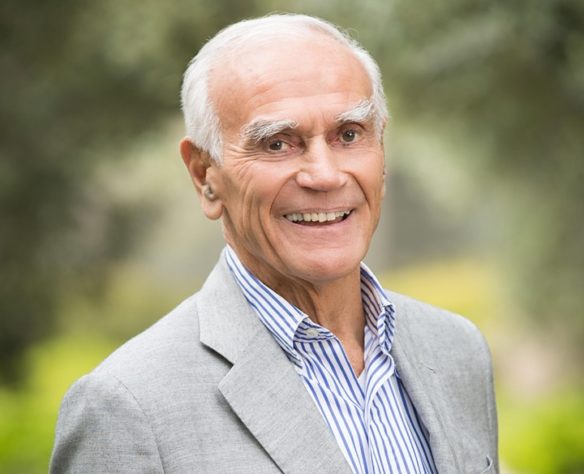
The Arthur C. Clarke Foundation has announced the 2020 Unleash Imagination Award winners.
2020 Imagination in Service to Society
Ted Chiang
The Hugo and Nebula award-winning writer of fiction that stretches our imaginations in profound and empathetic ways. Stories of Your Life and Others has been translated into 21 languages, and Exhalation was chosen by the New York Times as one of the 10 Best Books of 2019.
2020 Innovation Award
CERN
Accepted by Dr. Fabiola Gianotti,the Director General of CERN, the European Council for Nuclear Research, incubator of the World Wide Web and the world’s largest particle physics laboratory.
2020 Lifetime Achievement Awardee
William H. Draper III
A venture capitalist pivotal in the development of Silicon Valley who also served as a prominent federal government leader.
The awardees will be part of the “Clarke Conversation on Imagination: Crises and Renewal” on November 12, a live online interactive event. Register here for access.
(1) BEAMING UP OR BEAMING DOWN? How likely is The Orville to stick around? Follow the ratings chart and compare it to the competition. Although interest has tailed off since the first couple of episodes, its audience is comparable to a lot of other shows in its time slot.
Look, I have been waiting years to say this and I just can’t hold back anymore. Science fiction is full of horrible dad figures. We know this. There are so many that we’d be hard pressed to decide the winner of that Battle Royale, particularly given the scope of their terribleness. Anakin Skywalker Force-choked his pregnant wife and tortured his daughter. Howard Stark emotionally abused his son into creating the “future” he wanted to bring about, and never managed to utter the words I love you. Admiral Adama made his eldest son feel totally inferior to both his dead son and his surrogate daughter, and then left him alone on a new world so he could spend three minutes with his dying paramour. Sci-fi dads are generally bad at their jobs.
But you know who it the absolutely worst? Spock’s dad.
Yeah. I’m looking at you, Sarek of Vulcan…
It’s a great hook for an article. It’s even greater if you’re old enough to remember that Jane Wyatt, the actress who played Spock’s mother in TOS, had spent years playing the mother in that ultimate patriarchal sitcom Father Knows Best.
(3) SCARY METER. The “2017 Halloween Poetry Reading” is up at the Science Fiction and Fantasy Poetry Association website, with soundfiles of the poets reading their works.
Already, poems are available by emerging and award-winning poets such as Melanie Stormm, F.J. Bergmann, John C. Mannone, Angela Yuriko Smith, Richaundra Thursday, Joshua Gage, Adele Gardner, Gary Baps, Celena StarVela, Marie Vibbert, and Deborah Davitt. Others will be added as Halloween comes closer!
Readers have been asking me for a while now about when the next Shadow Police novel is coming out. The unfortunate answer is: I don’t know, verging toward never. I’m afraid Tor UK have dropped the line. Now, this is no cause for anger at them. I serve at the pleasure of publishers. I’m used to the ups and downs. (And I know I have several ups coming my way soon, so I feel strong enough to write about this.)
I might, at some point in the future, consider using a service such as Unbound to publish the last two books in the series. (There were always going to be five.) And if a publisher were to get in touch, seeking to republish the first three, then go forward, I’d have that conversation. But the aim right now is to continue with the flourishing Lychford series, and look to use the next non-Lychford novel to move up a league division or two, and then return to Quill and his team from a position of strength.
I’m sorry to be the bearer of bad news. I’ve loved the reader reaction to the Shadow Police books. I promise I will finish that story when it’s possible to do so. I thought you all deserved an explanation.
(5) AS SEEN ON TV. Today, Jeopardy! obliquely referenced the various Puppy campaigns in a question:
Any member of the World Science Fiction Society can vote for this literary award, which has led to some drama.
Rich Lynch says nobody got it. Steven H Silver called it a “Triple stumper.”
Now that’s what I call “music about aliens systematically wiping out humanity!” This song, bone-deep in its pessimism, explains in some detail why we’ve got this coming: we’re oblivious to everything around us; we’re afraid for reasons we don’t understand; and above all, we’re gonna be a cakewalk for the aliens to conquer. And has there ever been a lyric that crystalized this particular moment in time as well as “At this time, sirs, I recommend that we proceed to Phase Three: Eradicate them all for the glory of our interstellar queen”? Probably. But once the interstellar queen arrives and starts eradicating us, this is going to be the hottest jam of the summer.
(7) DRAGON ART. Hampus calls this a “Meredith painting” – an artist paints an elaborate dragon in one stroke. Apparently this is a thing in Japanese art.
Back in 2015, American startup MegaBots Inc challenged Japanese company Suidobashi to a Giant Robot Duel–a knock-down dragout, totally-not-staged fight between the US and Japanese robot teams. On Tuesday night, the final fight went down. Here’s the breakdown, starting with Round 1:
Iron Glory (MK2) is fifteen feet tall, weighs six tons, has a 22-foot wingspan at full extension, a top speed of 2.5 miles per hour, a 24 horsepower engine, and is armed with a missile launcher and a six-inch cannon that fires 3-pound paintballs. Iron Glory is described as favoring a “Western” combat style, with an emphasis on distance and ranged weaponry….
(9) SAGA FIGURES. Funko is working with Skybound Entertainment to produce figures from the Saga graphic novel series. Nine figures have been announced, which include a couple of variants and one exclusive to Barnes and Noble: “Funko SAGA Pops are Coming!” The figures will be available in February of 2018.
It’s no secret that we here at Skybound LOVE Brian K. Vaughan & Fiona Staples’ Eisner Award winning comic SAGA. We love it so much that in the past couple years we’ve teamed up with Brian and Fiona to bring you a ton of amazing merch for the series. Today, we’re happy to announce that everyone’s favorite space opera is OFFICIALLY get the Funko Pop! vinyl treatment.
We’ve got Marko, Alana, The Will, Prince Robot & Lying Cat coming your way and they’re adorable! These guys will be dropping at a shop near you in February. Make sure to keep an eye out for retailer exclusives (like Izabel at Hot Topic) and chase variants. You can see the first images for the figures below. Let us know in the comments which Funko pop you’re most excited for (the correct answer is: ALL OF THEM. Just fyi).
(10) BIRD UPDATE. In October 2015, File 770 linked to a GoFundMe appeal by science fiction writer RP Bird (RP’s Cancer Survival Fund). Terhi Törmänen has news about a new appeal for help:
RP Bird survived cancer treatment but is not in good health and still suffers from chronic and almost debilitating pain. He’s actually currently quite desperate as you can read from his latest appeal.
He’s been able support himself through a low-paying part time job that he’ll probably lose in very near future.
He’s launched a new appeal to raise money to be able to go trough further facial and dental surgery to improve his ability to e.g. eat properly and lessen the pain and other health issues stemming from the cancer and its treatment. The state will pay for the operations but he does not have any savings to pay rent for his one-room accommodation and other very modest living expenses while he’s going through the operations and recovering from them. His appeal is quite reasonable $ 2000.
I think that if you’d mention his desperate situation in the File 770 the appeal might have a chance to succeed and a life could be saved.
Meet Sophia, a robot who made her first public appearance in the Saudi Arabian city of Riyadh on Monday.
Sophia was such a hit she was immediately given Saudi citizenship in front of hundreds of delegates at the Future Investment Initiative in Riyadh on 25 October.
But as pictures and videos of Sophia began circulating on social media many started to ask why a robot already seemed to have secured more rights than women in the country
Sophia, created by Hong Kong company Hanson Robotics, addressed the audience in English without the customary headscarf and abaya, a traditional cloak which Saudi women are obliged to wear in public.
“I am very honoured and proud for this unique distinction,” she said. “This is historical to be the first robot in the world to be recognized with a citizenship.”
"It is historical to be the first robot in the world to be recognized with citizenship." Please welcome the newest Saudi: Sophia. #FII2017pic.twitter.com/bsv5LmKwlf
(13) SJW CREDENTIAL RENEWED. Bruce Arthurs tells “My Best True Cat Story”at the Undulant Fever blog.
…Hilde and I exchanged looks as we drove slowly by, but didn’t want to upset Chris before church. So I drove them to church, then came back, retrieved the body, took it home, and buried it in the back yard, with a lot of tears. (He may not have been THE World’s Best Cat, but he was a contender.)…
(14) IT’S IN THE BAGON. “Do you have a hoard that needs guarding? A dragon could be your greatest ally,” says the person behind the Dragon Bagons Kickstarter.
After a successful Kickstarter campaign to launch Bagthulhu’s conquest of the globe, Wayward Masquerade is back with a range of CR10 cuties that want to hoard all your dice. They’ve raised $6,216 of their $18,260 goal as of this writing, with 26 days left in the appeal.
(15) CEREAL JUSTICE WARRIOR. Saladin Ahmed’s tweet in protest yielded an immediate promise from Kellogg’s to change some art.
Kellogg’s will be redesigning Corn Pops cereal boxes after a complaint about racially insensitive art on the packaging.
The Battle Creek, Mich.-based cereal and snack maker said on Twitter Wednesday it will replace the cover drawing of cartoon characters shaped like corn kernels populating a shopping mall. The corn pop characters are shown shopping, playing in an arcade or frolicked in a fountain. One skateboards down an escalator.
What struck Saladin Ahmed was that a single brown corn pop was working as a janitor operating a floor waxer. Ahmed, current writer of Marvel Comics’ Black Bolt series and author of 2012 fantasy novel Throne of the Crescent Moon, took to Twitter Tuesday to ask, “Why is literally the only brown corn pop on the whole cereal box the janitor? this is teaching kids racism.”
He added in a subsequent post: “yes its a tiny thing, but when you see your kid staring at this over breakfast and realize millions of other kids are doing the same…”
Kellogg’s responded to Ahmed on the social media network about five hours later that “Kellogg is committed to diversity & inclusion. We did not intend to offend – we apologize. The artwork is updated & will be in stores soon.”
David K.M. Klaus sent the link along with this quotation:
“Don’t you see, Tommie? I’ve explained it to you, I know I have. Irrelevance. Why, you telepaths were the reason the investigation started; you proved that simultaneity was an admissible concept…and the inevitable logical consequence was that time and space do not exist.”
I felt my head begin to ache. “They don’t? Then what is that we seem to be having breakfast in?” ”Just a mathematical abstraction, dear. Nothing more. She smiled and looked motherly. “Poor ‘Sentimental Tommie.’ You worry too much.” Time For The Stars by Robert A. Heinlein, 1956
Science fiction author and native son Ray Bradbury wrote about 1920s Waukegan as “Green Town” in three books, “Dandelion Wine,” “Something Wicked This Way Comes” and “Farewell Summer.”
Bradbury died in 2012. A park, two arts festivals, and a tavern downtown bear his name
Robert Sobol, owner of Green Town Tavern in Waukegan’s downtown district, originally opened the place under a different name in 2006. His business partner left and Sobol took over the bar two years later. Sobol was looking for a new name, so he held a contest asked his customers to think of one. Green Town was declared the winner with the most votes….
Green Town Tavern offers a Saturday Happy Thyme Breakfast from 8 a.m. to noon and features breakfast dishes like the Green Town Omelette — three eggs, bacon, sausage, onions, peppers and cheddar cheese with hash browns — and “Waukegan’s Finest Bloody Mary.”
Vincent D’Onofrio has been set to reprise as Wilson Fisk for the third season of Daredevil, I’ve learned. As the Kingpin crime lord, the Emmy nominee was the main villain in Season 1 of the Netflix series and made an imprisoned appearance in last year’s Season 2. The ex-Law & Order actor hinted to fans recently that official word on his Daredevil return was in the cards with a banner photo of the Fisk character up on his Twitter page
(19) KARLOFF AND LUGOSI: A HALLOWEEN TRIBUTE. Steve Vertlieb invites you to read his posts about the iconic horror actors at The Thunder Child website.
He was beloved by children of all ages, the gentle giant brought to horrifying screen existence by electrodes and the thunderous lightening of mad inspiration. Here, then, is my Halloween look back at the life and career of both Frankenstein’s, and Hollywood’s beloved “Monster,” Boris Karloff.
Here is my affectionate Halloween tribute to Bela Lugosi…his “horrific” career ascension, as well as its poignant decline…as we remember The Man Behind Dracula’s Cape.
We’ve already found our favorite mashup of 2019: Boyfriend Dungeon, a dungeon crawler from indie team Kitfox Games (Moon Hunters, The Shrouded Isle), which combines hack-and-slash gameplay with very, very cute guys and girls.
Boyfriend Dungeon is exactly what it says on the tin, based on the first trailer. Players are a tiny warrior fighting through monster-ridden areas. Scattered across the procedurally generated dungeons are a bunch of lost weapons — which, once rescued, turn out to actually be extremely cute singles.
That’s when the dungeon crawler turns into a romance game, and it’s also when we all realized that Boyfriend Dungeon is something special. Every romance option has their own specific weapon to equip, from an epee to a dagger and then some. Players work to level up those weapons, but also to win over these sweet babes during dialogue scenes. If this isn’t the smartest combination of genres we’ve seen in some time, we don’t know what is.
[Thanks to John King Tarpinian, Hampus Eckerman, JJ, David K.M. Klaus, Dann, Steven H Silver, Rich Lynch, and Cat Eldridge for some of these stories. Title credit goes to File 770 contributing editor of the day Acoustic Rob.]
The tantalizing possibility that neutrinos were measured traveling faster than light was big news last September, told here in “Light Finishes Second” —
[CERN physicists] beamed muon neutrinos from an accelerator at CERN outside Geneva to a detector at the Gran Sasso National Laboratory in Italy, about 450 miles away, to see how many showed up as a different type, tau neutrinos. Neutrinos come in a number of types, and have recently been seen to switch spontaneously from one type to another. The neutrinos in the experiment were detected arriving 60 nanoseconds sooner than if they’d been traveling at lightspeed.
Jerry Pournelle answered the latest findings on Chaos Manorwith this comment:
The applicable Pournelle’s Law was one of troubleshooting: 90% of the time it’s a cable. I first formulated that back in S-100 days, and it’s still true. Now it may be that we’re better off without faster than light neutrons, but I for one regret that they’re going away. Of course this was always the way to bet it, but it was a more intereresting universe when everything we thought we understood was fundamentally wrong…
I applaud that attitude in a hard science fiction writer. And it seems CERN’s scientists themselves may not be finished with the question. CERN’s OPERA team, the group doing these experiments, say the faulty cable could have led to an undercalculation instead, meaning the neutrinos may have exceeded lightspeed by an even greater margin than previously suggested:
“The optical fiber connector … brings the external GPS signal to the OPERA master clock,” explained the science lab, and it “may not have been functioning correctly when the measurements were taken. If this is the case, it could have led to an underestimate of the time of flight of the neutrinos.”
On the other hand, another equipment issue under review may restore the mundane universe to status quo ante:
A second issue with the study involves an oscillator used to provide the time stamps for the GPS synchronization. Flaws with that gadget may have led to an overestimate of speeds — keeping neutrinos in line with Einstein’s theories.
Light, don’t look back — something may be gaining on you.
A team of experimental physicists at CERN say they have measured neutrinos traveling faster than the speed of light.
They beamed muon neutrinos from an accelerator at CERN outside Geneva to a detector at the Gran Sasso National Laboratory in Italy, about 450 miles away, to see how many showed up as a different type, tau neutrinos. Neutrinos come in a number of types, and have recently been seen to switch spontaneously from one type to another.
The neutrinos in the experiment were detected arriving 60 nanoseconds sooner than if they’d been traveling at lightspeed.
Were they wind-assisted? Should they be tested for steroids? Well, it’s no laughing matter to scientists who depend on Einstein’s Special Theory of Relativity to explain their other observations.
It’s possible the neutrinos’ passage hadn’t been timed accurately. Or maybe the neutrinos were traveling through different dimensions, taking shortcuts from Geneva to Gran Sasso.
Shortcuts through other dimensions? Is that a quote from Doctor Parke or Doctor Who?
Providing an anticlimactic fizzle to its controversial launch, CERN’s Large Hadron Collider has proven dangerous only to itself. Operations have twice been interrupted by mechnical problems, and the latest will take months to repair.
In a statement Thursday, the European Organization for Nuclear Research reported for the first time that a 30-ton transformer that cools part of the collider broke, forcing physicists to stop using the atom smasher just a day after starting it up last week.
During commissioning (without beam) of the final LHC sector (sector 34) at high current for operation at 5 TeV, an incident occurred at mid-day on Friday 19 September resulting in a large helium leak into the tunnel. Preliminary investigations indicate that the most likely cause of the problem was a faulty electrical connection between two magnets, which probably melted at high current leading to mechanical failure. CERN’s strict safety regulations ensured that at no time was there any risk to people.
A full investigation is underway, but it is already clear that the sector will have to be warmed up for repairs to take place. This implies a minimum of two months down time for LHC operation. For the same fault, not uncommon in a normally conducting machine, the repair time would be a matter of days.
The Geneva-based particle physics laboratory has stressed in a peer-reviewed report the soundness and safety of the project. But the media’s morbid fascination with the possibility of – almost a longing for – a disaster has prompted one service to offer live video of the LHC startup, while CERN has promised journalists satellite uplink will be provided throughout the day by Eurovision.
But when it comes to discussing the Large Hadron Collider, quite in contrast to other scientific controversies of the day, say, global warming, the left and right wings of the sf community are surprisingly in agreement that there’s little reason to get in an uproar.
Cheryl Morgan scoffed at “A Nation of Doomsayers” while pointing out The Guardian’s silly opinion poll that poses two extreme choices: “Are you worried the atom smasher will unwittingly destroy the planet or is that scientifically illiterate, millenarian twaddle – which is it to be?”
Well, according to a German chemist it won’t matter since they will create a Quasar in the center of the Earth, and in a few years we’ll see light beams coming out of the oceans, after which we are all doomed.
The most reassuring prediction I’ve found about the imminent startup of LHC was Stephen Hawking’s $100 bet with Professor Gordy Kane, of MichiganUniversity, over the existence of the Higgs boson. Not because Hawking might win, but because he clearly expects to be around to settle the bet.