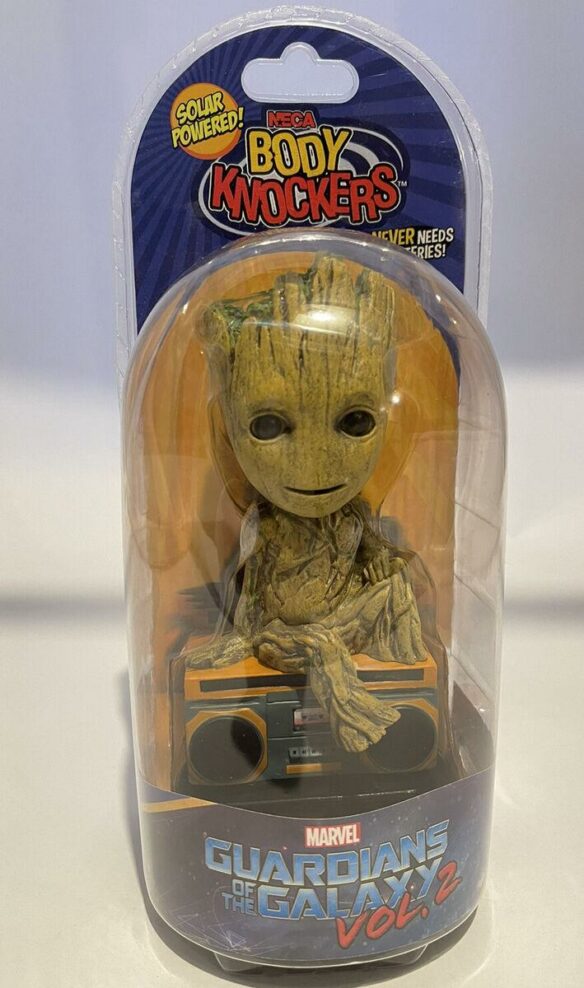
NECA Marvel Guardians of the Galaxy 2: Body Knocker Groot
Review by Cat Eldridge: Unlike the first film with its very adult Groot, Guardians of the Galaxy, Volume II features a much smaller Groot, say about a foot in height. Whereas the adult Groot came across, at least to me, as a bit somber, this one’s a hyperkinetic creature about as disciplined as a kitten in what it should do and not do. And that’s why I decided I wanted an action figure of him that I’d be placing – naturally — among my houseplants.
There are lots of baby Groots on the market, no surprise there, with a very nice life-sized one from Hot Toys that’ll set you back just under two hundred dollars. Errr… no thanks as even if I could afford it playing in the houseplants simply wouldn’t do.
Mine was a mere seventeen dollars and does just fine even if I’ll never use the shake and shimmy feature. Yeah the one I like and purchased at Newbury Comics is called NECA Marvel Guardians of the Galaxy 2: Body Knocker Groot.
He’s not big, I’d say just about four inches on a boom box as you can see from the image here. He’s cute, very much a plant creature sitting among my house plants. Theoretically he’s solar powered but I’m betting he’s not waterproof so that’ll short out if you put him where I have.
He’s got the right face as even the eyes are superb for such a small figure, and the smile is just right. Even the Boom Box that he’s sitting on is nicely detailed and looks like it could actually play music. On the other hand adult Groot looks too much like an Ent in Peter Jackson’s Lord of The Rings movies, but this looks utterly original. Did I say he’s cute? Well he is. Utterly cute.
[Introduction: Melanie Stormm continues her humorous series of posts about the misdirected emails she’s been getting. Stormm is a multiracial writer who writes fiction, poetry, and audio theatre. Her novella, Last Poet of Wyrld’s End is available through Candlemark & Gleam. She is currently the editor at the SPECk, a monthly publication on speculative poetry by the SFPA.]
THE PROCRASTINATE-A-THON
Hello, All! Melanie here.
Last week, Writer X was met with some strange behavior from her boyfriend and fellow writer, Tod Boadkins. In previous weeks, Tod had promised X a “romantic gift” if she could refrain from defending her BFF’s feelings with violence.
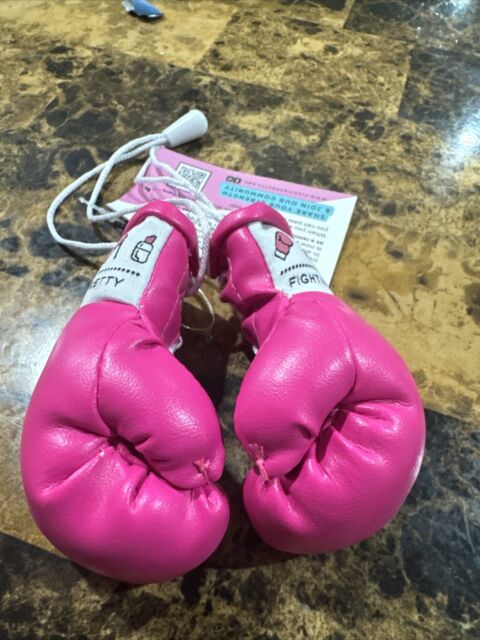
Surprise, surprise! X did this. She was rewarded with a gift and a comment that the gift had been made possible by the money Tod had saved on bail money. It was a pair of hot pink boxing gloves.
X immediately put these to use in settling the score between her and an unpleasant visitor from Massachusetts. That’s when Tod started acting strangely anxious. It turns out the pair of boxing gloves weren’t the present, but served as a sort of “wrapper” for the real present…
Which was a ring.
In the meanwhile, Tryxy the Demon and #bestkitten were flush with excitement from their latest gig. They’re supposed to be writing music and launching a website for their band, but sometimes we don’t do what we’re supposed to do.
Without further ado…
Subject: PROCRASTINATE-A-THON
Dear Gladys,
As you know, the town has announced at the very last possible minute that it’s holding a procrastinate-a-thon to raise money to purchase an extra large wall calendar for the town council so that they can see what they should be working on and when it should be done by.
Previously the town would prioritize tasks by rushing off to whatever thing had caught on fire at the moment, but after the grease fire in the kitchen of the parks department, it was clear that new approaches had to be put in place!!!
The extra large wall calendar should fix this, but they have a stretch goal that would allow them to get a large monkey to periodically set fire to the extra large wall calendar as a means of encouraging them to not ignore the calendar in the ways that calendars are obviously designed to be ignored.
I have come up with an incredibly genius plan to beat EVERYONE and raise the MOST money!!!!
The way it works is that participants select a task that they’re going to procrastinate about and get pledges from friends and family. For every hour the participant procrastinates on their task, the pledgers agree to pay whatever amount to the Extra Large Wall Calendar Fund. There are also bonus pledges allowed if the task that is being procrastinated is something you really have no business procrastinating about.
Now Gladys, you can bet that most participants are going to be uncreative. They’re going to procrastinate on all the usual things. Things like cleaning your gutters, or exercising, or doing your taxes, or seeing your doctor about the peculiar smell of pickled mangos that keeps wafting from your feet after you go running which is why you keep putting off exercising. BUT MY PLAN IS AMAZING!!!!!
Oh, and all of my friends at the Ink Black Coffee Club Critique Group have decided that since we’ve all been procrastinating about our latest writing projects, that it made sense to keep doing it for a good cause. Every single one of them has filled out their pledge sheet with the name of their latest work-in-progress. And they’re ALL gloating because everyone knows that writers are professional procrastinators so CLEARLY NO ONE IN TOWN KNOWS WHAT THEY’RE IN FOR!!!!!!!
Taxes??? They’re procrastinating on something as easy as taxes???? No one wants to do their taxes, it’s EASY to procrastinate on doing your taxes. BUT WRITING. Oh, YES, WRITING!!!!! Writing is something literally no one cares if you do and may suddenly get a glazed over expression if you bring it up at parties so the only reason to write IS BECAUSE YOU REALLY REALLY REALLY LOVE IT!!!!!!
And who procrastinates doing stuff they really really love????? WRITERS!!!!!!1
We’re AMAZING.
BUT WITH THIS PLAN I’M GOING TO BEAT ALL THE WRITERS, TOO!!!!!!!!!!!!!!! I just need to borrow your dishwasher. If you could just throw it in your car and bring it to me now, that’d be perfect.
Anyhoo, I’m sure you’re dying to know how my love life is going.
The ring that my meta fiancé, award nominated fantasy writer Tod Boadkins gave me FITS PERFECTLY!!!!!! And of course I said yes to whatever it was he was asking. Which it turns out is to be meta-engaged!!!!! I’m META ENGAGED, GLAYDS!!!!!!!!!
I’m going to be married eventually!!!!!
Of course you probably don’t know what meta engaged means because you’re behind the times and we’re very progressive so I guess I’ll explain. My meta fiancé has had several long talks with his therapist who’s pointed out that he’s afraid to “seriously commit to anything else but writing” and “why does he have such a hard time trusting others enough to express commitment” and “isn’t it time he face this tendency head on?”
That’s when he had the brilliant idea of proposing because we already mostly live together and, according to him, the thought of me marrying him makes him “incredibly happy” about sixty percent of the time and “incredibly panicked” the other forty percent.
And that when he came up with the idea of a meta-engagement. This means that it is probably going to take years for us to actually get married because our engagement is more “abstract” than “concrete.” A meta-engagement is to engagements what metaphilosophy is to philosophy which basically means that you can’t earn a college degree on the topic but you can use it to make people feel like you MIGHT be smarter than them.
In the meanwhile, Tryxy and #bestkitten are in a slump. They were so giddy last week about making a website and writing new music, but now they have what Tryxy is calling the No Upcoming Gig Blues. They SHOULD be working on planning their website and writing new music, but neither of them has the motivation since their festival gig isn’t until late May when New England can be very-nearly-but-not-quite safe from having four feet of snow suddenly dumped on us.
Instead, Tryxy is trudging around the house in his favorite velour tracksuit and matching house slippers, doomscrolling, and drinking coffeemate directly from the bottle with no chaser. The more he drinks, the more sluggish he gets because apparently he needs the stimulation of a weekly gig to plan websites and work on new songs. And #bestkitten is a cat.
Anyhoo, what else was I saying???? Oh yes!!!!
This is how I’m going to win the Procrastinate-a-thon.
I’m not just procrastinating on writing my latest work-in-progress, I’M PROCRASTINATING EVEN THINKING ABOUT WHAT MY LATEST WORK IN PROGReSS WILL Be!!!!!!!
But that’s not all.
The most ingenius part of what I’m doing to win is that the Procrastinate-a-thon OFFICIALLY ENDeD thIS MORNING!!!!!
Yes, Gladys, you’ve read that right. I’m TURNING IN MY PLEDGE SHEET AFTER THE EVENT HAS ENDED!!!!!
I just need you to loan me your dishwasher. It has nothing to do with the Procrastinate-a-thon. It’s just that there’s been a pile of dishes in our kitchen sink that has been there so long, no one can remember who’s turn it was to do the dishes and I’m pretty sure it was Tryxy’s so I need to give him YOUR dishwasher so he can stop putting it off. I DON’t NEED ANY MORE COMPETITION IN THE PROCRASTINATE-A-THON.
As I think of it Gladys, WHAT IF EVERYONE IN MY HOUSE IS COMPETING AGAINST ME??? WHAT IF META-ENGAGEMENT IS Just a way to procrastinate about marriage????
We could be engaged for years!!!! Possibly Even FOREVER!!!!1 This man is truly a genius. And what about Tryxy and #bestkitten putting off making website plans?????
Gladys, do you think they’re participating in the fundraiser too???? I don’t know who to trust!!!! Don’t tell anybody my secret!!!!! And also please don’t put off bringing me your dishwasher, I don’t need YET ANOTHER COMPETITOR!!!!
Pages next week, Gladys!
xox,
X
P.S. Please sign up and pledge to support me as I procrastinate. I’m accepting contributions of $20 an hour or more. THANDK YOU!!!!!
[Introduction: Melanie Stormm continues her humorous series of posts about the misdirected emails she’s been getting. Stormm is a multiracial writer who writes fiction, poetry, and audio theatre. Her novella, Last Poet of Wyrld’s End is available through Candlemark & Gleam. She is currently the editor at the SPECk, a monthly publication on speculative poetry by the SFPA.]
THE BOXING GLOVES MYSTERY
Hello, All! Melanie here.
When we last left our heroes, Tryxy the demon and his bandmate #bestkitten were booked to play a show at Paul Revere Preschool & Craft Brewery in Boston. There were threats of Cthulhu cultists, talent abductions, misguided GPS directions, and even a ghoul attack, but DemonKitty put on a great show regardless! The band is starting to go places, which Tryxy’s always wished for.
This gig was made possible by Arnold Rolfson, an A&R rep whose selfishness makes Writer X want to protect her BFF Tryxy’s feelings with violence.
But here’s the twist, last week Tod Boadkins, Writer X’s boyfriend, promised her a “special romantic present” if she could refrain from violence for a whole week. And guess what? She did it! A surprising success, indeed.
I didn’t think she’d make it. Since she’s been working hard to lose weight, X has been punchier than usual. I don’t blame her. Nothing fuels the temper like eating fewer carbs.
Without further ado…
Subject: TOURIST SEASON!!!!!!
Dear Gladys,
I don’t know how I’m supposed to focus on being the next big epic fantasy writer of all time when spring tourist season is already upon us!!!!
Sure, New Hampshire is a rugged and beautiful land of pristine lakes, angry sasquatches, vengeful ski slopes, and haunted antiques, but why do people from the state-south-of-us-that-shall-not-be-named insist on coming up here and MASS-ing everything up????
It all started when we got back from Boston last week. I needed to focus on next moves for getting DemonKitty out to the world. I also discovered I gained three pounds from when I accidentally drank a guzzler mug full of movie theater butter.
Nothing makes me focus like a good power walk in a new location so I started going down to Tatoskok lake to walk the new paved path on the shore line.
I was getting on some speed when I passed the cabins and that’s when I met that gosh darn kangaroo!!!!!! Don’t you hate it when Franklin Park Zoo lets its animals out on vacation???? Some of those animals are used to being in the spotlight and they have no idea how to interface with the rest of us mere mortals!!!!
Anyhoo, this kangaroo hops out of the larger cabin with a margarita in his paw and starts sucking it through a straw and watching me as I went by with a bored, amused expression on his face.
I was just a couple feet away when he says, “That’s a lot of pink for someone no one wants to look at. Spandex isn’t everyone’s friend.”
It took a second for me to understand him because of his accent and then another whole second for me to realize HE WAQS TALKING TO ME!!!!!
Now Gladys, I bet you probably think that all kangaroos have Australian accents but that’s just an example of stereotyping a species. This kangaroo definitely sounded like he was from the bronx.
I was so upset, I couldn’t concentrate, but I also couldn’t clobber him because I promised my boyfrriend, award nominated fantasy writer Tod Boadkins, that I wouldn’t get violent for a whole week and I still had two days to go thanks to a minor setback with a loud cellphone talker in the library.
But I went the next morning hoping for some peace and quiet so that I could create a masterplan for DemonKitty and it was like that kangaroo was waiting at the door watching for me to come!!!!!
“Nice hair curlers. Goes with your huffy puffy look. In fact, that’s what I’ll call ya. Liddle miss Huffy Puffy. How ya doin Miss Huffy Puffy?”
I stopped and shook my fist at him but without the ability to follow it up, it only made him double over laughing at me. You should never get into a bare knuckle fist fight with a kangaroo for obvious reasons, everyone knows that.
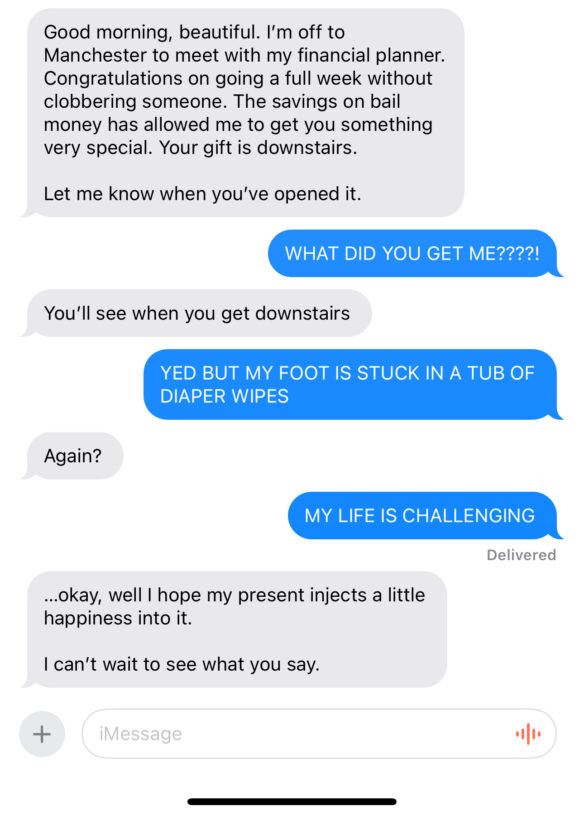
Fortunately for me, my week is up!!!! And I woke up to this text message from my boyfriend.
As soon as I figure out how to get my foot out of this tub of diaper wipes, I’m going to run downstairs and open it!!!!!! Everyone knows you shouldn’t attempt going down a set of stairs with a tub of diaper wipes on your foot.
Safety first, Galdsy!!!!!!!!
xox,
X
Subject: SWEET REVENGE!!!!!!!
Dear Gladys,
Well, I know my boyfriend loves me!!!! Because when I finally got my foot free of those diaper wipes I opened up my special present and found these beauties waiting for me!!!!
How did he know I needed a pair of hot pink boxing gloves?????? It’s like he’s psychic or something, but I know he isn’t because he doesn’t have a certificate like I do.
I instantly texted him and let him know I got his gift and that I was going to put them to immediate use!!!!!
As soon as I finish lacing these up, I’m off to Tatoskok Lake. Let’s see if that bully kangaroo can back up his mouth!!!!!!
This will get me all fired up for our DemonKitty band meeting this evening!!!
xox,
X
Subject: THaT sliPpPEry KAGNAROO!!!!!
Dear Gladys,
it’s been several days since I’ve got my brand new boxing gloves and I haven’t even been able to use them!!!!
Anyhoo, I’m sure you’re dying to know how my writing is going. I’ll have you know I’ve been writing haiku. I’m a well rounded writer. Not everyone can write haiku, you need five syllables, then seven syllables, then five syllables. Even I came to the art accidentally. My first one I wrote this morning when I discovered a haiku hidden in my shopping list. Most of my haiku are “found poetry.” Here’s the one I wrote this morning.
Fat Free Half And Half Low Calorie Rice Cakes Vat of Rocky Road
We have had a few productive meetings about DemonKitty’s future. They’ve been booked for a music festival, but what Tryxy and #bestkitten want to do is figure out how we can get more gigs both in and out of New Hampshire using the music festival booking as a way of proving they’re an in-demand band.
First, we decided we needed a way of letting people know that they’re even playing the music festival. Or any show at all. Other than flyers.
Then, we realized that probably we should focus on making people know that the band exists. We came to the conclusion that we need an OFFICIAL DEMONKITTY WEBSITE. After all, this isn’t just a hobby anymore. DemonKitty are professionals!!!!!!!
The only problem is the webdesigner costs real money and so far DemonKitty has only been paid in t-shirts and soggy, unseasoned curly fries so we’re working with a very low budget.
BUT LET ME TELL YOU ABOUT THIS STUPID KANGAROO!!!!!
Whenever I have my boxing gloves on, I can’t find him!!!!! The first time I went with my gloves, he came out, sucked on his margarita and watched me coming toward him.
“Would you look who’s here? It’s liddle miss huffy puffy. How you doing liddle miss huffy puffy?” And then I got close enough and he saw I was laced and ready to go with a boxing glove on each fist!!!!
“Ah shit,” he said. And then he hopped into his cabin and locked the door!!!!!
No matter what I do, if I don’t have my boxing gloves on, he’s picks on me. If I do have my boxing gloves on, he runs into his house!!!!!
I’ve taken to stashing the gloves in a few different locations so that I can whip them out real fast and lay some hurtin’ on that kanga!!!!!!
In the meanwhile, my boyfriend has been acting very strange since I opened my present. He keeps asking me what my answer is and if the present he gave me gives me any thoughts about us. ???? I keep telling him that I’m very thankful for the present but I am completely focused on the kangaroo right now!!!!!!
I don’t know why he’s upset, I use them every day!!!!!!
xox,
X
Subject: WEBSITE DESIGN!!!!!!
Dear Gladys,
We figured out what to do about the website budget!!!!! I found a free webbuilder service called crappy.web!!!!! At crappy.web, you can design your own professional looking website without having to pay someone who actually knows what they’re doing!!!!!!! I’m going to build demonkitty’s website!!!!!!
Also: i snuck out to the lake last night and while that evil kangaroo was busy partying on his back deck with a couple of sloths and an extremely loud life coach, I slid my boxing gloves into his bushes!!!!!
Just wait til morning!!!!!!
xox,
X
Subject: WHY IS MY BOYFRIEND SO MAD?????
Dear Gladys,
I can’t believe I’m writing you this email from Lake Tatoskok in the middle of the night. My boyfriend, award nominated fantasy writer Tod Boadkins, got SUPER upset tonight when I came home without my boxing gloves.
At first I thought he was angry that I’m planning to fight that kangaroo, but when he found out the kangaroo calls me Liddle Miss Huffy Puffy, he completely agreed that that kangaroo needs to get clocked!!!!
But he was angry that I left them in the bushes especially since the boxing gloves were “so expensive.” I told him that I would replace the boxing gloves if they went missing and that didn’t console him AT ALL.
So now I’m out here at the lake and the lake monster is making super loud growly noises that keeps creeping me out and I’m digging around in the bushes looking for my gloves because my boyfriend said, “It’s not the gloves, it’s what’s inside the gloves!”
I’m pretty sure I just stepped in wet poison ivy.
Okay I’ve got ‘em!!!! I’m just going to dig one hand around inside and…
oh, there’s something in there.
it’s kinda small and hard.
and cirvular.
It’s a ring. With a white metal band and a pink stone.
Gladys, why would there be a ring with a pink stone in my boxing gloves. Why would my boyfriend, award nominated fantasy writer Tod Boadkins, give me a ring???
Review by Denise Kitashima Dutton: I’m always game for dark chocolate. Plus, I’m a sucker for hazelnuts (aka filbert, a name I absolutely love) in any form. So hello, combination of the two! Ghirardelli blends their premium chocolate with nicely minced nuts to create a bar that’s going onto my list of favorite candies.
This chocolate is chewy at room temperature. It’s a nice chewiness, without the waxy feel some lesser chocolate bars have. Substantial scattering of diced hazelnuts give each bite a bit of crunch to go along with that chew. (Note: putting the bar in the fridge gives it a snap that makes it easy to parse out equal squares, and gives the nuts extra crispness.) Ghirardelli makes no mention of the percentage of cacao in this bar, but as it’s in their “Intense Dark” line and the chocolate has a lovely deep color, I’d guess it’s over 70%. Could be wrong in that, though.
Each bar gives you eight 1×1″ squares, which makes parceling out individual nibbles very easy. Y’know, if you’re the kind that can stop at one square. The website says this bar is perfect for sharing, but screw that. It’s too yummy; before you know it, it’s gone.
Pairs well with wine, coffee, a nice oolong, or champagne. If you can stand to share, add squares of this bar to a charcuterie board. It’d make incredible s’mores, especially if you swap your graham crackers with shortbread or solid slices of angel food cake. What? With chocolate this good, you’ll want to head for the good stuff just to keep up.
Denise Kitashima Dutton has been a reviewer since 2003, and hopes to get the hang of things any moment now. She believes that bluegrass is not hell in music form, and that beer is better when it’s a nitro pour. Besides GMR, you can find her at Atomic Fan Girl, Movie-Blogger.com, or at that end seat at the bar, multi-tasking with her Kindle.
[Introduction: Melanie Stormm continues her humorous series of posts about the misdirected emails she’s been getting. Stormm is a multiracial writer who writes fiction, poetry, and audio theatre. Her novella, Last Poet of Wyrld’s End is available through Candlemark & Gleam. She is currently the editor at the SPECk, a monthly publication on speculative poetry by the SFPA.]
PAUL REVERE PRESCHOOL & CRAFT BREWERY
Hello, All! Melanie here.
In previous weeks, our friend Writer X has thrown herself into boosting the music career of her BFF and high-ranking teenage demon Tryxy. When last we heard from them, the band DemonKitty (a band consisting of Tryxy and his adorable cat #bestkitten) had the opportunity to travel to Boston to perform for an A & R rep at a music label.
This is an exciting opportunity for any band, but the music industry is a lot like the publishing industry; it delivers highs and lows, sometimes simultaneously.
Tryxy and #bestkitten’s hopes were dashed when they learned that Arnold Rolfson had no interest in their band but was looking for talented musicians to play his original music.
It wasn’t all bad. Arnold Rolfson later extended the opportunity for DemonKitty to come back to Boston and play for a local preschool. My old music mentor used to tell me, “No matter what happens, always play the gig.”
Without further ado…
Subject: DemonKitty is Shipping up to Boston!!!!!
Dear Gladys,
No one was expecting the ghoul attack. In fact, we spent most of the day worried about how DemonKitty’s show at Paul Revere Preschool & Craft Brewery in Boston was going to go. No matter what we were worried about, it turns out we were worried about the wrong thing.
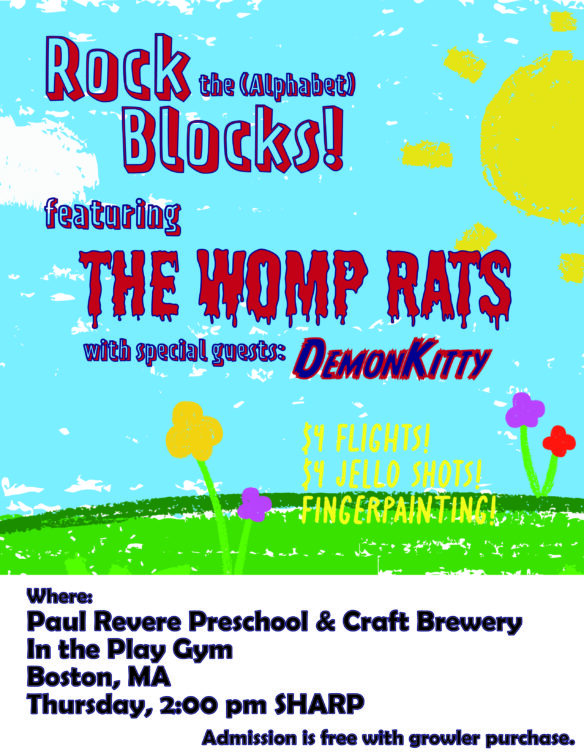
It all started two weeks ago when I got an unexpected text from Arnold Rolfson, the A & R rep for the Yankee’s Suck Label, asking if DemonKitty would be up for opening for local Boston band The Womp Rats at a preschool.
I don’t trust that Arnold Rolfson, Gladys. Not as far as I can throw him. And I’ve been power-walking with weights so I’m pretty sure that’s at least three or four feet. Not that my boyfriend, award nominated fantasy writer Tod Boadkins, will let me test that theory!!!!!
Anyhoo, I’m sure you’re dying to know how my writing is going. Lately, I haven’t been writing much fiction, but I have been writing in my journal a lot and doing this thing I call Word Vomit. Basically, I set my timer for twenty minutes and I write EVERYTHING that comes to my mind whether or not it makes sense. So basically it’s like an email.
Back to the Preschool show!!!
So Tryxy was really excited that Arnold Rolfson invited DemonKitty to open up for The Womp Rats. After all, it would be DemonKitty’s very first show NOT IN NEW HAMPSHIRE!!! And when we were in Boston two weeks ago, we drove by a methadone clinic where we saw an elder god administering medication to someone wearing a Womp Rats t-shirt, so this band is FAMOUS!!!!!!
Personally, I was worried about the venue. Arnold Rolfson stressed me out talking about how DemonKitty has to bring their A game.
He said: “These are very discerning three-year olds. They’re tired of Baby Shark. They want something even more distilled. I just so happen to have written a song that I know would kill it for DemonKitty and, if you ask nicely, I’ll let them play one of my originals.”
I was very stressed out. How was I going to keep from sporking Arnold Rolfson in the ear if he keeps trying to bogart DemonKitty for his own stupid music?? And how was DemonKitty supposed to play for a bunch of discerning preschoolers??? DemonKitty’s music isn’t for everyone. It’s only for the most sophisticated and artistic of listeners like myself.
But Tryxy wasn’t worried. “Half of our songs are just meowing, and we have a cat in the band, and we vomit rainbows at the end. If that doesn’t win preschoolers over, nothing will.”
It turns out, I was entirely worried about the wrong thing, and I’m not talking about the Cthulhu Cultist Parade that was all over the news that morning because Boston officials issued a Cthulhu Manifestation Advisory.
We drove down to Boston and dropped my boyfriend, award nominated fantasy writer Tod Boadkins, off at the John Quincy Adams High School & Cannabis Dispensary because he was asked to host a writing workshop for teens this week. Then, we set off to Paul Revere Preschool & Craft Brewery but GPS accidentally rerouted us to Abigail Adams Middle School & Vape Supply Warehouse.
Tryxy was clutching his knees with anxiety. We had lost an ENTIRE hour with the GPS accident and he was sure we were going to get to the school late and make a very bad impression on the Womp Rats. He had bought a Womp Rats t-shirt for them to sign. Then, to make matters worse, we couldn’t find parking ANYWHERE NEAR THE SCHOOL.
It turns out, there was nothing we could do about the Womp Rats. The second I drove through the gym doors and parked on the indoor play gym, Arnold Rolfson came up to us and told us that the Womp Rats were threatening not to play because they were unhappy he had booked DemonKitty as their opening act.
It turns out The Womp Rats had requested a band called “Lieger Tiger” to open for them. Apparently Lieger Tiger is a high brow free form jazz act that uses only bear horns and fingernails on chalkboards for all their sounds. The Womp Rats thought that if a “bunch of nobodies like a demon and a cat” opened for them, that they’ll stop pulling in better venues.
That was CRUSHING. And when I saw the look on Tryxy’s face, I very nearly kidnapped all three members of the Womp Rats and tied them up in an industrial trash compactor where they could be crushed for crushing my BFF, but my boyfriend, award nominated fantasy writer Tod Boadkins, promised me that if I refrain from hurting anyone for a full week, he’s got a romantic surprise for me!!!!
Anyhoo, we muscled through the situation and started setting up Tryxy’s drum kit when the preschool administrator came running into the gym saying that students were being kept in their classes until the Cthulhu Cultist Parade passed by and we could be reasonably assured that the kids wouldn’t be eaten by a god-monster before the busses came.
I don’t know why Boston gets so up in arms about Cthulhu. Everyone knows that Cthulhu rarely attacks Suffolk County. IT’S ESSEX THAT HAS TO WATCH OUT!!!!!
THEN, it turns out the school had to delay the show even more because, after the Cthulhu cultists passed, it was time for the children to attend some special Touch and See craft activity called “How to Grow a Callous on Your Liver and a Chip on Your Shoulder For Young Bostonians.”
So the show was delayed by a whole HOUR. Every single minute, Tryxy got more anxious that the Womp Rats would make good on their threat not to play at all, and he even began to doubt himself!!!!
Sure enough, the clock struck three and about one hundred preschoolers were released into the play gym like a pack of Juicy-Juice fueled piranhas. That’s when Tryxy began to crash his cymbals and beat his drums like he’d never play again.
The CROWD WENT WILD!!!! They sang their hits “Ninevah Burns In My Soul,” “Meow,” and “Meow Meow” TWICE because the kids ate it up. You should’ve seen the little preschooler’s faces light up when Tryxy worked his magic and he and #bestkitten opened up their mouths like they were going to throw up and rainbows of light streamed out of their mouths over the gym!!!!!
There was NO WAY the Womp Rats could follow that.
And luckily for them, they didn’t have to. Because everyone knows that Boston’s problem isn’t with Cthulhu. Boston’s problem is with Ghouls. Ghouls are always taking over the North End and the T. And it just so happens that Paul Revere Preschool and Craft Brewery is near the North End and that’s when about thirty ghouls barreled through the broken gym doors I’d driven through and carried off the Womp Rats and about sixty growlers of Belgian White.
A REPORTER’S NOTEBOOK: A FEW THOUGHTS ON SOME OF THE 2024 HUGO AWARD FINALISTS
By Chris M. Barkley: I, like many of you reading this, were absolutely riveted around 11:00 a.m. (Eastern Detested Time, as far as I’m concerned) on March 29th when the 2024 Glasgow World Science Fiction Convention Committee announced the Finalists for the Hugo Awards.
Having (possibly) won a Hugo Award in the Fan Writing category a mere five months and a week ago, I have a vested interest in the proceedings. As many of you may remember, I did recuse myself from future consideration in the category in my (somewhat surprising) acceptance speech on the stage of the 2023 Hugo Awards Ceremony in Chengdu, China. I’ll say more on this later on.
From the safety of our kitchen nook, my partner Juli and I watched the YouTube video presentation of the Finalists:
Naturally, having been associated with the awards for a full quarter century (WHERE did the time go?), I have a few thoughts about this year’s Finalists:
— The very first thing that jumps out at me is that there are numerous nominees from China. After the debacle over explosive revelations regarding the 2023 Hugo Awards and the numerous calls for accountability and transparency over the past few months, it is heartening to know that despite the fact some of them were legitimately denied their voting rights, fans in China showed that they are still willing, at least for the time being, to being part of this process. I hope you are as excited as I am about this encouraging sign.
Before last year, the Hugo Awards had a reputation for being transparent in their processes and publication of voting results, something other prestigious literary awards (the National Book Awards, the Pulitzer, Booker and Nobel Prizes) notoriously do not divulge.
And, I argue, it is because that tradition was egregiously transgressed and the corruption was thankfully exposed.
Needless to say, I can hardly wait for this year’s Hugo Nominee packet and read entries they chose.
— But, on the other hand, I am disheartened to read that several people, most prominently Bigolas Dickolas Wolfwood (in Best Related Works), Natasha Bardon (Best Editor-Long Form) and Camestros Felapton (Best Fan Writer), Hai Ya (Best Novelette, The Far North), Martha Wells (Best Novel, System Collapse) turned down their nominations. Each had their own reasons; while I don’t know why Wolfwood and Hai Ya declined, Martha Wells has previously stated she would not accept any more nominations for her Murderbot stories or novels. On his blog page, Felapton stated that:
“2023 looms large here and there were definitely people I would rather see on the Hugo ballot for Best Fan Writer this year than myself. One was obviously Paul Weimer but I was certain he’d be top of most people’s ballots anyway but I was hoping some Chinese fans would make it onto the category. That didn’t happen but it is a decent list of finalists and there is nobody there that I would have wanted to replace.
Closely related to this was also the sense that I was likely to have gathered additional votes from things that I had written in 2024, specifically on the 2023 Hugo Award stats. Even if that wasn’t the case it would have felt like it was the case to me. So, I thought I’d feel happier skipping this year and putting my hat into the ring for next year.
I hope that makes sense. Thank you to everybody who voted for me and apologies for not publicly asking people not to vote for me before the deadline. 2023 stuff sort of got in the way of thinking about 2024 stuff.
I must state for the record that I have the utmost respect for Mr. Felapton and his works, and if I had not totally screwed up my timing on getting my ballot in, his name would have occupied one of my slots. It will definitely happen next year.
The biggest news from last Friday was Ms. Bardon’s statement. On Instagram she explained:
“I’d like to thank everyone who nominated me for Best Editor, Long Form for the#HugoAwards2024.
I’m honoured to have made the final list.
Unfortunately, given the censorship in 2023, and as a professional working within a field that often feels closed off by gatekeepers, I feel unable to accept the nomination. Though I applaud the transparency of this year’s organisers, I do not feel there has been enough to safeguard this from happening again, nor right the wrongs of 2023.
Congratulations to all finalists.”
It should be noted that Ms. Bardon is R.F. Kuang’s editor. Ms. Kuang’s bestselling fantasy novel Babel was notoriously excluded from last year’s Hugo Award Finalist list due to the malfeasance of the Chengdu Hugo Award Administrators. I have to believe that may have been a factor in her decision. My respects to her as well.
— Novels, Short Fiction and Series: Despite being retired with a lot of time on my hands, I must confess that being on a fixed income, I have been woefully behind on reading novels and short fiction over the past decade or so. But, I am looking forward to reading some old favorites like Ann Leckie, Martha Wells, Nghi Vo, T. Kingfisher, Naomi Kritzler and John Scalzi, as well as some who are relatively new to me such as C.L. Polk, P. Djèlí Clark, Emily Tesh and all of the Chinese nominees. Similarly, I am hopelessly behind on every single series on the list; I’ll try to get caught up but if I can’t by the voting deadline I may abstain from voting in this category altogether.
— Related Works: I have had a keen interest in history, science and literary criticism since I was in grade school so I am quite pleased with the finalists in this category. In fact, I may splurge and buy hardcover copies of A City on Mars by Kelly Weinersmith and Zach Weinersmith, A Traveler in Time: The Critical Practice of Maureen Kincaid Speller edited by Nina Allan and All These Worlds: Reviews & Essays by Niall Harrison. But I have to admit that the most intriguing entry here is the publication of The Culture: The Drawings, by the late Iain M. Banks, which showcases the drawings and sketches he used as reference points for his acclaimed fictional series. I don’t know if I can afford it but I have one hand on my credit card…
— Best Dramatic Presentation, Long Form: Among this year’s crop of finalists, the biggest surprises was NOT Greta Gerwig’s Academy Award nominated Barbie (which I knew upon viewing was an automatic shoo-in) but the frothy fantasy/heist movie Dungeons & Dragons: Honor Among Thieves, which delves deeply into the game’s mythos without alienating anyone who knows nothing about the role playing game.
Spider-Man: Across the Spider-Verse was also a slam dunk for a nomination although I was not inclined to nominate (or vote for) it myself because it ends on a cliffhanger and I usually don’t want to award an uncompleted story (and I’m looking at YOU Dune Parts One and Two).
And while I’m looking forward to watching Nimona and The Wandering Earth II, it’s Poor Things, also a 2024 Best Picture nominee, that interests me most because I see it as a possible dark horse winner in this category.
You may also be on the lookout for a WSFS Business Meeting petition to extend the nomination period for the critically acclaimed (and a 2024 Oscar Winner for Best Special Effects) Godzilla Minus One, which had a limited theatrical run late last year.
One more thing; I would have nominated this year’s Best Picture winner, Oppenheimer, but I am only slightly disappointed it didn’t make the cut this year seeing that the Long Form category could have been filled with three times as many outstanding films and streaming series from 2023.
— Best Dramatic Presentation, Short Form: FINALLY, the nominators are showing some love for Star Trek: Strange New Worlds! And two outstanding episodes got the nod; “Those Old Scientists” is a hilarious crossover with the animated series Below Decks wherein Ensigns Mariner (Tawny Newsome) and Boimler (Jack Quaid) get entangled in a time travel accident that has them interacting in the past with their legendary crushes Captain Pike (Anson Mount), Spock (Ethan Peck) and Uhura (Celia Rose Gooding). The ensuing hijinks made this an instant classic. The other episode, “Subspace Rhapsody” is another fun episode that has the crew of the Enterprise forced to perform in various forms of song AND dance. Fun, fun, fun!
Doctor Who returned last December, with two of the three being David Tennant-Catherine Tate specials, the trapped on a starship “Wild Blue Yonder’ and “The Giggle” which introduced of the energetic new Doctor, Ncuti Gatwa and a terrifying turn by Neil Patrick Harris as the villainous Celestial Toymaker.
The category is rounded out by what I consider are the two frontrunners; the final episode of Season 2 of Loki, “Glorious Purpose”, which may feature the very last appearance of Tom Hiddleston in his iconic title role and episode 3 of The Last of Us miniseries, “Long, Long Time”, in which guest stars Nick Offerman and Murray Bartlett give the most tearful and wrenching performances in the history of television (Offerman won a 2024 Emmy for Guest Actor, Bartlett was nominated as well).
— Best Semiprozine: We could argue all day (and all night as well) about why this outdated and ill-titled category still exists but I think we can agree that all of the nominees are worthy of the Hugo Award. Among them are two previous winners (FIYAH Literary Magazine and Uncanny Magazine) and two perennial nominees (Escape Pod and Strange Horizons) and two newcomers, GigaNotoSaurus and khōréō, of whom I have never heard of before but look forward to sampling.
— Best Fanzine: Let’s all give a BIG welcome to first time Hugo Award nominees Black Nerd Problems (which is proudly based in Columbus, Ohio) and Gerri Sulivan’s Ideas, which was last seen in the year 2000 and saw the light of day again this past year. Being well acquainted with Journey Planet, The Full Lid, Unofficial Hugo Book Club Blog and Nerds of a Feather, Flock Together, I look forward to reading the best they had to offer from last year.
— Best Fan Writer: A VERY necessary aside; when I first started advocating for changes regarding the Hugo Award categories 25 years ago, one of the very first things that some of the more sage members of the Business Meeting crowd drilled into my head was that these awards were not supposed to be popularity contests, but by the merit of the work itself. Officially, as far as they were (and still are) concerned, the award does not go to the creator of the work but to the work itself.
With that in mind, I thanked those who voted to make the works of a person of color for the very first time in the history of the Hugo Awards. I also made an impassioned and open ended plea to not make me the last POC to win and I pledged to recuse myself from the category for just that purpose.
I should also say that after the revelations about the voting scandal were made public last February, a number of people made it known that they were going to nominate me again this year. And while I have very little doubt I could have made the ballot, I made the decision not to rescind the recusal and if I had been nominated I would have turned it down.
For better or worse, my name will be permanently affixed to the 2023 Hugo Awards and I am unwavering in my belief that other and more diverse fan writers should have a chance to be spotlighted.
This year’s finalists, while all being quite worthy of the award (several are folks I consider good friends and peers), that I am slightly disappointed that this group is decidedly less diverse than recent years. However, the nominators, for this year, have spoken.
Paul Weimer, who was unjustly left off of last year’s ballot is rightfully present, along with my fellow 2023 finalists Jason Sanford, Bitter Karella, Örjan Westin and two nominees from previous years, James Davis Nicoll and Alasdair Stuart. I look forward to reading their packet selections and I wish them all good luck.
If you value this category as I do, advocate for other voices and from different cultures and countries for next year and every year afterwards.
—The Astounding Award for Best New Writer: One of the things I look forward to every year is reading the stories from the writers in this category.
The BIG news in the Astounding Award category this year is the appearance of Xiran Jay Zhao on the ballot. They were excluded as a finalist for Best New Writer of 2023, despite receiving enough votes to place fourth on the nomination long list.
Dell Magazines, who sponsors the award, granted Zhao an additional year of eligibility. As someone who has advocated making this category (and the Lodestar Award) actual Hugo Award categories, I am glad they are not in this particular case because there are no provisions in the World Science Fiction Convention Constitution to grant this rather immediate and welcome remedy.
I am ecstatic about Zhao’s presence and can hardly wait to read what stories they, and all of the other Finalists, will select for us to read.
One final note: As of this posting, I have heard that the 2023 Hugo Award Finalists have not received their nomination certificates and souvenir pins. If this is true, I find this omission terribly upsetting. In addition, those who still want their Hugo Award trophies (and I am among them) have not received them yet, nearly six months after the end of the Chengdu Worldcon. And while I realize that some may not want them due to the association with the scandal, I think that the Chengdu Worldcon Committee has an obligation to offer these items to those who wish to have them.
As such, I want to publicly urge the responsible parties involved to fulfill their obligations and reach out and poll all of the 2024 Hugo Award Finalists to see if they want to receive what they rightfully deserve.
Review by Denise Dutton: I could get used to high-quality chocolate. Don’t get me wrong; I love me some Thousand Dollar Bars and Reese’s Peanut Butter Cups. I’m as red-blooded as the next chocoholic. But there’s something absolutely decadent about a Fair Trade bar made with organic ingredients. Something that’s got less than a handful of ingredients, yet tastes like something Big Candy could only dream of creating. Like the stuff that comes from Hu Kitchen. I’ve bitten into their Almond Butter+Puffed Quinoa bar and it was absolutely wonderful. But I wondered; would dark chocolate and hazelnut spread work well together, or would it be chocolate overload?
I needn’t have worried. Hazelnut is just as yummy as its almond predecessor. Instead of a Nutella-esque flavor, think of actual filberts hazelnuts ground up and mixed with a touch of sugar to form paste. I loved the nutty taste of this filling, and I’ll definitely be coming back for more; this ain’t no praline, it’s full nut y’all, and it’s glorious. I love hazelnuts, and while I also enjoy the chocolaty spread made from them, this is much more my speed. The nuts are front and center, in perfect balance with the rich and cocoa-heavy chocolate that surrounds it. Having too sweet a filling would have sent this bar into unappetizing sugar overload, and I applaud Hu for knowing when to say when.
This bar easily breaks into eight two-big-bite pieces, and I’d add them to a fruit and cheese tray, or charcuterie board. The not-too-sweet balance of dark chocolate and nuts would play well with soft or hard cheeses, or any meat that isn’t overly peppered. Pop some bubbly to go with it – the cocoa butter richness here almost screams for something bubbly as an accompaniment – and enjoy. But I find that a few squares are perfect; you’ll want to savor this bar, not shove it into your pie-hole like an animal. Are we not men? Well, we’re not on the Island of Doctor Moreau, nor are we Devo (at least I’m not, however much I long for one of those hats), so let us savor.
Or just hole up in your rattiest sweats and scarf down a couple of pieces with a plain seltzer while binging documentaries on YouTube. Tomato-potato.
Denise Kitashima Dutton has been a reviewer since 2003, and hopes to get the hang of things any moment now. She believes that bluegrass is not hell in music form, and that beer is better when it’s a nitro pour. Besides GMR, you can find her at Atomic Fangirl, Movie-Blogger.com, or at that end seat at the bar, multi-tasking with her Kindle.
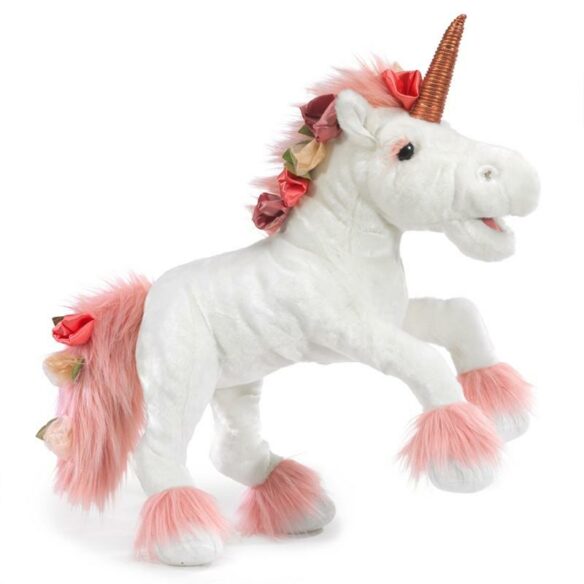
Review by Camille Alexa: Ahh, Unicorn. Mythical, magical, mysterious. Holding this Folkmanis puppet of you, I can’t help wishing it were more as I picture you. Folkmanis got some things right. They did not, for example, neglect your billygoat’s tuft, that underchin goatee featured — flowing, curling — in medieval prints of you. They chose a rather nice fur for your hide: marshmallow white with a hint of opal sparkle. Your neck in this, your likeness, is depicted as long and elegant (as it should be), your velvet-lined ears prick forward, alert, and your eyes are deeper-set than any mere horse’s eyes, without the gentle passivity of a domesticated animal. No: these eyes are dark, and narrowed, and hinting at the capacity for violence if need be…
So those things they got right. But other things, other elements, are not as I would have them. Not for you, O ethereal creature, whom Leonardo da Vinci described in his fifteenth-century Notebooks as a libidinous beast, which “through its intemperance and not knowing how to control itself, for the love it bears to fair maidens forgets its ferocity and wildness; and laying aside all fear it will go up to a seated damsel and go to sleep in her lap, and thus the hunters take it.”
Maybe that’s it. Maybe this puppet is one of those captured-type unicorns, with a silver collar and everything. The horn here isn’t an embarrassment: it stands, proud and spiraled, all to the good. But that mane makes you look like a mop, dear Unicorn! A muppet, a widget, a buffoon! Not at all suited to the gravitas owed your majestic station. And the structure of your face has a somewhat bloated quality, poor thing, as though one late night too many has been passed trawling the streets for fair maidens or seated damsels, long past last call at the pub.
And yet, I’d still rather have a mythical world with you than without you, a catalogue with your likeness rather than without. So kudos, Folkmanis, for attempting to capture this most elusive of creatures in the three Ps: polyester, polyurethane, and PVC.
Review by J.J.S. Boyce: Today we take a look at three bars from American chocolate makers Scharffen Berger. Using restored, vintage machinery from Europe, and starting from the raw cacao beans, this is the very definition of artisanal chocolate. I sampled a bitter-sweet, with 70% cacao content, and two semi-sweets of 62%.
The bitter-sweet is very smooth and chocolaty, while still possessed of a pleasant, but not overwhelming sweetness. As with all good darks, a little goes a long way. One bite should satisfy one’s chocolate craving, but it’s delicious enough that one can go through a 1-oz bar (28 g) in one sitting without meaning to.
I preferred it to the plain semi-sweet, which was still good, but not chocolaty enough for my taste. This is, of course, completely personal. The perfect balance between sweetness and chocolate is a moving target.
The highlight of today’s chocolate offerings was the semi-sweet mocha. I’ve had chocolate-covered coffee beans before, but could only handle them in small doses. A whole coffee bean with a thin layer of chocolate is a bit much; Scharffen Berger’s mocha bar provides a more palatable coffee to chocolate ratio. The ground coffee also contributes a pleasant crunchiness to the bar’s texture, and offsets the sweeter chocolate a bit.
All in all, I would say Scharffen Berger is an excellent choice if you are looking for high quality chocolate. You can find more information and place orders at their website.
J.J.S. Boyce is a freelance writer and science teacher. He tries to use both sides of his brain regularly, but will probably never know enough opera to be a Jeopardy! champion. His author blog is at www.jjsboyce.ca; his reviews can be found at Green Man Review, Sleeping Hedgehog, and Blogcritics; other work can be found at Terry, the Science Creative Quarterly, and print media.
[Introduction: Melanie Stormm continues her humorous series of posts about the misdirected emails she’s been getting. Stormm is a multiracial writer who writes fiction, poetry, and audio theatre. Her novella, Last Poet of Wyrld’s End is available through Candlemark & Gleam. She is currently the editor at the SPECk, a monthly publication on speculative poetry by the SFPA.]
AN AUDIENCE OF ONE
Hello, All! Melanie here.
The roads for an up-and-coming writer and an up-and-coming musical act are similar. The highways are abundant with highs and lows, and all its drainage ditches overflow with uncertainty and cast off dreams.
At the start of the year, Tryxy and Writer X wished to succeed in their respective artistic pursuits, and X also hoped to shed a few pounds. Since then, X has been gung ho about getting Tryxy a steady stream of gigs, however humble. But Tryxy has grappled with the herculean task of writing enough original music to fill an entire set.
When last we left Writer X, the demon Tryxy, #bestkitten, and X’s boyfriend Tod Boadkins, Tryxy and #bestkitten’s band, DemonKitty, had a gig at a bus stop. With just five songs, DemonKitty couldn’t fill the hour they had been booked for.
As fate would have it, their set was unexpectedly interrupted by a lost A & R man from a renowned music label in Boston. Yes, A & R reps still play a crucial role in today’s direct-to-audience music industry, much like acquisition editors in the publishing world. This unexpected encounter could potentially change the course of Tryxy and Writer X’s journey.
DemonKitty was invited to Boston this week to play for the A & R rep (named Arnold Rolfson because—according to X—that’s what “A & R” stands for.)
Whatever wariness I have about music labels, I’m excited for DemonKitty. Of the hundreds of thousands of bands out there dreaming of the big time, few will ever get so lucky a break. But there’s also a danger to getting your lucky break before you’re ready for it.
Without further ado…
Subject: Cat-urday Comfort Fest!!!!!!!
Dear Gladys,
I’m writing to cordially invite you to our Comfort Fest this Saturday. I’ll just need you to bring a few things which I’ll detail later so that you don’t forget.
We are on our way back from Boston. My boyfriend, award nominated fantasy writer Tod Boadkins, is driving and Tryxy and #bestkitten are in a ramen coma in the back seat so I’m free to write you.
I am very proud of Tryxy. It has been a big week for him and that’s the most important thing. Today we all learned that playing music is pretty much the same thing as writing SFF except that they are completely different.
It all started on our way down to Boston when we entered gridlocked traffic as soon as we crossed the boundary of New Hampshire into Masshole-landia. It’s incredible how different the two states are!!!!!! On the New Hampshire side of the border, its sprawling highways, pine trees, mooses, and sasquatches, but the second you cross into Massachusetts, BAM! the roads shrink, pot holes mouths open and devour cars at random, spitting out shocks and suspension all over the place, and storm clouds roll in with eldritch horrors flinging madness from the skies.
While waiting for the DOT to clear a misplaced Shoggoth from I-93, Tryxy started fretting again about the fact that he only has five songs and what if that isn’t enough for Arnold Rolfson and he completely blows it??? To make matters worse, he was EXTREMELY NERVOUS about having to play a show for just one person.
It was so bad, we had to let him out of the car several times to upchuck his hot cheetos in a drainage ditch full of natty ice cans, cynicism and broken dreams.
That’s when my boyfriend, award nominated fantasy writer Tod Boadkins, decided to give Tryxy a little advice.
“You know, an audience of one isn’t a bad thing, Tryxy,” he said. “In fact, an audience of one is all you need to write a story. Maybe that can be true for playing a show, too! When I’m getting ready to write, I pick one person—just one person—that I’m going to write this story for and then I tell the story in the way I think they would like it. And sometimes that one person you’re writing for can be you.”
“Ohhhhhh, why did you have to bring up writing??????” Tryxy wailed and tumbled out of the car again to make another deposit in the wildlife.
You see, Galdsy, not only has Tryxy been nervous about performing for Arnold Rolfson, he’s also had a bad case of writer’s block. Every time he thinks about writing another song as good as “Ninevah Burns In My Soul” or “Meow” or “Meow Meow,” he gets nauseous.
However, I couldn’t let my boyfriend’s silly advice be the last thing Tryxy heard!!!!
I vehemently disagree with writing to an audience of one!!!!
I mean, if all you ever want to be is an award nominated fantasy writer, maybe writing to an audience of one is enough for you, but if you want to be the next big epic fantasy writer of all time LIKE ME!!!!! you have to write stories that are all things to all people!!!!!!!!
“Tryxy, what you need to do is play for the whole world!!!” I said as soon as he got back in the car and rinsed the bile from his teeth.
“I only have five songs,” he moaned. “I can’t even play longer than twenty minutes.” And he dumped his head in his lap.
“What if you just play the five songs really really really slow?” asked my boyfriend.
We all thought that might be a plan.
Seven hours later, we had crossed twenty miles and finally reached Boston where we drove around in endless loops of one way streets until we found our destination: a squalid little warehouse pitched on some desolate corner of Mass Ave.
Arnold Rolfson greeted us at the door with a freshly waxed handlebar mustache and a cloud of weed. He bowed ostentatiously and told Tryxy how excited he was for DemonKitty to come down and play for him and how his music label could take them places they’d never dream of going—like playing Arkham or Miskatonic University!
“Hey! I go to Miskatonic University!” cried Tryxy.
But Arnold Rolfson wasn’t listening. He was texting someone on his phone. He waved a hand at us for us to follow and we awkwardly shuffled after him carrying Tryxy’s drums and #bestkitten’s microphone. Tryxy tried asking Arnodl who else played at Miskatonic U but Arnold just waved him away and kept texting. Tryxy gave me a round-eyed look of uncertainty.
“It’s fine, it’s fine,” I whispered.
Arnold Rolfson waved us into a little black room with a tiny stage where Tryxy and #bestkitten set up. Then Arnold said, “Just give me a half hour of your best stuff. No need to play too long.”
And Tryxy gave me another round-eyed look and his face covered with a pale sheen of sweat. I was afraid he’d let go of some more hot cheetos!!!!!
But I had nothing to worry about Gladys!!!!!! Because DEMONKITTY PLAYED THEIR HEARTS OUT FOR NINETEEN WHOLE MINUTES!!!!!!!! I’ve never seen them play so good!!!!!! THEY WERE AMAZING!!!!!! Tryxy really took my advice to heart and played for THE WHOLE WORLD!!!!!
But in the end, I wasn’t sure Arnold Rolfson even saw it, he was so busy looking down at his phone, the reflection of blue light shimmering on his waxy mustache.
“What’s your next song?” asked Arnold.
“T-that’s a-all o-of t-them?” mewed Tryxy.
Arnold pulled his mouth and his mustache into a frown. “That wasn’t even twenty minutes and I didn’t hear a single.”
Tryxy was crestfallen.
And then Arnold Rolfson lit up like lightning struck his brains. “HEY! How about this? Tell you what I’ll do. I have a bunch of original material I’VE written on Garage Band. Excellent stuff. All of it slaps. How about DemonKitty switches out and plays MY music? That could be a good deal for you. But I keep the publishing.”
I’m not sure what Tryxy said in return because I had unconsciously picked up a folding chair and was preparing to bring it down soundly on Arnold Rolfson’s head when my boyfriend, award nominated fantasy writer Tod Boadkins, wrestled it from my grasp and secured me in a half nelson.
Needless to say, the only way to end that kind of day was to drown our disappointments in all the ramen and boba tea we could get our hands on!!!!! Sometimes, it’s just not fair that people don’t get what you’re doing or that they pretend to care but they don’t. But like Tryxy and #bestkitten said after our fifteenth ramen egg, “At least I’m doing it with my friends.”
And that’s when Cat-urday Comfort Fest was born!!!!!!!! It starts at 11:00 a.m. this Saturday and goes to whenever feels nice. It’s taking place on my couch. The whole idea is that we all dress in sweatpants and onesies and pile onto a big couch with our favorite cats and watch movies until the cows come home!!!!!!
Bring a cat, Galdsy!!!!!! And whoever else you want to come!!!!
Pages next week!!!
xox,
X
P.S. Uh oh. I can’t believe this. Arnold Rolfson just texted me and asked if I could get DemonKitty to open for an up-and-coming Boston band called the Womp Rats!!!! I don’t trust that Arnold Rolfson!!! What do I do?????