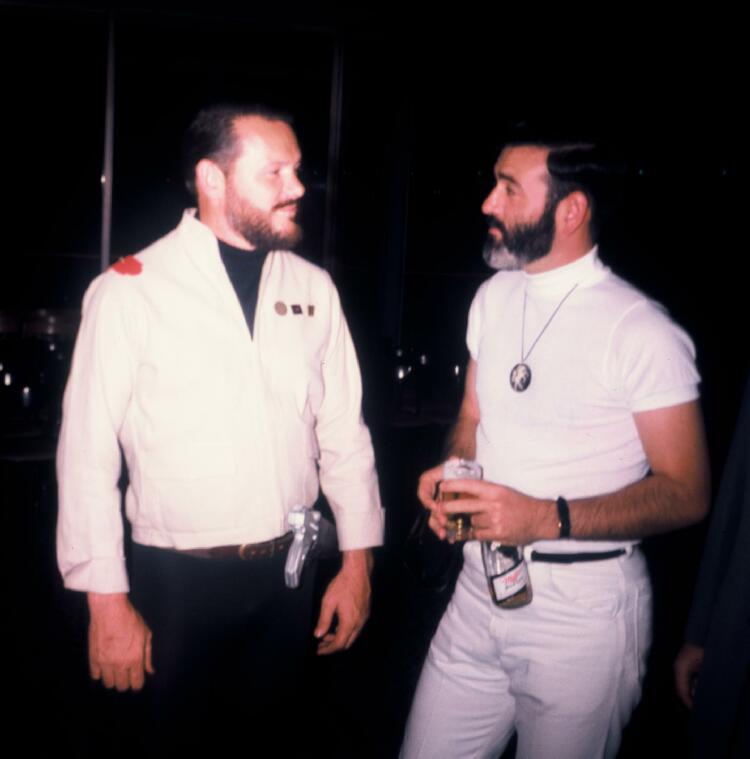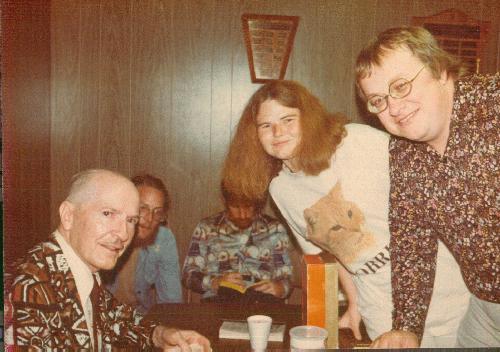
Robert Heinlein, Beverly Warren and Bill Warren at LASFS in 1976. Photo from Fanac.org.
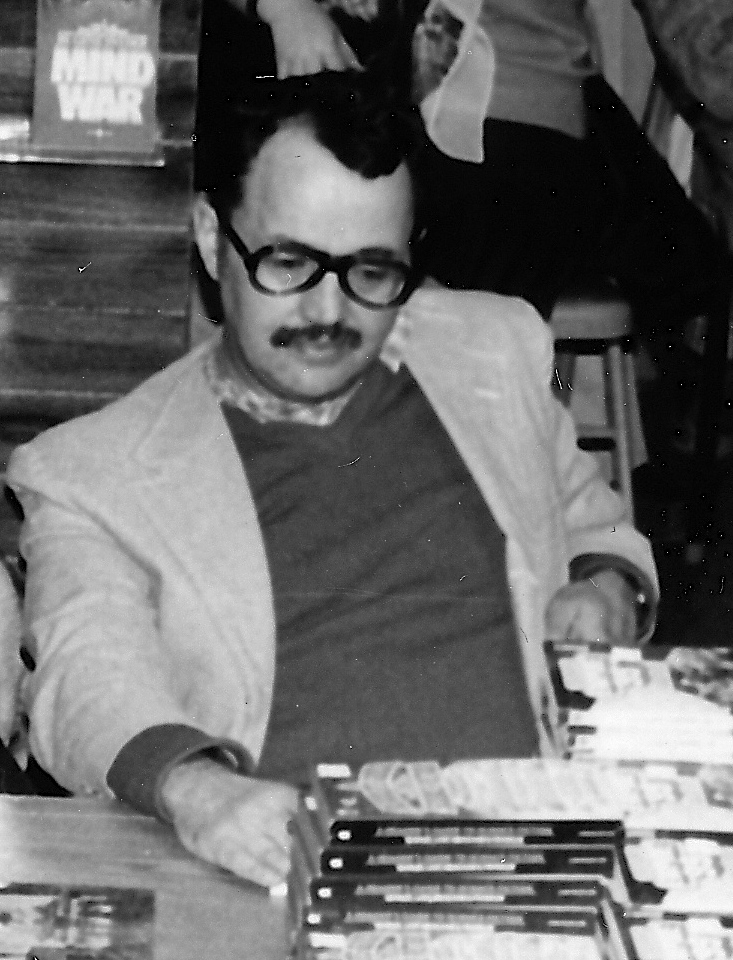
Critic, film historian and long-time LASFS member Bill Warren died October 7. Over the past decade he’d suffered from a series of cardiac and pulmonary health problems, and lately was treated for an infection but never recovered.
When Mark Evanier announced Bill’s passing yesterday, he paid tribute to Bill’s wife, Beverly: “The last few weeks, I’ve watched her tend to his needs night and day, doing every single thing you’d want someone to do for you if you were in his position…except maybe go home and get some sleep.”
Bill and Beverly Warren married in 1966, and that same day moved from Oregon to LA. Bill had been corresponding with Forry Ackerman since 1958, and the couple’s new social life centered on the Ackermansion and Forry’s activities. That included celebrity encounters with horror stars like Boris Karloff and Christopher Lee, and a party invitation that led to their immersion in organized fandom. Bill later recalled for File 770:
Forry Ackerman invited us to a birthday party for Dr. Donald A. Reed, president of the Count Dracula Society. We’d heard of the Society, but had as yet had no contact with it, and were a little uncertain about it. Somehow, the idea of dressing up in tuxes to attend dinners given by a group named after a vampire seemed a little more bizarre than our countrybumpkin Oregon minds could deal with right away. But Forry told us there would be interesting people at the party.
Upon arriving at the event, held in the screening room at the back of Milt Larsen’s home, the first two people we saw were Robert Bloch and Christopher Lee, neither of whom we had met until that time. Both were charming and affable, with Bloch being especially warm. A cake with a bat on it was presented to Don, and then we all sat down to watch WereWolf of London, the first time we’d seen it on a screen. We joined the Dracula Society on the spot.
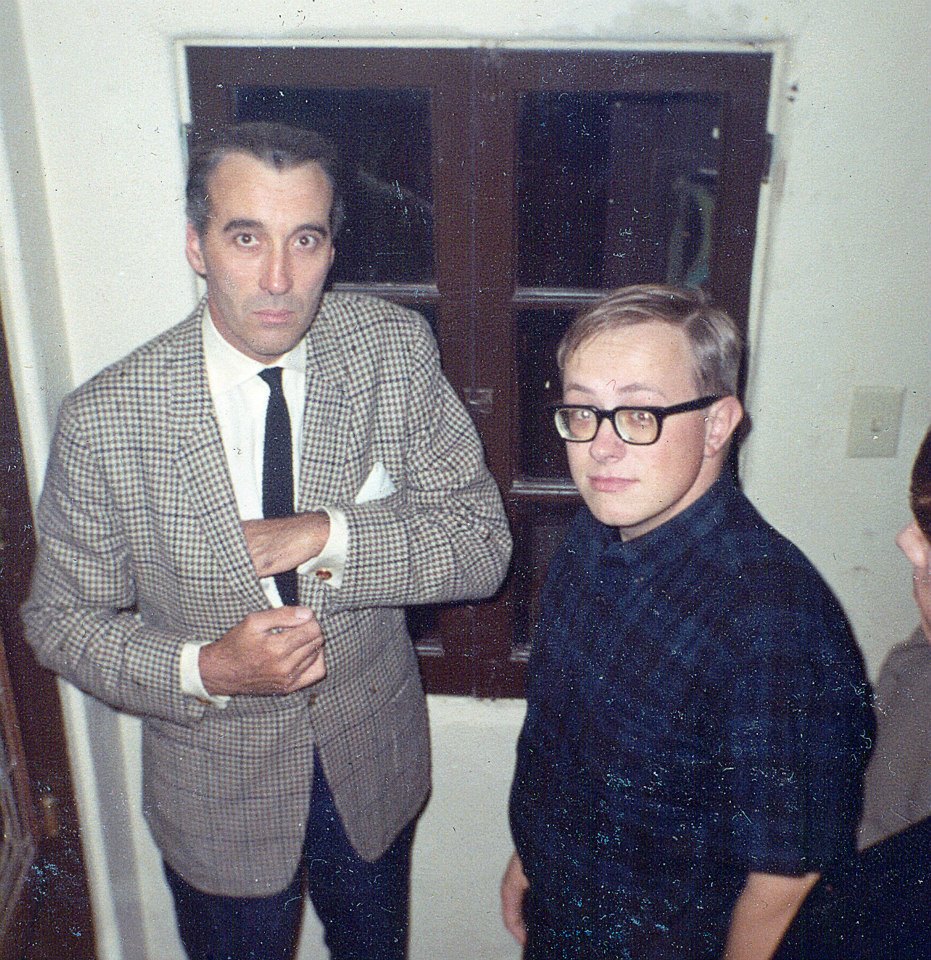
Christopher Lee and Bill Warren in late 1960s, in home theater of Milt Larsen.
This was also the period when Bill met Ray Bradbury for the first time, at a big surprise party for Forry in 1967. The photo below was taken five minutes after they met, after they had swapped glasses and discovered their prescriptions were similar.
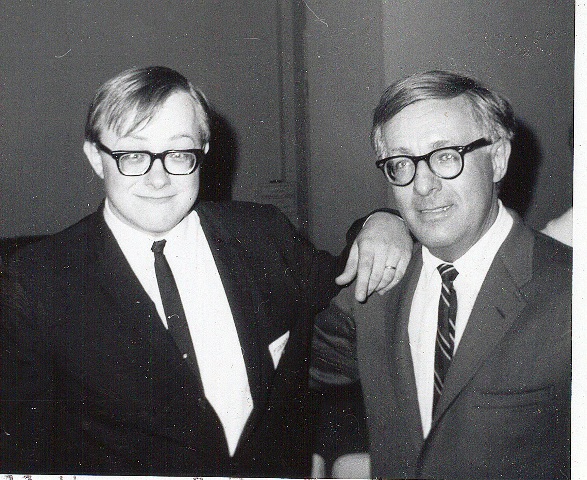
Bill Warren meets Ray Bradbury.
Ackerman, a founding LASFS member, probably brought Bill and Beverly into that club, too: they joined in December 1966. Bill became one of its hardest-working members, honored with the Evans-Freehafer Award in 1973, and he served for many years on the Board of Directors. His suggestion led to making a one-shot winter convention into the club’s annual LosCon.
Bill launched his writing career in the Sixties. His short story “Death Is a Lonely Place” appeared in the first issue of the magazine Worlds of Fantasy in 1968. The story hit the newsstands just before the 1968 Worldcon, precipitating another meeting between Bill and Ray Bradbury, as Bill remembered:
At the Oakland-Berkeley Worldcon in 1968 (or so), I was sitting in the coffee shop with some friends when we saw Bradbury enter the hotel. He smiled and waved at me — then, to my surprise, made an abrupt turn and came into the coffee shop to talk to me. He said I always knew where the best stuff was going on, so where should he go? We chatted a bit, and he breezed out of the place. My friends stared at me in shock. Ray fucking BRADBURY? Did I know Bradbury THAT well? I said “Evidently so,” but I was quite puzzled myself — yes, I knew him (thru Forry), but I didn’t think I did know him that well. So later I encountered him in a hallway and asked about it. He was ready for me. He said that at an early convention (I figure this was the post-WWII Worldcon in LA), he was with a bunch of friends when Leigh Brackett came up and chatted with him about his work. He was puzzled; they WERE friends, but it seemed out of character for her to approach him like that. So he asked her about it. She said she was trying to encourage his career as a writer, by treating him as a fellow professional — and did it in front of his friends, to give him egoboo. Bradbury said “Now you have to pass it on.”
During this period, he also wrote scripts for (Jim) Warren Publishing’s black-and-white comic books Creepy, Eerie, and Vampirella. Later he was a contributing editor to Leonard Maltin’s annual Movie Guide for more than twenty years. He produced annual movie reports for many Nebula anthologies.
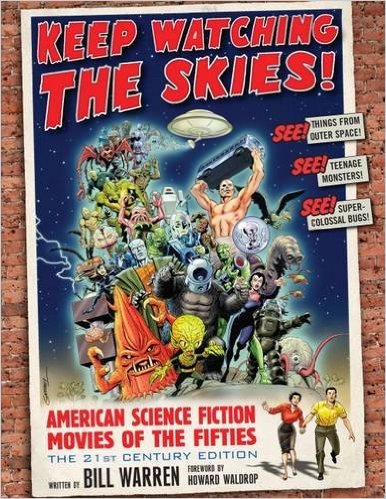
Subsequently he wrote film history books, The Evil Dead Companion, about Sam Raimi’s horror series, Set Visits, interviews with filmmakers on the sets of their films, and Keep Watching the Skies, about science fiction movies of the 1950s.
He also co-authored a fannish mystery with his friend Allan Rothstein, Fandom Is A Way of Death, published and sold during the 1984 Worldcon. The solution to the mystery was placed in a separate envelope at the back of each copy, because only on the last day of the con was the murderer was revealed — and took a bow.
I met Bill and Beverly at the very first LASFS event I ever attended, the 1970 LASFS Anniversary Dinner.
When I co-chaired the 1978 Westercon with Ed Finkelstein, Bill ran the film program. And I remember that right after the con was over, before the rented prints had to be returned, Bill gathered the committee at the LASFS clubhouse to watch a couple of the rarely-seen feature films he’d chosen. The 13 of us who’d run the con were exhausted – which caught the eye of fanartist Linda Miller, who did a drawing of us symbolically clumped together for mutual support, a triangular composition with the tallest, Bill Welden, in the center, and the rest distributed around him by height….
Bill participated in the early days of social media. In 1989, he created the ShowBiz Roundtable for the online service GEnie to generate discussions about films and other aspects of show business.
When his friends produced movies, there was often a minor role or appearance as an extra for him –Joe Dante, Don Glut, and Somtow Sucharitkul were among the people who cast Bill in The Howling (1981), The Laughing Dead (1989), Hollywood Boulevard II (1990), My Lovely Monster (1991), Ill Met By Moonlight (1994), Dinosaur Valley Girls (1996), and The Naked Monster (2005).
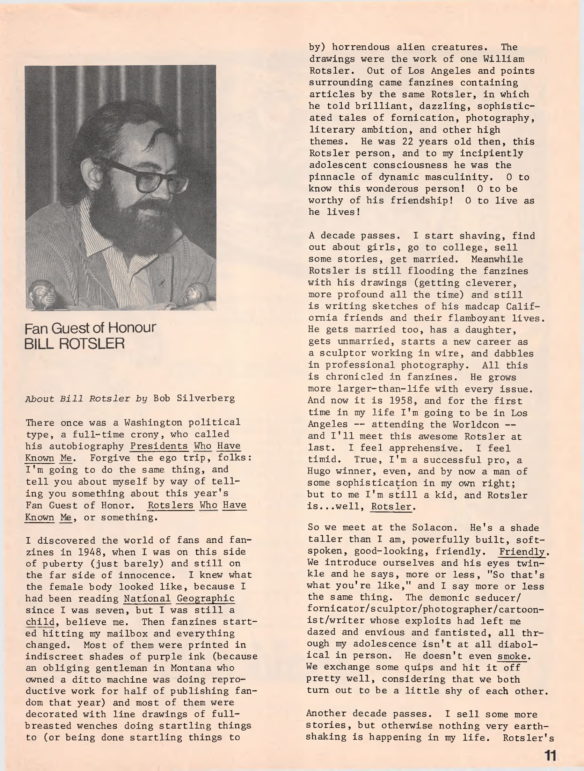
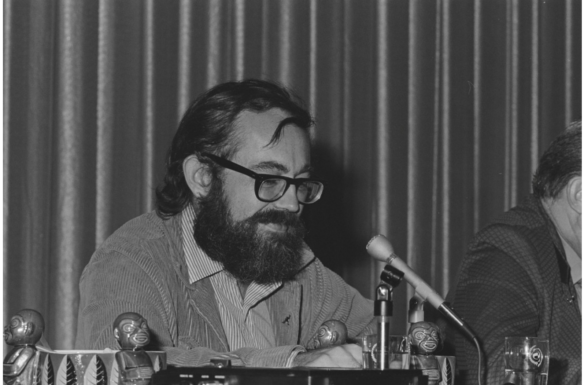
During the 1990s, he and Bill Rotsler produced segments surveying American television for the French TV series Destination. In fact, the day before Rotsler died in 1997, he and Bill had driven all over Hollywood shooting video of billboards for an installment of the show.
And after Rotsler died, Bill became the custodian of his good friend’s unpublished fan art, of which there was an enormous amount. He did his utmost to get it into the hands of fanzine editors for publication. Bill also discovered the raw material for 15 more issues of Rotsler’s fanzine Masque, which he completed and distributed to the mailing list.
The last time I saw Bill was at a Loscon room party a few years ago where he was doing what he liked most, holding his friends spellbound with his endless supply of anecdotes from Hollywood history. The things about movies that fascinated him growing up had never lost their allure, for as he told an interviewer:
I found that my taste as a kid was pretty reliable, even if more enthusiastic than myself as an adult. I no longer think that It Came from Beneath the Sea and Creature with the Atom Brain are the two best movies ever made, though I still like both of them. And those I didn’t like then, I still don’t like.