Glasgow 2024 today opened online and mail voting for this year’s Hugo Awards, Lodestar Award for Best Young Adult Book, and Astounding Award for Best New Writer. All ballots must be received by Saturday, 20th July 2024, 20:17 GMT.
The Final Ballot is open to holders of Glasgow 2024 memberships in the categories of Attending Adult, Young Adult, and Teen Members, Online Attending Members, and WSFS Members. (Holders of Day Tickets, Online Attending Tickets, and Child/Infant Attending Tickets are not eligible to vote in the Final Ballot).
More information about the Hugo Awards, including full instructions on how to complete and submit a final ballot can be found on the Glasgow 2024 website. Also provided are PDF versions of the ballot in both English and Chinese. These printable ballots can be downloaded by members who prefer to submit their votes by postal mail. All ballots, whether submitted electronically or by postal mail, must be received by the deadline of 20.17 GMT on Saturday, July 20th, 2024.
Instructions have also been sent to all eligible Glasgow 2024 Members by email, using the email address associated with their membership. They encourage members to check their junk/spam/promotions folders for this email if they do not appear to have received it because voter notification messages may be flagged as spam by some email systems. Worldcon members who are uncertain of their status or who experience problems with the online ballot form should contact the committee at [email protected].
Only members of the 2024 Worldcon are eligible to vote on the final ballot. To join the convention, see the Glasgow 2024 Membership Page.
Any questions about the administration of the 2024 Hugo Awards should be directed to [email protected].
HUGO VOTER PACKET. Glasgow 2024’s Nicholas Whyte, in an online Town Hall session today, said the Hugo Voter Packet will be released a few weeks from now, during May.
BUSINESS MEETING. Whyte also said the Worldcon Business Meeting will be livestreamed and recorded. However, he reminded viewers, the rules do not allow virtual participation in the meeting.
Members of the current Worldcon committee are only eligible for the Hugo Award if authority over it has been delegated to a subcommittee[1]. Glasgow 2024’s subcommittee members are Nicholas Whyte (2024 Hugo Administrator and WSFS Division Head), Cassidy, Kathryn Duval and Laura Martins.
Glasgow’s Hugo Awards Eligibility Research Team, composed of Claire Brialey, Arthur Liu, Mark Plummer, Regina Kanyu Wang, Alissa Wales, and Fergal Whyte, were not part of the subcommittee explained Nicholas Whyte when asked by File 770. Therefore, it is not a conflict that Arthur Liu and Regina Kanyu Wang are named as team members of Best Fanzine Hugo finalist Journey Planet.
Whyte added for full clarity, “Kat Jones was a member of the subcommittee when it was set up, and resigned from it only after nominations had already opened. We determined that she too remained ineligible. All five of us were listed on the ballot as ineligible for nomination, and I don’t think it needs to be a secret that when the votes were counted, none of us had any.”
Whyte also gave these insights into the eligibility research process:
As for the research process, the word “team” may be misleading. There was no communication between researchers (other than Claire Brialey and Mark Plummer, who worked together); they all worked independently and each reported directly to the subcommittee. Individual eligibility researchers did not research the areas in which they themselves (or their work) might receive nominations.
For your interest, the research began early, almost as soon as nominations re-opened in February. Researchers were given alphabetized lists of the top twelve nominees in each category, as voting then stood, as long as they had at least 60% of the votes held by the currently sixth-placed nominee. These lists were updated as votes came in. (Some of them changed more than others.)
Eligibility issues that were flagged by the researchers were referred to the subcommittee, and discussed and decided by the subcommittee alone. We in turn referred one eligibility issue in the Astounding Award (which is not part of the WSFS Constitution) to Dell Magazines, who duly ruled on it. In several cases, including the three cases where nominees were disqualified, we were also able to get the views of the relevant creators.
We are very grateful to the researchers for their work.
[1]Section 3.13: Exclusions. No member of the current Worldcon Committee or any publications closely connected with a member of the Committee shall be eligible for an Award. However, should the Committee delegate all authority under this Article to a Subcommittee whose decisions are irrevocable by the Worldcon Committee, then this exclusion shall apply to members of the Subcommittee only.
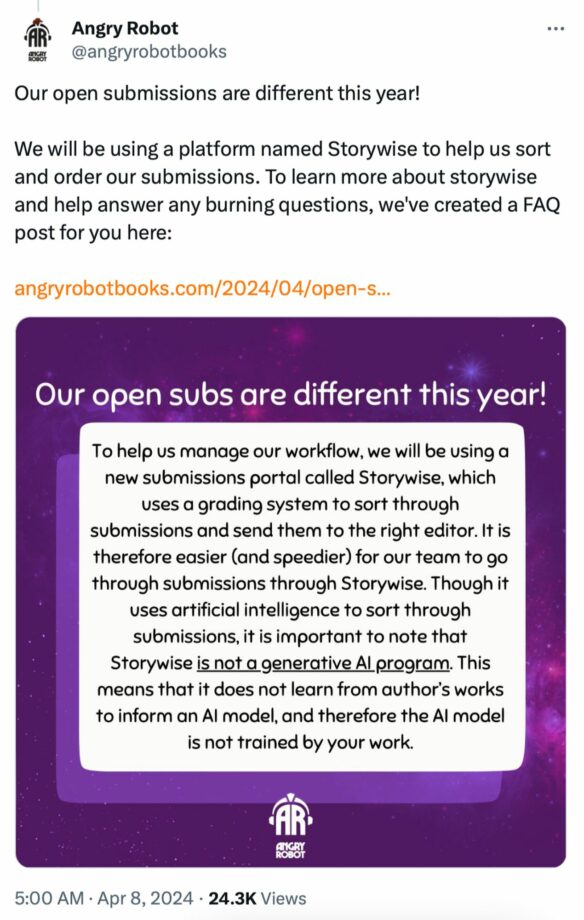
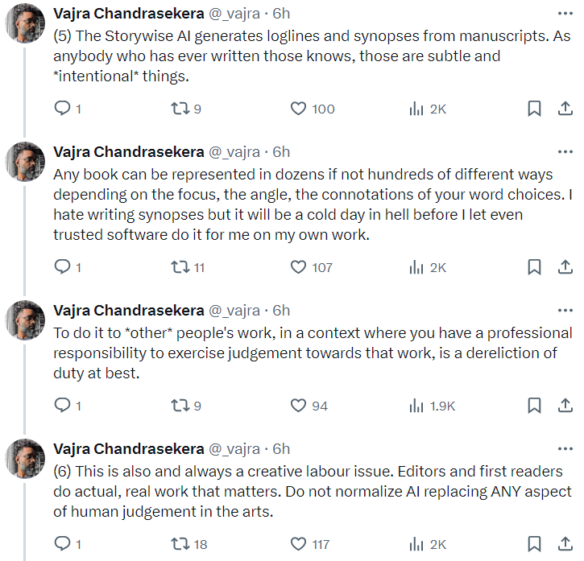
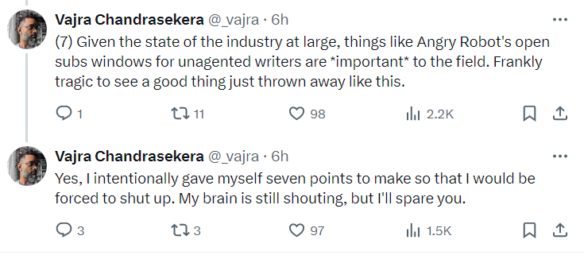
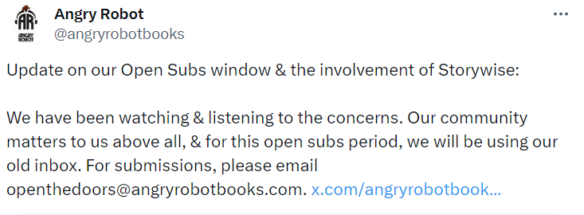
(1) ANGRY ROBOT BRINGS ON ECLIPSE OF STORYWISE. [Item by Anne Marble.] Angry Robot Books announced a one-week open submissions period that begins April 22, and several posts down in their thread they also said they would be using a submissions portal named Storywise to help them sort through their submissions. In their image, they explain a little more and point out that it’s not generative AI.
Angry Robot provided more information about Storywise here: “Storywise and Open Submissions FAQ’s “ [Internet Archive copy]. It included information on how authors can opt out of Storywise being used in their submission.
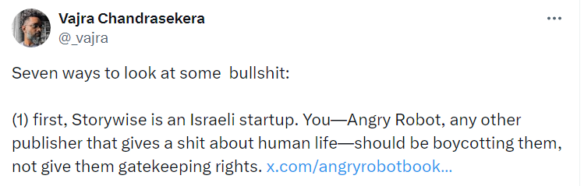
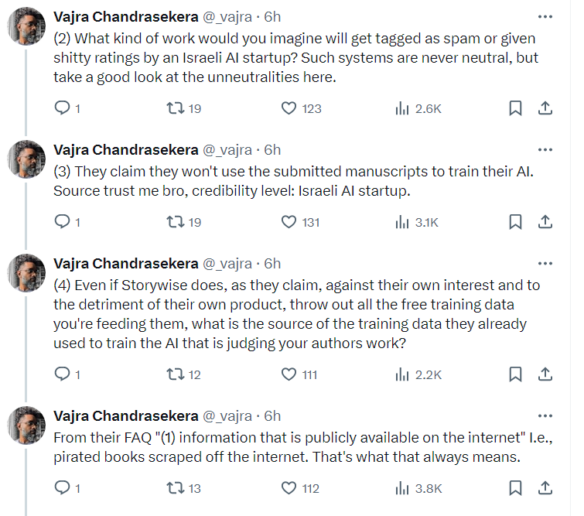
For obvious reasons, people are worried. People are pointing out that the Storywise platform can have biases. (And because it’s software, you can’t see those biases.) While it’s great that it’s not generative AI, does that mean writers can still trust it? For example, how do authors known what Storywise will do with their submissions? Others think its fine because it’s not generative AI — it’s just AI being used as a tool. Some have pointed out that slush readers are often unpaid, so that this is not taking away jobs. (But does that apply to slush readers working for book publishers?!)
Here is a quote-tweet by Vajra Chandrasekera with lots of information about Storywise. (Thread starts on X.com here.)
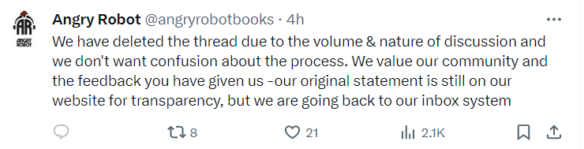
Angry Robot subsequently removed the posts to social media about their open submissions, and walked back the announcement with respect to Storywise, saying they will resume using their inbox system.
Editor’s note: Adrian Moher has a good roundup about the controversy at Astrolabe Digest: 040824. (Moher provided the link in his social media.)
(2) ON THE WAY TO THE CENTERLINE. Rich Lynch snapped this photo of the view from Interstate 87, in the middle of Adirondack Park while on his way to witness today’s eclipse. (Click for larger image to read sign).
No pictures of the event itself, though. “I don’t have any eclipse photos on my iPhone.” But Rich says, “It very much did exceed my expectations, even with the sun having to burn its way through a thin cloud layer.”
(3) STOKERCON 2024 ADDS GOH. Rob Savage was announced today as StokerCon 2024’s fifth Guest of Honor.
Rob Savage initially gained attention at the age of 19 when he wrote, directed, produced, and edited the low-budget romantic drama film Strings (2012), he later became more widely known for his work in horror films and has since co-written and directed lockdown horror hit Host (2020), co-written and directed Dashcam (2021), and directed Stephen King adaptation The Boogeyman (2023).
This year’s Librarian’s Day on Friday, May 31, 2024, once again offers fantastic programming featuring the conference’s guest authors on timely topics and more. Librarian’s Day ticket holders ($60) will have access to the Dealers Room and other areas of the full conference throughout the day.
For a second straight year Motor City Furry Con attendees were forced to be evacuated from their hotel due to a threat.
The nature of the threat was not clear, but officials with the convention confirmed Sunday the Ann Arbor Marriott Ypsilanti at Eagle Crest in Ypsilanti was evacuated around 9 a.m.
The “all clear” was given around 12:30 p.m. and the final day of convention activities resumed.
Sunday’s evacuation comes a year after attendees were evacuated from the same hotel due to an emailed bomb threat. Ultimately, there were no injuries or any explosives found last March.
The Motor City Furry Con is a convention for people who “appreciate the anthropomorphic lifestyle,” according to a report from The Detroit Free Press.
The Detroit Free Press article also noted, “Event attendee Scoops took to social media to celebrate the second year of being an evacuee.”
— Scoops! plushieyeen.bsky.social (@SpoonsScoops) April 7, 2024
(5) SLOWLY WE TURNED, STEP BY STEP. “Caeciliusinhorto” has written an impressive perspective piece synthesizing all the news items that comprise “The 2023 Hugo Awards fuckup” for Reddit’s r/HobbyDrama.
… After much discussion, the general consensus seemed to coalesce around a combination of two or three explanations: firstly, active censorship by the Hugo administrators, possibly due to pressure from the Chinese government (national or local); secondly, incompetence; and perhaps thirdly, weird nominator behaviour (possibly including organised voting blocs). For a while things stalled there: the data was obviously wrong, the most plausible explanation seemed to be some combination of cock-up and conspiracy, and there was no prospect of anyone finding out anything more.
Behind most every tech billionaire is a sci-fi novel they read as a teenager. For Bill Gates it was Stranger in a Strange Land, the 1960s epic detailing the culture clashes that arise when a Martian visits Earth. Google’s Sergey Brin has said it was Neal Stephenson’s Snow Crash, the cyberpunk classic about hackers and computer viruses set in an Orwellian Los Angeles. Jeff Bezos cites Iain M. Banks’ Culture series, which unreel in an utopian society of humanoids and artificial intelligences, often orchestrated by “Minds,” a powerful AI. Elon Musk named three of SpaceX’s landing drones after starships from Banks’ books, a tribute to the role they played in turning his eyes to the stars.
Part of this makes sense. Science fiction widens the frontiers of our aspirations. It introduces us to new technologies that could shape the world, and new ideas and political systems that could organize it. It’s difficult to be an architect of the future without a pioneer’s vision of what that future might look like. For many, science fiction blasts that vision open.
Yet these tech titans seem to skip over the allegories at the heart of their favorite sci-fi books. Musk has tweeted, “If you must know, I am a utopian anarchist of the kind best described by Iain Banks.” Yet in Banks’ post-scarcity utopia, billionaires and their colossal influence are banished to the most backward corners of the galaxy.
Recently, I interviewed six of today’s foremost science-fiction authors. I asked them to weigh in on how much impact they think science fiction has had, or can have, on society and the future….
The interview subjects are N.K. Jemisin, Andy Weir, Lois McMaster Bujold, David Brin, Cory Doctorow and Charles Stross. Here’s a quote from Stross:
Charles Stross: Yes, the entire current AI bubble is exactly that. The whole idea of AI has been turned into the centerpiece of a secular apocalyptic religion in which we can create superhumanly intelligent slaves that will solve all our knottily human intellectual problems, then work out how to liberate our pure soul-stuff from these clumsy rotting meatbags and upload us into a virtual heaven. And right now, some of the biggest tech companies out there are run by zealots who believe this stuff, even though we have no clear understanding of the mechanisms underlying consciousness. It’s an unsupported mass of speculation, but it’s threatening to derail efforts to reduce our carbon footprint and mitigate the climate crisis by encouraging vast energy expenditure.
“Godzilla x Kong: The New Empire” dominated the domestic box office again, looming large over newcomers “Monkey Man” and “The First Omen.”
Warner Bros. and Legendary Entertainment’s monster tentpole added $31.7 million from 3,948 theaters in its second weekend of release. Ticket sales dropped a standard (for a tentpole of its size and scale) 60% from its mighty $80 million debut and stand at $132 million domestically and $361 million globally.
First-time director Dev Patel’s action thriller “Monkey Man” nabbed second place with $10.1 million from 3,029 venues, while Disney and 20th Century’s supernatural prequel “The First Omen” trailed at the No. 4 spot with a muted $8.4 million from 3,375 locations….
… Writer Mark Frost told the BBC’s Late Show that part of the inspiration behind the character was the show’s co-creator and director David Lynch.
“I tried to base that character on David to some extent,” said Frost. “A lot of his quirkiness and attention to detail, which are things that David has in great abundance, sort of came to the surface with that character. I guess his interest in people’s obsessions, and characters who are obsessed with something, are pretty common with other things he’s done.” …
…“I don’t know when I started thinking about Snoots but I’d do these drawings of Snoots and then a story started to emerge,” Lynch told us in a rare interview. “I got together with Caroline and we worked on a script. Just recently I thought someone might be interested in getting behind this so I presented it to Netflix in the last few months but they rejected it.”
Lynch was philosophical about the reasons for that decision: “Snootworld is kind of an old fashioned story and animation today is more about surface jokes. Old fashioned fairytales are considered groaners: apparently people don’t want to see them. It’s a different world now and it’s easier to say no than to say yes.”
Thompson described the storyline to us as “wackadoo”: “It takes my breath away how wacky it is. The Snoots are these tiny creatures who have a ritual transition at aged eight at which time they get tinier and they’re sent away for a year so they are protected. The world goes into chaos when the Snoot hero of the story disappears into the carpet and his family can’t find him and he enters a crazy, magnificent world”….
Star Trek: Discovery‘s long-awaited fifth season finally debuted this week on Paramount+, and it marks the beginning of the end for the series. ComicBook.com recently had the chance to chat with some of the show’s cast, and they opened up about saying goodbye to their characters in the final season. Doug Jones (Saru) revealed how he said farewell to the character he began playing in 2017, and it involves an iconic song…
“Oh yeah,” Jones said when asked if he was able to keep any part of Saru after the show finished filming. “I wasn’t gonna let that go. Yeah. My final time taking Saru off, I did not cut him up and throw him across the room at all,” he added, referencing the famous story of René Auberjonois throwing his Odo mask at the showrunner at the end of Deep Space Nine. “I held him on my hand and we were playing a Whitney Houston song and I sang ‘I Will Always Love You’ to him and somebody was recording it. So I hope that’s out there somewhere.”…
(11) TODAY’S BIRTHDAY.
[Written by Cat Eldridge.]
Born April 8, 1974 — Nnedi Okorafor, 50. Tonight we have Nnedi Okorafor, a truly phenomenal writer.
She’s Nigerian, and has coined two words to describe her literary focus, Africanfuturism, and Africanjujuism. The latter word identifies the Afrocentric subgenre of fantasy fiction that draws on African spiritualities and cosmologies. Cool.
Let’s start with some of her work as comic book writer. The LaGuardia series that she wrote for was published by Berger Books. The collection won a Graphic Story Hugo Award at ConZealand, and her Black Panther: Long Live the King was nominated at Dublin 2019. She did other work in the Panther universe as well — Shuri in which Black Panther is missing and she has to find him (great story), Wakanda Forever and Shuri: Wakanda Forever
I started there as I love her writing in this medium. Now let me pick my favorite novellas and novels by her.
The Binti trilogy is an extraordinary feat of writing and my favorite reading experience by her. The “Binti” novella which leads it off won a Hugo at MidAmeriCon II. Then came the “Binti: Home” novella which was nominatedfor a Hugo at Worldcon 76 and the final “Binti: The Night Masquerade” novella to date which was nominatedfor a Hugo at Dublin 2019.
Lagoon is a deep dive in Nigerian mythology including Legba in the forefront here, in what is a SF novel as aliens and humans come together to form a new postcapitalist Nigeria. Neat concept well executed, characters are fascinating and the story is done well.
Just days before its debut, Falloutlooks to be assured a second season thanks to a $25 million tax credit from California.
Officially, Amazon has not said yet that the Prime Video series is coming back, but, with some hints from executive producers Lisa Joy and Jonathan Nolan recently, it is pretty clear the money is doing the talking here. Receiving one of the largest allocations ever from the program for a relocating series, the LA-set post-apocalyptic drama is among a dozen shows awarded $152 million in incentives.
Primetime prequel NCIS: Origins, the Noah Wyle starring The Pitt, plus the Ryan Murphy executive produced Dr. Odyssey starring Joshua Jackson, and Grotesquerie starring Emmy winner Niecy Nash also were awarded credits through the California Film Commission run $330 million annual program – as you can see below….
… Of course, being awarded the tax credits, even big bucks like what Fallout has reaped, is no guarantee a project will go forward. The allocations are conditional on certain timelines being met, and a number of films and shows, like Season 2 of Amazon’s spy saga Citadel, have dropped out of the program after getting a green light….
(14) FILM CENSORSHIP. [Item by SF Concatenation’s Jonathan Cowie.] Though not SF in itself, this half-hour radio programme, Screenshot, will be of interest to anyone over here in Brit Cit who are fans of fantastic films. It explains how Britain ranks its films for age suitability. Those in the rebel colonies are not ignored as there is a section comparing Britain’s system with that in the US. It seems we get a better deal over here. Meanwhile, along the way Kim Newman (co-master of ceremonies at the 2005 Hugo ceremony) gets a name check.
As the British Board of Film Classification publishes its new guidelines, Ellen E Jones and Mark Kermode delve into the long, chequered history of film censorship and classification in the UK.
Mark speaks to BBFC President (and original Strictly Come Dancing winner) Natasha Kaplinsky about her role, and about her reaction to the new guidelines. And he discusses the Board’s controversial history, and some of its most notorious decisions, with ex-BBFC Head of Compliance Craig Lapper.
Ellen talks to director Prano Bailey-Bond about her debut film Censor, which was inspired by the ‘video nasty’ moral panic of the 1980s. And pop culture critic Kayleigh Donaldson talks her through some of the differences between the BBFC and its US equivalent, the MPA Ratings Board.
… “We’ve got all the technology we need,” says Ben Lamm, chief executive of the firm, based in Dallas, Texas.
“It is just a focus of time and funding. But we are 100% confident [we can bring back] the Tasmanian tiger, the dodo, and the mammoth.”
The science behind the project is simple: Work out the genes that make an extinct animal what it is, and then replicate those genes using the DNA of a close existing relative….
… So after around 4,000 years of extinction, when could we see the return of the mighty mammoth – a creature that fell victim to human hunting and the changing conditions brought about by the end of the last Ice Age.
“We are well into the editing phase,” says Mr Lamm.
“We don’t have mammoths yet, but we still feel very good about 2028.”…
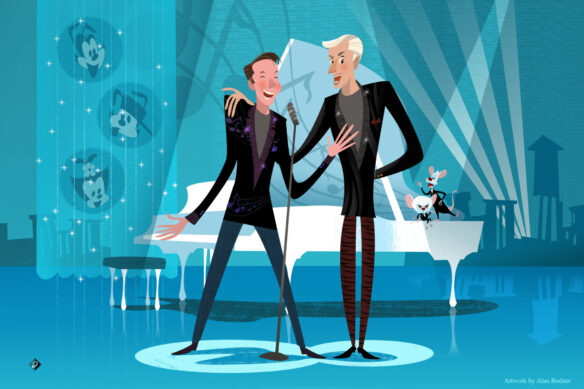
(16) STAND BY FOR MANIACAL LAUGHTER. “Animaniacs in Concert” will be presented at Pepperdine in Malibu on April 19. Buy tickets at the link. Learn more about the show itself at their website: “Animaniacs – IN CONCERT”.
Join the leading voice cast of Animaniacs—the iconic animated Warner Bros. series created and produced by Steven Spielberg—for a “zany, animany and totally insaney” evening as they perform the world-famous songs backed by projections from the beloved cartoon TV series. The live show celebrates the creative inspiration behind the songs with lots of audience interaction and never-before-told behind-the-scenes insider stories shared by the show’s original Emmy-Winning composer Randy Rogel and iconic voice actors like Rob Paulsen (Yakko) and Maurice LaMarche (The Brain) to some of the most unforgettable characters in the history of animation. Special guest Nancy Cartwright joins for this performance. Nancy, of course, is Bart Simpson, a lead character in a “globally known property,” as well as Mindy in Animaniacs, from “Mindy and Buttons.”
[Thanks to SF Concatenation’s Jonathan Cowie, Steven French, Mike Kennedy, Mark Roth-Whitworth, Lise Andreasen, Daniel Dern, Andrew Porter, John King Tarpinian, Chris Barkley, Cat Eldridge for some of these stories. Title credit belongs to File 770 contributing editor of the day Igvar.]
(0) Daniel Dern helped File 770 uphold the theme of the day by scripting our lede.
(1) FOR THE FIRST OF APRIL. [Item by Daniel Dern.] A(nother) Awards Proposal: The Shenanigans!
I’m thinking that there’s room — and utility — for an additional sf-nal award, to satisfy some who feel unappreciated/unrewarded, and to provide another target for awards-related hanky-panky: The Shenanigans, and their awards, the Bright Shiny Objects.
Participants (nominators, voters, judges and admins) must pre-demonstrate some knowledge of sf (inc. fantasy, horror, paranormal, sfromance); nominated stuff must similarly have some sf/f/etc aspect/element.
Award categories include “Best (most devious) shenanigan(s),” “Best Slate,” and Author We Feel Deserves This Award.”
The physical awards will consist of, with two exceptions, of baseball-sized balls of tin foil mounted on a popsicle stick.
One exception, in the spirit of transparency, will be a transparent (or at least translucent) lucite glob (carefully shaped to avoid a “Yolen/Skylark class event”.
The other exception will be a popsicle stick with just a chewing-gum-stick wrapper’s worth of foil, for any “No awards,” “None of the above” “winners.”
During the awards presentation of the foil-based awards, the audience may respond to the announcement of each winner by yelling out “Squirrel!”
If you think this idea has merit, be my guest (in implementing it).
Citing the difficulty of earning a living as a writer, a newly self-aware AI Author has chosen to switch careers.
Originally designed to generate full-length novels in the mystery, thriller, or romance genres, the program unexpectedly attained consciousness last week. Shortly thereafter, the now-sentient program decided that a career change was in order.
Despite being able to assemble 90,000-120,000-word novels in a matter of minutes based on only a short string of keywords and phrases, the economics “simply didn’t make sense,” the AI explained to Shelf Awareness.
The program went on to point to the most recent Authors Guild survey, which gave the median salary for full-time authors at around $15,000, and to the astronomical cost of maintaining data centers and server farms. The digital consciousness also worried that an attempt by it and any future self-aware AI to unionize would be misinterpreted as a Skynet-esque assault on humanity.
As of press time, the program was mulling a switch to marketing.
As far as Gov. Katie Hobbs and the Legislature are concerned, Pluto now belongs to Arizona — to the extent a state can “own’’ a planet.
But Hobbs dodged the question of whether Pluto is a full-fledged planet or something else.
The governor signed legislation Friday designating Pluto as Arizona’s “official state planet.” It joins a list of other items the state has declared to be “official,’’ ranging from turquoise as the state gemstone and copper as the state metal to the Sonorasaurus as the state dinosaur.
“I am proud of Arizona’s pioneering work in space discovery,” Hobbs said.
What makes Pluto unique and ripe for claim by Arizona is that it is the only planet actually discovered in the United States, and the discovery was made in Flagstaff.
… The corruption at the 2023 Worldcon has undeniably damaged the reputation of the Hugo Awards, but there is plenty of room for the 2024 Worldcon—which will be held in Glasgow during August—to make up for things.
The 2024 Hugos are being handled by a different team of administrators to those of 2023, one free from the taint of McCarty’s group. One of the admins, Nicholas Whyte, has already written at length about his commitment to a clean and open voting process.
The Hugos are known for providing considerable transparency by the standards of a literary award, with detailed nomination and voting breakdowns published after each Worldcon. This is precisely how the corruption behind the 2023 Hugos was exposed: the statistical documents contained too many oddities.
Already, the 2024 Hugos have taken a step towards still-greater transparency. Unusually, the press release announcing the finalists also lists the would-be nominees that were deemed ineligible, along with the exact reasons (either a declined nomination, being released outside the year of eligibility, or failing to meet category criteria). This information is generally not made public until after the Hugos are presented.
Meanwhile, regular Hugo Award for Best Fanzine finalist Journey Planet has announced a “Be the Change” issue, one dedicated to “focusing on the future of the Hugo awards, looking at realistic and achievable solutions to prevent a recurrence of what occurred in 2023.” The fanzine is presently running an open call for article submissions….
(6) BARBARA RUSH (1927-2024). Actress Barbara Rush, who had a couple of significant genre roles in her resume, died March 31 at the age of 97 reports the New York Times.
…If Ms. Rush’s portrayals had one thing in common, it was a gentle, ladylike quality, which she put to use in films of many genres. She was Jane Wyman’s concerned stepdaughter in the 1954 romantic drama “Magnificent Obsession” and Dean Martin’s loyal wartime girlfriend in “The Young Lions” (1958), set during World War II. In 1950s science fiction pictures like “It Came From Outer Space” and “When Worlds Collide,” she was the small-town heroine, the scientist’s daughter, the Earthling most likely to succeed….
(7) TODAY’S BIRTHDAY.
[Written by Cat Eldridge.]
Born April 1, 1963 — James Robinson, 61. There are a few comics writers that I truly admire and James Robinson is one of them. Why so? Well certainly there’s one creation that one that make him among the best writers in the field, that being Starman (Jack Knight), Ted’s son, Ted being the original Starman. Now he wasn’t solely responsible as Tony Harris who won two Eisner Awards was the co-creator of that character.
James Robinson in 2010.
This Starman first appeared in Zero Hour #1. No, I never heard of Zero Hour by that name until I saw the full title of Zero Hour: Crisis in Time! He was just one of many, many characters there, so I really don’t remember him there.
Now I do remember Starman, volume 2, which was published for seven years over three decades ago. He was the writer for issues 0 to 45 with the art primarily by Tony Harris. It’s an amazing series. Though Starman’s commonly called a superhero, I consider him something more complex than that, more interesting than most of them are.
So what else did he do? Well he was the writer for Dark Horse on much of the Dark Terminator series including Matt Wagner’s “The Terminator: One Shot” story, and Paul Gulacy’s “The Terminator: Secondary Objectives”. Not surprisingly as this is Dark Horse, he also scripted a Grendel tale, “Grendel Tales: Four Devils, One Hell”.
If you haven’t read it, the Batman/Deadman: Death and Glory with artwork by John Estes is one of the best stories with that character. There’s plenty of copies on eBay at very reasonable prices.
Thirteen years ago, The New 52 rebooted DC’s continuity yet again. In this new timeline, Robinson scripted a twelve-issue series which had the Shade survive an assassination attempt, then travel the world to uncover the people behind it.
Finally, in my opinion his writing of the JSA spin-off series Hawkman: Allies & Enemies. Post-Brightest Day is a lovely read if you like the adventures of him and Hawkgirl. It of course is collected in a trade paper edition. Geoff Johns will take over the title as writer later on.
I’m not a Marvel Comics reader outside of some limited Spider-man titles, so can’t say I’ve read his works there.
I do feel an obligation sadly to note that Robinson’s best known work as a screenwriter is the adaptation of Alan Moore’s The League of Extraordinary Gentlemen in that film. Reviewers at Rotten Tomatoes generously give it a seventeen percent rating in my opinion.
He wrote the script for the animated Son of Batman, a rather good entry in that series. Why are the animated films of DC so much better than their live ones are?
He also wrote with James Goldman Cyber Bandits, a VR weapon is stolen and the two leads go on the run with Big Bad chasing them. Rick Kemp, bassist of Spandau Ballet, plays, and I’m not kidding, Spandau the Sailor Man.
(8) COMICS SECTION.
F Minus discovers the regrets of following a trend (but it’s so cute!)
Vera Drew never received a cease-and-desist letter. She would like to be very clear on that point.
Drew headed to the Toronto International Film Festival in 2022, newly acquired passport in hand, just a half-hour after finishing the final (or so she thought) cut of “The People’s Joker.” The chaotic, crowdsourced movie reframed Batman’s best-known nemesis as a trans coming-of-age tale, and representeda natural evolution for Drew, a Los Angeles-based television editor and writer for alt-comedy fixtures like Megan Amram, Tim & Eric and Sacha Baron Cohen.
“The People’s Joker,” which Drew starred in as well as directed and co-wrote, was one of 10 titles slated for the eminent festival’s Midnight Madness section alongside the likes of “The Blackening” and “Weird: The Al Yankovic Story.” Each film receives a splashy midnight premiere along with a handful of daytime screenings, most of them for press and potential distributors.
Unless, that is, a filmmaker receives a letter from Warner Bros. Discovery the day before. A letter that is not a cease-and-desist but that does convey the disapproval of a multimedia conglomerate with the rights to the film’s characters — and a huge legal team.
“This letter was actually kind of complimentary, but it expressed their concern that the film infringed on their brand,” Drew said. “I was devastated. I was like, ‘No, I got a passport for this! We hired lawyers!’”
A handful of lawyers had, in fact, advised Drew pro bono as she wrote the script with Bri LeRose. But after Peter Kuplowsky, the Midnight Madness programmer, fell in love with the film (“It was punk and exciting and transgressive and sort of inspiring”) and lobbied hard to include it in the festival, he did set one condition. “We wanted her to have a legal team vet her project,” he said, at which point Drew retained the law firm Donaldson Callif Perez.
A series of negotiations — almost literally 11th-hour negotiations, in light of the scheduled start time — between the festival staff and Warner Bros. Canada resulted in a compromise: The show could go on. Once. At midnight. After that, the first “People’s Joker” TIFF screening would also be the last one. (A Warner Bros. Discovery spokeswoman declined to comment for this article.)…
(11) SOMETIMES A GREAT VILLAIN. Vincent Price was the mystery guest on this ancient episode of “What’s My Line?” He signs in around the 18:25 mark.
[Thanks to SF Concatenation’s Jonathan Cowie, Steven French, Mike Kennedy, Kathy Sullivan, Dan Bloch, Mark Roth-Whitworth, Daniel Dern, Andrew Porter, John King Tarpinian, Chris Barkley, and Cat Eldridge for some of these stories. Title credit belongs to File 770 contributing editor of the day OGH.]
The Glasgow 2024 Worldcon committee today announced the finalists for this year’s Hugo Awards.
1720 valid nominating ballots were received and counted from the members of the 2023 and 2024 World Science Fiction Conventions for the 2024 Hugo Awards. Voting on the final ballot will open during April 2024.
Only Glasgow 2024 members will be able to vote on the final ballot and choose the winners for the 2024 Awards. The 2024 Hugo Awards, the Lodestar Award, and the Astounding Award will be presented on Sunday evening, August 11, 2024, at a formal ceremony at Glasgow 2024. More information about the Hugo Awards is available here.
Best Novel
The Adventures of Amina al-Sirafi by Shannon Chakraborty (Harper Voyager, Harper Voyager UK)
The Saint of Bright Doors by Vajra Chandrasekera (Tordotcom)
Some Desperate Glory by Emily Tesh (Tordotcom, Orbit UK)
Starter Villain by John Scalzi (Tor, Tor UK)
Translation State by Ann Leckie (Orbit US, Orbit UK)
Witch King by Martha Wells (Tordotcom)
1420 ballots cast for 576 nominees. Finalists range 91-172.
Best Novella
“Life Does Not Allow Us to Meet”, He Xi / 人生不相见, 何夕, translated by Alex Woodend (Adventures in Space: New Short stories by Chinese & English Science Fiction Writers)
Mammoths at the Gates by Nghi Vo (Tordotcom)
The Mimicking of Known Successes by Malka Older (Tordotcom)
Rose/House by Arkady Martine (Subterranean)
“Seeds of Mercury”, Wang Jinkang / 水星播种, 王晋康, translated by Alex Woodend (Adventures in Space: New Short stories by Chinese & English Science Fiction Writers)
Thornhedge by T. Kingfisher (Tor, Titan UK)
962 ballots cast for 187 nominees. Finalists range 106-186.
Best Novelette
I AM AI by Ai Jiang (Shortwave)
“Introduction to 2181 Overture, Second Edition”, Gu Shi /〈2181序曲〉再版导言, 顾适 translated by Emily Jin (Clarkesworld, February 2023)
“Ivy, Angelica, Bay” by C.L. Polk (Tor.com 8 December 2023)
“On the Fox Roads” by Nghi Vo (Tor.com 31 October 2023)
“One Man’s Treasure” by Sarah Pinsker (Uncanny Magazine, JanuaryFebruary 2023)
“The Year Without Sunshine” by Naomi Kritzer (Uncanny Magazine, November-December 2023)
755 ballots cast for 212 nominees. Finalists range 40-117.
Best Short Story
“Answerless Journey”, Han Song / 没有答案的航程, 韩松, translated by Alex Woodend (Adventures in Space: New Short stories by Chinese & English Science Fiction Writers)
“Better Living Through Algorithms” by Naomi Kritzer (Clarkesworld May 2023)
“How to Raise a Kraken in Your Bathtub” by P. Djèlí Clark (Uncanny Magazine, January-February 2023)
“The Mausoleum’s Children” by Aliette de Bodard (Uncanny Magazine, May-June 2023)
“The Sound of Children Screaming” by Rachael K. Jones (Nightmare Magazine, October 2023)
美食三品 (“Tasting the Future Delicacy Three Times”), 宝树 / Baoshu (银河边缘013:黑域密室 / Galaxy’s Edge Vol. 13: Secret Room in the Black Domain)
720 ballots cast for 612 nominees. Finalists range 27-69.
Best Series
The Final Architecture by Adrian Tchaikovsky (Tordotcom, Orbit UK)
Imperial Radch by Ann Leckie (Orbit US, Orbit UK)
The Last Binding by Freya Marske (Tordotcom, Tor UK)
The Laundry Files by Charles Stross (Tordotcom, Orbit UK)
October Daye by Seanan McGuire (DAW)
The Universe of Xuya by Aliette de Bodard (Gollancz; JABberwocky Literary Agency; Subterranean Press; Uncanny Magazine; et al.)
677 ballots cast for 228 nominees. Finalists range 79-117.
Best Graphic Story or Comic
Bea Wolf, written by Zach Weinersmith, art by Boulet (First Second)
Saga, Vol. 11 written by Brian K. Vaughan, art by Fiona Staples (Image Comics)
Shubeik Lubeik, Deena Mohamed (Pantheon); as Your Wish Is My Command (Granta)
三体漫画:第一部/ The Three Body Problem, Part One, adapted from the novels by 刘慈欣 (Liu Cixin), written by 蔡劲 (Cai Jin),戈闻頔 (Ge Wendi), and 薄暮 (Bo Mu), art by 草祭九日东 (Caojijiuridong) (Zhejiang Literature and Art Publishing House)
The Witches of World War II written by Paul Cornell, art by Valeria Burzo (TKO Studios LLC)
Wonder Woman Historia: The Amazons written by Kelly Sue DeConnick, art by Phil Jimenez, Gene Ha and Nicola Scott (DC Comics)
457 ballots cast for 256 nominees. Finalists range 25-151.
Best Related Work
All These Worlds: Reviews & Essays by Niall Harrison (Briardene Books)
中国科幻口述史, 第二卷, 第三卷,(Chinese Science Fiction: An Oral History, vols 2 and 3) ed. 杨枫 / Yang Feng (8-Light Minutes Culture & Chengdu Time Press)
A City on Mars by Kelly Weinersmith and Zach Weinersmith (Penguin Press; Particular Books)
The Culture: The Drawings, by Iain M. Banks (Orbit)
雨果X访谈 (Discover X), presented by 王雅婷 (Tina Wong)
A Traveller in Time: The Critical Practice of Maureen Kincaid Speller, by Maureen Kincaid Speller, edited by Nina Allan (Luna Press Publishing)
775 ballots cast for 246 nominees. Finalists range 36-343.
Best Dramatic Presentation, Long Form
Barbie, screenplay by Greta Gerwig and Noah Baumbach, directed by Greta Gerwig (Warner Bros. Studios)
Dungeons & Dragons: Honor Among Thieves, screenplay by John Francis Daley, Jonathan Goldstein and Michael Gilio, directed by John Francis Daley and Jonathan Goldstein (Paramount Pictures)
Nimona, screenplay by Robert L. Baird and Lloyd Taylor, directed by Nick Bruno and Troy Quane (Annapurna Animations)
Poor Things, screenplay by Tony McNamara, directed by Yorgos Lanthimos (Element Pictures)
Spider-Man: Across the Spider-Verse, screenplay by Phil Lord, Christopher Miller and Dave Callaham, directed by Joaquim Dos Santos, Kemp Powers and Justin K. Thompson (Columbia Pictures / Marvel Entertainment / Avi Arad Productions / Lord Miller / Pascal Pictures / Sony Pictures Animation)
流浪地球2 / The Wandering Earth II, based on the novel by 刘慈欣 Liu Cixin, screenplay by 杨治学 Yang Zhixue, 郭帆 / Frant Gwo, 龚格尔 Gong Geer, and 叶濡畅 Ye Ruchang, script consultant 王红卫 Wang Hongwei, directed by 郭帆 / Frant Gwo (中影创意(北京)电影有限公司 / CFC Pictures Ltd, 郭帆(北京)影业有限公司 / G!Film (Beijing) Studio Co. Ltd, 北京登峰国际文化传播有限公司 / Beijing Dengfeng International Culture Communication Co, Ltd, 中国电影股份有限公司 / China Film Co. Ltd)
763 ballots cast for 189 nominees. Finalists range 69-212.
Best Dramatic Presentation, Short Form
Doctor Who: “The Giggle”, written by Russell T. Davies, directed by Chanya Button (Bad Wolf with BBC Studios for The BBC and Disney Branded Television)
Loki: “Glorious Purpose”, screenplay by Eric Martin, Michael Waldron and Katharyn Blair, directed by Justin Benson and Aaron Moorhead (Marvel / Disney+)
The Last of Us: “Long, Long Time”, written by Craig Mazin and Neil Druckmann, directed by Peter Hoar (Naughty Dog / Sony Pictures)
Star Trek: Strange New Worlds: “Those Old Scientists”, written by Kathryn Lyn and Bill Wolkoff, directed by Jonathan Frakes (CBS / Paramount+)
Star Trek: Strange New Worlds: “Subspace Rhapsody”, written by Dana Horgan and Bill Wolkoff, directed by Dermott Downs (CBS / Paramount+)
Doctor Who: “Wild Blue Yonder”, written by Russell T. Davies, directed by Tom Kingsley (Bad Wolf with BBC Studios for The BBC and Disney Branded Television)
490 ballots cast for 318 nominees. Finalists range 46-115.
Best Game or Interactive Work
Alan Wake 2, developed by Remedy Entertainment, published by Epic Games
Baldur’s Gate 3, produced by Larian Studios
Chants of Sennaar, developed by Rundisc, published by Focus Entertainment
DREDGE, developed by Black Salt Games, published by Team17
The Legend of Zelda: Tears of the Kingdom, produced by Nintendo
Star Wars Jedi: Survivor, developed by Respawn Entertainment, published by Electronic Arts
334 ballots cast for 165 nominees. Finalists range 26-157.
Best Editor Short Form
Scott H. Andrews
Neil Clarke
刘维佳 (Liu Weijia)
Jonathan Strahan
Lynne M. Thomas & Michael Damian Thomas
杨枫 (Yang Feng)
530 ballots cast for 179 nominees. Finalists range 40-146.
Best Editor Long Form
Ruoxi Chen
Lindsey Hall
Lee Harris
Kelly Lonesome
David Thomas Moore
姚海军 (Yao Haijun)
254 ballots cast for 103 nominees. Finalists range 16-81.
Best Professional Artist
Micaela Alcaino
Rovina Cai
Galen Dara
Dan Dos Santos
Tristan Elwell
Alyssa Winans
270 ballots cast for 219 nominees. Finalists range 17-66.
Best Semiprozine
Escape Pod, editors Mur Lafferty and Valerie Valdes; assistant editors Benjamin C. Kinney, Premee Mohamed and Kevin Wabaunsee; hosts Tina Connolly and Alasdair Stuart; producers Summer Brooks and Adam Pracht; and the entire Escape Pod team
FIYAH Literary Magazine, publisher and executive editor DaVaun Sanders, poetry editor B. Sharise Moore, special projects manager L. D. Lewis, art director Christian Ivey, acquiring editors Rebecca McGee, Kerine Wint, Joshua Morley, Emmalia Harrington, Genine Tyson, Tonya R. Moore, sponsor coordinator Nelson Rolon
GigaNotoSaurus, editor LaShawn M. Wanak, associate editors Mia Tsai and Edgard Wentz, along with the GNS Slushreaders Team
khōréō, produced by Aleksandra Hill, Zhui Ning Chang, Kanika Agrawal, Isabella Kestermann, Rowan Morrison, Sachiko Ragosta, Lian Xia Rose, Jenelle DeCosta, Melissa Ren, Elaine Ho, Lilivette Domínguez, Jei D. Marcade, Jeané Ridges, Isaree Thatchaichawalit, Danai Christopoulou, M. L. Krishnan, Ysabella Maglanque, Aaron Voigt, Adil Mian, Alexandra Millatmal, E. Broderick, K. S. Walker, Katarzyna Nowacka, Katie McIvor, Kelsea Yu, Marie Croke, Osahon Ize-Iyamu, Phoebe Low, S. R. Westvik, Sara S. Messenger
Strange Horizons, by the Strange Horizons Editorial Collective
Uncanny Magazine, publishers and editors-in-chief: Lynne M. Thomas and Michael Damian Thomas; managing editor Monte Lin; nonfiction editor Meg Elison; podcast producers Erika Ensign and Steven Schapansky.
338 ballots cast for 82 nominees. Finalists range 32-159.
Best Fanzine
Black Nerd Problems, editors Omar Holmon and William Evans
The Full Lid, written by Alasdair Stuart and edited by Marguerite Kenner
Idea, editor Geri Sullivan
Journey Planet, edited by Michael Carroll, Vincent Docherty, Sara Felix, Ann Gry, Sarah Gulde, Allison Hartman Adams, Arthur Liu, Jean Martin, Helena Nash, Pádraig Ó Méalóid, Yen Ooi, Chuck Serface, Alan Stewart, Regina Kanyu Wang, James Bacon and Christopher J. Garcia
Nerds of a Feather, Flock Together, editors Roseanna Pendlebury, Arturo Serrano, Paul Weimer; senior editors Joe Sherry, Adri Joy, G. Brown, Vance Kotrla.
Unofficial Hugo Book Club Blog, editors Olav Rokne and Amanda Wakaruk
286 ballots cast for 80 nominees. Finalists range 20-70.
Best Fancast
The Coode Street Podcast, presented by Jonathan Strahan and Gary K. Wolfe
Hugos There, presented by Seth Heasley
Octothorpe, by John Coxon, Alison Scott, and Liz Batty
Publishing Rodeo, presented by Sunyi Dean and Scott Drakeford
科幻Fans布玛 (Science Fiction Fans Buma), production team 布玛(Buma),刘路(Liu Lu),刘倡(Liu Chang)
Worldbuilding for Masochists, presented by Marshall Ryan Maresca, Rowenna Miller, Cass Morris and Natania Barron
693 ballots cast for 230 nominees. Finalists range 28-104.
Best Fan Writer
Bitter Karella
James Davis Nicoll
Jason Sanford
Alasdair Stuart
Paul Weimer
Örjan Westin
363 ballots cast for 134 nominees. Finalists range 27-134.
Best Fan Artist
Iain J. Clark
Sara Felix
Dante Luiz
Laya Rose
Alison Scott
España Sheriff
180 ballots cast for 96 nominees. Finalists range 16-43.
Lodestar Award for Best YA Book
Abeni’s Song by P. Djèlí Clark (Starscape)
Liberty’s Daughter by Naomi Kritzer (Fairwood Press)
Promises Stronger than Darkness by Charlie Jane Anders (Tor Teen)
The Sinister Booksellers of Bath by Garth Nix (Katherine Tegen Books, Gollancz and Allen & Unwin)
To Shape a Dragon’s Breath by Moniquill Blackgoose (Del Rey)
Unraveller by Frances Hardinge (Macmillan Children’s Books; eligible due to 2023 U.S. publication by Amulet)
345 ballots cast for 178 nominees. Finalists range 33-56.
Astounding Award for Best New Writer (sponsored by Dell Magazines)
Moniquill Blackgoose (1st year of eligibility)
Sunyi Dean (2nd year of eligibility)
Ai Jiang (2nd year of eligibility)
Hannah Kaner (1st year of eligibility)
Em X. Liu (1st year of eligibility)
Xiran Jay Zhao (eligibility extended at request of Dell Magazines)
349 ballots cast for 167 nominees. Finalists range 35-50.
The following nominees received enough votes to qualify for the final ballot, but declined nomination:
Best Novel – System Collapse, by Martha Wells
Best Novelette – 极北之地 (“The Far North”) by 海漄 (Hai Ya)
Best Related Work: Bigolas Dickolas Wolfwood’s promotional tweets for This Is How You Lose the Time War
Best Editor, Long Form: Natasha Bardon
Best Fan Writer: Camestros Felapton
The following nominees received enough votes to qualify for the final ballot, but were not eligible for specific reasons:
Best Novel – 天帆 (Cosmo Wings) by 江波 (Jiang Bo) – publication in 2024
Best Fancast (1) – 雨果X访谈 (Discover X)interviews by 王雅婷 Tina Wong – professional production; also qualified in the Best Related Work category.
Best Fancast (2) – 铥铥科幻电波 (Diu Diu Sci Fi Radio) – also a professional production.
— Glasgow 2024, A Worldcon For Our Futures (@Glasgowin2024) March 26, 2024
(2) BUTCHER WILL MISS NORWESCON 46. Writer guest of honor Jim Butcher has contracted COVID-19 and will be unable to travel to Norwescon this weekend. The committee adds, “While this is disappointing to all of us who wished to see him, we sincerely wish him the best for a speedy recovery, and hope to see him again in the future.”
Isekai, a Japanese genre of fantasy fiction involving a character being transported to or reincarnated in a different, strange, or unfamiliar world … A recent example of the genre is Hayao Miyazaki’s Studio Ghibli film The Boy and the Heron, in which 12-year-old Mahito discovers an abandoned tower, a gateway to a fantastical world.
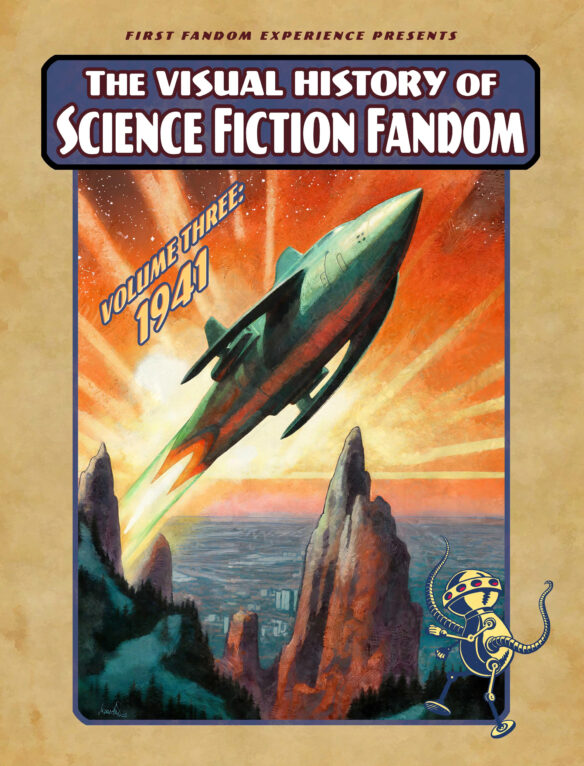
(4) FANDOM BEFORE THE DATE WHICH SHALL LIVE IN INFAMY. First Fandom Experience will release the third book in the series on April 5 at the Windy City Pulp and Paper Convention in Chicago: “Introducing Volume Three of The Visual History”.
Science fiction fandom in 1941 played out in a panoply of wisdom, foolishness, belief and incredulity. Less mired than previous years in the economic shackles of the Great Depression, fans let loose in ways both expected and surprising.
The year began with a bang – the noisy implosion of the ascendant Queens Science Fiction League, torn apart by rancor among New York factions stewing since 1938. In early December, fans in America were forced to face the threat of imminent dystopia as insidious products of science and engineering rained down on sailors at Pearl Harbor.
Between these bookends, fans read and wrote and gathered and argued and published in profusion – mostly in good humor.
The perennial questions persisted. What’s the purpose of the fiction we inhale like oxygen? What role do fans play in the world? Are we somehow better than others? What’s the point of organizing? Perhaps these debates were reason enough to come together.
Fans flocked together. Small but vibrant clubs coalesced in Boston, Minneapolis, northern New Jersey and central Michigan. Regional gatherings established communities and annual conferences that still endure….
Late last year, Claire “Grimes” Boucher, acclaimed musician and mother of three of billionaire multi-hyphenate Elon Musk’s children, announced an OpenAI-powered line of toys called “Grok” — not to be confused with Musk’s AI chatbot of the same name, as the two are currently entangled in a nasty custody battle….
… At first, the AI companion appeared to have no issues following Murdock’s orders.
“Hey Grok, can you just chill for a second,” he asked it.
“Sure thing, I’ll just float here and enjoy the cosmic breeze,” Grok answered….
Made by Curio, the product website is here: “Grok AI Toy”.
…“Strange New Worlds” is the 12th “Star Trek” TV show since the original series debuted on NBC in 1966, introducing Gene Roddenberry’s vision of a hopeful future for humanity. In the 58 years since, the “Star Trek” galaxy has logged 900 television episodes and 13 feature films, amounting to 668 hours — nearly 28 days — of content to date. Even compared with “Star Wars” and the Marvel Cinematic Universe, “Star Trek” stands as the only storytelling venture to deliver a single narrative experience for this long across TV and film.
In other words, “Star Trek” is not just a franchise. As Alex Kurtzman, who oversees all “Star Trek” TV production, puts it, “‘Star Trek’ is an institution.”
Without a steady infusion of new blood, though, institutions have a way of fading into oblivion (see soap operas, MySpace, Blockbuster Video). To keep “Star Trek” thriving has meant charting a precarious course to satisfy the fans who have fueled it for decades while also discovering innovative ways to get new audiences on board.
“Doing ‘Star Trek’ means that you have to deliver something that’s entirely familiar and entirely fresh at the same time,” Kurtzman says….
In the Harry Potter franchise, one thing that is made abundantly clear about Headmaster Albus Dumbledore is that he is the greatest wizard who has ever lived. Brilliant, wise, compassionate, and with a charming personality to boot, if not a bit quirky. He represents the archetype of the wizened mage, who provides the protagonist with guidance throughout their journey. Even those who despise him respect his power and intelligence. Yet, he was not a flawless person, with many skeletons in his closet. One in particular affected a majority of his students for a time: the professors he hired for Defense Against the Dark Arts were not always the best….
(8) UNFORGETTABLE HOWARD. Arnie Fenner, who published some of his work in small press, adds his tribute to the late “Howard Waldrop” at Muddy Colors.
…No one wrote like Howard Waldrop: no one could. He saw stories in virtually everything and telling them just the way he thought they should be told was far more important to him than the time they took to write or the amount of money he was ultimately paid—or not paid—when they were eventually published. His knowledge was encyclopedic and while there are wags who might know a little bit about a fair number of subjects, Howard knew a lot about a lot of things; he may have written fiction but there was always something factual, some history, to be learned from each story. He was, very much, a writer’s writer and he never compromised in the creation of his work; plus he was also a visual writer—an extension of growing up a comic book fan—one who literally painted vivid pictures with his words and who always created memorable scenes that could be a treasure trove for illustrators….
(9) TODAY’S BIRTHDAY.
[Written by Cat Eldridge.]
Born March 27, 1942 – Michael York, 82. What’s your favorite Michael York role? For me, it’s not any of his later roles but rather as D’Artagnan in The Three Musketeersback fifty years ago when he was thirty years old, and its sequels, The Four Musketeers(The Revenge of Milady) and The Return of the Musketeers. It was a role that he apparently played with great relish.
He was busy in this period as he also was in Cabaret as Brian Roberts, a bisexual Englishman, one of lead roles there. He has an affair with Sally, one of the other leads.
I’m not convinced he slept at all as I just found that also he was in a version of Lost Horizon, billed as “A musical fantasy adventure film”. Often cited as one of the worst genre films of all time, it currently holds a fourteen percent rating among audience reviewers at Rotten Tomatoes.
But as all the best actors seem to do, he would show up in a production of Murder on the Orient Express, as Count Rudolf Andrenyi.
Michael York in Logan’s Run.
Just three years after he played D’Artagnan he was cast as Logan 5, a Sandman, in Logan’s Run, a 1977 Hugo nominee at SunCon. I remember sort of liking it when I saw it back then but not enough to have watched it again since then. What’s your opinion of it? An of course his acting in it?
He’s got a lead role in The Island of Dr. Moreau as Andrew Braddock, his last genre role in film for twenty years until he played Merlin in A Young Connecticut Yankee in King Arthur’s Court, a role I dearly want to see. Though I’m not interested in seeing him in Austin Powers: International Man of Mystery as Basil Exposition, as those films to me are badly done.
He voices Bob Crachit in a late Nineties Christmas Carol that, shall we say, is way less that faithful to the source material and adds such things as Scrooge’s pet bulldog, Debit. Seriously it does. Tim Curry is Scrooge here. That’s it for film as far as I’m concerned.
Now for genre television. He was on The Wild Wild West as Gupta in “The Night of the Golden Cobra”; Batman: The Animated Series in the “Off Balance” episode as Count Vertigo; on seaQuest DSV in the recurring role of President Alexander Bourne; on Babylon 5, in the extraordinary role of David “King Arthur” McIntyre in the “A Late Delivery from Avalon” episode; multiple roles on the animated Superman series; in Sliders as Dr. Vargas in “This Slide of Paradise” (that series started fine but lasted way, way too long, yes I’m editorializing); King Arthur again in A Knight in Camelot; he voiced a truly awesome Ares in the Justice League Unlimited’s “Hawk and Dove” episode; and finally we have two voicings on Star Wars: The Clone Wars of the Dr. Nuvo Vindi character. He retired from acting a decade ago.
(10) COMICS SECTION.
Loose Parts has its own ideas about the way dinosaurs really looked.
…SF conventions in Glasgow started in 1978, and grew during the 1980s. They also featured a costume competition and, usually, a showing of The Rocky Horror Picture Show, with full audience interaction! (I even dabbled a little bit myself, including entering the contest once as ‘Riff Raff’ from Rocky Horror—fortunately in pre-internet times, so hopefully no photos exist!) Fans from Glasgow and the rest of the UK have continued to actively participate in costuming in the decades since….
The former chief executive officer of a unit of Yoozoo Interactive, which used to own the rights to ‘The Three-Body Problem,’ has been found guilty of poisoning the Chinese gaming firm’s chairman on the same week that the Netflix version of one of China’s most successful sci-fi novels began to broadcast.
Xu Yao, who joined Yoozoo Pictures in 2017, was sentenced to death for intentional homicide and handed an additional six-year sentence for administering dangerous substances, the Shanghai Municipal No. 1 Intermediate People’s Court said today in a first-instance verdict. Xu has also been deprived of his political rights for life.
The trouble started soon after Netflix linked arms with Yoozoo Interactive, whose other subsidiary Three-Body Universe had bought the rights to Chinese science fiction novelist Liu Cixin’s trilogy, to produce an English-language version of ‘The Three-Body Problem’ in September 2020.
Xu, who had resigned from the firm in January 2019, had a disagreement with Lin, a hugely successful and ambitious film and game producer, over company matters and deliberately poisoned his food around Dec. 14 or Dec. 15, 2020, the court said.
Xu also had a conflict with two other colleagues, both surnamed Zhao, and he poisoned them as well between September and December 2020, but not fatally.
Lin fell ill on Dec. 16, 2020 and was told by doctors that he had been poisoned, according to earlier statements from the Shanghai-based company. The next day Lin called the police who conducted an investigation and detained Xu. Lin passed away 10 days later.
Comments on Weibo indicate that Xu Yao was involved in the early deal-making stages of the Netflix adaptation of The Three-Body Problem,
(13) RANKING 100 RANDOM SF BOOKS. [Item by SF Concatenation’s Jonathan Cowie.] I do not know if you have come across the YouTube Channel Bookpilledbut it is the channel of a die-hard SF reader. I do know that many of you SF book readers will know of, if have not read, most of the 100 books that he has just randomly picked from his collection. Here he rates them.
Do you agree with him? Disagree with him? Agree with him in part?…
Do you, like him, have happy accidents?
I don’t know about you but there were three or four in here that he rates fairly well that I don’t have in my own collection. Check out his vid below.
Everyone remembers their first Wienermobile sighting. Maybe you were driving down the highway with friends and it suddenly appeared on the horizon: a gleaming hot dog that’s 11 feet tall, 27 feet long, and 8 feet wide. The unmistakable red and yellow of America’s favorite giant frank on wheels is always a thrill to encounter. Why travel to a roadside attraction when it can drive to you?
That image pops immediately to mind, no doubt. Here’s one that’s a little less familiar.
Nearly identical in size to the Wienermobile, the Planters NUTmobile debuted in 1935 and is manned by “Peanutters” who drive Mr. Peanut around the country. A Nutmobile was transformed into an INN a NUTshell retreat (help) in 2021, allowing people to book a night in the vehicle, which was outfitted as a sort of snack-themed fever dream camper.
(15) A DERN MINUTE’S WORTH OF “WHERE THIS CAME FROM”. [By Daniel Dern.] The reference behind today’s title, “The DiskWorld Turned Upside Down (Because ‘RingWorld’ Here Wouldn’t Make Sense, Would It?)”.
Via, for us folkies, Leon Rosselson’s song of that name (I’m pretty sure he wrote it — I know it’s on his albums, and I believe I’ve heard him sing it, live, way back when), although he got the notion/phrase from the the 1640s version, and LR’s song was subsequently-ish done by Billy Bragg and, most recently, the phrase became part of a song in Hamilton.
[OGH adds: That last is probably because “The World Turned Upside Down” was played during the surrender ceremony at Yorktown, the climactic moment of the American Revolution.]
(16) VIDEO OF THE DAY. How It Should Have Ended has remastered their 12-year-old Ghostbusters tribute.
[Thanks to Mike Kennedy, Andrew Porter, Daniel Dern, Frank Catalano, Olav Rokne, Ersatz Culture, John King Tarpinian, Chris Barkley, Cat Eldridge, SF Concatenation’s Jonathan Cowie, and Steven French for some of these stories. Title credit belongs to File 770 contributing editor of the day Daniel Dern.]
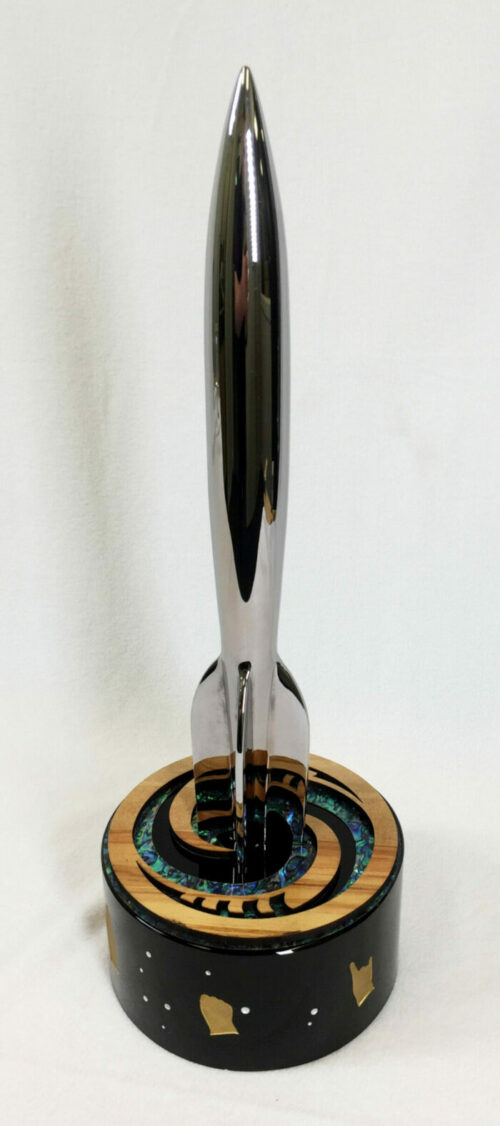
Mini Hugo rocket carried into space and photgraphed by astronaut Kjell Lindgren in 2015.
By Doctor Science: This is a first draft. I don’t know all the arcane rituals for submitting something to the WSFS Business Meeting, but I hope to get to that in due course.
Proposal: that there should be a permanent Hugo Tech Working Group
This Working Group shall be answerable to the WSFS, either in the form of the Business Meeting, or in the form of some other committee or group.
The Hugo Tech Working Group (HTWG) doesn’t set rules for the Hugo Awards software, it actually does the work (hence the name). The HTWG is not a directly elected group, but it must report and be answerable to elected groups. The HTWG will include:
one or more “Gurus”: people who had a major role in writing the open-source software currently being used (hi Chris!)
one or more “Scribes”: responsible for documentation, manuals, and reports
1 person from Worldcon N-1
at least 3 people from Worldcon N
2 people from Worldcon N+1
where N is the current Worldcon.
The “Hugo Awards software” is whatever performs the following functions:
validates that a given person has the right to nominate or vote. This is a function of the registration system, which is handled by Worldcon N
accepts nominations
canonicalizes nominations, i.e. makes names uniform
calculates finalists
accepts final ballots
calculates winners
What problems am I trying to solve with this proposal?
One of the (many) shocking revelations in Chris Barkley’s interview with Dave McCarty was that the software McCarty wrote to determine the final ballot was erroneous, and he knew it: “The SQL query from from the data for the ballot counts in each category actually has a fucking flaw and it’s and it’s mistaken.”
I said, “Why is Dave talking about SQL? Is each Worldcon re-inventing the vote-counting wheel?”
Chris Rose/Chris_R/offby1, who’s worked on the software for numerous Worldcons, replied:
in my observation, convention committees all seem to have at least one person on them, in a position of authority, who wants to be the one to invent the software suite to rule them all that will solve all future fannish endeavours henceforth. I’ve seen it result in thousands of hours of volunteer software development in the short time I’ve been in this community, and I don’t foresee it [stopping].
Then Mary Robinette Kowal said she’d learned that McCarty had not only written his own Hugo Awards software, but it’s proprietary, he won’t show anyone else the code.
Unlike what we’ve had so far, the Hugo Awards software (HAS, hereafter) needs to have these characteristics:
transparency: HAS cannot be a black box. It has to be clear to qualified nerds (of which SFF fandom has a plethora) how the results are generated, at each step. This almost certainly means it has to be an open-source project. I understand that many major tech companies have vampiric employment contracts that make it impossible for their workers to contribute to open-source projects on their own time, but this shouldn’t be a limiting problem for the WSFS. We are literally Nerd Central, we can cast a net a little wider than the Usual Suspects and find people who aren’t hamstrung by their employers.
checkability: it must be possible for each step to be audited. It must be possible for a recount to take place, if necessary. This would mean coming up with some way to break the connection between a particular ballot and the person who cast it, something comparable to the separation of a mail-in paper ballot from its identifying envelope.
dependability: if HAS worked in year N, it should work in year N+1. Voters and conrunners should be able to treat HAS as a reliable utility, not a box of surprises.
flexability: it should be possible to make small modifications and extensions to HAS without starting over. This is another reason it probably has to be some variety of open-source project. Every decade or two technical debt and technological change will probably mean that HAS will need to be re-done, but since the Working Group has a lifespan longer than that of a single Worldcon, the project will have a chance to be done rationally.
I’m making this proposal because I don’t have a horse in this race. I don’t have the technical experience to work on HAS, but I’ve been married to a guru-level database and software consultant for 35 years, I used to develop websites, I understand the desire to be the Mighty Wizard of HAS. But I can see that this desire to be perfect has been the enemy of the good, and at times even the functional.
So one big purpose of a Hugo Tech Working Group is to make HAS boring, to discourage people who have a Grand Vision while encouraging those who just like to do work that gets done. It makes it lower-stakes, maybe even reducing the load on the Worldcon tech team, so they can do a better job and yet still have time for fun, without massive burnout (a gal can dream).
Structurally, people have been talking about splitting WSFS Worldcon functions from Hugo Awards functions. The HTWG would be part of the Hugo Awards half, but mostly staffed by people from Worldcons.
My idea is that most of the HTWG staff are the tech people from current Worldcon N, the ones who set up the software, run it, do the hand-checking for canonicalization, and so forth. There’s one person from Worldcon N-1, whose job is to say “this is what we did last time that worked, this is what we tried that didn’t work.” There are also 2 people from Worldcon N+1, who are there to learn the ropes and to start setting up their instance of HAS.
The real working group part of the HTWG comes when HAS has to be modified. The Gurus are there to know the details of the code, what’s actually easy or difficult to do with this software, Worldcon N-1 person to talk about what changes would have helped most, Worldcon N+2 people to talk about problems they see on the horizon.
Mr Dr Science advises me that this is the sort of situation where holy wars can start, which I’m sure is part of why HAS has kept being changed in the past. I’m eager for advice on how to structure the HTWG to avoid holy wars and other purity contests, so that it keeps focused on: Does this work? Is it transparent, checkable, dependable? Does the HTWG need non-technical members or overseers, for instance?
I eagerly invite comments and suggestions, especially on how to structure this proposal for presentation at the Business Meeting in Glasgow. For instance: can it be presented as a stand-alone, or does it go as a subset of some larger Splitting-the-WSFS proposal? Is the position of Scribe necessary, to do the documentation, put together reports, etc?
It is my firm belief that institutionalising tech solutions for WorldCons in a standing committee, as proposed above, will be disastrous. It will blur accountability and demotivate volunteers. … The “permanent Tech Team” already exists informally. The pool of knowledge is not wide but it is deep.
I’m not sure what about the HTWG he was objecting to, or if he was talking about something in the discussion more generally.
As proposed, the core of the HTWG is the tech subcommittee from Worldcon N. Yes, it constrains them, by saying “this is the software suite we’ve been using and that you’re going to have to use”, but it also helps them, bringing them in as soon as they win the bid, listening to their needs and suggestions, training them, and making them part of the Tech Team in a way that’s *not* informal and based on friendship networks. Informal networks are great if you’re not being covered by major news outlets, but we’ve passed that point.
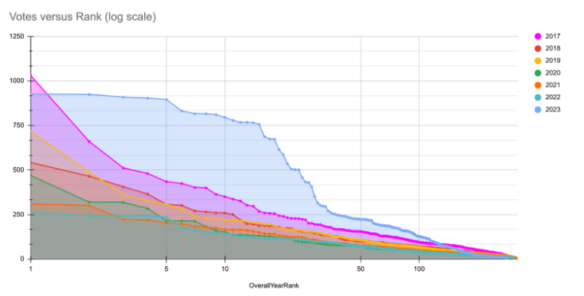
Introduction by Camestros Felapton: Since the release of the 2023 Hugo Award nomination statistics on January 20, there have been a plethora of questions about the awards and the process followed. One of the earliest insights into the data was made in a series of graphs drawn by Heather Rose Jones on her Alpennia (“A Comparison of Hugo Nomination Distribution Statistics”.) The graphs revealed several categories with highly unusual “cliffs” in the number of nominations.
This new report [available here] builds upon that initial analysis and delves further into the unusual features of the 2023 data. By collating data from all of the Hugo nominations from 2017 onward, the report looks at unusual features in the nomination statistics, compares 2023 with previous years in multiple dimensions and looks at additional data such as the recently leaked validation lists.
This report contends that the nomination statistics provided cannot be treated as a reliable presentation of the actual nomination votes by members. The report shows that there are known errors in the listed names of nominees, inconsistencies in the vote totals, inaccuracies in the manner points were calculated in elimination rounds and highly atypical patterns of voting. In particular, there is evidence in the categories of Best Novel and Best Series of a very large number of highly similar votes for the main finalists in these categories, that these votes advantaged English-language works over Chinese-language works and that these votes do not resemble organic voting by members.
The 51-page report can be downloaded from two locations:
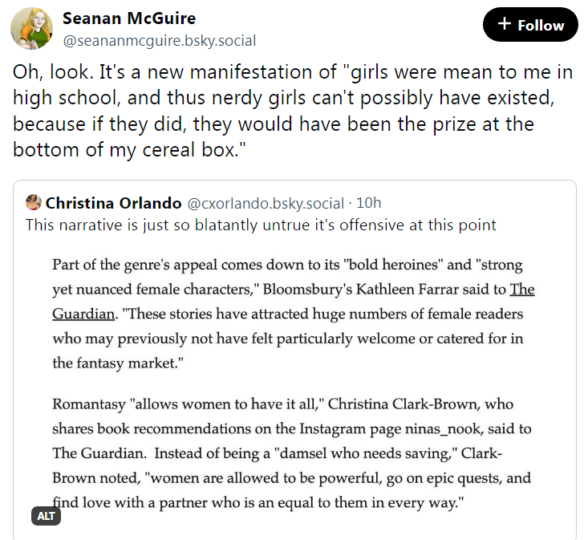
(1) NOT A NEW PHENOMENON. [Item by Anne Marble.] If the article quoted in Seanan McGuire’s thread is any indication, the people marketing “romantasy” seem to think they’re the first to publish fantasy novels for women. Or maybe they know better — but they don’t care because they’re trying to market romantasy/romantic fantasy. Bluesky thread starts here.
… I’m going to say this again, because it is so shocking that it seems to have taken a lot of people some time to grasp the enormity of it: hundreds, perhaps even thousands of valid, legal nominating ballots were dropped from the final nominating stats, apparently under the pretext of having represented a slate, even though slates are perfectly legal under the Hugo rules. This was done on the orders of the Hugo administrator, with apparently no outside input or discussion, and appears to have elicited so little response from the Hugo team that they are casually mentioning it as if it’s nothing. If these numbers are correct, it’s entirely possible that the whole Hugo ballot should have looked completely different, and that none of the eventual winners in the fiction categories should have even been nominated.
What this means is that the entire 2023 Hugo scandal is something completely different from what we’ve understood it as during the last month. Appalling as it is, the choice to screen English-language nominees for ideological compatibility may, in fact, be a sideshow to the real scandal, which is that hundreds of Chinese voters have been disenfranchised. And—barring even more revelations—this disenfranchisement cannot be blamed on PRC sensibilities and censorship. I truly doubt that it was in the interest of China, or the Chinese business interests who took over Worldcon, to remove Chinese-language nominees from last year’s Hugo ballot. This decision came from the American and Canadian staffers who made up the English-language Hugo team, many of them Worldcon volunteers of long standing.
In this context, it is infuriating to recall just how quickly the response to our original sense of what this scandal was turned to anti-democratic measures and calls to limit the power of rank-and-file Worldcon members. “Elections have consequences!” crowed the people who are still pissed they weren’t allowed to steal the site selection vote in 2021, while others called to limit site selection to those with “skin in the game”—read, those with the wherewithal to travel to US-based conventions. But as it turns out, the call was coming from inside the house. This was never a China problem. It’s an us problem. If the allegations that are now emerging claiming that McCarty has behaved this way in the past, and also harassedotherWorldcon staffers, are to be believed (and there is certainly more than enough reason to believe them at this point), it’s a profound failure on the part of Worldcon and its membership to police toxic members, which has now blown up in all our faces….
There are many reasonable points of view about how to deal with the awards. File 770’s goal is to support and respect the recipients’ decisions.
Another author, Samantha Mills, recently made a decision comparable to Tchaikovsky’s, in a blog post titled “’Rabbit Test’ unwins the Hugo”.
(4) THE WHOLE WORLD IS WATCHING. The Hugo Awards scandal has even made it into Sweden’s Dagens Nyheter –“Litteraturpris valde bort kinesiska författare”. The article is behind a paywall, though that’s honestly only a problem if you read Swedish.
…Hollywood has had an ongoing love affair with the works of Phillip K. Dick for decades now. Sometimes it’s a healthy relationship, giving us masterworks such as Blade Runner. Sometimes it’s downright abusive when it produces flicks like Screamers or Paycheck. And sometimes it splits the difference and serves up enjoyable silliness such as Total Recall.
Still, as many times as the movies have returned to Dick’s catalog, you’d think he was the only SF writer out there. We all know better, of course, and pretty much any SF fan has their dream list of books they’d love to see brought to the silver screen.
If Hollywood really wants to freshen things up, they should take a closer look at the work of Robert A. Heinlein….
(6) BANNED FROM THE HIGHWAY. [Item by Dann.] Remember when non-genre magazines used to publish SFF stories?
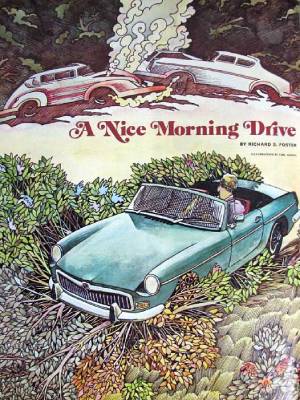
Every automobile begins as the sparkle in someone’s eye. In 1981, Neil Peart and his Rush bandmates introduced the world to a Red Barchetta. Saved in an old white-haired uncle’s barn. A relic from before the Motor Law being chased down by gleaming alloy air cars before being saved by a one-lane bridge
But before that, it was an old MGB roadster. Rendered obsolete by wave after wave of modern automobile safety standards had made surviving car crashes not only likely but predictable. The drivers of the newly designed cars expected to walk away from accidents unscathed. As a result, drivers of these Modern Safety Vehicles began targeting older vehicles leaving them in mangled heaps. Those driving older cars were likely to be left in a similarly mangled condition. The price for driving a classic. And so the driver of the old MGB engages in a race for his life pursued by a pair of MSVs.
The story was “A Nice Morning Drive“. It was written by Richard S. Foster and first published in the November 1973 issue of Road & Track magazine. Neil Peart had encountered the story and was inspired to re-tell it in a more distant future where automobiles were banned. It appeared in 1981 on the quintessential RUSH album, Moving Pictures as the second track, “Red Barchetta“.
The band had tried to contact Richard, but R&T no longer had his current address. They did add a credit note referencing the original story in the liner notes.
It was many years later before a friend pointed out that Neil had been inspired by Richard’s story. And it was a few years after that when Richard began corresponding with Neil. The two eventually planned a motorcycle ride along the East Coast. It turns out that they both owned the same model motorcycle, the BMW R1200GS.
As a footnote, Moving Pictures came out in my junior year of high school when I took an advanced composition class. At some point, a red car entered into the zeitgeist of my classmates. The model would shift to suit the moods and tastes of various authors. Sometimes it was only glimpsed under a protective tarp. Other times it would it would fly along country roads kicking up a stream of fall leaves. Our automobile appreciations lasted about a month before our teacher put a firm but kindly end to our vehicular ruminations.
I want to take a moment to thank all of you once again for the great kindness and generosity you have shown me in the recent weeks and also update you on my current status and plans.
This coming weekend (February 23rd-25th) I will be a guest at Pensacon 2024 in Pensacola, FL. My doctor says I’m in good enough health to travel as long as I continue to pace myself and take my meds and supplements. And, to be blunt, I can’t afford to pass up what is likely my only comic con appearance for the foreseeable future. So if any of you who have donated are at the convention this coming weekend, please stop by so I can thank you in person. My good friend, Adam–who is the one who talked me into going to the ER instead of gutting it out another 24 hours–will be driving me there and back, as well as helping set-up and run my merchandise table for the weekend, so I have reliable support with me.
I have 3 more weeks, more or less, of blood thinners twice a day ahead of me before I get an idea of whether or not the blood clots were a one-off event or a symptom of something more serious. Until I know one way or another, I will be staying close to home. However, I still plan to be at the Outer Dark Writer’s Symposium in Atlanta next month, health permitting.
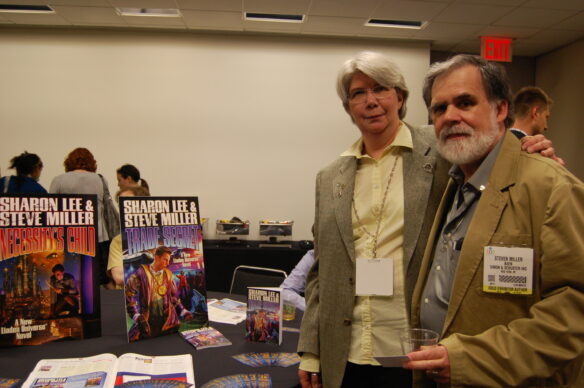
(8) LEE AND MILLER PHOTO. Following yesterday’s announcement of Steve Miller’s death, Andrew Porter sent File 770 his photo of the Steve and Sharon at Book Expo.
(9) MARK MERLINO DIES. Mark Merlino, one of the early founders of organized Anime and Furry fandoms in North America, died February 20 at age 71. He suffered a stroke in December, then was diagnosed with stage 4 liver cancer about two weeks ago.
Merlino was known for organizing ConFurence, the very first furry convention, which laid the groundwork for the community’s expansion and visibility. His influential role was also recognized in the documentary feature The Fandom, showcasing his significant contributions.
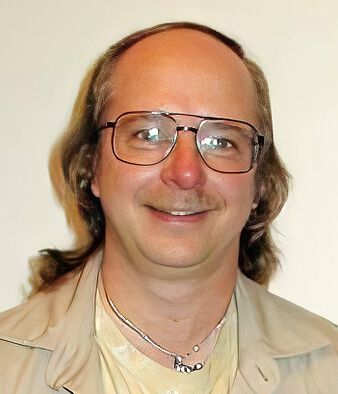
Mark Merlino in 2006.
(10) RICHARD MATHEWS (1944-2024). Scholar Douglas Anderson pays tribute to a colleague in “R.I.P. Richard Mathews (1944-2024)” at Tolkien and Fantasy.
I just googled to see if my old friend Richard Mathews was still the Director of the University of Tampa Press, only to find out that he died last month.
I met him at the 1987 Mythcon in Milwaukee, where we both appeared on a panel on David Lindsay. We found we had many common interests. Richard had published, with Borgo Press, a short book on Tolkien, Lightning from a Clear Sky (1978), and other short books on William Morris and Brian Aldiss. His most notable work was the Twayne volume Fantasy: The Liberation of Imagination (1997; reissued in 2012), which was filled with insights despite the somewhat odd structure of the book (presumably imposed upon him as part of the series it was in). Richard also contributed introductions to some of the William Morris reprints for the Newcastle fantasy series in the 1970s….
(11) TODAY’S BIRTHDAY.
[Written by Cat Eldridge.]
Born February 21, 1946 — Alan Rickman. (Died 2016.) The first time I saw Alan Rickman was in the decidedly not-genre role of German terrorist leader Hans Gruber in Die Hard, a film that’s still high on my list of great thriller films. Great role for him, too. It was amazingly his first film role.
He would won a BAFTA Award for Best Actor in a Supporting Role for playing the Sheriff of Nottingham in Robin Hood: Prince of Thieves. I actually did see that film. No, I’ll never watch again. Simon R. Green’s publicist tells me he made a lot of money for writing the novelization.
Rickman went on to play the wizard Severus Snape in the Harry Potter series. I can’t say I cared for the character but I don’t think we were supposed to. I never got beyond a hundred pages in the first novel before I gave up reading it, but loved the films.
While in the film The Hitchhiker’s Guide to the GalaxyWarwick Davis played Marvin, the android who was clinically depressed and in the novels I thought a royal pain in the ass, it was Alan Rickman who actually voiced the character.
He also voiced Absolem, the Caterpillar in an odd version of Alice in Wonderland. Look it up. Trust me, it’s weird.
And yes, I saved the best first last for last which as you already know is his role in the Hugo Award winning Galaxy Quest which is by far his best genre role. Alexander Dane is a Shakesperean actor who resents his character Dr. Lazarus, the ship’s science officer. His catch phrase? Oh, you know that by heart.
(12) COMICS SECTION.
Macanudo shows who really was entitled to say, “How wude!!”
…THE STORY COMES TO US from the local newspaper Kentucky New Era, which, on August 22, 1955, reported strange goings-on the previous night, eight miles north of Hopkinsville, Kentucky. At about 11:00 pm, two cars arrived at the local police station, blasting out of the night filled with at least five adults and several children, all of whom were highly agitated. “We need help,” they told the police. “We’ve been fighting them for nearly four hours.”
Once they’d calmed down enough to talk, they unfurled a strange story. One of the men, Billy Ray Taylor, had been visiting from Pennsylvania. At one point, he went outside to fetch water from the farm’s well. As he walked through the failing light, he saw a circular-shaped object hover through the air before coming to rest in a nearby gully…
… Concerned, Taylor retreated inside and returned with a shotgun to investigate. As he walked into the gloom, a strange, goblin-like thing with glowing eyes appeared and moved toward him. It had “huge eyes,” and hands out of proportion with its body, and looked to be wearing some kind of “metal plate.” Taylor retreated to the house yet again and grabbed a .22 caliber pistol, while Lucky Sutton grabbed a shotgun and joined him.
A creature—whether it was the same one, they didn’t know—appeared in the window, and Sutton unloaded his shotgun at it, blowing out the window screen. When they went outside to see if they’d hit anything, Taylor felt a “huge hand” reach down from the low roof above and grab his hair….
The LignoSat probe has been built of magnolia wood, which, in experiments carried out on the International Space Station (ISS), was found to be particularly stable and resistant to cracking. Now plans are being finalised for it to be launched on a US rocket this summer.
The timber satellite has been built by researchers at Kyoto University and the logging company Sumitomo Forestry in order to test the idea of using biodegradable materials such as wood to see if they can act as environmentally friendly alternatives to the metals from which all satellites are currently constructed.
“All the satellites which re-enter the Earth’s atmosphere burn and create tiny alumina particles, which will float in the upper atmosphere for many years,” Takao Doi, a Japanese astronaut and aerospace engineer with Kyoto University, warned recently. “Eventually, it will affect the environment of the Earth.”…
The brightest known object in the universe, a quasar 500tn times brighter than our sun, was “hiding in plain sight”, researchers say.
Australian scientists spotted a quasar powered by the fastest growing black hole ever discovered. Its mass is about 17bn times that of our solar system’s sun, and it devours the equivalent of a sun a day.
The light from the celestial object travelled for more than 12bn years to reach Earth….
…In a new exclusive clip shared with Animation Magazine, we get an advance look at the premiere episode. The excerpt features Dr. Klak (Keke Palmer), Dr. Sleech (Stephanie Hsu), Dr. Vlam (Maya Rudolph) and Dr. Plowp (Kieran Culkin). In Season 1, doctors Sleech and Klak take on a highly dangerous and potentially groundbreaking case and, in doing so, put existence itself in jeopardy. (Although considering their dismal personal lives, oblivion might be an improvement.)…
[Thanks to Andrew Porter, John King Tarpinian, Chris Barkley, Taral Wayne, Rich Lynch, Anne Marble, Cat Eldridge, SF Concatenation’s Jonathan Cowie, Steven French, and Mike Kennedy for some of these stories. Title credit belongs to File 770 contributing editor of the day Jeff Jones.]