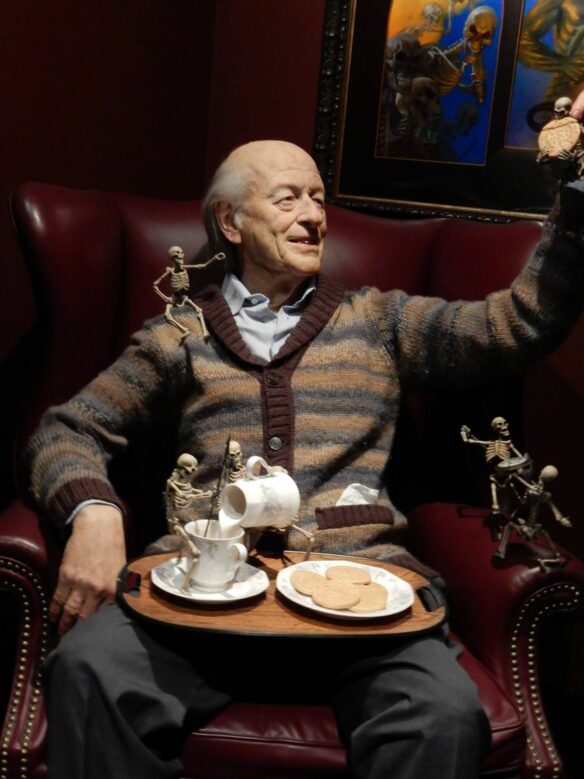
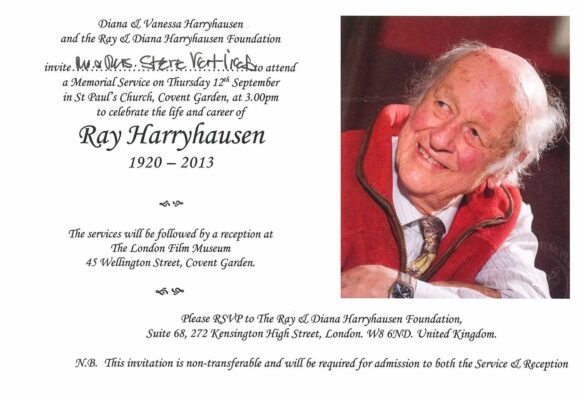
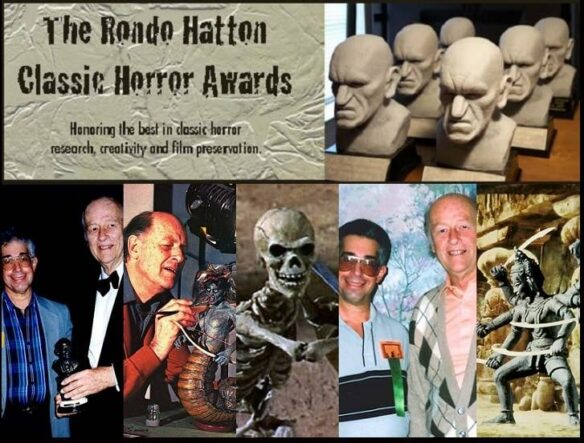
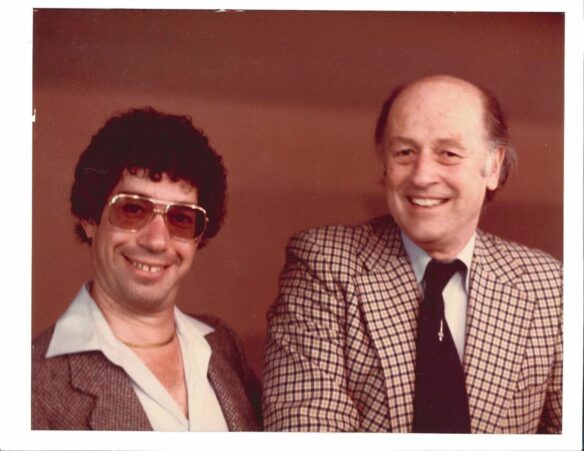
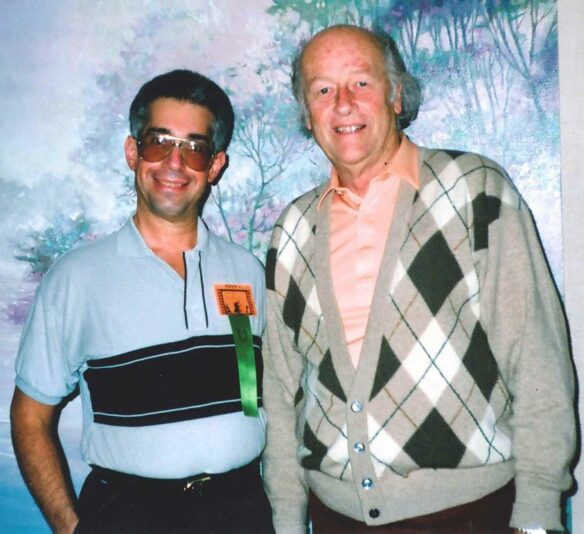
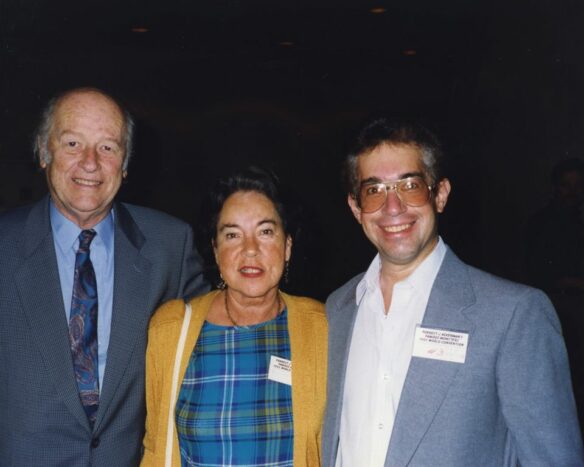
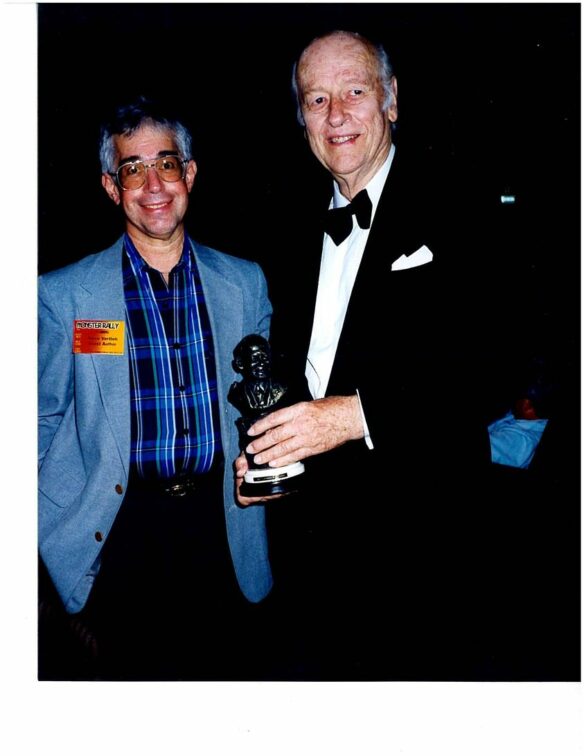
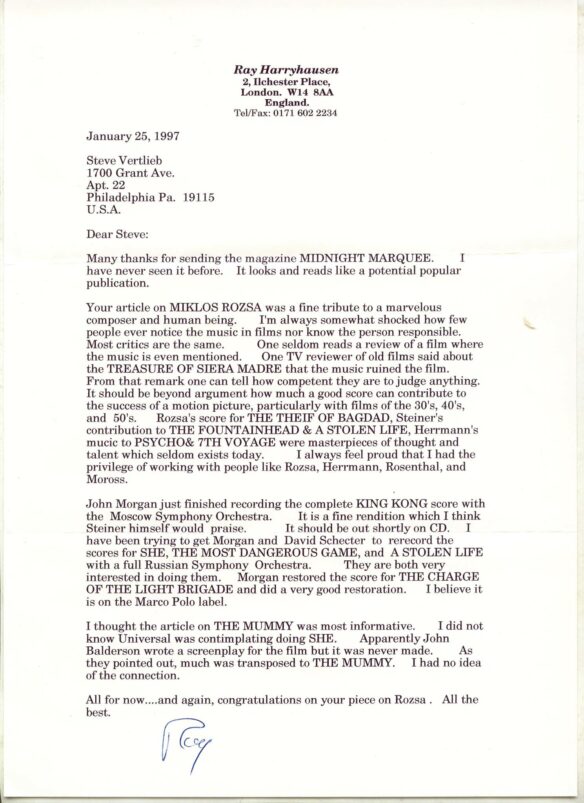
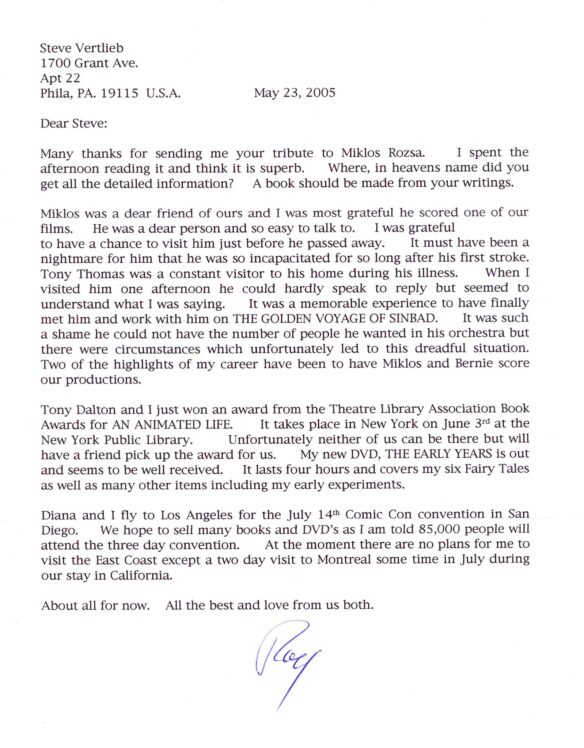
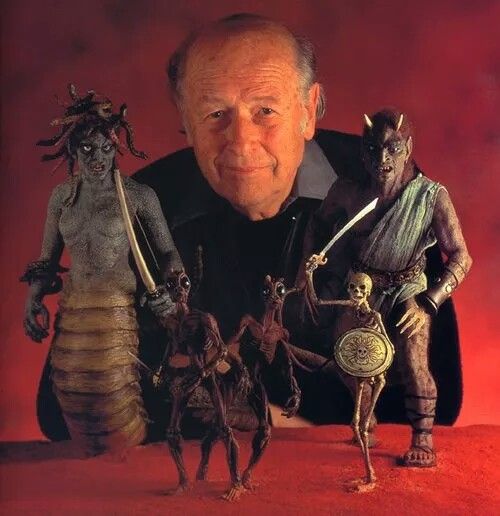
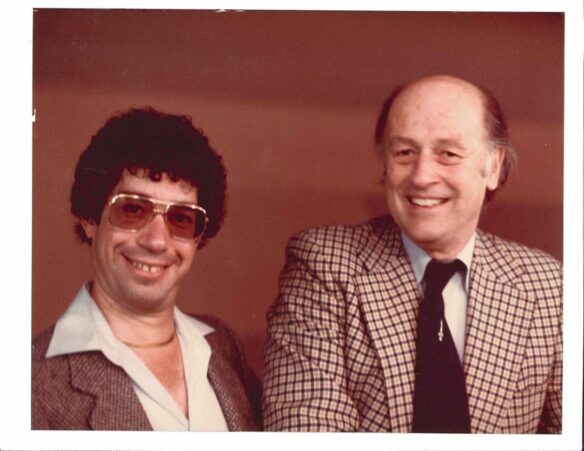
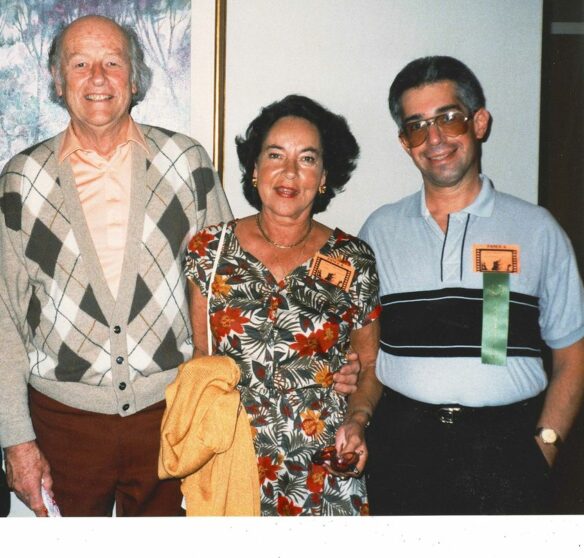
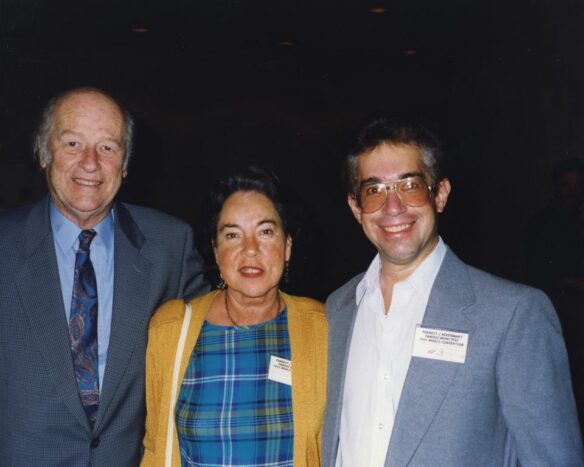
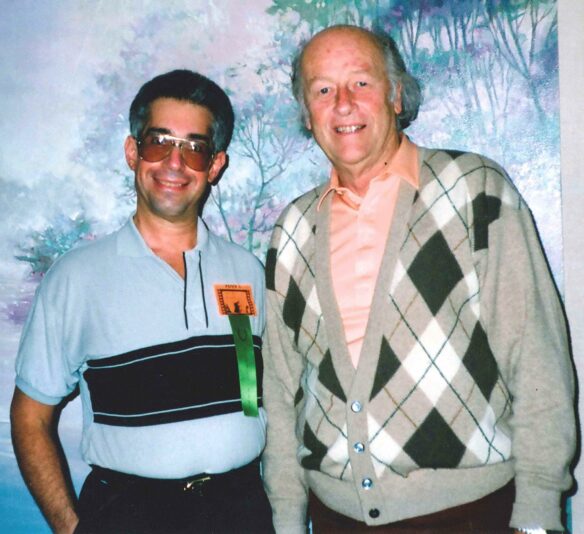
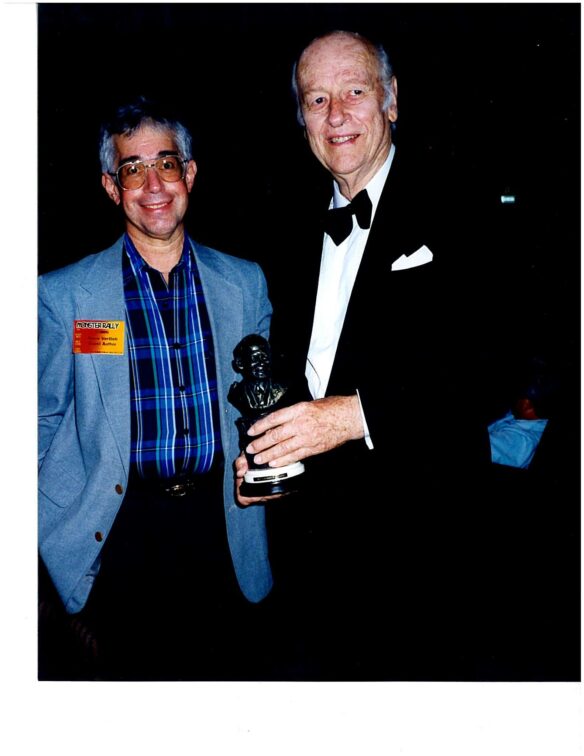
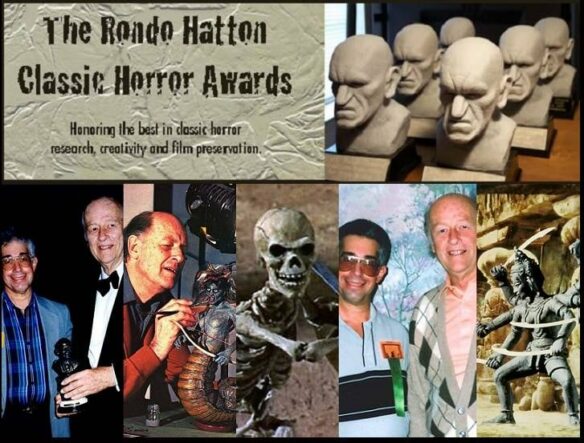
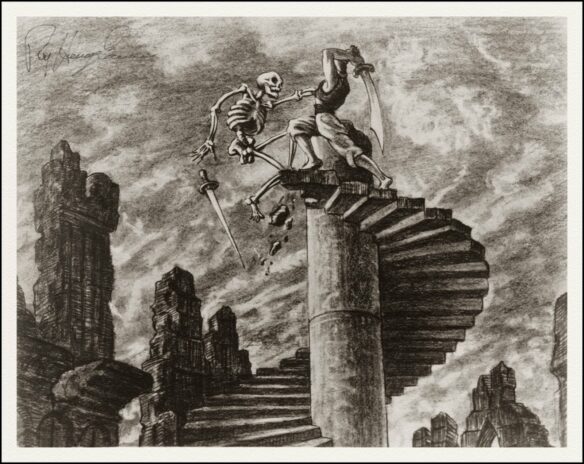
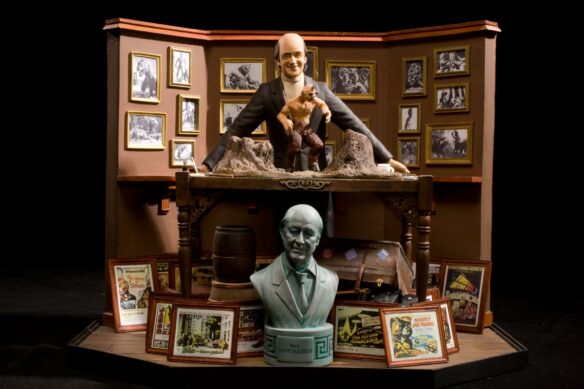
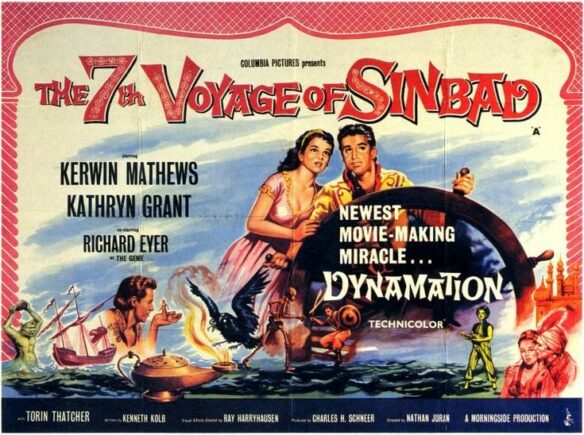
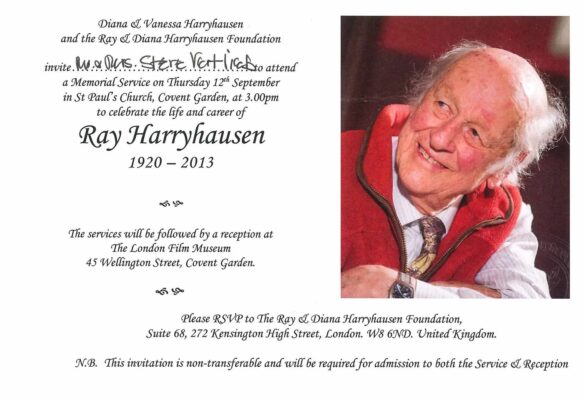
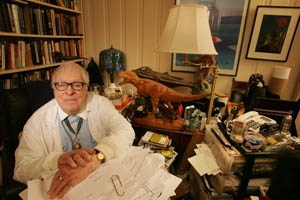
By Steve Vertlieb: Ray Harryhausen remains one of the most revered figures in fantasy/sci-fi motion picture history. Born June 29, 1920, Ray was not only a childhood hero, but became a dear and cherished friend of nearly fifty years duration. June 29, 2020, commemorated his genius, as well as the joyous centennial of his birth with numerous remembrances, events, and exhibitions in celebration of his 100th birthday throughout the world.
His work in films inspired and influenced generations of film makers, and garnered him a special Academy Award, presented by Tom Hanks, for a lifetime of cinematic achievement. Steven Spielberg joyously proclaimed that his own inspiration for directing Jurassic Park was the pioneering special effects work of Harryhausen.
My loving remembrance of Ray was published by The Thunderchild shortly after his death on May 7, 2013, nominated by the annual Rondo Awards for Best Article of the Year, and published once more for what would have been his 100th birthday on June 29th, 2020, by the Hugo Award winning web magazine File 770.
It was my celebration and loving remembrance of the life and work of cinematic master, and special effects genius, Ray Harryhausen. It was also the tender story of a very special man, as well as an often remarkable personal friendship. I love you, Ray. You filled my dreams, my life, and my world with your wondrous creatures.
In sweet recollection of this wonderful soul, here is an affectionate tribute to my friend of forty-eight years, and boyhood hero of interminable recollection and duration, as well as a pioneering champion of original music written for the motion picture screen … the incomparable Stop Motion genius, and Oscar honored special effects pioneer, Ray Harryhausen.
Journey with me now to a “Land Beyond Beyond” where dreams were born, cyclopean creatures thundered across a primeval landscape, mythological dragons roared in awe struck wonder, and magical stallions ascended above the clouds in intimate personal correspondence … Once Upon A Time.
The Judith A. Markowitz Award for Exceptional New LGBTQ Writers recognizes LGBTQ-identified writers whose work demonstrates their strong potential for promising careers. The award includes a cash prize of $1,500. This year, the award goes to Naseem Jamnia and Maya Salameh.
Naseem Jamnia (they/them) is the Locus-nominated author of The Bruising of Qilwa, a novella introducing their queernormative, Persian-inspired world, which was shortlisted for the IAFA’s Crawford award. Named the inaugural Samuel R. Delany Fellow, they’ve also received fellowships from Lambda Literary and the Otherwise Award, and their nonfiction has appeared in The Rumpus, The Washington Post, Cosmopolitan, New Orleans Review, Sarah Gailey’s Stone Soup newsletter, and other venues. They are the managing editor of Sword & Kettle Press, a tiny independent publishing house of feminist speculative writing, and their debut middle grade horror, Sleepaway, is out in 2025 from Aladdin. Find out more and sign up for their newsletter at naseemwrites.com, or follow them on social @jamsternazzy.
How has access to queer literature/queer stories impacted your life as a queer person and shaped you as a queer writer?
When I was growing up, the closest I saw my gender portrayed in stories was with the “girl disguises herself as a boy to do the thing” trope, a la Mulan and Tamora Pierce’s Alanna books. I had to resort to fanfiction to explore queerness in terms of sexuality (and even then, rarely or never saw a portrayal of someone on the asexual spectrum). Much of my own writing growing up explored these issues inadvertently and vaguely, as I did not know what I was exploring at the time. However, once terms like “nonbinary” or understanding of transness outside a binary entered the public lexicon in the last 10-ish years, the wealth of queer literature we’ve seen explicitly including various identities has made a world of difference, helping me to understand and embrace my own various identities, which has since allowed me to live as my truest self. With this clearer understanding, I’ve taken the lack of what I saw growing up to turn into what I wish I had seen and where I wish we can go in the future. I’m grateful so many queer books exist now for kids and adults alike to explore the multiplicity of queer experiences….
(2) REUBEN FINALISTS INCLUDE TWO SFF ARTISTS. [Item by Dariensync.] Girl Genius creator Phil Foglio and frequent Neil Gaiman collaborator Colleen Doran have both been nominated for Reuben Awards by the National Cartoonist Society. Foglio for Online Comics: Long Form for Girl Genius, Doran for Best Graphic Novel for her adaptation of Neil Gaiman’s Chivalry. “Finalists Announced For 2022 NCS Divisional Awards For The 77th Annual Reubens”.
(3) STARS ON MARS. You can watch the first aired episode of Stars on Mars on the FOX website. William Shatner serves as Mission Control.
Many fans feel that modern fantasy movies began in 2001 with the one-two punch of The Lord of the Rings: The Fellowship of the Ring and Harry Potter and the Sorcerer’s Stone. Both having been produced after the CGI revolution of the 1990s, they applied the full power of the latest visual effects techniques to bring two beloved fantasy book series vividly to life.
But fantasy films go back a lot further than 2001. Since the dawn of movies, imaginative filmmakers have striven to use the medium’s unique capabilities to bring to life visions that cannot exist in reality. Long before computers were rendering T. rexes and Orc armies, special-effects crews had already amassed a huge bag of tricks to put fantastical stories on the screen, including stop-motion, bluescreen, forced perspective, puppets, and giant props.
Three of the four most highly-rated films have effects by Ray Harryahausen. Number one is –
Jason and the Argonauts
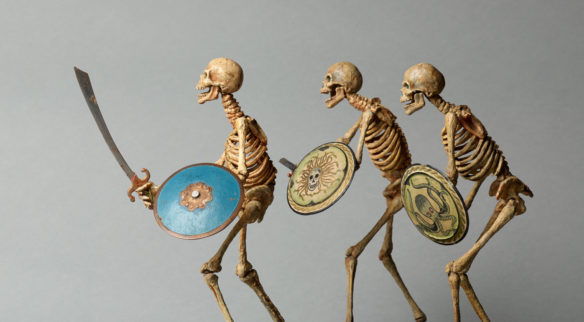
A retelling of the myth of the Golden Fleece, 1963’s Jason and the Argonauts was one of the peaks of Ray Harryhausen’s special effects career. Numerous striking effects appear throughout the film, but the show-stopper is the epic battle where Jason and his men confront an army of magically animated skeletons.
I had three men fighting seven skeletons, and each skeleton had five appendages to move in each separate frame of film. This meant at least 35 animation movements, each synchronized to the actor’s movements. Some days I was producing just 13 or 14 frames a day, or to put it another way, less than one second of screen time per day, and in the end the whole sequence took a record four and a half months to capture on film.
(5) YOU SAW IT HERE FIRST. At Galactic Journey, John Boston reviews the issue of Amazing which scored the coup of publishing an excerpt from Delany’s Nova, the novel Campbell declined to serialize in Analog: “[June 6, 1968] The Stalemate Continues (July 1968 Amazing)”.
Once more, all but one item of fiction are reprints, though this issue’s exception is more considerable than some: House A-Fire, by Samuel R. Delany, described as a short novel (at 33 pages!) on the cover and contents page, though editor Harrison acknowledges in the letter column that it is actually an excerpt from Delany’s new novel Nova, forthcoming from Doubleday. Delany’s name is misspelled on the cover and contents page and in Harrison’s editorial, spelled correctly on the story’s title page and in the letter column. Are you getting tired of all this nit-picking? So am I. But the persistent sloppiness of this magazine continues to irritate….
What was it about the horror genre that drew you to it?
I’m less certain that I chose horror; I think horror chose me. Truthfully, from as far back as I can remember, I was drawn to all things dark. As a kid, my earliest recollections of being terrified were watching made-for-TV movies from the 70s like Don’t Be Afraid of the Dark, Gargoyles, and Trilogy of Terror. I can still remember damn near pissing myself when that little Zuni fetish doll from the latter chased poor Karen Black around her apartment! (laughs)
As I got a little older, my Dad would take me to the movies as part of our weekend “buddy days”. They were usually Irwin Allen disaster flicks or movies with a lot of car chases, but then a little film called Jaws was released. I was eight years old and can still feel the knot in my stomach the first time I heard those opening notes of John Williams’ now-legendary score. I think I only made it up to the point that the ill-fated skinny-dipping Chrissie gets slammed into the buoy before I pleaded with my Dad to leave. It would take three subsequent tries before I could make it through the entire film, each time making it a little further into the film before my ever-patient father heard the desperation of the “Please, Daddy…can we leave now?” in my voice. Jaws was a rite of passage for me; it was the first time I needed to summon and sustain any sense of real bravery. When I finally saw those end credits, it was a mark of accomplishment… a hint of manhood, if you will.
1978 was a game changer for me—the cusp of adolescence and the release of John Carpenter’s Halloween. If Jaws hooked me, Halloween reeled me in and cemented what would become a lifelong adoration of both slasher films and a certain actress named Jamie Lee Curtis.
(7) MEMORY LANE.
2005 – [Written by Cat Eldridge from a choice by Mike Glyer.]
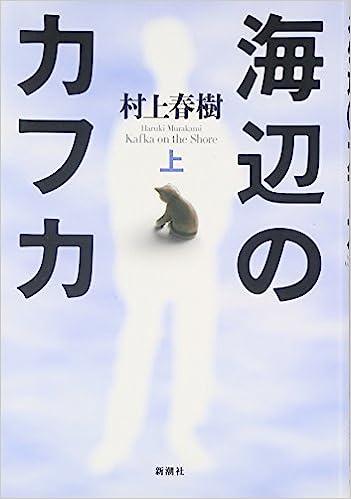
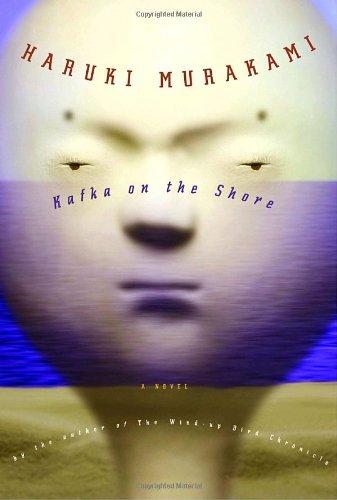
I won’t say that Haruki Murakami is author that I’m at familiar as he isn’t. Kafka on the Shore is the English translation of the original Japanese publication which is this, 海辺のカフカ.
Alfred Knopf published the first English language edition eighteen years ago.
It would win a World Fantasy Award.
It is an available from the usual suspects.
And now for our Beginning…
So you’re all set for money, then?” the boy named Crow asks in his typical sluggish voice. The kind of voice like when you’ve just woken up and your mouth still feels heavy and dull. But he’s just pretending. He’s totally awake. As always.
I nod.
“How much?”
I review the numbers in my head. “Close to thirty-five hundred in cash, plus some money I can get from an ATM. I know it’s not a lot, but it should be enough. For the time being.”
“Not bad,” the boy named Crow says. “For the time being.
I give him another nod. “I’m guessing this isn’t Christmas money from Santa Claus.”
“Yeah, you’re right,” I reply.
Crow smirks and looks around.
“I imagine you’ve started by rifling drawers, am I right?”
I don’t say anything.
He knows whose money we’re talking about, so there’s no need for any long-winded interrogations.
He’s just giving me a hard time.
“No matter,” Crow says. “You really need this money and you’re going to get it—beg, borrow, or steal. It’s your father’s money, so who cares, right? Get your hands on that much and you should be able to make it. For the time being. But what’s the plan after it’s all gone? Money isn’t like mushrooms in a forest—it doesn’t just pop up on its own, you know. You’ll need to eat, a place to sleep. One day you’re going to run out.”
(8) TODAY’S BIRTHDAYS.
[Compiled by Cat Eldridge.]
Born June 7, 1944 — Mildred Downey Broxon, 79. Author of three novels and some short stories, heavy on Nordic-German mythology. The Demon of Scattery was co-written with Poul Anderson. There are no digital books available for her and her printed editions are out of print now. I see no sign that her short fiction has been collected into a volume to date.
Born June 7, 1952 — Liam Neeson, 71. He first shows up in genre films as Gawain in Excalibur and as Kegan in Krull. He plays Martin Brogan in High Spirits, a film I enjoy immensely. Next up is the title role in Darkman, a film I’ve watched myriad times. He’s Dr. David Marrow in The Haunting which I’d contend is loosely off of The Haunting of Hill House by Shirley Jackson. Now we get him as Qui-Gon Jinn in The Phantom Menace. Followed unfortunately by his horrid take as Ra’s al Ghul in Batman Begins and as a cameo in the The Dark Knight Rises. Now he voiced Aslan with amazing dignity in The Chronicles of Narnia franchise and voiced Zeus as well in the Titans franchise.
Born June 7, 1954 — Louise Erdrich, 69. Writer of novels, poetry, and children’s books featuring Native American characters and settings. She is an enrolled member of the Turtle Mountain Band of Chippewa Indians. Her genre work includes according to ISFDB the Ojibwe series of The Antelope Wife which won a World Fantasy Award and The Painted Drum, plus stand-alone novels of The Crown of Columbus (co-written with her husband Michael Dorris) and Future Home of the Living God.
Born June 7, 1968 — Sarah Parish, 55. In “The Runaway Bride“, a Tenth Doctor story, she got to play, with the assistance of extensive CGI, one of the nastiest Who villains to date, The Empress of the Racnoss, an oversized vicious spider with a human face. Great episode. It’s our introduction to Donna Noble, his Companion for quite some time to come. In a much lighter role, she played Pasiphaë on BBC’s Atlantis series.
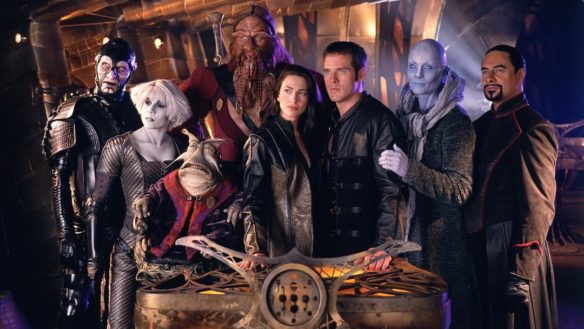
Born June 7, 1969 — Anthony Simcoe, 54. Ka D’Argo in Farscape, one of the best SF series ever done. If you don’t watch anything else, just watch the finale, The Peacekeeper Wars as it’s fairly self contained. Farscape is the SF he did. If you can find a copy, Matt Bacon’s No Strings Attached: The Inside Story of Jim Henson’s Creature Shop is a wonderful look at the creation of the creatures on the show including D’Argo facial appendages.
Born June 7, 1972 — Karl Urban, 51. He’s in the second and third installments of The Lord of the Rings trilogy as Éomer. He is McCoy in the Trek reboot franchise, Cupid on Xena: Warrior Princess and Hercules: The Legendary Journeys, John Kennex on Almost Human, Vaako in the Riddick film franchise, and Judge Dredd in Dredd. For the record, I liked both Dredd films for varied reasons.
Born June 7, 1974 — David Filoni, 49. Creator and an executive producer on Star Wars Rebels, a most awesome series, for all four seasons, and was supervising director and a writer on another excellent series, Star Wars: The Clone Wars. (I like the animated series far better than the live action films.) He makes his live acting debut in The Mandalorian playing Trapper Wolf, an X-Wing pilot, in “The Prisoner” episode. It’s also worth noting that he his first job was directing episodes during the first season of animated series Avatar: The Last Airbender
Born June 7, 1979 — Anna Torv, 44. She’s best known for her role as FBI agent Olivia Dunham on Fringe. She also played an ITU nurse in Frankenstein, a modern adaptation of that novel. She voiced the lead of Nariko in the animated Heavenly Sword film based off the game of the same name.
(9) COMICS SECTION.
The Argyle Sweaterreveals an astronomical feature apparently known only to Federation navigators.
…Above you see the first page of a letter sent by Jack Liebowitz to Jerry Siegel on September 28, 1938. For context, as this point, ACTION COMICS #5 had been published and the character of Superman was heating up. The McClure Newspaper Syndicate, which had been noncommittal about their interest in developing Superman as a newspaper strip, suddenly showed new signs of life, which had caused Siegel to write to Detective Comics and request that they return all rights but first publication to Superman to Siegel and Shuster. As you can imagine, Jack Liebowitz and his boss Harry Donenfeld weren’t having any part of that….
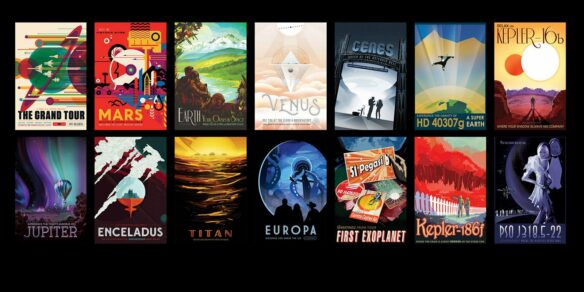
(11) VISITING SPACE. [Item by Mike Kennedy.] This $50 Lego set was inspired by a group of “space travel posters” created by the Jet Propulsion Laboratory for NASA. In turn, those were inspired in part by classic travel posters from the golden age of luxury travel. “Retro NASA Space Tourism Posters made from LEGO Bricks are a Space Nerd Must-Have” at Yanko Design.
Here are the four LEGO “posters”.
Here are examples of NASA’s space travel posters.
(12) JEOPARDY! [Item by David Goldfarb.] On Monday’s episode, a clue from Single Jeopardy and one from Double Jeopardy.
In the first round, the category was “Task: Force”, and the $400 clue:
This term for a fictional energy barrier has been traced back to the 1931 sci-fi story “Islands of Space”
Returning champion Jared Watson knew it was a force field.
In the second round, “Movie Continents” for $2000:
Antarctica: a shape-shifting alien menaces helicopter pilot Kurt Russell
Harrison Seidel identified “The Thing”.
On Tuesday’s episode, “Books and Authors” had this at the $2000 level:
Her novel “Kindred” tells of Dana, a young Black woman who is transported from the 1970s back in time to the pre-Civil War South
Jared Watson (who gave the Vulcan sign during the intro, and made the A in Jared into a little Star Trek glyph) responded correctly.
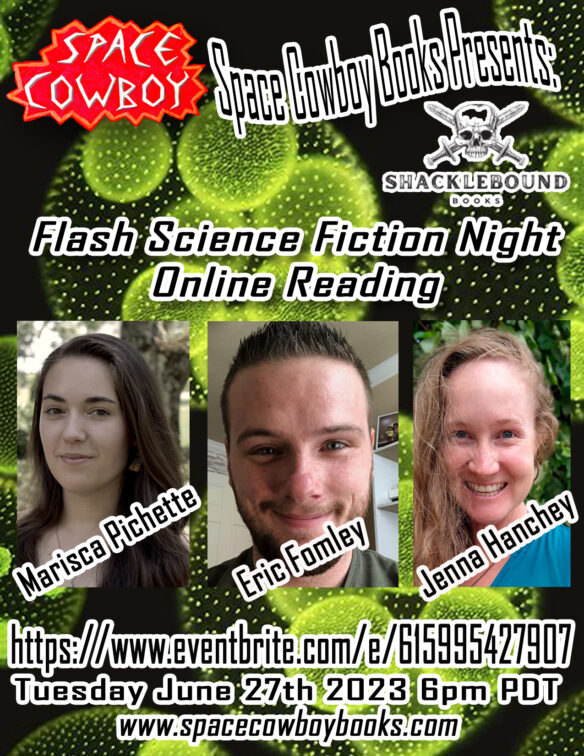
(13) FREE FLASH SF EVENT. Space Cowboys Books of Joshua Tree, CA is hosting a “Flash Science Fiction Night Online Event” on Tuesday June 27 beginning at 6:00 p.m. Pacific. Register for free here.
Join us online for an evening of short science fiction readings (1000 words or less) with Shacklebound Books authors Marisca Pichette, Eric Fomley, and Jenna Hanchey. Flash Science Fiction Nights run 30 minutes or less, and are a fun and great way to learn about new authors from around the world.
[Thanks to Andrew Porter, John King Tarpinian, Chris Barkley, David Goldfarb, Dariensync, Michael Toman, Cat Eldridge, SF Concatenation’s Jonathan Cowie, and Mike Kennedy for some of these stories. Title credit belongs to File 770 contributing editor of the day Cat Eldridge.]
By Steve Vertlieb: Ray Harryhausen remains one of the most revered figures in fantasy/sci-fi motion picture history. Born June 29, 1920, Ray was not only a childhood hero, but became a dear and cherished friend of nearly fifty years duration. On June 29, 2020 his genius, as well as the joyous centennial of his birth, was commemorated with numerous remembrances, events, and exhibitions in celebration of his 100th birthday throughout the world.
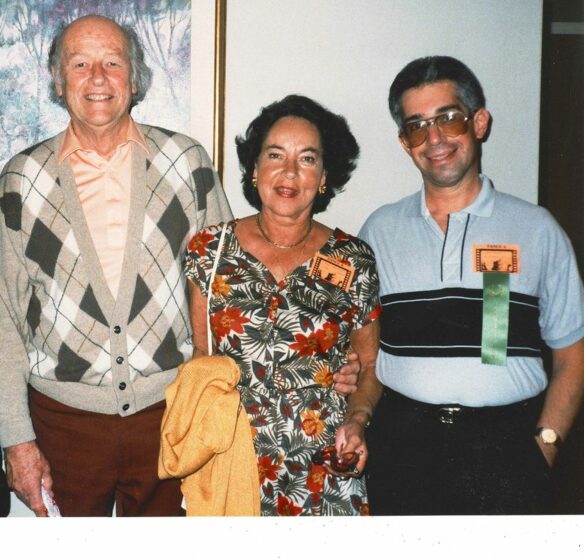
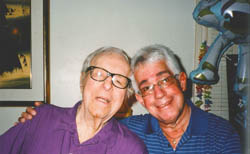
Steve and Ray HarryhausenRay & Diana Harryhausen, and Steve Vertlieb
His work in films inspired and influenced generations of film makers, and garnered him a special Academy Award, presented by Tom Hanks, for a lifetime of cinematic achievement. Steven Spielberg joyously proclaimed that his own inspiration for directing Jurassic Park was the pioneering special effects work of Harryhausen.
Published by The Thunderchild shortly after his death on May 7, 2013, nominated by the annual Rondo Awards for Best Article of the Year in Spring, 2014, and published once more for what would have been his 100th birthday by Hugo Award winning web magazine File 770, this remains a celebration and loving remembrance of the life and work of cinematic master, and special effects genius, Ray Harryhausen. It is also the tender story of a very special man, as well as an often remarkable personal friendship. I love you, Ray. You filled my dreams, my life, and my world with your wondrous creatures.
In remembrance of this wonderful soul, here is my affectionate tribute to my friend of forty-eight years, and boyhood hero of interminable recollection and duration…the incomparable Stop Motion genius, and Oscar honored special effects pioneer, Ray Harryhausen.
Journey with me now to a “Land Beyond Beyond” where dreams were born, cyclopean creatures thundered across a primeval landscape, mythological dragons roared in awe struck wonder, and magical stallions ascended above the clouds…Once Upon A Time. “From the Land Beyond Beyond: An Intimate Personal Remembrance of Ray Harryhausen” at The Thunderchild.
Ray Bradbury at his home in Los Angeles
(photo by Danny Tuffs, Getty Images)
By Steve Vertlieb: He was a kindly, gentle soul who lived among us for a seeming eternity. But even eternity is finite. He was justifiably numbered among the most influential writers of the twentieth century. Among the limitless vistas of science fiction and fantasy he was, perhaps, second only in literary significance to H.G. Wells who briefly shared the last century with him. Ray Bradbury was, above all else, the poet laureate of speculative fiction. He shared with Ernest Hemingway the simplicity of phrase inspired by genius. No more legendary literary figure ever claimed Earth as his home, and yet Ray Bradbury was a childlike gargantuan whose life and artistry were shaped by the wonder and innocence of curiosity and tender imagination.
He was born into a world of rocket ships and monsters, a universe traversed by Buck Rogers, Flash Gordon, Frankenstein, Dracula, and a miraculous primordial ape called KING KONG. His boyhood was transformed by the promise of distant worlds and stranger creatures whose outward malevolence masked secret torment, the sadness of being deemed somehow different.
Ray Douglas Bradbury was born in Waukegan, Illinois (a hometown he shared with Jack Benny) on August 22nd, 1920. From birth he shared an affinity with the magical realm of motion pictures. His middle name was dedicated to the imagery of screen swashbuckler Douglas Fairbanks, and so Ray always knew that his spiritual ancestors consisted of pirates and colorful masked swordsmen. Coming of age during America’s great Depression, the gregarious youth was lifted by the seat of his pants by silken images painted in celluloid. His heroes consisted not only of daring cavaliers such as Fairbanks, but by the pervasively exotic characterizations of Lon Chaney Sr., Boris Karloff and Bela Lugosi. The mystic lure of far away worlds beckoned the impressionable adolescent with the promise of tomorrow, while monstrous cinematic cadavers and rockets to Mars replaced the mundane scenery of a Depression-stricken America.
As sympathetic souls and kindred spirits came together in pre-destined unison, Bradbury found himself drawn to the early worlds of science fiction, fantasy, pulp fandom and, together with fellow teenagers Ray Harryhausen and Forrest James Ackerman, began their journey of discovery, forming what has come to be recognized as “first fandom,” in pursuit of creative profit and recognition. Bradbury would later state that he owed everything to Forry Ackerman who sold his first published story. The third member of the imaginative trio, Ray Harryhausen, formalized their creative partnership with the visual realization of Bradbury’s short story “The Fog Horn.” Published in a celebrated issue of The Saturday Evening Post, the short story concerning a sea beast consumed by the tantalizing image of an isolated light house, became the basis for Harryhausen’s first solo screen effort, The Beast From 20,000 Fathoms.
Rod Serling encouraged the celebrated writer to join his literary enclave at CBS Television as the decade reached its conclusion and, while Bradbury submitted several scripts to Serling’s classic science fiction/fantasy anthology series, The Twilight Zone, only one was aired as a part of the series. “I Sing The Body Electric,” inspired by Walt Whitman’s famous poem, served as the basis for a Bradbury story in which an electric grandmother is hired by a wealthy widower to work as his children’s nanny. The episode aired as a part of the series on May 18th, 1962 and was later included in a famous Bradbury anthology of the same name published in 1969. While this remains the only episode of the series penned by Bradbury, Serling managed to include an affectionate reference to the writer in his own melancholy tale (“Walking Distance”) of an advertising executive on the verge of a nervous breakdown, coming home once more to the small town in which he had spent his boyhood. As Martin Sloan (Gig Young) walks along the streets of Homewood, he makes a casual reference to the Bradbury house standing prominently in his gaze. Homewood sweetly represented small town Americana from which both writers had migrated.
Ray Bradbury turned his adolescent energy and enthusiasm into poetic imagery, and brought a human face to Man’s exploration of the stars. When Neil Armstrong took his first small steps upon the lunar landscape in July,1969, generating a giant leap of faith for all Mankind, Bradbury’s frustration over the lack of excitement shown by the television networks covering the monumental story exploded into headlines, and a memorable tirade by the world’s most eloquent innocent. Bradbury sat solemn and quiet as a guest on a network Lunar themed telecast, struggling to fill time with inanity after insanity. Unable to contain his rage at the proliferation of stupidity filling the national airwaves, the child in a man’s body rose to his feet…outraged by the lack of understanding and exhilaration being exhibited by David Frost and his disinterested panel of guests…and threatened to walk off of the live telecast. His contempt for the bland assemblage of guests apparent, Bradbury admonished them as he would a poor student in the gaze of a disappointed teacher. “This is the greatest night in the history of the world,” he raged. The lack of excitement over this cherished, awe inspiring moment in time, was just too much for this child of wonder either to accept or to absorb. The moment that Ray, and millions of children around the world, had dreamt of and imagined since Buck Rogers and Superman had first flown into space some thirty years earlier was finally here. That these simple, uninspired talk show guests were consumed with themselves, rather than this extraordinary moment of mortal achievement and exploration, was more than Bradbury could endure.
Like millions of imaginative children inhabiting Bradbury’s world, I revered his name and legend. Ray Bradbury signified everything I’d ever dreamt of or aspired to.
As a quiet, introspective boy growing up in Philadelphia during the nineteen fifties, I became a poster child for what would one day become known as “A Monster Kid” — a generation of “baby boomers” weaned on, and inspired by, television, the huge monster movie craze of the fifties, and the introduction of a genre movie magazine with the unlikely name of Famous Monsters of Filmland. The progenitor of this magical publication was none other than the editor who had first brought Ray Bradbury to the attention of publishers. Forrest J Ackerman, or as he was known to his millions of adoring children, “Uncle Forry.”
Forry was the Hans Christian Anderson of science fiction, fantasy, and horror, a Walt Disney father figure who, like the proverbial “Pan,” would lure willing children to worlds and concepts beyond the stars, filling their imaginations with inspirational promise and invitation. He was a joyous Pied Piper who, together with his boyhood friends, Ray Bradbury and Ray Harryhausen, would cause generation after generation of creative youth to embrace their dreams, and create their own fantastic lives and careers. Steven Spielberg and George Lucas were only two of the many artists who found their singular paths among the clouds inhabited by Bradbury, Harryhausen, and Ackerman.
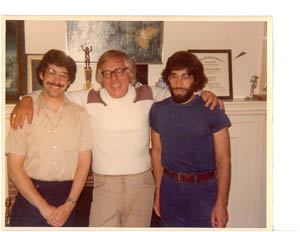
Ray Bradbury with Steve and Erwin Vertlieb
It was during the wonderful Summer months of 1974 that I traveled for the first time to Los Angeles, and came face to face with the land of fantasies, dreams, imagination, and motion pictures that had so consumed and mesmerized my own impressionable childhood. I was like the proverbial kid in the candy store. Everywhere I turned represented the reflection of my own childhood longing and wanderings.
Among my friends of the period was composer and orchestrator John Morgan. John announced one afternoon that he had received an invitation to Ray Bradbury’s house that evening, and he wondered if my brother Erwin and I would like to join him for the royal summons. I swallowed my singular exhilaration, and excitedly accepted his generous invitation. Bradbury’s residence was a large yellow structure in a quiet residential neighborhood. We nervously climbed the outer steps and rang the door bell. As the door opened, Ray greeted us personally and ushered the three of us into his living room. I was both thrilled and frightened, for here within my gaze was the legendary writer smiling at me and extending his hand. His hands, I remember, were very large and inviting and I became lost inside their welcome grasp. Ray asked me about my own career, and I told him that I was a published writer and minor film historian. My day job was, I explained, a film editor at a Philadelphia television station.
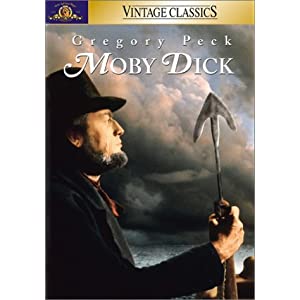
He asked if I knew that he had written the screen play for John Huston’s magnificent 1956 production of Moby Dick. I assured him that I had. He was very proud of the gift that Huston had given him after the picture had been released. It was a 16-millimeter Technicolor print of the Warner Bros. release given him personally by the director. Ray was like a little kid proudly showing off his Hopalong Cassidy pistol. He asked if I’d like to see a few minutes of the film. I said yes, of course, and he ran to find the print. His joy was infectious as I watched him delicately thread the projector and share his treasure with us.
As the film began to unspool on the screen in his living room I could see that the print was immaculate. My film editor’s eye, however, noticed just the beginnings of an emulsion scratch in the otherwise gorgeous Technicolor print. I took my life in my hands, and asked Ray to stop the film for a moment. I don’t know if it was courage on my part or youthful arrogance. It’s difficult now to say which. Ray looked at me with a puzzled expression. I asked him if he ever cleaned his projector “gate.” He asked what I meant. I said “Ray, do you have a box of cue tips and some Isopropyl Alcohol?” Here was one of the most important writers of the Twentieth Century going dutifully to fetch a box of cue tips for this young upstart transgressing his hospitality. I honestly thought he would lift me bodily from my chair, and hurl me out the door to the street below. Instead, like the gentle soul he was, he went out into another room to bring what I had requested. I took a cue tip from the box he had handed me and immersed it in the accompanying bottle of alcohol. I showed him how to clean the “gate” of the projector in the areas that came into contact with the film print and assured him that this procedure would help to keep his beloved Technicolor print from being torn and permanently scratched. He thanked me for this simple lesson in film maintenance, and appeared grateful, but I was thoroughly convinced at the time that I would soon be black listed all over Hollywood, and forbidden from ever encountering or confronting this splendid Ice Cream Man again. That was Ray. He was just a big kid…a gentle, enthusiastic child with the talent and intellect of a genius.
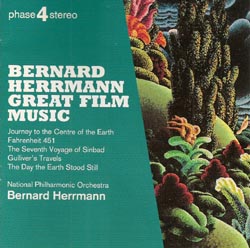
During that same trip out West we had the unique opportunity to sit in the audience with Ray and his wife for a live, small theater production of Fahrenheit 451. Ray told me that he adored Bernard Herrmann’s original score for the Truffaut film version of his famous novel and, at his insistence, the small theater troupe used excerpts from the Herrmann recording of his score for London Phase 4 Records, with the composer conducting The London Philharmonic Orchestra. The experience was surreal.
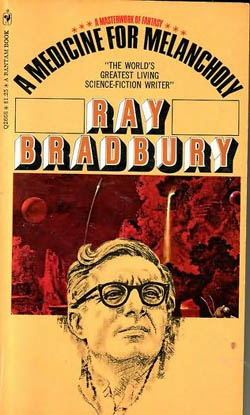
After that, Ray and I maintained a sporadic, yet steady correspondence for the rest of his life. I remember running into him at one of Forry Ackerman’s Famous Monsters Of Filmland conventions in Virginia in 1993. I hadn’t seen Ray in years. He was surrounded, as he always was, by a burgeoning crowd of awe-struck fans. I approached him and asked if he remembered an arrogant young man some twenty years earlier who had had the temerity, in his own living room, to lecture him on the care and feeding of his 16-millimeter movie projector. He looked up at me from the hotel couch on which he was sitting and grinned somewhat impishly, pointing his finger in my direction. “Was that YOU?” I assured him that I was, indeed, that brazen young lad. We both chuckled over the recollection of that embarrassing episode so many years earlier. He might have cringed at my appearance, but he didn’t. He simply chuckled in delight. He was A Medicine For Melancholy.
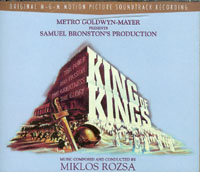
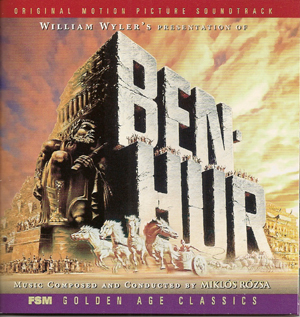
Among the many ties that bound us together was Ray’s passionate interest in symphonic motion picture music written for the screen. We shared a love for the music of such composers as Bernard Herrmann, Miklos Rozsa, and Max Steiner among others. I had known Miklos Rozsa as a friend for nearly thirty years, and Ray not only admired his music, but had worked together with the composer during the filming of King Of Kings for MGM in 1961. Rozsa had won a richly deserved Oscar for his magnificent 1959 score for Metro-Goldwyn- Mayer’s Ben-Hur, and so was asked to write the music for the studio’s early sixties remake of the original 1927 Cecil B. DeMille silent classic. Ray was hired by Metro to write the narration spoken by Orson Welles scattered throughout the picture, and attended some of the recording sessions with Rozsa.
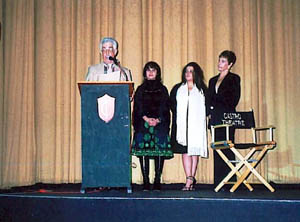
In 2007 the historic Castro Theater in San Francisco was preparing a special film festival honoring the work of the legendary composer, and I was asked to choose the films for the presentation, write the liner notes for the program, and co-host the festival. As it turned out, the Miklos Rozsa film festival became a major San Francisco event in late 2007 and early 2008 with seventeen motion pictures presented to packed houses over a nine-day period. The composer’s daughter, Juliet Rozsa, along with his granddaughters Nicci and Ariana, all drove in from Los Angeles and appeared with me on stage during the introductions. I was honored to read proclamations from both the Mayor of San Francisco, as well as the Hungarian Ambassador to The United States. However, the introduction that thrilled me the most was one written expressly for the event by Ray Bradbury.
Knowing Ray’s love for film music, I wrote him about the festival. He wrote me back asking if he might contribute his own written introduction to the festival. I was honored to accept his lovely request. After all, who was I to say say “no” to Ray Bradbury. Consequently, I felt a tingle of excitement as I read Ray’s brief, loving words from the stage to an audience of some seven hundred people just prior to my “live” interview with Juliet Rozsa, and a 35-millimeter screening of the composer’s masterpiece, Ben-Hur.
Over the years that followed I continued to correspond with Ray, both my mail and through the internet. Each Christmas would bring Ray’s newest holiday poetry which seemed to arrive not through conventional mail delivery but, rather, upon wings of angels within a snow covered sleigh. On one memorable occasion, after sending him an article I’d written pertaining to the science fiction genre we both so adored, he wrote me a lovely note thanking me for continuing to write about the worlds of fantasy and science fiction. He felt a singular obligation to keep the faith, so to speak, through his own place in literary history, and wanted to thank me, as well, for continuing to carry the torch along with him. Despite his advancing years and assorted health problems, which included a debilitating stroke in 1999, he was still the same little boy who had discovered the wonder of other worlds and galaxies so many decades before. Like Ray Harryhausen and Forry Ackerman, with whom he had shared his first spiritual journeys to outer space, he wrote “Steve…You’re a good pal.” I nearly cried when I read that, and wanted to reach out and hug this gentle soul whose life and work had so touched and impacted my own.
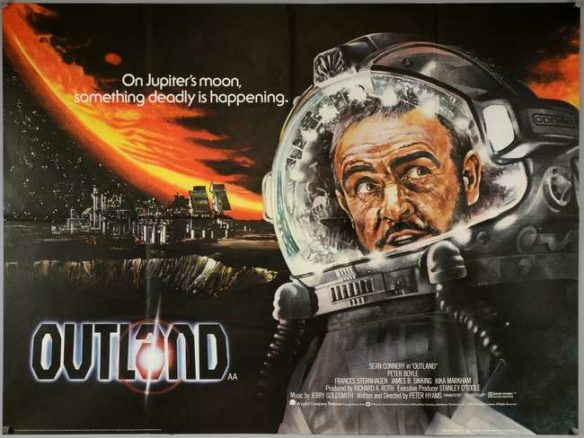
Ray continued to find wonder in the music of the movies and particularly loved Jerry Goldsmith’s valiant score for The Wind and The Lion. His affection for Goldsmith’s exhilarating musical themes for the romantic Sean Connery adventure film inspired his own work, and he proudly acknowledged his debt to the composer’s symphonic poetry in creating Now And Forever: Somewhere A Band Is Playing, published by William Morrow Company in 2007.
Jerry Goldsmith
I published my own tribute to Jerry Goldsmith and his music for another epic score, First Knight, in June, 2011, at Film Music Review, and discussed Ray’s love for that earlier Goldsmith music. I sent the article to Ray’s beloved daughter, Alexandra (Zee) shortly after its online publication. I think that one of the greatest thrills of my life, perhaps, was when Zee took my work along with her during a trip to her dad’s home a few weeks later, and read it to him. She wrote me that he smiled from ear to ear and offered his own enthusiastic comments as she read him my words about the Goldsmith music.
Several weeks later I received a small parcel from Ray in the mail. On the face of the large white envelope were two postage stamps honoring Edgar Allan Poe.
Next to the stamps, Ray had drawn an arrow pointing toward Poe, and written in big letters “My Pa.”
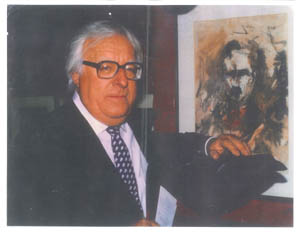
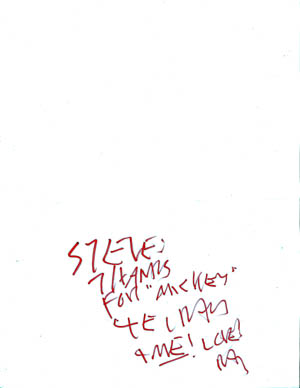
Inside the envelope were a photograph of Ray standing next to a painting of Poe, along with a handwritten note which read…
Steve:
Thanks for “Mickey” (Miklos Rozsa) 4E (Forry Ackerman) Xmas & ME!
Love, Ray
I got to see Ray a couple of more times, and those visits were the most wonderful love fests that I could have imagined. After the death of his lifelong friend friend Forry Ackerman, I sent Ray my Rondo-nominated tribute to my own forty-seven year friendship with Uncle Forry and, as I sat at his side, Ray said “I owe him everything.” I visited Ray shortly after his ninetieth birthday in late August, 2010. He was busily involved in numerous tributes, interviews and appearances honoring his birthday, but he told Zee to please somehow fit me into his schedule…and so I traveled with my little brother Erwin to Ray’s house to spend a loving hour at his feet. It was difficult for him to speak due to ill health, but he was obviously happy to see us and felt invigorated by our visit. I continued to feel astonished that this world renowned literary figure, this giant of a writer, was still living within the confines of the very same humble home he’d shared with an unsuspecting, quiet residential neighborhood for some fifty years. When I asked him about it, he told me that he’d raised his family and enjoyed much of his fame and success in his beloved house. Why would he ever wish to leave it?
In January, 2010, I discovered that my own health had been dramatically failing and that I would need major open heart surgery quite soon if I were to survive. In mid February of that year we scheduled surgery for a few weeks hence. I wrote Ray of my impending procedure, and he playfully instructed Zee to write me of the poetic irony of my requiring heart surgery right around Valentine’s Day. He further instructed her to tell me that he would not allow me to die. Who was I to contradict Ray Bradbury?
I was able to visit Ray one more time during the closing days of August, 2011. Once again, the demands on his time had become nearly impossible, as the world around him was beginning to understand and respect the significance and singular importance of the solitary inspiration who had so profoundly influenced the better part of their lives. Once again, Ray grew excited at the prospect of my impending visit and asked Zee to please arrange his schedule so that he might find time to see me. When Zee wrote me that “Dad” was excited about seeing me during my visit to Los Angeles, I humbly pondered the reasons why Ray Bradbury…this living legend…would grow excited over seeing me, of all people. I think the reason for his enthusiasm had little to do with me personally. It was just that Ray had never truly grown up. He was still the eternal innocent…still the little boy possessed of childlike awe and wonder who was eager to stop time and simply visit with an old “pal.”
Ray had just turned ninety-one and was visibly excited over the news that a film production company had just purchased the rights to his novel Dandelion Wine. As we entered the house, Zee told me that her dad was thrilled by the report and that he couldn’t wait to tell me about it. When I entered his den I found him in good spirits and quite animated. We talked of the sale, and of our nearly forty-year friendship. As the time wore on, and Ray was growing tired, I grew unusually sentimental as we were to preparing to leave. I filled up with tears as I told Ray how deeply I loved him, and how he had so profoundly impacted not only my life, but the lives of literally millions of friends and admirers all over the world who loved him as well, and owed him so very much. I arose from my chair and embraced this frail, gentle soul. I kissed him on his cheek, and told him how much he meant to me. He said “I love you, too, Steve” as each of us smiled and fought back the inevitable tears.
As we left the modest home on Cheviot Drive, I turned once more to see the façade and stood there for a moment, deep in thought and contemplation. As we got into the car, I said to Erwin “I have a terrible feeling that this is the last time we’ll ever see Ray.”
The remaining months of 2011 slipped quickly away. A new year was dawning but, with it, came new health concerns…not only for me, but for my beloved mom who had celebrated her one hundredth birthday six months earlier. In the early morning hours of February 1st, 2012, I received the dreaded telephone call that my mother had passed away. Among the treasured notes and letters of condolence that I received was a touching E-mail from Ray and Zee Bradbury expressing their sadness over the loss of my mom.
Nostalgia for things past and for a simpler time, perhaps, has become a common thread shared by so many so called “baby boomers.” In December, 2011, I was interviewed in my home for two hours by film director Robert Tinnell and a camera crew for a new film documentary concerning the “Monster Kid” phenomenon inspired by Forrest J Ackerman, his groundbreaking Famous Monsters Of Filmland Magazine, and the hugely popular, affectionately remembered monster movie craze of the 1950’s. Such luminaries as Steven Spielberg and George Lucas owe their careers to the phenomenon, as do such decidedly minor players as myself. While the film has not yet been completed, the producers released a theatrical trailer promoting their forthcoming documentary in the Spring. I sent the link for the trailer to Zee Bradbury, inspiring her to write back that “Dad should really be a part of this.” I telephoned Bob Tinnell on his mobile phone while he was driving in West Virginia to let him know that Ray Bradbury was interested in appearing in his film. He pulled off to the side of the road in excitement over the news. I put Bob in touch with Zee, and they arranged for Bob to come and visit Ray either in late May or early June, 2012, to interview him for the film.
In the meantime, I had spoken with Zee about my own impending return to Los Angeles in late August, 2012 and, as usual, she wrote back that her dad was excited about seeing me, and had asked her to re-arrange his schedule so that he might find the time to do so. While at work on the morning of Wednesday, June 6th, I received an E-Mail from Bob Tinnell letting me know that Ray had passed away during the night before at his home in Los Angeles. I stared at my Blackberry phone in stunned silence, unable to fully grasp the news. Ray Bradbury was gone. I began to cry. My lifelong hero and friend had died. I would no longer behold his wonderful face and childlike smile, nor would I ever again find my own hands lost in his. He had joined Forry and his other pals in what must surely be Science Fiction Heaven. Ray shared our lives and existence for an all too brief and shining moment in eternity, and now he had departed, leaving us to face a world sadly dreary in his absence.
Ray has found peace in another realm of immortality, having joined The Ghosts of Forever, and yet his work lives on beyond his fabled physical presence, and we shall continue to sing Bradbury Electric in joyful celebration and chorus for the remainder of our own solitary sojourn upon this wondrous sphere.
[Some of the images in the remembrance are from the author’s personal collection. Others are from online sources and no copyright infringement is intended or implied.]
…What started in 1992 as an experiment in bringing horror to tweenage bookworms has become a cross-media phenomenon that includes TV shows, movies, comic books and video games. And if Stine had had his way three decades ago, the serieswould have ended before it even began.
“I didn’t want to do Goosebumps,” he reveals now, crediting his wife — author and editor Jane Waldhorn — with pushing him to confront the one thing he actually was afraid of: writing for a younger audience. “She kept after me, saying, ‘No one’s ever done a horror series for 7- to 12-year-olds. We have to try it!’ I said, ‘All right, we’ll try two or three of them.'”…
I’m continuing my Non-Fiction Spotlight project, where I interview the authors/editors of SFF-related non-fiction books that come out in 2022 and are eligible for the 2023 Hugo Awards. For more about the Non-Fiction Spotlight project, go here. To check out the spotlights I already posted, go here.
Why should SFF fans in general and Hugo voters in particular read this book?
McCARTY: I have some great interviews with some great science fiction and fantasy writers such as Alan Dean Foster, Harry Turtledove, Terry Brooks and Charles de Lint and Connie Willis. Plus, a slew of horror and dark fantasy writers and filmmakers as well.
The book is bursting at the seams with great interviews. You’ll walk away knowing more about the interviewees but also about the horror and science fiction publishing and film industry the art and craft of writing books and doing movies.
I hope the reader comes away more knowledgeable and inspired and will write a terrific work after they finish the book. No thanks needed.
(3) ORWELL PRIZES. The Orwell Foundation announced the Orwell Prizes 2022 on July 14.
The Orwell Prize for Political Fiction 2022: Small Things Like These by Claire Keegan (Faber).
The Orwell Prize for Political Writing 2022: My Fourth Time, We Drowned by Sally Hayden (Harper Collins)
The Orwell Prize for Journalism 2022: George Monbiot (The Guardian)
The Orwell Prize for Exposing Britain’s Social Evils 2022: The Cost of Covid – Burnley Crisis by Ed Thomas (BBC News)
A Special Prize was awarded to David Collins and Hannah Al-Othman (The Sunday Times) for The Murder of Agnes Wanjiru. All winners receive £3000 and took part in the Awards Ceremony at Conway Hall on Thursday 14th July 2022. Jean Seaton, the Director of The Orwell Foundation, said of the Book Prizes:
Both Sally Hayden and Claire Keegan have, in very different ways, written gripping stories about things that should alarm us: there are awful truths right at the heart of our societies and systems. However, in their wit, elegance and compassion, these powerful winning books also help us think about the choices we make, and how to make the future better. Orwell would be proud.
(4) FREE READ. The Sunday Morning Transport is doing four free stories in July. The second, Ian Tregillis’ “The Owl and the Reptiloid”, examines a vision of first contact and what comes after.
Edy is boarding the 147 at Foster, running late to a soul-rotting customer-service gig just off Michigan Avenue, when the Secret Masters grace Chicago with a Black Triangle of its very own. But at the historic moment, she’s earning a little sigh of disdain from the bus driver, thanks to some amateur-hour fumbling of her Ventra card….
After decades of declining union membership, organized labor may be on the verge of a resurgence in the U.S. Employees seeking better working conditions and higher pay have recently organized unions at Starbucks, Amazon, Apple and elsewhere. Applications for union elections this year are on pace to approach their highest level in a decade. I asked Noam Scheiber, who covers workers and labor issues for The Times, what’s behind the latest flurry of union activity.
Ian: You recently profiled Jaz Brisack, a Rhodes scholar and barista who helped organize a union at a Starbucks in Buffalo that was the first at a company-owned store in decades. Why did she want to work there?
Noam: Jaz comes out of a tradition. We saw it during the Depression; people with radical politics taking jobs with the explicit intention of organizing workers. The term for this is “salting,” like the seasoning. The practice has had some limited success in recent decades, but we’re seeing a broader revival of it, and Jaz is part of that. Several salts got jobs at Amazon and helped organize a facility on Staten Island. Academics like Barry Eidlin and Mie Inouye have written extensively about this.
(6) PODCAST PEOPLE. Simultaneous Times is a monthly science fiction podcast produced by Space Cowboy Books in Joshua Tree, CA. Episode 53 presents stories by Geoff Habiger and Jonathan Nevair read by Jean-Paul Garnier.
Stories featured in this episode:
“Kreuzungmeister” by Geoff Habiger.
“That New Spaceship Smell” by Jonathan Nevair.
(7) HARRYHAUSEN’S LEGACY. [Item by Martin Morse Wooster.] In this video, the Royal Ocean Film Society looks at how Ray Harryhausen, “one of Hollywood’s most beloved craftsmen,” combined live action and stop motion animation. He notes that the methods Harryhausen used were actually quite complicated, and just as Harryhausen built on the work of Willis O’Brien, so do today’s animators at ILM and WETA Digital use Harryhausen’s techniques as a basis for their own work.
(8) LAST SURVIVING MEMBER’S BOTTLE. John L. Coker III told First Fandom members in the latest Scientifiction that he had acknowledged Robert A. Madle as the sole surviving member of First Fandom and dispatched to him the bottle of Beam’s set aside for the winner of a tontine established over 60 years ago.
I sent him the last man’s bottle, inscribed thusly: “This bottle is reserved for science-fiction fandom’s Living Legend Robert A. (Bob) Madle, who in 1958 suggested the idea of forming an organization called First Fandom, a fun-loving group of science-fiction fans of the Golden Era. Founders of First Fandom included C. L. (Doc) Barrett, Don Ford, Lou Tabakow, Ben Keifer and Lynn Hickman. The first person to join the group other than the founders was Robert Bloch. First Fandom would give recognition awards to the great authors of the past, publish a magazine and keep the history of science fiction in front of today’s fans. It would be a “last man’s club” with the final member “knocking off a privately held fifth of liquor.”
(10) HARRY ALM OBIT. Long-time Louisiana fan Harry Alm, husband of Marilyn and mainstay of their region’s fandom (not least filking), died this morning. Marilyn announced the news on Facebook.
(11) MEDIA BIRTHDAY.
1982 – [By Cat Eldridge.] Forty years ago on a summer July evening, Elliott Gould and Mimi Kuzyk starred in this most excellent half hour episode broadcast on HBO of The Ray Bradbury Theater called “The Happiness Machine”.
It is based off the short story that may have first been published in the Saturday Evening Post or the Dandelion Wine novel that was also published that month.
SPOILER ALERT (AS IF YOU NEEDED ONE)
After having upon a summer morning what he thinks is the perfect happiness in watching bees buzzing, birds chirping and children playing and so on the husband builds a happiness machine for his family so that they can experience the joy he feels, but the machine’s effect is not what he expects.
It gives the user a perfect experience of whatever they want which leads to deep depression upon coming back to their usual life. Now given this a Bradbury story, you already know that will be an upbeat ending. After he destroys the Happiness Machine, his wife points out that reality (bees buzzing, birds soaring and chirping with children playing), and of course his home and family are the actual Happiness Machine.
END OF THE SPOILERS (AS IF YOU NEEDED TO BE TOLD)
I like Bradbury, his stories always just interesting enough to worth reading or watching. I thought HBO do a rather great job with the Ray Bradbury Theater.
It’s streaming presently on HBO Max. As always please don’t link to copies on YouTube as they are pirated. We’ll just need to remove your post.
(12) TODAY’S BIRTHDAYS.
[Compiled by Cat Eldridge.]
Born July 17, 1889 — Erle Stanley Gardner. Though best remembered for the Perry Mason detective stories, he did write a handful of SF stories, all of which are collected in The Human Zero: The Science Fiction Stories of Erle Stanley Gardner. It is not available from the usual digital suspects but Amazon has copies of the original hardcover edition at reasonable prices. (Died 1970.)
Born July 17, 1952 — David Hasselhoff, 70. Genre roles in the Knight Rider franchise, Nick Fury: Agent of Shield film, as the title characters in — and I’m not kidding — Jekyll & Hyde: The Musical, and in Guardians of the Galaxy: Vol. 2.
Born July 17, 1954 — J. Michael Straczynski, 68. Best known rather obviously for creating and writing most of Babylon 5 and its all too short-lived sequel Crusade. He’s also responsible as well for the Jeremiah and Sense8 series. On the comics sides, he’s written The Amazing Spider-Man, Thor and Fantastic Four. Over at DC, he did the Superman: Earth One trilogy of graphic novels, and has also written Superman, Wonder Woman, and Before Watchmen titles.
Born July 17, 1965 — Alex Winter, 57. Bill in Bill & Ted’s Excellent Adventure and its sequels Bill & Ted’s Bogus Journey and Bill & Ted Face the Music. And though I didn’t realize it, he was Marko in The Lost Boys. He directed two Ben 10 films, Ben 10: Race Against Time and Ben 10: Alien Swarm. He also directed Quantum is Calling, a short film that has cast members Keanu Reeves, Simon Pegg, John Cho, and Paul Rudd.
Born July 17, 1967 — Kelly Robson, 55. She finally has a collection out, nearly five hundred pages of fiction, Alias Space and Other Stories. It’s available at the usual suspects for four dollars and ninety-nine cents. Bliss! It contains “A Human Stain” for which she won a Nebula, and two Aurora winners, “Waters of Versailles” and “Gods, Monsters, and the Lucky Peach”.
Born July 17, 1976 — Brian K. Vaughan, 46. Wow. Author of Ex Machina, the stellar Pride of Baghdad, Runaways, the Hugo winning at LoneStarCon 3 Saga (which has won a BFA and a Dragon), Y: The Last Man which briefly was a series, and one of his latest undertakings, Paper Girls, which is wonderful. You could spend an entire summer just reading those series. In his spare time, he was a writer, story editor and producer of Lost during seasons three through five, and he was the showrunner and executive producer of the Under the Dome series.
Born July 17, 1992 — Billie Lourd, 30. Lourd is the only child of actress Carrie Fisher. She appeared as Lieutenant Connix in the Star Wars sequel trilogy. She also has been a regular cast member on American Horror Story for five seasons.
(13) COMICS SECTION.
Candorvillethinks we should not be assuming this widely believed astronomical fact is true.
(14) FERDINAND’S OFFSRING.[Item by Martin Morse Wooster.] In the Washington Post, the weekly humor competition, conducted by Pat Myers, is about feghoots. And boy, are the winners groaners!
Here are some of the entries that stumped me. YMMV, as they say; the puns might jump right out at you. If so, or if you just want to guess, leave a comment right here at the bottom of the column, rather than in the usual forum of the Style Invitational Devotees group on Facebook. I’m reprinting the entries as they came in, with no editing except to fix spelling, typos, etc. I didn’t check at all who wrote them, though if their authors want to reveal themselves in the comments thread, fine with me!
…The individual placed several different orders, amounting to $35,000 worth of medical and engineering textbooks, each costing between $100 and $200. Then, in late May, staff received a notification from the store’s merchant service provider, flagging a credit card the person used as fraudulent.
The bookstore co-owners went through the individual’s purchases — all of which were shipped to the same address outside Michigan — and quickly realized that the person had placed every past order using a stolen credit card, as well.
“That’s when we started to consider closing,” said Cooper, 28.
They contacted to law enforcement, their insurance provider and different banks, hoping for a reprieve from the serious financial toll they knew the scam would take on their small company. The cost, they were told, would probably fall entirely on them — which would put them out of business.
… “We realized we needed to ask for help,” Erin Pineda said.
The store co-owners started a GoFundMe campaign, and within 10 days, they surpassed their goal of $35,000. They were stunned by the generosity.
“We’re just blown away by how the community responded and lifted us up in a really difficult situation,” Erin Pineda said. “It was incredible.”…
(16) VIDEO OF THE DAY. [Item by Martin Morse Wooster.] An old man struggles to keep his house from collapsing and deal with aging in this 2017 animated film directed by Wong Jin Yao.
[Thanks to Chris Barkley, Michael Toman, Cat Eldridge, Cora Buhlert, “Orange Mike” Lowrey, Mike Kennedy, Martin Morse Wooster, JJ, John King Tarpinian, and Andrew Porter for some of these stories. Title credit belongs to File 770 contributing editor of the day Bill.]
(1) SPECULATIVE LITERATURE FOUNDATION. In the Mohanraj and Rosenbaum Are Humans podcast, episode 15, “An Interview with Farah Mendelsohn”, Mary Anne Mohanraj’s icebreaker question opens the way for an exchange with Farah Mendlesohn about the challenges of coming to a country from somewhere else, and some immediate worries for Mendlesohn about the consequence of Brexit. There follows discussion about international science fiction and Mendlesohn’s book The Pleasant Profession of Robert A. Heinlein.
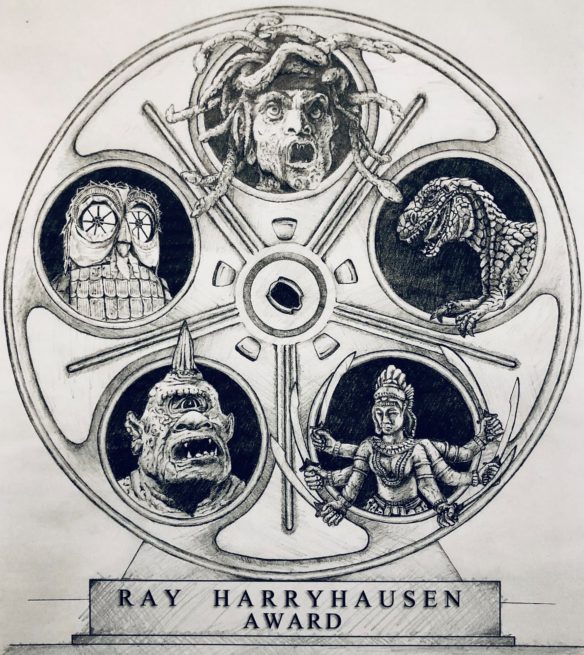
(2) HARRYHAUSEN AWARDS CREATED. The Ray and Diana Harryhausen Foundation have announced a new film awards program — The Ray Harryhausen Awards — “established in honor of the legendary master of stop-motion animation.’ Beginning January 1, 2022 they will be accepting entries under the following categories:
Best Feature Film Animation
Best Short Film Animation
Best Student Film Animation
Best Commercial Film Animation
Best Online Film Animation
Best Television Animation
Harryhausen Hall of Fame Award
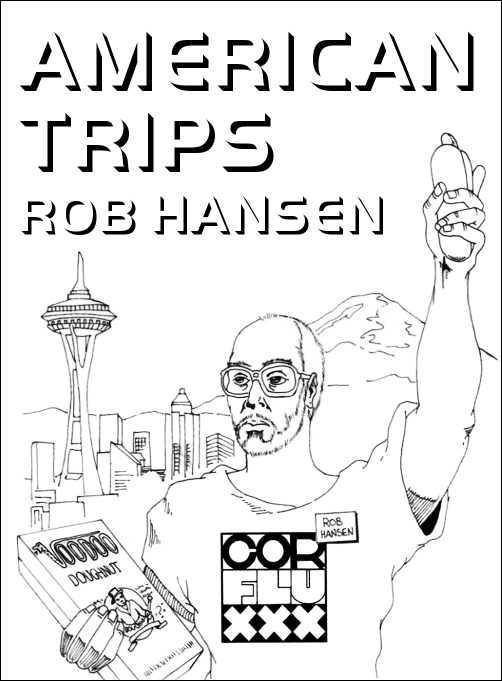
(3) FREE DOWNLOAD FROM TAFF. Rob Hansen collects the rare and esoteric convention reportage of … Rob Hansen! – in American Trips, the latest addition to the selection of free ebook downloads at David Langford’s unofficial Trans-Atlantic Fan Fund site, where they hope you’ll make a little donation to the fund if you please.
Following the 1984 TAFF trip described at length in On the TAFF Trail, Rob Hansen attended a number of other US conventions and wrote further reports collected in this ebook – covering multiple Corflus (1986, 1989, 1990, 2013), two Disclaves (1992, 1995) and the 1997 Boskone/Fanhistoricon at which Rob, as Britain’s leading fan historian, was a special guest.
The cover art is by Rob Hansen. 41,000 words.
Here is a brief extract:
The conversation turned to convention reports and I outlined my conreport writing philosophy for them.
“D. West says they should be ‘the truth, the whole truth, and a few lies to make it interesting’. My reports are the truth,” I explained, “but enhanced. I give the truth a little nip and tuck, and maybe a nose job, but I never go as far as breast implants.”
(4) LGBT PUBLISHING CONTROVERSY IN HUNGARY. AP News that Hungarian authorities have issued a fine over a book featuring ‘rainbow families’. The book in question is by Lawrence Schimel, who started out in the sff genre. His work has received the Science Fiction and Fantasy Poetry Associaton’s Rhysling and Dwarf Stars awards, the Gaylactic Spectrum Award, and also has twice received the Lambda Literary Award for non-genre work.
Hungarian authorities have fined the distributor of a children’s book that features families headed by same-sex parents, relying on a law prohibiting unfair commercial practices and fueling a debate over recent government steps seen as limiting the rights of LGBT people.
The fine comes as Hungary’s government is already under widespread scrutiny over legislation it passed last month that prohibits the depiction of homosexuality or gender reassignment to minors. The law, which is set to take effect on Thursday, was described by rights groups as an attack on the LGBT community, and rebuked by high-ranking European officials as a violation of the European Union’s values.
Speaking to the European Parliament in Strasbourg on Wednesday, European Commission President Ursula von der Leyen called the law “a disgrace” and warned Hungary that the EU’s executive arm would use all its powers to uphold European law.
It was amid this escalation over Hungary’s policies that a local government fined the distributor of “What a Family” – a combined Hungarian translation of American author Lawrence Schimel’s books “Early One Morning” and “Bedtime, Not Playtime!”— $830. Each of Schimel’s books depicts the daily routines of a child, one with two mothers and one with two fathers.
The fine was imposed by the Pest County Government Office — the local authority responsible for the county surrounding Hungary’s capital, Budapest….
A Pest County official told commercial television station HirTV Tuesday that the book’s Hungarian distributor, the Foundation for Rainbow Families, had violated rules on unfair commercial practices by failing to clearly indicate that “What a Family!” contained “content which deviates from the norm.”
“The book was there among other fairytale books and thus committed a violation,” Pest County Commissioner Richard Tarnai said. “There is no way of knowing that this book is about a family that is different than a normal family.”…
(5) MEMORY LANE.
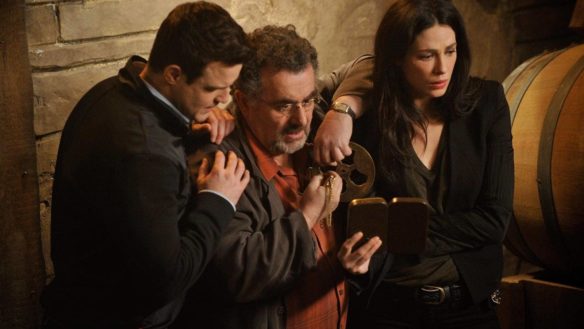
2009 – Twelve years ago this week the Warehouse 13 series premiered on Syfy. It was produced by Jacks Kenny, David Simkibs and Drew Greenberg. It was created by Jane Espenson, writer and producer on Buffy the Vampire Slayer, and Brent Mote who had little genre writing experience at all. The original cast was Eddie McClintock, Joanne Kelly and Saul Rubinek. It would run for five seasons and sixty four episodes. Almost all critics really liked it although one who didn’t called it, and I quote, “An unholy cross between The X-Files, Bones, and Raiders of the Lost Ark.” WTF?!? Audience reviewers at Rotten Tomatoes currently really like it, giving it a rating of eighty eight percent. You can watch it on the Peacock streaming service where I plan on watching it. (CE)
(6) TODAY’S BIRTHDAYS.
[Compiled by Cat Eldridge.]
Born July 8, 1906 — Walter Sande. He’s best remembered for being on Red Planet Mars, The War of the Worlds and Invaders from Mars, but he also showed up playing a heavy in such serials as The Green Hornets Strikes Again! and Sky Raiders, the latter being at least genre adjacent. He’s had a recurring role as Col. Crockett on The Wild Wild West, and one-offs on Voyage to the Bottom of The Sea, The Man from U.N.C.L.E., Lost in Space and Bewitched. (Died 1971.)
Born July 8, 1944 — Jeffrey Tambor, 77. I first encountered him on Max Headroom as Murray, Edison’s editor. Later on, he’s Mayor Augustus Maywho in How The Grinch Stole Christmas. Finally I’ll note he was in both of the only true Hellboy films that there was playing Tom Manning, director of the Bureau of Paranormal Research and Defense.
Born July 8, 1953 – Mark Blackman, 68. Mark frequently writes about the Fantastic Fiction at KGB and New York Review of Science Fiction readings series for File 770. He was a member of Lunarians and chaired Lunacon 38 in 1995. He was a member of the New York in 1989 Worldcon bid. (OGH)
Born July 8, 1955 — Susan Price, 66. English author of children’s and YA novels. She has won both the Carnegie Medal and the Guardian Prize for British children’s books. The Pagan Mars trilogy is her best known work, and The Sterkarm Handshake and its sequel A Sterkarm Kiss, will please Outlander fans.
Born July 8, 1970 — Ekaterina Sedia, 51. Her Heart of Iron novel which was nominated for a Sidewise Award for Alternate History is simply awesome. I’d also recommend The Secret History of Moscow as well. It’s worth noting that both the usual suspects list several collections by her, Willful Impropriety: 13 Tales of Society, Scandal, and Romance and Wilful Impropriety. They’re quite superb it turns out as is Paper Cities: An Anthology of Urban Fantasy anthology she edited which won a World Fantasy Award. I note that’s she not published anything for a half decade now.
Born July 8, 1978 — George Mann, 43. Writer and editor. He’s edited a number of anthologies including the first three volumes of Solaris Book of New Science Fiction. Among my favorite books by him are his Newbury & Hobbes series, plus his excellent Doctor Who work. The Affinity Bridge, the first in the Newbury & Hobbes series, was nominated for a Sidewise Award.
Born July 8, 1988 — Shazad Latif, 33. If you watched Spooks, you’ll remember him as Tariq Masood. (Spooks did become genre.) He was Chief of Security Ash Tyler in Discovery,andDr. Jekyll and Mr. Hyde in Penny Dreadful. He voiced Kyla in The Dark Crystal: Voice of Resistance. And he was in the Black Mirror episode “The National Anthem” as Mehdi Raboud.
(7) COMIC-CON SCHEDULE. Comic-Con@Home 2021 will run for three days from July 23-25. The online event is free to attend. The Program Schedule dropped today. All panels will be available to stream on the Comic-Con International YouTube page. Most will be pre-recorded.
(8) SWAMP THINGIE. Could Loki made a nice handbag? I don’t mean could he sew it – could he be it? “’Loki’: The Glorious Debut of Alligator Loki” at Marvel. BEWARE SPOILERS. Or so I assume.
…Jokingly calling the stuffed alligator a “real diva” on set, Herron explains that the series’ first AD “actually stuck googly eyes on it. It was like a Muppet character on set.” But Alligator Loki wasn’t all just fun and games, as he was useful for the actors who had to interact with him, especially Jack Veal (Kid Loki), who frequently carries Alligator Loki from location to location.
“You put [the stuffed alligator] in there, and the actors can interact with it and get a sense of how heavy or how large the alligator would be,” notes Herron. “[It was filmed] in the world of imagination with our cast because sometimes they were acting to a blade of grass.”
Like all characters, Alligator Loki also went through a few different looks before settling on the version viewers see on-screen.
“We had some early versions when we were doing visual effects that probably were a bit too cute, in the sense of it was a bit more like a cartoony kind of alligator,” Herron explains. “But it just became funnier and funnier the more it looked like a real alligator that just happened to be wearing the horns. That was the sweet spot. Once we landed in that spot where it felt like a real alligator, but with a kind of slightly jaunty horns on, that’s where we were like, ‘Oh, there he is.’”
However, this doesn’t answer the most pressing question: Is Alligator Loki really a Loki?
(9) WHAT IF? Disney Plus dropped a trailer for “Marvel Studios’ What If…?”, an alternate universe animated anthology.
Enter the multiverse of unlimited possibilities. Watch the exciting trailer for Marvel Studios’ first animated series, What If…? “What If… ?” features fan-favorite characters, including Peggy Carter, T’Challa, Doctor Strange, Killmonger, Thor and more. The new series, directed by Bryan Andrews with AC Bradley as head writer, features signature MCU action with a curious twist. What If…? starts streaming August 11, 2021, with new episodes Wednesdays on Disney+.
(10) HIGH DEFINITION. Dwayne Johnson posted on Instagram a photo of how makeup artists are making his muscles “more terrifying” in Black Adam. See the image in this Collider article: “Black Adam: Dwayne Johnson Reveals Training Image”.
“Big week for #BlackAdam shooting my ‘champion’ scenes with my shirt off and showing my body” reads the caption. “Been working extremely hard dieting, training and conditioning unlike any other role of my entire career.” Johnson goes on to explain his training strategy, from manipulating his electrolytes and incorporating more intense cardio to push-and-pull resistance training in order to get the “dense, dry, detailed muscle” definition that he wanted for his role. The new photo comes weeks after Johnson gave fans the tiniest hint of his Black Adam costume in a similar social media post.
…But as the trailer (below) proves, this version of the beloved holiday figure is anything but jolly, and the only gift he’ll be bringing this year is the baseball bat he seems to be wielding. (No word yet if it makes a difference whether you’re naughty or nice.)
(12) TRAILERS AND CLIPS. Recently unveiled, a featurette about King’s Man: Legacy, coming in December, and a trailer for The Addams Family 2, in theaters October 1
As a collection of history’s worst tyrants and criminal masterminds gather to plot a war to wipe out millions, one man must race against time to stop them. Discover the origins of the very first independent intelligence agency in The King’s Man.
[Thanks to Mike Kennedy, Andrew Porter, Martin Morse Wooster, Meredith, Michael J. Walsh, Daniel Dern, David Langford, JJ, Michael Toman, John King Tarpinian, and Cat Eldridge for some of these stories. Title credit belongs to contributing editor of the day Peer.]
A very very different America was going to be unveiled in Season 2 of Lovecraft Country, creator Misha Green revealed today after HBO officially pulled the plug on the acclaimed horror drama.
A couple of hours after Deadline exclusively reported on the surprising demise of the the Jurnee Smollett, Jonathan Majors and Michael Kenneth Williams starring series, showrunner Green took to social media to paint a picture of what might have been. It was certainly something to see, especially leading into the July 4th weekend:
(2) BARBARIC YAWP. Cora Buhlert’s provocatively-titled “Conan the Socialist” lives up to its billing. (You never suspected that about Conan, did you?) BEWARE SPOILERS about the Thirties Robert E. Howard tale under discussion.
… My teenaged self certainly enjoyed the Conan stories as great and glorious adventures. Plus, there was the thrill of reading “violent American trash” that sensible educated people weren’t supposed to read or enjoy. However, upon rereading these stories as an adult, I find that there is a lot of depth and subtext in the Conan series that my teenaged self missed.
T2 is a departure from the far bleaker original, 1984’s TheTerminator, which its creator calls a “science-fiction slasher film.” Linda Hamilton’s franchise protagonist, Sarah Connor, has transformed from a put-upon heroine to a self-trained commando whose attempts to thwart the coming apocalypse land her in a psychiatric hospital. Her son, John, the future leader of the resistance in the war against the genocidally self-aware defense system Skynet, is in foster care. And the T-800, once a remorseless killer with a curious but hypnotic Austrian accent, somehow helps bring them together as a family—then helps them save the world.
… Cameron: I talked to Dennis Muren at ILM. I said, “I’ve got an idea. If we took the water character from The Abyss, but it was metallic so you didn’t have the translucency issues, but you had all the surface reflectivity issues and you made it a complete human figure that could run and do stuff, and it could morph back into a human, and then turn into the liquid metal version of itself, and we sprinkled it through the movie, can we do it?” He said, “I’ll call you back tomorrow.”
… Cameron: Linda, I called her up and I said, “Look, they want to pay us a lot of money to make a sequel. Are you in or are you out? But just between you and me, I don’t really want to do it if Sarah doesn’t come back and I don’t want to recast Sarah, so you got to say you’re in.” And she and I weren’t involved. [Editor’s note: Cameron and Hamilton were married from 1997 to 1999.] We hadn’t even really hung out at all much since the first film. She was making a movie somewhere down South.
And so she said, “Yeah, in principle, I’m in, but I want to be crazy.” I said, “Well, what do you mean, crazy? How crazy?” She said, “Crazy, like I’ve been driven crazy.” I said, “Like you’re in an insane asylum, like you’re institutionalized?” She said, “Yeah, sure. Let me play crazy. Let me go nuts.” I said, “All right. Well, you’re going to get my version of nuts,” and she said, “All right. I’m down.”
…The book is set some time after this Transition, and follows a tea monk, Sibling Dex, who goes from settlement to settlement as a travelling salesperson-slash-roaming therapist. Despite bringing joy and comfort to those visited, Dex is unsatisfied and heads out into the wilds, looking for a new purpose – eventually making contact with a robot, Mosscap, the first time humans and robots had met in centuries.
On Sunday the Sun said Alexander was thrashing out final details with the BBC to succeed Jodie Whittaker and become the 14th Doctor.
If it happens, Alexander, 30, would be the first out gay actor to play the Time Lord.
Whittaker’s departure from Doctor Who has not been announced, although rumours abound that the next series and two special episodes, to be broadcast next year, will be her final outings…
(6) PAST IN PERSPECTIVE. Lovecraft and Howard scholar Bobby Derie discusses how segregation and Jim Crow laws affected the 1951 and 1953 Worldcons: “Jim Crow, Science Fiction, and WorldCon”.
… There were less than 200 attendees. Nolacon Bulletin #2 (July 1951) lists 196 members; Harry Warner, Jr. in in his memoir of fandom in the 50s A Wealth of Fable says 183 were officially registered “and 300 or more persons were believed to be on hand at one time or another” (352).
…One highlight was a midnight showing of The Day the Earth Stood Still at the local Saenger Theater. Seating was segregated. Black attendees would have had to enter through a side door, to sit up on the balcony. Had any black science fiction fans done so, the film they watched could have stood as a metaphor for the mythic white space they found themselves in: a film of the possibilities of the future starring white people, for white people; the few non-white actors such as Rama Bai and Spencer Chan went uncredited….
… “Sectional discrimination” in 1952 was the “reverse racism” of the 2020s—a fallacy used by those who claim that efforts to combat or reverse racial discrimination are themselves a form of discrimination. Boggs’ claims break down what might be the typical white fan’s mindset of the era: philosophically displeased with Jim Crow, but unwilling to actually do anything about it….
(7) MEDIA BIRTHDAY.
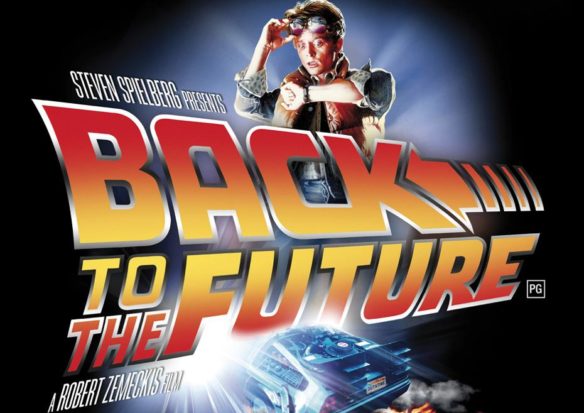
July 3, 1985 – Thirty-six years ago, Back to the Future premiered. It was directed by Robert Zemeckis from a screenplay by Zemeckis and Bob Gale. Bob Gale and Neil Canton were the producers. It of course starred Michael J. Fox, Christopher Lloyd, Lea Thompson and Crispin Glover. It would win the Hugo Award for Best Dramatic Presentation at ConFederation besting Ladyhawke, Cocoon, Brazil and Enemy Mine. Critics loved it with Ebert comparing it to Capra’s It’s A Wonderful Life. It was a box office success being the top grossing film of the year. And audience reviewers at Rotten Tomatoes currently give it an absolutely superb ninety-four percent rating.
(8) TODAY’S BIRTHDAYS.
[Compiled by Cat Eldridge.]
Born July 3, 1926 — William Rotsler. An artist, cartoonist, pornographer and SF author. Well that is his bio. Rotsler was a many time Hugo Award winner for Best Fan Artist and one-time Nebula Award nominee. He also won a Retro Hugo for Best Fan Artist of 1946 and was runner-up for 1951. He is responsible for giving Uhura her first name, and he wrote “Rotsler’s Rules for Costuming.” (Died 1997.)
Born July 3, 1927 — Ken Russell. Film director whose Altered States based off of Paddy Chayefsky’s screenplay is certainly his best-remembered film. Though let’s not overlook The Lair of the White Worm he did off Bram Stoker’s novel, or The Devils, based at least in part off The Devils of Loudun by Aldous Huxley. (Died 2011.)
Born July 3, 1937 — Tom Stoppard, 84. Playwright of Rosencrantz and Guildenstern Are Dead. He co-wrote the screenplays for Brazil (with Terry Gilliam) and Shakespeare in Love (with Marc Norman). He’s uncredited but openly acknowledged by Spielberg for his work on Indiana Jones and the Last Crusade.
Born July 3, 1943 — Kurtwood Smith, 78. Clarence Boddicker in Robocop, Federation President in Star Trek VI: The Undiscovered Country, and voiced Kanjar Ro in the most excellent Green Lantern: First Flight. He’s got series appearances on Blue Thunder, The Terrible Thunderlizards (no, I’ve no idea what it is), The X-Files, Star Trek: Deep Space Nine, Star Trek: Voyager, Men in Black: The Series, 3rd Rock from the Sun, Todd McFarlane’s Spawn, Justice League, Batman Beyond, Green Lantern, Beware the Batman, Agent Carter and Star Trek: Lower Decks. His latest genre role was Old Man Miller on the Netflix series Jupiter’s Legacy.
Born July 3, 1946 — Michael Shea. Shea’s first novel, A Quest for Simbilis was an authorized sequel to the first two Jack Vance’s Dying Earth novels. Vance was offered a share of the advance but declined it. (It was declared non-canon when the next novels in the series were written by Vance.) A decade, he’d win a World Fantasy Award for his Nifftthe Lean novel, and a second twenty years later for a novella, “The Growlimb.” (Died 2014.)
Born July 3, 1948 — Marc Okrand, 73. A linguist in Native American languages who’s the creator of the Klingon language. He first applied it by dubbing in Vulcan language dialogue for Star Trek II: The Wrath of Khan, and then was involved in the Search for Spock, The Final Frontier, The Undiscovered Country, and the both rebooted Trek films. Later he developed the language for the Kelpien race in the second season of Discovery.
Born July 3, 1962 — Tom Cruise, 59. His first genre role was as Jack in Legend. Next up was Lestat de Lioncourt in Interview with the Vampire followed by being Ethan Hunt in the first of many excellent Mission Impossible films. Then he was John Anderton in Minority Report followed by Ray Ferrier in War of The Worlds. I’ve not see him as Maj. William Cage in Edge of Tomorrow so I’ve no idea how good he or the film is. Alas he was Nick Morton in, oh god, The Mummy.
Born July 3, 1964 — Payton Reed, 57. Did you know there was A Back to the Future TV series? Well there was and he directed it back in 1991. It was animated and only Christopher Lloyd was involved as a voice actor. He went on to much later direct Ant-Man, Ant-Man and the Wasp and the forthcoming Ant-Man and the Wasp: Quantumania. He directed two episodes of The Mandalorian.
(9) STAND UP GUY. [Item by Cora Buhlert.] From 2017, a full cast audio adaptation of the short story “Waterfront Fists” by Robert E. Howard, performed by a group called the Violet Crown Radio Players. This is not an SFF story, but one of the Sailor Steve Costigan stories about the adventures of a not very smart boxing sailor and his faithful bulldog (Howard wrote more Costigan stories than he ever wrote Conan stories), but very nicely done. Hosted by The Cromcast, a Weird Fiction Podcast: “The VCRP Present Waterfront Fists!”
(10) STONE SOUP. Sarah Gailey’s “Building Beyond” writing prompt “Optimus Prime Time” brings her together with Elizabeth Kestrel Rogers and Julian Stuart to play with this idea —
The AI uprising has come and gone and after a brief period of discomfort, we’re all mostly pretty cool with each other at this point. There’s a television network that is strictly dedicated to entertainment by robots, for robots.
(11) YOUNG RAY HARRYHAUSEN. First Fandom Experience remembers when “Ray Harryhausen Released the Kraken in 1938”. They show the creature’s evolution from Harryhausen’s fanzine art to the movie Clash of Titans.
The Kraken debuts
More from Harryhausen’s conversation with David Kyle:
“In the mid-1930s when I was still in high school, Forry told me about the little brown room in Clifton’s Cafeteria where the Los Angeles chapter of the Science Fiction League would meet every Thursday. Members included Russ Hodgkins, Morojo, and T. Bruce Yerke. Robert Heinlein used to come around, and a guy named Bradbury. We were a group who liked the unusual. There was a fellow named Walt Daugherty, who was an anthropologist by trade, and a photographer. He would make presentations about Egyptology. Another young fellow named Ray Bradbury would arrive wearing roller skates. After selling newspapers on the street corner he would skate to meetings because he had no money. He used to go meet the stars at the Hollywood Theater where they did weekly radio broadcasts. Ray was writing for Forry’s magazine called Imagination. I did one of the covers for an issue, which was mimeographed.”…
(12) VAMPIRES AND WEREWOLVES. Anna J Walner has two books in The Uluru Legacy Series, the first out in June, the second coming in November.
Anna J. Walner
A girl in search of her family finds more than she ever dreamed possible. Blending myth with reality, this award-winning debut provides a truly unique and realistic spin on the genre you love.
Enter a world hidden to human eyes for over three centuries. A safe haven for both Vampire and Werewolf. She’ll become something she never thought existed, agree to things she never thought she would, and find a life worth dying for.
In Garkain:
Amelia’s journey to find the truth behind her adoption twenty-five years ago, might end up being just a quick tour around the sights and a visit with her biological family.
Or it could reveal a more mysterious and shocking history to her lineage than she thought possible. The realization that vampires and werewolves have existed all along in secret. A place called The Colony.
Amelia realizes she must make a choice. Join The Colony and her family, or literally be made to forget they ever existed in the first place.
The thrilling debut of The Uluru Legacy Series will change the vampire and werewolf rulebook. Blending myth with reality, it provides a truly unique and realistic spin on the genre you love.
In Larougo —
While some questions will be answered, more will be raised. As new truths come to light, and new evils make themselves known, not everyone will survive.
The vision for a new Colony is at stake as Amelia and Roan discover they’re part of something even larger than they thought.
(13) VIDEO OF THE DAY. Mind Matterssays about Sarah Gross’ short film Boléro:
The theme is very topical indeed: Ending crime on the part of private citizens via total surveillance (in this case via a sort of enhanced telepathy) results in unlimited crime on the part of the government.
The synopsis continues:
In a future where telepaths are used by the government to monitor the public and root out insurgents, Maya, a non-speaking teen, witnesses her father’s brutal and unjust execution. Set on a path of revenge and destruction, Maya joins the Resistance, hellbent on tracking down Reader 8, the telepath responsible for her father’s death. However, when Maya finally locates her target after years of searching, she is confronted with a choice: either capture Reader 8 and deliver essential intelligence to the Resistance or take him out and fulfill her vengeful quest.
[Thanks to Martin Morse Wooster, JJ, Michael Toman, Alan Baumler, John King Tarpinian, Cat Eldridge, Mike Kennedy and Andrew Porter for some of these stories. Title credit belongs to contributing editor of the day Soon Lee.]
(1) HUGO VOTING AND PACKET UPDATE. DisCon III addressed Facebook readers’ questions about when online Hugo voting will be available.
Some of you have been asking about the Hugo voting links so, here’s what’s happening: Hugo voting links won’t appear on your DC3 membership page until voting opens. We’ll let our members and the public know when that happens via email, social media, website, press releases, etc. We’re also working hard to get the Hugo packet of nominated works Worldcon members have come to expect out later this spring.
(2) BEYOND AFROFUTURISM. Clarion West and the Seattle Public Library have two more Beyond Afrofuturism virtual panels happening in May. Register here.
Come talk publishers on Sunday, May 16th, 1 p.m. Pacific with Bill Campbell (Rosarium), Milton Davis (MVmedia), Zelda Knight (AURELIA LEO), and Nicole Givens Kurtz (Mocha Memoirs) for Power in Publishing: Publishers Roundtable.
With major publishers stuck in a cycle of selling the same mainstream stories or tightening their belts when it comes to the work of marginalized communities, how are Black publishers shaping opportunities for BIPOC writers to have their voices heard?
Featuring: Bill Campbell (Rosarium), Zelda Knight (AURELIA LEO), Milton Davis (MVmedia), and Nicole Givens Kurtz (Mocha Memoirs)
Moderated by Clinton R. Fluker, Ph.D. Curator of African American collections at Emory University’s Stuart A. Rose Library
The event is presented in partnership with the Seattle Public Library and is supported by The Seattle Public Library Foundation.
And on Monday, May 17th, 7 p.m. Pacific, join editors Eboni Dunbar and Brent Lambert of FIYAH Magazine, Craig Laurance Gidney of Baffling Magazine, Chinelo Onwualu of Omenana and Anathema, and LaShawn Wanak of Giganotosaurus for Zines and Magazines: Expanding Worlds in Speculative Fiction.
(3) U.S. BOOK SHOW. The U.S. Book Show is a new book fair created by Publishers Weekly. The three-day show debuts virtually May 25 – 27. Publishers Weekly says they are focusing “on crafting a meeting place for publishing professionals and book buyers, with an emphasis on serving the interests of librarians and booksellers.”It’s a successor to BookExpo America/
…While at its height ABA and BookExpo America attendance never reached the draw of European book shows such as the Frankfurt Book Fair (286,000 attendees in 2017, according to Wikipedia), BookExpo saw global acceptance from the publishing community. In its 2002 iteration at the Javits Center in New York, BEA saw more than 30,000 attendees, including approximately 7,000 booksellers and librarians. By 2018, BookExpo in the same venue saw 7,800 total attendees.
The demise of the show provided an opening for Publishers Weekly to step in. The U.S. Book Show will be held virtually in 2021 and assessed after the fact for future possibilities.
David Bradley has praised original Doctor Who star William Hartnell as he returns to the role of the First Doctor in much anticipated live event Time Fracture.
The renowned actor first played the role in 2013’s An Adventure in Space and Time, which explored the creation of the long-running series, in which he portrayed both Hartnell and the late actor’s incarnation of the Doctor.
Bradley made such a strong impression on fans that he was invited back by writer Steven Moffat to play the First Doctor in two episodes of Doctor Who, both of which aired as part of Peter Capaldi’s stint on the show.
As he prepares to return to the role once again for Time Fracture, Bradley has hailed Hartnell’s “total dedication” to Doctor Who in an interview on the show’s official YouTube channel.
“He laid the template,” Bradley said. “All of the other subsequent doctors, they all owe a lot to William Hartnell. As it was, it started this phenomenon.”
…Bradley will co-star opposite John Barrowman in upcoming live event Time Fracture, billed as an “immersive experience”, which he believes could convert even non-believers.
…For over 35 years, Clarion West has held strictly to the Milford peer workshop model, assuming it to be the superior workshop method for all writers.
This belief was shaken a year ago, when we had to postpone the Summer Workshop for the first time in our history. In discussions with our instructors, we heard something new. A quiet criticism of the unchanging. A gentle push to consider that not every writer has been involved in the conversations around — and represented in — the design of our workshops.
Over the course of the last year, Clarion West has begun the process of exploring where our assumptions about key components of the workshop, including critiquing methods and social interactions, have limited the experiences of writers from a broad range of underrepresented communities. Communities whose voices are still emerging in prominent speculative fiction outlets.
And as we started looking for answers, we have found that a serious examination of traditional peer critique methods has been happening in the broader writing and workshopping field. See below for a recommended reading list.
As a result of this self reflection, Clarion West recognizes that changes need to be made within the workshop model. Our staff, alumni, faculty, and participants will help evolve our workshop culture and create protocols towards equity, empowerment, and innovation.
Clarion West seeks to make the structural changes needed to ensure that our workshops and classes are places where all participants will feel welcome and safe….
(6) HARRYHAUSEN EXHIBITION. The Ray Harryhausen, Titan of Cinema Exhibition just opened at National Galleries Scotland in Edinburgh and continues through February 2022. Quite a bit of material at the link — video, images, articles.
An online counterpart is also available: Ray Harryhausen: Titan of Cinema Virtual Exhibition Experience, “a carefully curated package which includes a series of films, never-seen-before interviews, exhibition footage, film clips and specially created animation sequences which demonstrate Harryhausen’s innovative processes. Book now.”
Film special effects superstar Ray Harryhausen helped elevate stop motion animation to an art. His innovative and inspiring films, from the 1950s onwards, changed the face of modern movie making forever.?This is the largest and widest-ranging exhibition of Ray Harryhausen’s work ever seen, with newly restored and previously unseen material from his incredible archive.
Ray Harryhausen’s work included the films Jason and the Argonauts, the Sinbad films of the 1950s and 1970s, One Million Years B.C. and Mighty Joe Young. He inspired a generation of filmmakers such as Peter Jackson, Aardman Animations, Tim Burton, George Lucas, and Steven Spielberg, and his influence on blockbuster cinema can be felt to this day.
Titan of Cinema traces Harryhausen’s career as a special effects guru, whose only limits was his boundless imagination. Titan of Cinema shows his creative processes: from embryonic preparatory sketches, through to model making and bringing characters to life who went onto terrorise and delight audiences in equal measure on the cinema screen.
Two years after aliens land on Earth, survivors from Sydney, Aus., fight in a desperate war as the number of casualties continue to grow. It’s described as “Avatar meets Star Wars meets Independence Day,”
(8) DUKAKIS OBIT. Actress Olympia Dukakis died May 1 reports NPR. She was 89. An Oscar-winner, she was famous for non-genre roles in Moonstruck and Steel Magnolias. Her claims to genre fame are a role in the TV movie The Librarian: Return to King Solomon’s Mines and, if movies with talking dogs count as genre, Look Who’s Talking and its sequels Look Who’s Talking Too and Look Who’s Talking Now.
(9) MEDIA BIRTHDAY.
May 1, 1981 –On this day in 1981 in Canada, Outland premiered. Directed by Peter Hyams and produced by Richard A. Roth and Stanley O’Toole, it starred Sean Connery, Peter Boyle, Frances Sternhagen, James B. Sikking and Kika Markham. It made the final list of nominees for a Hugo at Chicon IV the next year. Most critics liked its high noon in space plot but the audience reviewers at Rotten Tomatoes gave it a mediocre fifty percent rating. The box office barely beat out the cost of making the film.
(10) TODAY’S BIRTHDAYS.
[Compiled by Cat Eldridge and John Hertz.]
Born May 1, 1905 – E. Mayne Hull. One novel, a dozen shorter stories. Some when re-issued also bore the name of her husband A.E. Van Vogt; for attempts to give credit where due, see here. (Died 1975) [JH]
Born May 1, 1924 — Terry Southern. Screenwriter and author of greatest interest for the screenplay from Peter George’s original novel, Two Hours to Doom (as by Peter Bryant) of Dr. Strangelove Or: How I Learned to Stop Worrying and Love the Bomb directed (and in part written) by Stanley Kubrick. He was also involved in scripting Barbarella. Though uncredited, he did work on the script of Casino Royale as well. (Died 1995.) (CE)
Born May 1, 1937 – Suzanne Vick. Two fanzines credited to both her and her husband Shelby Vick, one of our greats; much activity names him, careful fanhistory may discover her part more explicitly. Three daughters, of whom I have learned little. (Died 2002) [JH]
Born May 1, 1946 — Joanna Lumley, 75. No, she was no Emma Peel, but she was definitely more than a bit appealing (pun fully intended) in the New Avengers as Purdey. All twenty-six episodes are out on DVD. Her next genre outing was In Sapphire & Steel whichstarred David McCallum as Steel and her as Sapphire. If you skip forward nearly near twenty years, you’ll find her playing The Thirteenth Doctor in The Curse of Fatal Death in a Comic Relief special. Yes, she played the first version of a female Thirteenth Doctor.
Born May 1, 1952 — Andy Sawyer, 69. Member of fandom who managed the Science Fiction Foundation library in Liverpool for 25 years up to last year. For his work and commitment to the SF community, the Science Fiction Research Association awarded him their Thomas D. Clareson Award for Distinguished Service. The paper he wrote that I want to get and read is “The Shadows out of Time: H. P. Lovecraftian Echoes in Babylon 5” as I’ve always thought The Shadows were Lovecraftian! And his fanpublication list is impressive, editing some or all issues of &, Another Earth Matrix, Paperback Inferno and Acnestis. (CE)
Born May 1, 1954 – Joel Rosenberg. A score of novels, as many shorter stories. Correspondent of Asimov’s, the Patchin Review, SF Chronicle, SF Review. Interviewed in Thrust. Early author of gamers-transported-into-the-gameworld-which-may-not-be-what-they-thought fiction. (Died 2011) [JH]
Born May 1, 1956 – Phil Foglio, age 65. Colorful, comical graphic artist. Illustrated R. Asprin’s MythAdventures, drew comic books from them, worked for DC, Marvel. Magic: the Gathering cards. Some of this, and more particularly Buck Godot and Agatha Heterodyne, Girl Genius, with wife Kaja Foglio (who coined gaslamp fantasy: “we have no punk, and we have more than just steam”). Two Hugos for P as Best Fanartist; three for K & P with Girl Genius as Best Graphic Story. Website. [JH]
Born May 1, 1955 — J. R. Pournelle, 66. Some years ago, I got an email from a J. R. Pournelle about some SF novel they wanted Green Man to review. I of course thought it was that Pournelle. No, it was his daughter, Jennifer. And that’s how I came to find out there was a third Motie novel called Outies. It’s much better than The Gripping Hand. (CE)
Born May 1, 1957 — Steve Meretzky, 64. He co-designed the early Eighties version of The Hitchhiker’s Guide to the Galaxy video game with the full participation of Douglas Adams. ESF also says that he did also a space opera themed game, Planetfall and its sequel A Mind Forever Voyaging in the Eighties as well. He also did the definitely more erotic Leather Goddesses of Phobos as well. CE)
Born May 1, 1984 – Lindsay Smith, age 37. Six novels, a dozen shorter stories; also comics, serials. She & Max Gladstone created, and she is showrunner & lead writer for, The Witch Who Came in From the Cold. [JH]
Born May 1, 1985 – Catherine Cheek, age 36. Three novels, as many shorter stories. Interviewed in Fantasy. Clarion San Diego graduate. Brown belts in two martial arts. Taught English two years in Japan. Throws pots, binds books, plays with molten glass. Has read Moby-Dick, Lolita, The Grand Sophy, Watership Down. [JH]
…Officials announced the flight extension Friday, following three short flights in under two weeks for the $85 million tech demo. Soon afterward, there was more good news: Ingenuity — the first powered aircraft to soar at another planet — had aced its fourth flight at Mars.
For Friday’s trip, Ingenuity traveled 872 feet (266 meters) at a height of 16 feet (5 meters) for two minutes — considerably farther and longer than before. An attempt Thursday had failed because of a known software error.
On its fifth flight in another week or so, the 4-pound (1.8-kilogram) chopper will move to a new airfield on Mars, allowing the rover to finally start focusing on its own rock-sampling mission. The rover is seeking signs of ancient life at Jezero Crater, home to a lush lakebed and river delta billions of years ago….
It’s a balancing act that has to do with the individual person’s talents. I happened to have this already in place, and have the right layering to find something useful. Other writers are different in finding their way in. I’m always trying to write something that hopefully applies to the current moment, but if you read it down the line, it has something that’s meaningful, too.
In the press notes, you said this novel was the result of realizing that “we were living in a dystopia for some time.” Are you a pessimist? Are we getting out of this dystopia any time soon?
The pessimism/optimism thing boils down to me being pessimistic when we’re not dealing with the full issue and full facts in front of us. When we try to deflect. In Florida, we have these solar farms coming in, but which are destroying natural habitats. Green tech is being delinked from environmental issues in distressing ways. That’s the kind of thing that worries me more than, say, a climate-change denier, who isn’t going to help in the first place.
(14) YOU DON’T SAY. Jason Sanford, in “Genre Grapevine for 4/30/2021” (a free Patreon article), starts his comments about a post here with these words:
He later continues, “The Worldcon code of conduct should not be used to shut down a legitimate critique of a genre issue,” leaving untouched the issue actually raised here of whether the Worldcon should adhere to its own Code of Conduct and not broadcast the insulting title. A title Sanford himself is strangely reluctant to repeat, changing the “u” in “Fuck” to an asterisk.
(15) VIVO. Netflix dropped a trailer for Vivo, an animated musical with Lin-Manuel Miranda.
An animated musical adventure that follows VIVO, a one-of-kind kinkajou (aka a rainforest “honey bear,” voiced by Miranda), who must find his way from Havana to Miami in order to deliver a song on behalf of his beloved owner and mentor Andres (Buena Vista Social Club’s Juan de Marcos Gonzáles). The film features original songs by Miranda, a score by Alex Lacamoire, and a screenplay by Quiara Alegría Hudes and director Kirk DeMicco (The Croods)….
Voice talent includes three-time Grammy-winning Latin pop legend Gloria Estefan as Marta, the love of Andres’ life, newcomer Ynairaly Simo as Gabi, Andres’ grand-niece, Zoe Saldana as Rosa, Gabi’s mother, Michael Rooker as Lutador, a villainous Everglades python, Brian Tyree Henry and Nicole Byer as a pair of star-crossed spoonbills, Leslie David Baker as a Florida bus driver, and Katie Lowes, Olivia Trujillo, and Lidya Jewett as a trio of well-meaning but overzealous scout troopers. VIVO is an exhilarating story about gathering your courage, finding family in unlikely friends, and the belief that music can open you to new worlds.
(16) VIDEO OF THE DAY. [Item by Martin Morse Wooster.] In “The Bizarre World of Fan Edits and Restorations” on YouTube, the Royal Ocean Film Society begins with fan edits we’ve all heard about (the mostly Jar Jar Binks-free version of The Phantom Menace) goes on to very strange edits (Planet Of The Apes reduced to a Twilight Zone episode, or Star Wars turned into silent films) and the historically important, such as a fan edit that presents a version of Richard Williams’s unfinished masterpiece The Thief And The Cobbler. As a bonus, you can find out which fan edit of a Brian De Palma film was so good that De Palma turned it into the director’s cut!
[Thanks to Martin Morse Wooster, Andrew Porter, Cat Eldridge, John Hertz, Michael Toman, John King Tarpinian, Mike Kennedy, and JJ for some of these stories. Title credit goes to File 770 contributing editor of the day Paul Weimer.]
(1) EVERYBODY COMPLAINS ABOUT THE WEATHER. And they complain even more if somebody does something about it. Sierra Garcia points to research about “How Early Sci-Fi Authors Imagined Climate Change” at JSTOR Daily.
More than a century before melting polar ice caps, geoengineering schemes, and soaring greenhouse gas emissions became the norm, humans causing climate change was the stuff of science fiction.
For a few decades in the late nineteenth and early twentieth centuries, authors from across ideologies and genres published stories that today would be called “cli-fi,” or climate fiction. French author Jules Verne, best known for popular adventure stories like Around the World in 80 Days and Twenty Thousand Leagues Under the Sea, penned a novel in 1889 called Sans Dessus Dessous about capitalists intentionally heating the Arctic to extract coal reserves. Mark Twain included a subplot of selling warm climates in his 1892 novel The American Claimant. Recently, literary scholar Steve Asselin reexamined these and dozens of other early cli-fi stories, finding several disquieting themes relevant to how we think about modern-day climate change.
…First the why: [Jude] Doyle says they left Substack because they were upset that Substack was publishing — and in some cases offering money upfront to — authors they say are “people who actively hate trans people and women, argue ceaselessly against our civil rights, and in many cases, have a public history of directly, viciously abusing trans people and/or cis women in their industry.”
Substack’s main business model is straightforward. It lets newsletter writers sell subscriptions to their work, and it takes 10 percent of any revenue the writers generate (writers also have to fork over another 3 percent to Stripe, the digital payments company).The money that Substack and its writers are generating — and how that money is split up and distributed — is of intense interest to media makers and observers
But in some cases, Substack has also shelled out one-off payments to help convince some writers to become Substack writers, and in some cases those deals are significant….
(3) CUT TO THE CHASE. In the Washington Post, David Betancourt interviews Zack Snyder and Deborah Snyder about the release of Zack Snyder’s Justice League, with Deborah Snyder saying “the fans got a huge corporation to listen to them and make this (Snyder cut) a reality,” but with Betanourt noting the release of the Snyder cut is also because HBO Max is hungry for superhero content to compete with Disney. “’Zack Snyder’s Justice League’ is what the director really wanted all along”.
… Knowing the Snyder Cut would be a streaming experience and not a theatrical one allowed it to grow. The film is four hours and two minutes, twice as long a the original. HBO Max’s hunger to have game-changing new superhero content to compete with Netflix and Disney Plus — not to mention a pandemic making everyone eager for more at-home offerings — created a golden opportunity for all involved.
“What the streaming services have done is allowed a lot more risks to be taken,” Deborah [Snyder] said. “There’s movies getting made — and [the Snyder Cut] is a perfect example — that wouldn’t be made if it wasn’t for the streamers. As a filmmaker and as a producer, that is exciting to me. I want to see the envelope being pushed and risks to be taken.”
(4) JOURNEY PLANET IS GETTING CRAFTY! They’re looking for a few good crafters… or any crafters really. Team Journey Planet (this time being James Bacon, Sara Felix, and Chris Garcia) is putting together a Crafting in the Time of COVID-19 theme issue that will explore the DIY methods that people tried to pass the time they would normally spend out in the world. They’re looking for stories of hobbies taken up or re-kindled, photos of crafts managed, art cars or campers created, art you might have created during lockdown, and much more.
Did you build a rudimentary lathe and start turning artisanal batbase bats? We wanna hear about it. Did you start painting alternate bookcovers for your favorite novels? We wanna see ’em? Take up bookbinding, or clockmaking, or knitting, crocheting or tiara-making? Share ’em with us.
Deadline is March 31 — send any submissions or questions to [email protected]
China told local media not to broadcast next month’s Oscars ceremony in real time and to play down coverage of the awards, according to people familiar with the matter, after a documentary on the Hong Kong protests was nominated and amid concern over the political views of Best Director contender Chloe Zhao.
…“Do Not Split,” nominated for best short documentary, chronicles the anti-Beijing demonstrations that took hold in Hong Kong in mid-2019 and China’s growing power and influence in the former British territory.
…While initially lauded in the Chinese press for the success of her naturalistic film “Nomadland,” Zhao — who won the Golden Globe for Best Director last month — has since attracted criticism for a 2013 interview where she is said to have described China as “a place where there are lies everywhere.”…
(6) FRANK THORNE OBIT. Frank Thorne (1930-2021), artist of the Red Sonja comics of the 1970s has died. Heavy Metal pays tribute:
… Red Sonja, a character from the Conan-verse created by Robert E. Howard, made her Marvel Comics debut in Marvel Feature #1, penciled by Dick Giordano. Thorne took over as artist in the second issue, and remained Red Sonja’s artist through the title’s seventh and final issue, dated November 1976. Red Sonja got her own title beginning in January 1977, illustrated by Thorne (he did it all — pencils, inks, colors and lettering, and cover art) through issue 11.
Thorne clearly relished Red Sonja; his association with the title went beyond a job and became part of his identity. There was also a performative aspect — Thorne would show up at conventions dressed in a wizard costume, accompanied by a model or few (calling themselves “The Hyborean Players”) wearing the famous scale-mail bikini of Red Sonja. One of the Red Sonja models was Wendy Pini, who managed to make conventions and photo shoots when she wasn’t illustrating the series that would make her famous in the comics world: ElfQuest. Yup, that Wendy Pini….
(7) MEDIA BIRTHDAY.
March 19, 1999 — On this day in 1999, Farscape premiered on Syfy. The series was conceived by Rockne S. O’Bannon and produced by The Jim Henson Company and Hallmark Entertainment. The Jim Henson Company was responsible for the various alien make-up and prosthetics, and two regular characters, Rygel and Pilot were completely Creature Shop creations. Filmed in Australia by Network Nine, it would would last for four seasons ending in The Peacekeeper Wars which is considered the fifth season.
(8) TODAY’S BIRTHDAYS.
[Compiled by Cat Eldridge and John Hertz.]
Born March 19, 1821 — Sir Richard Francis Burton KCMG FRGS. He was a geographer, translator, writer, soldier, cartographer, ethnologist, spy, linguist, poet, fencer and diplomat. He worked on the translation of an unexpurgated version of One Thousand and One Nights. Also, Vikram and the Vampire or Tales of Hindu Devilry. Mind you, he was also the publisher of both Kama Sutra and The Perfume Garden. Philip Jose Farmer made him a primary character of the Riverworld series. (Died 1890.) (CE)
Born March 19, 1894 – Lilith Lorraine. Author of poetry and otherwise, editor, radio lecturer, under various names. Half a dozen short stories, a hundred poems. Founded Avalon poetry ass’n; The Avalonian carried Robert Silverberg’s first paid story. Time Grows Thin posthumous coll’n of poetry (so consider the title!) has an introduction by Steve Sneyd. (Died 1967) [JH]
Born March 19, 1926 — Joe L. Hensley. He was a First Fandom Dinosaur which is to say he was active in fandom prior to July 4, 1939 and he received the First Fandom Hall of Fame Award. He is also a published genre author with ”And Not Quite Human” in the September 1953 issue of Beyond Fantasy Fiction being his first published work, and The Black Roads being his only genre novel. It does not appear that his genre works are available in digital editions. (Died 2007.) (CE)
Born March 19, 1928 — Patrick McGoohan. Creator along with George Markstein of The Prisoner series with him playing the main role of Number Six. I’ve watched it at least several times down the years. It never gets any clearer but it’s always interesting and always weird. Other genre credits do not include Danger Man but do comprise a short list of The Phantom where he played The Phantom’s father, Treasure Planet where he voiced Billy Bones and Journey into Darkness where he was The Host. (Died 2009.) (CE)
Born March 19, 1936 — Ursula Andress, 85. I’m sure I’ve seen all of the original Bond films though I’ll be damned I remember where or when I saw them. Which is my way of leading up to saying that I don’t remember her in her roles as either as Honey Ryder in the very first Bond film, Dr. No, or as as Vesper Lynd in Casino Royale. Bond girls aren’t that memorable to me it seems. Hmmm… let’s see if she’s done any other genre work… well her first was The Tenth Victim based on Sheckley’s 1953 short story “Seventh Victim”. She also appeared in The Mountain of the Cannibal God, The Fifth Musketeer, Clash of the Titans where she played of course Aphrodite, on the Manimal series, The Love Boat series and the two Fantaghirò films. (CE)
Born March 19, 1946 – John Gribbin, Ph.D., age 75. Eight novels, a score of shorter stories; columnist, correspondent, reviewer for Analog, Omni, Vector; fourscore books of nonfiction e.g. Almost Everyone’s Guide to Science (with wife Mary Gribbin); Hyperspace, Our Final Frontier; biographies of Einstein, Feynman, Schrödinger. Lifetime Achievement Award from Ass’n of British Science Writers. [JH]
Born March 19, 1953 – Laurie Sutton, age 68. A dozen novels. Worked for the Comics Code Authority awhile; “I never considered my job to be one of censorship…. being a comic book fan.” Then comics for DC (including Adam Strange) and Marvel (including Star Trek); introduced Frank Miller to Japanese comics. Publishing Innovation Award. [JH]
Born March 19, 1955 — Bruce Willis, 66. So do any of the Die Hard franchise count as genre? Setting them aside, he has a very long genre list, to wit Death Becomes Her (bit of macabre fun), 12 Monkeys (weird shit), The Fifth Element (damn great), Armageddon (eight tentacles down), Looper (most excellent), The Sixth Sense (not at all bad), Sin City (typical Miller overkill) and Sin City: A Dame to Kill For (yet more Miller overkill). (CE)
Born March 19, 1960 – Karen Cooper, age 61. Chaired Ditto 12 (fanziners’ con; Ditto, a brand of spirit duplicator). Long-time member of Minn-Stf. Her Minicon 34 Restaurant Guide (with husband Bruce Schneier) was a Hugo finalist for Best Related Book (as the category then was, now “Best Related Work”). Fan Guest of Honor at WindyCon 40. [JH]
Born March 19, 1964 — Marjorie Monaghan, 57. JoJo on all six episodes of Space Rangers. My brain keeps insisting it lasted much, much longer. She also was on Babylon 5 as the Mars Resistance leader during the Earth Alliance Civil War, where she was known as Number One. She’s also appeared on Quantum Leap, in the cyberpunk Nemesis film, in The Warlord: Battle for the Galaxy film, on Andromeda series and on The Great War of Magellan film. (CE)
Born March 19, 1970 – Kimberly Sabatini, age 51. One novel so far. Alice Curtis Desmond Award. When her father died, she “discovered … she’s full of questions that need to be answered.” Has read Endurance (Scott Kelly), The Wonderful Wizard of Oz, Hidden Figures, Frankenstein, Nothing Stopped Sophie (Sophie Germain), Seabiscuit, Gone With the Wind. [JH]
Born March 19, 1973 – Josh Rountree, age 48. One novel, twoscore shorter stories including “The Review Lester Bangs Would Have Written for the New Stones Album if He’d Lived Long Enough to Witness the Fall of Humanity and the Rise of the Other”. Seen in Andromeda Spaceways, Beneath Ceaseless Skies, Daily SF, Electric Velocipede, Realms of Fantasy. [JH]
Of the seemingly thousands of Pop figures that Funko has made, it’s weird to think that the company has only released six from Star Trek: The Original Series, way back in 2013. Sure, it’s made characters from The Next Generation, the Star Trek Beyond movie, and even put the cast of The Big Bang Theory in Trek uniforms since then. But Funko will finally right this wrong later this year with eight new figures from TOS.
The original six Pop figures included Kirk, Spock, Scotty, a Klingon, an Andorian, and an Orion Slave Girl. It shouldn’t be surprising that after so long, as StarTrek.com reports, the new series also contains a Kirk and Spock, but now the former is sitting in his captain’s chair, while Spock is, uh… holding a cat…
Spock with Gary Seven’s familiar from “Assignment: Earth”
The Scottish National Gallery of Modern Art has turned its Ray Harryhausen tribute into a “virtual experience” after spending years working on the exhibition with the legendary movie-maker’s family.
A £10 pass, which is available from today, will offer unlimited access to the online incarnation of the exhibition, which explores how Harryhausen inspired cinematic legends like Steven Spielberg, George Lucas and Peter Jackson thanks to his groundbreaking work on Jason and the Argonauts, Clash of the Sitans, Earth vs the Flying Saucers and the Sinbad series.
They will be able to secure glimpses of rarely-seen models, drawings, sketches, photographs, posters and storyboards drawn from the archives of the Ray and Diana Harryhausen Foundation, which is run by the family of the Californian-born special effects legend and his wife, who both passed away in 2013.
(11) ZOOMING WITH THE BENFORDS. Fanac.org’s next FanHistory Zoom will be “The Benford Twins, Fandom and the Larger Universe” on March 27, 2021, 2 pm Eastern. To receive a Zoom link, please RSVP to [email protected].
Jim and Greg Benford (founding editors of the legendary fanzine Void) became fans in the 1950s, and throughout a lifetime of science, professional writing, and extensive accomplishments, they have remained fans. In this Zoom session, they’ll talk about their introduction into fandom, their fandom over the years, and tell stories about the important and interesting people they’ve met. What influence has fandom had on them? Did relocation change their interactions with fandom? How have their professional lives influenced their fandom? Join us and find out (and expect a few surprises.)
The current schedule of future Fan History zoom sessions is available here.
NASA completed an engine test firing of its moon rocket Thursday, after the first attempt in January ended prematurely.
This time, the four main engines of the rocket’s core stage remained ignited for the full eight minutes. Applause broke out in the control room at Mississippi’s Stennis Space Flight Center once the engines shut down on the test stand.
NASA officials called it a major milestone in sending astronauts back to the moon, but declined to say when that might occur or even whether the first test flight without a crew would occur by year’s end as planned.
Our solar system’s first known interstellar visitor is neither a comet nor asteroid as first suspected and looks nothing like a cigar. A new study says the mystery object is likely a remnant of a Pluto-like world and shaped like a cookie.
Arizona State University astronomers reported this week that the strange 148-foot (45-meter) object that appears to be made of frozen nitrogen, just like the surface of Pluto and Neptune’s largest moon Triton.
The study’s authors, Alan Jackson and Steven Desch, think an impact knocked a chunk off an icy nitrogen-covered planet 500 million years ago and sent the piece tumbling out of its own star system, toward ours. The reddish remnant is believed to be a sliver of its original self, its outer layers evaporated by cosmic radiation and, more recently, the sun.
(15) VIDEO OF THE DAY. “MCI Commercial With Leonard Nimoy, TOS Cast, and Jonathan Frakes” on YouTube reveals that in 1993 the original Star Trek cast was eager to call 1-800-3BEAMUP to get 20 percent off the MCI Friends and Family Plan. But who invited Jonathan Frakes to the party?
[Thanks to John King Tarpinian, Cora Buhlert, Mike Kennedy, Andrew Porter, Martin Morse Wooster, JJ, Cat Eldridge, John Hertz, and Michael Toman for some of these stories. Title credit belongs to File 770 contributing editor of the day Nicole J. LeBoeuf-Little.]
… “How do YOU know what the deal is, huh? My guy talked to the executor just yesterday, who told him this straight-up. How do YOU know better than HE does?”
How do I know better? How do I know these are just rumors?
Because I am the Executor of the Harlan and Susan Ellison Trust.
I’ve kept a low profile since accepting this position in order to focus on of the million-and-one details that have to be addressed. I don’t know if anyone reading this has ever been appointed an executor, but it is a massive undertaking. To be an executor is to inherit nothing but be responsible for everything, and to implement the last wishes of those who entrusted you with the totality of their life’s work.
Consequently, ever since Susan’s passing, 80% of my day, every day, has gone into establishing the Trust, dealing with tax issues, creditors, court documents, lawyers, accountants, affidavits, death certificates, corporate minutes…in simpler cases, the process only takes a few months, and usually ends by parceling out bequests or auctioning off the estate.
But that is not the case here, because there is the legacy of Harlan’s work that must be preserved and enhanced. Looking after all this, and seeing to Harlan and Susan’s wishes, is something I will likely be doing for the rest of my life.
Everything that Harlan ever owned, did or wrote will be fiercely protected. Steps are being taken to certify Ellison Wonderland as a cultural landmark, ensuring that it will remain just as it is long after I have gone to dust.
To revive interest in his prose, literary representation has been shifted to Janklow & Nesbit, one of the largest and most prestigious literary agencies in the world. Film and TV rights will be handled through A3, previously known as the Abrams Agency, also a leading and influential agency. I will be working hand in glove with them to get Harlan’s work back into print in a big way.
There is more to say on future plans – much more – but all of that will come in time….
…Harrow likes a secret society in the best way, and Witches is riddled with secrets, honeycombed with groups working toward overlapping or opposing goals. The Sisters engage in imaginative skulduggery, scrounging plans from overlooked skills and ignored know-how. She also likes an uprising, and here, where witchery and sickness both run deep as water under a layer of oil, that’s heady stuff. We all (I hope) agree women getting the vote was long overdue. Framing the reclamation of magic and power against that real-world struggle, which we know turned out a certain way, feels particularly apt to themes of once and future, poignant to the powerlessness many feel this year.
I adored watching characters as their expectations were subverted, as their understanding of their world expanded. Harrow revels in many-layered mysteries, in a story of many acts, in wordplay….
…Spiegelman’s success had the disconcerting effect of placing an artist who had been happy in the comix-with-an-x underground – a lysergic disciple of R Crumb – very firmly in the literary establishment. He became a staple of Tina Brown’s New Yorker, a darling of academics, and came to be regarded by many, not without resentment, as a sort of capo of the US comics scene.
“I remember when I first got this Pulitzer prize I thought it was a prank call,” he says, “But immediately after I got back to New York, I got an urgent call from a wonderful cartoonist and friend, Jules Feiffer: ‘We have to meet immediately. Can you come out and have a coffee?’ And we met. He said: ‘You have to understand what you’ve just got. It’s either a licence to kill, or something that will kill you.’”
That comics are now considered “respectable” – thanks in part to Maus – is something Spiegelman never quite looked for. But he acknowledges it has its advantages. “I’m astounded by how things have changed. And I would say I might have been dishonest or disingenuous when I said I wasn’t interested in it being respectable. I love the medium. And I love what was done in it from the 19th century to now. But I know that on some level, I want it to be able to not have to make everything have a joke, or an escapist adventure story.”
His rocket launch into canonicity was both “liberating and also incredibly confining – trying to find places to go where I wouldn’t have to be the Elie Wiesel of comic books”. Even at the time, Spiegelman seems to have been conscious that Maus would be in danger of defining him. The next project he took on was illustrating Moncure March’s jazz-age poem The Wild Party for a small press: “This was going to be a kind of polar opposite [to Maus]: decorative, erotic, frivolous in many ways and involved with the pleasures of making; although it didn’t turn out to be so pleasurable in its third year. Every project I start turns into a coffin.”
… In an email interview, Roanhorse tells me that’s something she’s always wanted to write about. “I have been reading epic fantasies inspired by European settings since I was a child, and while I’m still a fan of many of these works, I longed to see something different,” she says. “So I wrote it. I never made a conscious decision to go in that direction. That direction was simply the natural culmination of my love of the architecture, poetry, politics, and history of these places and people that I’ve been learning about forever.”
Previous reports that Tatiana Maslany was getting ready to go green may have been premature. The Canadian-born Orphan Black star recently told an Ontario newspaper that she’s not been cast, after all, as the star of Marvel’s upcoming She-Hulk series at Disney+.
Speaking with the The Sudbury Star this week, Maslany tapped the brakes on all the She-Hulk hype, saying she’s “unfortunately” not currently tied to the series. First reported by Variety in September, word quickly spread that Marvel had tapped Maslany to play Jennifer Walters (aka She-Hulk), the comics-based cousin of Bruce Banner.
(6) GAME FACE. Ty Schalter’s “Personal Canons: Ender’s Game” is the latest guest post in Sarah Gailey’s Personal Canons series.
…So why, then, am I putting on my cape and riding out for this book as one that Everyone Must Read?
It’s not just because it remains a beautiful piece of art. Neither is it just because many other great books Card wrote have been silenced by his own inability to let them speak for themselves. Nor is it just because Ender’s Game deserves to be snatched from the canonical pyre and preserved for future generations.
It’s because Ender’s Game is a warning.
It’s a warning to privileged kids like me, who believe they know better than everyone else, when they don’t know how to turn in their homework on time. It’s a warning to everyone who thinks the universe owes them anything, just because of the circumstances of their birth. It’s a warning to a society that will stop at nothing to put itself first, even if that means perverting everything it’s supposed to stand for. Most of all, it’s a warning to authors, to readers, to writers, to the SFF community.
Yes, it’s possible to build a future where everyone can thrive together. Where our stories and our lives are enriched by the diversity of our voices, experiences, myths, cultures, and canons. Where the stories we tell light the way for all of humanity.
But the moral arc of the universe doesn’t bend toward justice by default. It requires constant, collective work with hammer and tongs. It requires pain, exhaustion, sacrifice by those who are able on behalf of those who aren’t. It requires humble reflection on everything we’ve ever done and choosing to do the right thing now, again and again, no matter how badly (or how often) we’ve screwed up. It is the journey of a lifetime, or many lifetimes.
(7) THE LIGHTHEARTEDNESS OF OTHER DAYS. James Wallace Harris surveys the field in “Poking Fun at Science Fiction”, but confesses, “My problem is sarcasm, satire, and subtle jabs go right over my head (my lady friends take advantage of this).”
…Study that Emsh (Ed Emshwiller) painting above. At first I thought it a clever way to suggest action – a woman had been abducted from a space colony. But then I thought of something, and it became funny, But how could it possibly comic? Obviously a woman has been kidnapped by an alien on a colony world – that’s tragic. But if you know the history of science fiction magazines, and the cliches about covers with BEMs carrying off a scantily clad women, then you might think Emsh is playing around. In case you don’t know the lingo, BEM stands for bug eyed monster. Sex sells, even for science fiction magazines. Why did Emsh leave off the sexy woman and lower the sales of that issue? Because we expected a naked woman he thought might be funny to disappoint us. Sure, the painting is of a serious action scene, a man is running to rescue a woman. Maybe even the editor told him, “No babes.” But I like to think Emsh is also poking fun at science fiction (See the section below, Sex, Nudity, and Prudity in Science Fiction.)
Rhonda Fleming, the red-haired actress who became a popular sex symbol in Hollywood westerns, film noir and adventure movies of the 1940s and ’50s, died on Wednesday in Santa Monica, Calif. She was 97.
Ms. Fleming’s roles included those of a beautiful Arthurian princess in the Bing Crosby musical version of Mark Twain’s novel “A Connecticut Yankee in King Arthur’s Court” (1949).
… Ms. Fleming’s … last film was “The Nude Bomb,” a 1980 spy comedy based on the 1960s sitcom “Get Smart,” in which she played Edith Von Secondberg, an international fashion designer.
In a 1993 interview with The Toronto Star, relaxing at her California home with Mr. Mann, she said, “My husband recently asked me if I’d seen any movie I wanted to appear in.” She went straight for a specific role. “I said yes, the dinosaur in ‘Jurassic Park.’”
(9) MEDIA ANNIVERSARY.
1980 — Forty years ago at Noreascon Two, Alien would win the Hugo for Best Dramatic Presentation. It was directed by Ridley Scott from the screenplay by Dan O’Bannon off the story by O’Bannon and Ronald Shusett. This would the second Hugo nomination form O’Bannon who was nominated earlier at MidAmeriCon for Dark Star. He’d would win his second Hugo several years later for Aliens at Conspiracy ’87, and be later nominated at Chicon V for Total Recall and Alien 3 at ConFrancisco. A half million audience reviewers at Rotten Tomatoes give it a horrifyingly great ninety-four percent rating.
(10) TODAY’S BIRTHDAYS.
[Compiled by Cat Eldridge and John Hertz.]
Born October 17, 1856 – Jane Barlow. Knew French & German; classical scholar; pianist. D.Litt. from Univ. Dublin. A score of books; Irish Idylls went into nine editions. For us The End of Elfintown book-length poem; translation of The Battle of Frogs and Mice, title page here; under another name, A Strange Land. (Died 1917) [JH]
Born October 17, 1917 — Marsha Hunt, 103. Performer who appeared in both the original versions of the Twilight Zone and the Outer Limits, also appeared in Star Trek: The Next Generation, Shadow Chasers and Fear No Evil. (CE)
Born October 17, 1934 — Alan Garner, 86. His best book? That’d be Boneland which technically is the sequel to The Weirdstone of Brisingamen and The Moon of Gomrath but really isn’t. Oh, and The Owl Service is amazingly superb! There’s a BBC video series of the latter but I’ve not seen it. (CE)
Born October 17, 1942 – John Sapienza, Jr., 78. Gamer (six years in Alarums & Excursions), WSFA (Washington, DC, SF Ass’n) stalwart, helpful con-runner (he was at SMOFcon 7; SMOF for “secret masters of fandom” being as Bruce Pelz said a joke-nonjoke-joke; SMOFcon draws people who often do the work at SF conventions and want to do it better; SMOFcon 37 was in 2019), and lawyer, who found himself marrying Peggy Rae Pavlat, which had an effect like Atomic Mouse’s U-235 pills. He was and is quite worthy; I said the only way Peggy Rae could have got more sapience was by marrying him. [JH]
Born October 17, 1948 – Robert Jordan. Best known for the Wheel of Time series, finished by Brandon Sanderson at RJ’s death. Also Conan the Barbarian books. Under other names, historical fiction, a Western, dance criticism. In the Army earned a Distinguished Flying Cross with oak-leaf cluster, Bronze Star with “V” and oak-leaf cluster, two Vietnamese Gallantry Crosses with palm. His widow continues as an editor. (Died 2007) [JH]
Born October 17, 1950 – Michael J. Walsh, F.N., 70. Another WSFA stalwart, he chaired ConStellation the 41st Worldcon, three Disclaves including one he couldn’t attend, two Capclaves, Balticon 15, three World Fantasy Conventions. Fan Guest of Honor at Balticon 29, Lunacon 40, Armadillocon 36, World Fantasy Con 2018. Fellow of NESFA (New England SF Ass’n; service award). Publisher, Old Earth Books. Occasional Filer. [JH]
Born October 17, 1951 – Geraldine Harris, 69. Five novels, two shorter stories; see her Website here. Also children’s books on ancient Egypt. Married name Geraldine Pinch identifies her academic work in Egyptology, from which she says she has retired. [JH]
Born October 17, 1958 — Jo Fletcher, 62. British editor who, after working for Gollancz for 16 years, founded Jo Fletcher Books in 2011. Interestingly ISFDB says she’s done two World Fantasy Convention souvenir books, Gaslight & Ghosts and Secret City: Strange Tales of London, both with Stephen Jones. She also wrote with him the British Report aka The London Report for Science Fiction Chronicle. (CE)
Born October 17, 1968 — Mark Gatiss, 52. English actor, screenwriter, director, producer and novelist. Writer for Doctor Who; with Steven Moffat, whom Gatiss worked with on Doctor Who and Jekyll, he also co-created and co-produced Sherlock. As an actor, I’ll noted he does Vogon voices in The Hitchhiker’s Guide to the Galaxy, and is Mycroft Holmes in Sherlock. (CE)
Born October 17, 1971 — Patrick Ness, 49. Best known for his books for young adults, including the Chaos Walking trilogy and A Monster Calls. He’s also the creator and writer of the Doctor Who spin-off Class series. And he’s written a Doctor Who story, “Tip of the Tongue”, a Fifth Doctor story. (CE)
Born October 17, 1983 — Felicity Jones, 37. She played Ethel Hallow for one series of The Worst Witch and its sequel Weirdsister College. She’d later be in The Amazing Spider-Man 2 as Felicia Hardy and in Rogue One as Jyn Erso. I’d say her role as balloon pilot Amelia Wren in The Aeronauts is genre adjacent. (CE)
Born October 17, 1984 – Randall Munroe, 36. Stick-figure cartoons can degenerate into word gags, and the endlessly sour can tire like the sweet, but speaking of endlessness, “Time” in RM’s xkcd won the Best-Graphic-Story Hugo having been updated every thirty minutes 25-30 Mar 2013, then every hour until 26 Jul, in total 3,099 images; he evidently learned Time must have a stop; Huxley did. A teacher of mine said “There’s a sense in which a genius can’t be wrong.” [JH]
(11) COMICS SECTION.
October 17, 1937 — Huey, Dewey, and Louie (Donald Duck’s nephews) first appeared in a comic strip.
(12) GRAB AND GO. October 20 will be the day NASA’s OSIRIS-Rex snatches a sample from the asteroid Bennu. Planetary Society has a briefing: “Your Guide to the OSIRIS-REx sample collection”. Click on planetary.org/live for NASA TV coverage starting at 2:00 p.m. PT / 5:00 p.m. ET / 21:00 UTC.
…Collecting a sample from Bennu is no small challenge. The asteroid, which measures 500 meters (a third of a mile) wide, ended up being much rockier than mission designers expected. The sample site is just 16 meters in diameter and surrounded by boulders bigger than OSIRIS-REx itself. The spacecraft must collect its sample without guidance from Earth, since it currently takes nearly 20 minutes for signals to travel between our planet and Bennu at the speed of light.
The entire process takes almost 5 hours. OSIRIS-REx will match Bennu’s 4-hour rotation rate and slowly descend to the surface. To give the spacecraft more room to maneuver, it adjusts itself into a Y-shape, extending its sample arm 3 meters and tilting back its two solar panels. Eventually OSIRIS-REx must turn its high-gain antenna away from Earth, restricting the volume of information ground controllers can receive. The spacecraft figures out where it is by comparing surface views from prior flyovers with real-time camera images. It will back away immediately if it thinks it’s going to crash.
OSIRIS-REx won’t overstay its welcome, immediately backing a safe distance away from Bennu. The mission team will take pictures of TAGSAM to verify they got a sample, and later spin the spacecraft to weigh it. If for some reason things go awry, the spacecraft carries enough nitrogen for two more collection attempts. But if everything goes according to plan, OSIRIS-REx will store the sample in a capsule and depart for Earth next year. In September 2023, the capsule will parachute to a landing in Utah.
(13) POSSIBLE BREAKTHROUGH WITH BRAIN INSPIRED COMPUTING. [Item by SF Concatenation’s Jonathan Cowie.] A core trope of science fiction has been ‘artificial intelligence’ (AI) from Arthur Clarke’s HAL 9000 to Philip K. Dick’s replicants. In real life, computer scientists have over-used the term, applying it to things like facial recognition, and so for what SF folk would call AI they call it General Artificial Intelligence (GAI). In addition to the rod to GAI, there is also the problem of Moore’s Law by which computing power of a chip doubles every couple of years: this cannot go on indefinitely and we may reach the limit in a decade or so’s time. Chinese computer scientists from the Centre for Brain-Inspired Computing Research, Tsinghua University, Beijing, have just had a breakthrough that is likely to help address both issues. Their work is rather technical but in essence they have developed a new approach using neural networks. Instead of getting the network to work like a normal computer, they have developed a new computer system hierarchy. In essence, while normal computers have an algorithm described in software which is accurately compiled into an exact equivalent intermediate representation of hardware — a set of instructions that is then run on the hardware, what the computer scientists have done is develop an inexact, approximate way to do this. This overcomes the difficulty of producing exact representations in neural networks. One advantage of this is that their programs can be run on a number of different types of neural network. Another is that while exactness is lost, processing speeds and power greatly increases.
All this sounds very fine, but will it work? Well, they have tried it out with three experiments done both their new way and on a traditional computer as well as a platform, based on devices called memristors, that accelerate neural network function. One, was to simulate the flight of a flock of birds. The second was to simulate riding a bike, and the third performing a linear algebra analysis called QR decomposition. All worked. However the degree of accuracy presented by the new architecture depended on the degree of approximation used. For example, with 10% error no bird, in the flock of birds simulation, matched the standard computer simulation. But with 0.1% error nearly all the birds were plotted either overlapping or immediately adjacent to those plotted with the standard traditional computer simulation. It may well be that in a couple of decade’s time, when you are locked out of your home by your house AI and arguing with it to be let in, you may reflect that the key stepping stone to creating such GAIs was this research. (See the review article as well as the primary research abstract and the full paper (available only to subscribers and at subscribing academic libraries’ computer terminals.)
Sales of first editions have made headlines around the world this week after fetching eye-watering price tags.
A copy of William Shakespeare’s First Folio – the first collected edition of his plays, from 1623 – was sold by Christie’s at auction in New York for a record $9.98m (£7.6m), hot on the heels of the sale of a first edition of Harry Potter and the Philosopher’s Stone for £75,000 on Tuesday.
But beyond the big hitters, there are collectors all around the world quietly seeking out first editions. They can amass important collections that would be nigh-on impossible to achieve if it was art, and not books, they were buying.
… Beyond that, collectors love first editions because they can show how the author wanted the book to look and can be a joint collaboration between author and publisher.
F Scott Fitzgerald, for example, was shown the original artwork for the dust jacket of The Great Gatsby and it influenced his thoughts on the novel. He wrote to his publisher in August 1924, begging them to keep the jacket for him as he had “written it into the book”.
Arthur Ransome so disliked the drawings produced for his book Swallows and Amazons that only the dust wrapper, endpaper and frontispiece designs were retained. He would eventually go on to illustrate it himself.
The Hobbit’s famous first edition cover – featuring a mountainous landscape – was designed by JRR Tolkien himself and is loved by collectors and fans alike.
And Lewis Carroll withdrew the initial print run of Alice’s Adventures in Wonderland over the quality of the images. There are thought to be only 22 of them in existence; with such scarcity comes a willingness from collectors to pay huge sums.
Lightsaber technology has come a long way since Star Wars‘ George Lucas painted some wooden dowel rods for Obi-Wan and Darth Vader. Now people in the real world have actually created the ancient and respected blade of the Jedi — and it’s getting closer and closer to the legit canon construction. The latest evolution involves a retractable flaming beam that offers up 4000° of Darth Maul-halving power.
The latest step in The Hacksmith‘s grand quest for a real-life lightsaber (the YouTuber has been advancing his constructions over many different iterations) involves a retractable “blade” that replaces the super-hot metal rod from previous editions like the protosaber. Now it really looks like the lightsaber blade is extending and retracting, along with all the fiery damage it brings.
[Thanks to Andrew Porter, JJ, John King Tarpinian, Lise Andreasen, John Hertz, Mike Kennedy, Contrarius, Cat Eldridge, Michael Toman, SF Concatenation’s Jonathan Cowie, and Martin Morse Wooster for some of these stories. Title credit goes to File 770 contributing editor of the day OGH. Every now and then.]