A favorite approach to painting is to select a 'domestic' scene, many times hinted at within a narrative but not directly described. This is one such example with Bilbo writing his will for Frodo and contemplating keeping the One Ring. Frodo's Inheritance 11" x 14" Oil on panel pic.twitter.com/Ee7BP7WvTG
The Trustees of The Tolkien Society have released the shortlist for The Tolkien Society Awards 2024. Members of the Society have until April 12 to cast their votes.
(1) THE ROCKETS’ GREEN LIGHT. Early this morning in Los Angeles the last of two Space Shuttle Rocket Launch Motors made their way through Exposition Park to the California Science Center. Each is 116 feet long and around 12 feet in diameter.
They are part of the “Go for Stack” project to move and lift space shuttle components for the future Samuel Oschin Air and Space Center. What is Go for Stack?
“Go for Stack” is the complex process of moving and lifting each of the space shuttle components into place for Endeavour’s upcoming, awe-inspiring 20-story vertical display in the future Samuel Oschin Air and Space Center, which is currently under construction. This technically challenging feat has never been done outside of a NASA facility.
We have a special treat for you this month – Leah, Alicia, and Grace welcome not one… not two… but three guests! They are the editors of the forthcoming edited anthology ‘”There Are Many Paths to Tread”: Queer Approaches to Tolkien’s Middle-earth’ from McFarland (due to release in 2025), and each is a well-known Tolkien scholar in their own right – Robin Reid, Chris Vaccaro, and Steve Yandell. Join us as we discuss the landscape of Queer and Intersectional Tolkien studies, why they’re important, and what these important and fresh outlooks can contribute to Tolkien scholarship.
In the last two years, my books have been banned, challenged, or restricted in 44 cases in 40 communities across 16 states. Last Night at the Telegraph Club receives the most attention, but Ash, Huntress, A Line in the Dark and A Scatter of Light have also been targeted by book banners. The book bans have increased over time, and in the last couple of months I’ve learned about a new one almost every week…
In the spreadsheet, I’ve recorded 44 cases in which my books were targeted by right-wing activists. Those cases include:
Book bans, in which books are removed from school libraries and/or classrooms (either during an investigation of the challenge or completely);
book challenges, in which a community member makes a complaint about a book to a school district or library (this may not lead to an outright ban);
restrictions, in which a book is placed in a restricted section of the library or requires parental permission for access; and
instances in which a book published as young adult was moved to the adult section of a library.
I have chosen to count more than straightforward book bans, and I include the challenges I have found even if the book is not ultimately banned, because I’m interested in tracking all the ways my books are targeted. This is a personal analysis of how book banning has affected my work, not a broader analysis of book bans in America….
Here’s an example of Lo’s detailed analysis:
…. When asked if they had read the entire book, the challenger wrote, “I read a summary and it told me everything I need to know.” What concerns them? “This book promoting a sexual agenda to young people.”
Since they didn’t read the book, you may be wondering where they found these summaries or sections that they object to. While I don’t know where these specific two challengers found their summaries, I suspect they may have used conservative book banning Facebook groups or websites like Book Looks (created by Florida-based Moms for Liberty) or Rated Books (affiliated with the Utah-based Laverna in the Library). I think that whoever made the entries about Telegraph Club for these websites has in fact read the book, or at least they have combed through it line by line hunting for excerpts that they believe prove their allegations of a book’s offensive nature….
Chinese-language article about the WSFS Business Meeting
The con posted an article to weixin.qq.com entitled (via Google Translate) “Everyone, please check the introduction of the 2023 Chengdu World Science Fiction Conference Business Meeting!”. Most File 770 readers are likely to be already familiar with material about the WSFS Business Meeting – the article even has a section summarizing Robert’s Rules of Order – but there are a couple of interesting bits near the bottom of the page, as follows…
Who’s sponsoring the WorldCon? Some answers
The October 9th Scroll pointed out that the list of Chengdu Worldcon sponsors in the Business Meeting Agenda did not match announcements at a June Brand Conference. At the bottom of the page, there is what I believe is the first official confirmation of any sponsors on any of the Worldcon’s platforms. There are four levels or types of sponsor, the information I’ve been able to glean so far is:
“2023 Chengdu Worldcon Starseeker”
China Telecom (the only sponsor confirmed at the aforementioned Brand Conference)
Das Security – cybersecurity firm, apparently also known as DBAppSecurity, according to this article which states they were also a sponsor of the recent Asian Games alongside China Telecom and ICBC.
Starry Dome – I assume that this is the same company as 上海瀚海星穹网络科技 / Shanghai Hanhai Xingqiong Network Technology, but I’m still a bit unclear what exactly they do; websites that provide company data mention both technology and marketing. This listing states (via Google Translate) that “Shanghai Hanhai Xingqiong Network Co., Ltd. was established in 2023. It is a technology company dedicated to brand management, game distribution, omni-channel operation and entertainment innovation. At the beginning of its establishment, the company determined that the derivative incubation of the “Wandering Earth” IP would be its main business direction, and it has actively explored and developed in this field.”
Infinite Lagrange is a space strategy video game, available in a number of languages and platforms.
Trumpchi (aka GAC Motor in international markets) is a car company.
“2023 Chengdu Worldcon IP Cooperative Partner”
Three-Body Universe is a name I’ve seen a few times, but I never looked into. Per a recent Reddit thread, “Three Body Universe is the Chinese company behind most Three Body Problem IP like the Zhang Beihai season of the Three Body Minecraft animation, the TBP animation, the radio drama, etc…”
Note that the above list(s) include neither of the organizations named as sponsors in the Business Meeting Agenda document.
(5) ON WORLDCON WEEKEND PUTIN WILL BE IN CHINA, BUT NOT CHENGDU. [Item by Mike Kennedy.] Reuters News reports “China to host Belt and Road forum in Beijing Oct 17-18” on the same weekend as the Worldcon – and guess who will be there.
China will host its third Belt and Road Forum next week, its foreign ministry said on Wednesday, a President Xi Jinping signature event that President Vladimir Putin is due to attend on a rare trip abroad….
…Putin attended the two previous forums, in 2017 and 2019, and the Kremlin said in September he had accepted an invitation to the forum and for talks with Xi.
The Russian leader is not known to have gone abroad since the Hague-based International Criminal Court (ICC) issued a warrant for him in March over the deportation of children from Ukraine….
Overlaps Worldcon in time, but not in space by a few provinces and about 1800 km by road. It might inform someone’s decisions on when and where to sightsee.
(6) TOLKIEN SOCIETY SEMINAR. The Tolkien Society Online Seminar 2023 will be happening November 26, 2023 with the theme “Tolkien and Religion in the Twenty-First Century.” Complete information at the link, including a schedule of paper presentations.
… Although J.R.R. Tolkien deliberately excluded explicit religious references from his legendarium and rejected narrow allegorical readings of The Lord of the Rings, he made no secret of his devout Roman Catholicism and its importance to his sub-creative endeavor. From the creation myth of the “Ainulindalë” to the eucatastrophic destruction of the One Ring, Túrin Turambar’s doomed warrior courage to Frodo Baggins’s self-sacrificial humility, scholars have long examined the influence of Tolkien’s Christian faith and his abiding admiration for pre-Christian legends on the nature and history of Arda. Explorations of the legendarium from other religious perspectives or explicitly nonreligious perspectives have received less attention, however, as have studies of the reception of Tolkien’s work among (non)religious readers and communities….
(7) MYTHOPOEIC ONLINE EVENT. “Something Mighty Queer” is the theme of the Mythopoeic Society’s Online Midwinter Seminar 2024, to be held next year on February 17-18. The call for papers is at the link. The deadline to submit is November 30.
We invite submissions for an online conference that focuses on queerness in fantasy, science fiction, speculative fiction or other mythopoeic work. This can be queer representation within the work or engaging with mythopoeia through queer theory. “Queerness” is an intentionally ambiguous term, demonstrating the diversity of queer experiences, and the necessity of situating queerness as a liminal, complex paradigm. Queer theory is wider than the study of gender identity or sexuality, extending to taking positions against normativity and dominant modes of thought, and engaging with the indefinite….
…Martin: I talk to a lot of people about spirituality and about the value of spiritual communities, which I think are when people who have similar values gather together and have or seek transcendent experiences. And I think Star Trek, in all of its incarnations, represents that to a lot of fans. It is a spiritual world. They treat it with religious reverence. Have you encountered that? Do you get it?
Stewart: Yes. I see it very, very clearly and very strongly. It was about truth and fairness and honesty and respect for others, no matter who they were or what strange alien creature they looked like. That was immaterial. They were alive. And if they needed help, Jean Luc Picard and his crew, his team, were there to give it.
In a sense, we were ministers. And I have heard now so many times from individuals who have been honest enough and brave enough to tell me aspects of their life, of their health, of their mental health. And how it was all saved and improved by watching every week….
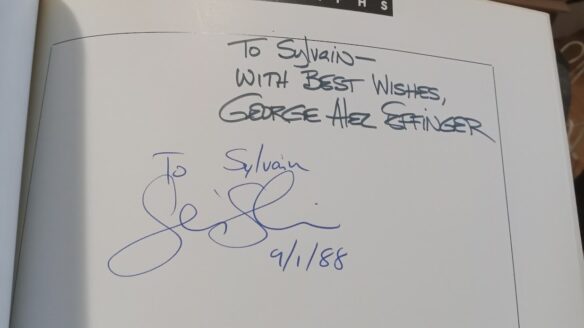
(9) SIGNATURE MYSTERY. [Item by Danny Sichel.] From the collection of the late Sylvain St-Pierre, Montreal fan, comes this autograph page from the souvenir program book for Nolacon II (Worldcon 1988). The top autograph is obviously from George Alec Effinger, but does anyone have any idea who the bottom one is from?
(10) MEMORY LANE.
2004 — [Written by Cat Eldridge.]
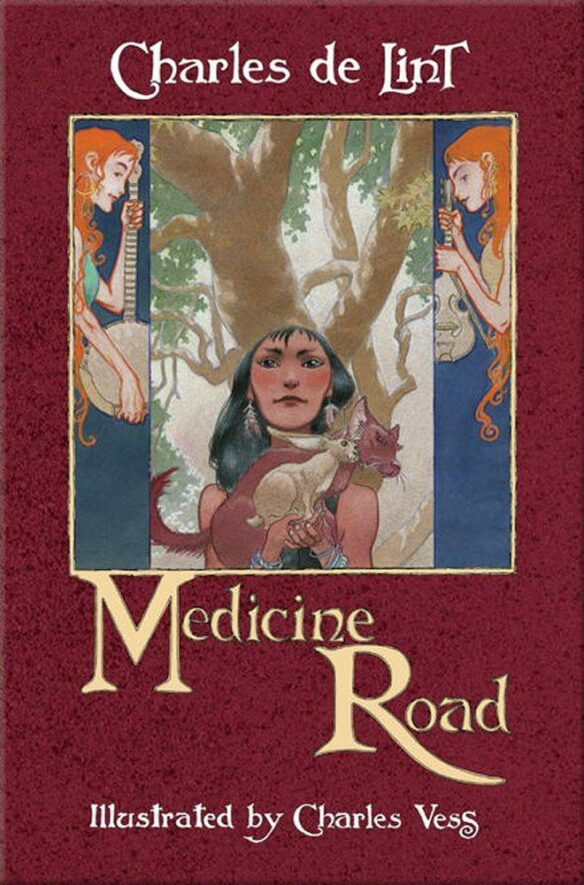
Charles de Lint’s Medicine Road which is where our Beginning is from has an interesting backstory, or at least the lead characters do. Now mind you, we won’t be meeting either of them in the Beginning. Well sort of we won’t.
There’s a minor spoiler here. Very minor.
There’s a number of stories that he did that are set within a place, a very rural Appalachian setting, roughly now though the year is never known to the reader. A children book, A Circle of Cats which Lis will be reviewing is where these stories began followed by The Cats of Tanglewood Forest which she has already reviewed here.
There’s a single story in this set of stories “Somewhere in My Mind There Is a Painting Box”. And now we get to the YA Seven Wild Sisters whereLaurel and Bess, musical twins, younger here than they will be in the adult Medicine Road where they are a folk singing duo, will get involved in the fey world of the region. Both of these will also be reviewed by her.
And here’s our Beginning…
CHANGING DOG AND CORN HAIR
One night, not so long ago, Changing Dog and Corn Hair met up in Sedona, Arizona, to have a talk about an old bargain they’d made with Coyote Woman. It’s funny, thinking of the two of them together like that; I can imagine them doing pretty much anything except getting along. Most times they’ll argue the colour of the moon, or the taste of water, if they can’t find something better to disagree on. There’s nothing much they ever seem to settle on, except that the other’s wrong.
But this night Corn Hair wasn’t aiming for an argument. She had herself a camp there by Oak Creek, on the south bank where the water runs below Cathedral Rock. It wasn’t much, just her bedroll laid out in the sand under the sycamores, with her pack doubling as a pillow. Close by, she’d built a small fire on which she was boiling water in a tin coffee pot, the bottom blackened from all its years of use. She ground some coffee beans using a flat rock and another the size of her fist for a mortar and pestle, scooping them into the now-boiling water when they were ground to her satisfaction. By the time Changing Dog came ambling down from the red rock scars skirting the solitary butte that towered above the creek, the coffee was thick and black, ready to drink.
Changing Dog nodded hello and sat cross-legged near the fire. He was a rangy, copper-skinned man with a narrow face and long, chestnut hair that streaked to a dark tan at his temples and was kept tied back with a thin strip of leather. You hardly ever saw him dressing up. That night he was wearing a white T-shirt and jeans, dusty tooled-leather cowboy boots and an old brown leather jacket going thin at the elbows. He wasn’t a homely man and he wasn’t particularly handsome, but he had these eyes that would grab anybody’s attention, especially a woman’s. They were a vivid cornflower blue that looked violet in the right light, and there was always a promise in them–not that he’d necessarily deliver, but that whatever might come, it would at least be interesting.
He accepted the tin coffee mug that Corn Hair handed him and took an appreciative sip. Setting the mug in the sand, he pulled a tobacco pouch from his pocket and rolled them each a cigarette, lighting them with a twig from the fire. He left one hanging from his lips, offering the other to Corn Hair.
(11) TODAY’S BIRTHDAYS.
[Compiled by Cat Eldridge.]
Born October 11, 1949 — Sharman DiVono, 74. She was the primary writer of the Star Trek comic strip from a year in the early Eighties. She’s written a number of other strips such as Pebbles and Bamm-Bamm, The Man from Planet X and Tarzan. She has written for three animated series — G.I. Joe, Bill & Ted’s Excellent Adventures and Star Wars: Droids. She’s written one genre novel, Blood Moon.
Born October 11, 1960 — Nicola Bryant, 63. Well known for her role as Perpugilliam “Peri” Brown, a companion to both the Fifth and Sixth Doctors. She also worked in “The Two Doctors” story so she appeared with the Second Doctor as well. Of course she’s done Big Finish Doctor Who audio dramas. Like so many, many genre performers, she shows up in the video Trek fan fiction playing Lana in Star Trek Continues.
Born October 11, 1964 — Michael J. Nelson, 59. Best known for his work on Mystery Science Theater. He was the head writer of the series for most of the show’s original eleven-year run, and spent half of that time as the on-air host. Bad genre films were a favorite target of him and his companions. Not that they don’t deserve it.
Born October 11, 1965 — Sean Patrick Flanery, 58. I really do think that his best work was on The Young Indiana Jones Chronicles and the films that followed. It certainly wasn’t as Bobby Dagen in Saw: The Final Chapter, a film best forgotten. (It gets a forty-one percent rating among audience reviewers at Rotten Tomatoes, much better than I expected.) He appeared as Jake Greyman in Demon Hunter, another low budget horror film, and as John in The Evil Within. I see a pattern…
Born October 11, 1972 — Nir Yaniv, 51. Author, editor, musician, and filmmaker. He founded a webzine for the Israeli Society for Science Fiction & Fantasy. Currently, he’s the chief editor of Chalomot Be’aspamia, Israel’s only professionally printed genre magazine. His short fiction has appeared in Weird Tales, Apex Magazine and The Best of World SF. He co-wrote The Tel Aviv Dossier with Lavie Tidhar.
Born October 11, 1972 — Claudia Black, 51. Best known for being Aeryn Sun in Farscape, arguably the best SF video series ever done, Vala Mal Doran in Stargate SG-1 and Sharon “Shazza” Montgomery in Pitch Black. She also had a recurring role as Dahlia in The Originals and starred as Dr. Sabine Lommers in The CW’s Containment series.
Born October 11, 1976 — Emily Deschanel, 47. Temperance “Bones” Brennan in Bones which crossed over with Sleepy Hollow twice (she visited the latter once) and she had a bit part on Spider-Man 2. More notably she was Pam Asbury in Stephen King’s Rose Red series. Actually the forensic science on Bones is genre, isn’t it?
Star Trek: Prodigy, the animated kids show that was canceled at Paramount+ with its second season still midway through production, has found a new home.
Netflix has scooped up both the previously aired first season and has committed to airing the sophomore run once that completes production. Season one will stream later this year, with the second batch due in 2024.
The Paramount Global-backed Paramount+ axedProdigy in June when it became the latest streamer to take advantage of tax write-offs.
Prodigy, though, was a particular surprise given the series is produced in-house by CBS Studios, where Star Trek captain Alex Kurtzman is based with a nine-figure overall deal….
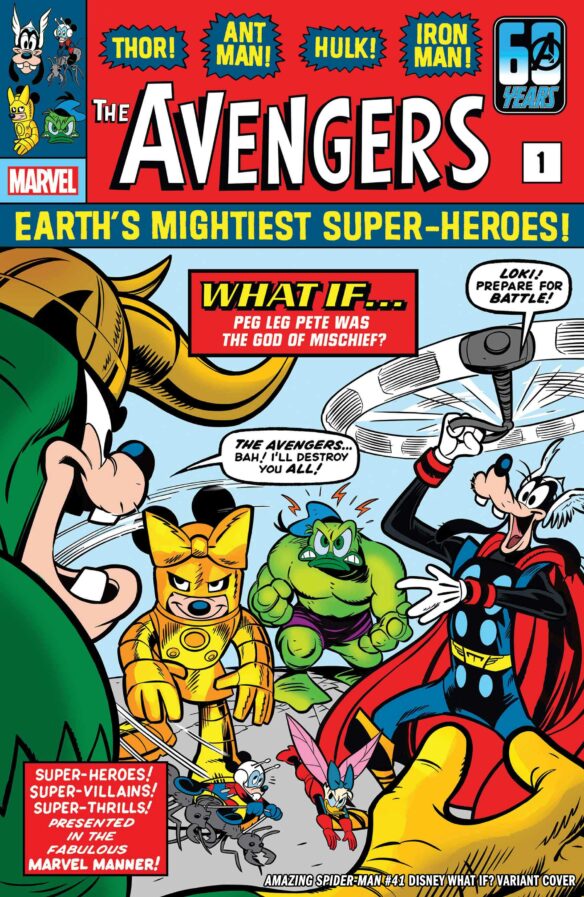
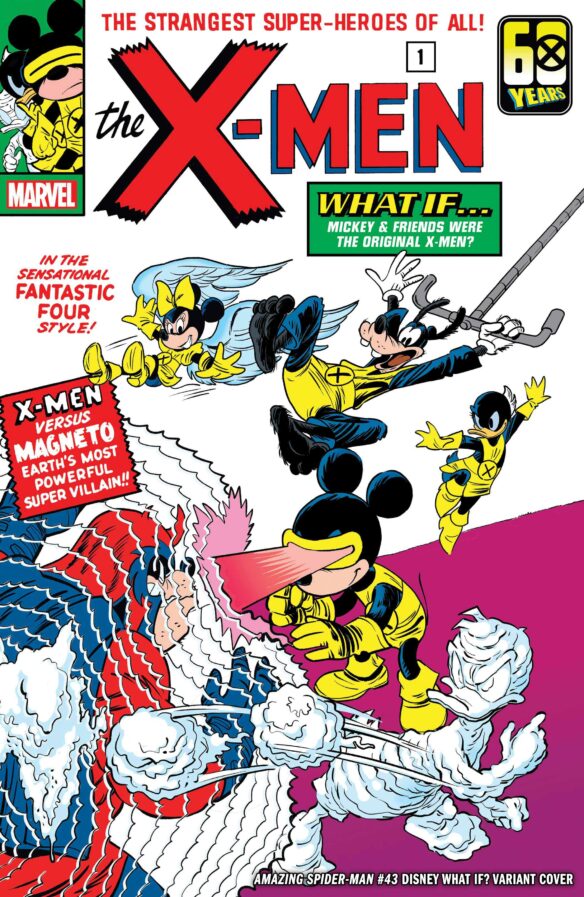
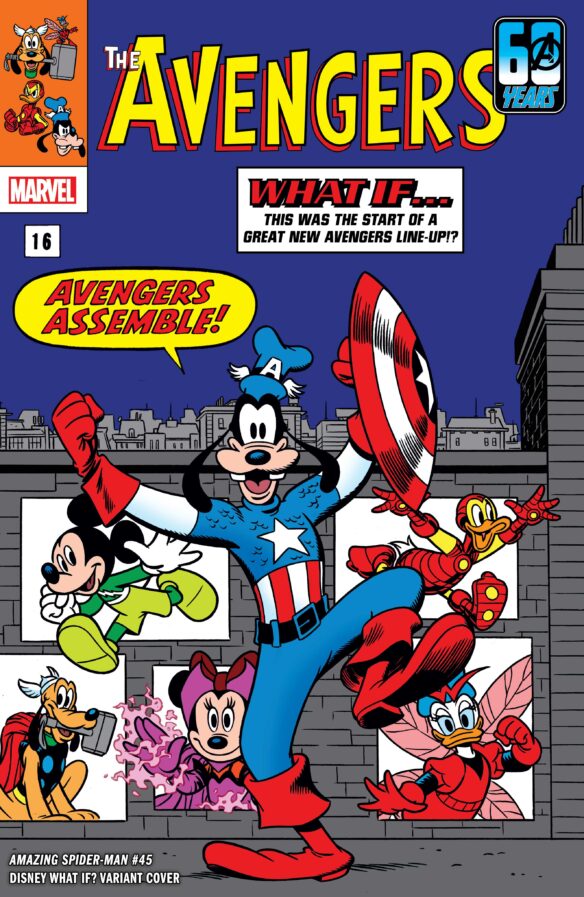
Classic Disney characters will grace the covers of Marvel’s comics in 2024 to celebrate the Avengers and X-Men‘s 60th anniversary.
The Disney What If…? variant cover series will be a monthly program adorning select issues of Amazing Spider-Man. There are twelve covers, and they will be released monthly throughout 2024. They will feature Mickey Mouse, Minnie Mouse, Donald Duck, Goofy and other classic Disney characters in milestone moments from Avengers and X-Men history. Marvel revealed the first three covers, one recreating Avengers #1 with Peg Leg Pete as Loki, another with Mickey and friends as the original X-Men, and the third showing the iconic Disney characters assembling as the Avengers, even giving Goofy Captain America‘s shield and Pluto Thor’s hammer.
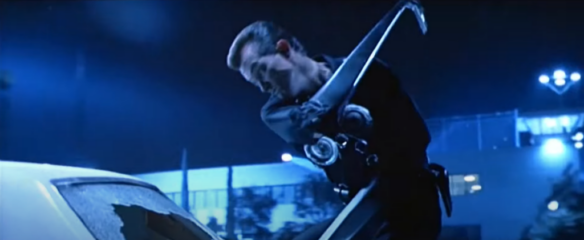
When it comes to explosive sequels, few in the industry can make a more bombastic blockbusting entry into a franchise like James Cameron. Having taken audiences on a pulse pounding tour de force with his follow up to the critically acclaimed Alien and made a splash with the cutting-edge special effects technologies which brought to life his memorable creations in The Abyss, one would think that Cameron would be hard pressed to continue his upward trajectory as the king of Blockbusters. Then, on July 3rd, 1991, it happened. Like a nuclear blast from his harrowing future vision of a robotic apocalypse, he unleashed yet another pioneering action film with Terminator 2 . A sequel that not only raised the stakes presented in the original film but proved to be an even bigger critical success. Among the memorable characters and sequences, a particular liquid metal menace played by a then unknown actor, Robert Patrick, captivated audiences and the vast pop-culture consciousness, the T-100.
Flash forward 32 years, and I find myself typing this entry while sitting in a large warehouse. Don’t worry. It might be a little imposing, but a fallout shelter it is not. The world hasn’t been taken over by artificial intelligence (yet), and as a cataloger working on Heritage Auctions’ various upcoming auctions, I continually find myself in a movie memorabilia mecha. And though I’ve held pieces from iconic films spanning the history of Hollywood, very few pieces have made my heart race the way these prop T-1000 hooked arms have….
(16) COULD THIS KSR SCENARIO REALLY WORK? [Item by John A Arkansawyer.] A speculative article from the BBC on climate change uses Kim Stanley Robinson’s Ministry for the Future as a hook. Beware spoilers. “To avert climate disaster, what if one rogue nation dimmed the Sun?” at BBC Future.
…In Robinson’s imagined scenario, India’s rogue deployment of solar geo-engineering turns out to be broadly benign, and buys time to scale-up emissions reductions. But in the real-world, the idea that such a deus ex machina technology could ever be safely deployed remains highly speculative, with many risks and unknowns.
So if one rogue nation did decide to dim the Sun for real, what environmental and geopolitical consequences might unfurl? And is the safe deployment of such a technology even a conceivable goal? …
… After a detailed analysis of the observations, the astronomers concluded that the blast of infrared radiation came from a hot new object or “synestia” created by the collision of two planets nearly as large as Neptune. Based on the infrared readings, the vast spinning object had a temperature of more than 700C for about three years. It will eventually cool and form a new planet around the star.
According to details published in Nature, the star began to dim about 2.5 years after the afterglow began as a massive cloud of fine impact debris drifted across the face of the star.
“It’s the first time we’ve seen the afterglow from such an event,” said Simon Lock, another co-lead author at the University of Bristol. “We’ve seen debris and discs before, but we have never seen the afterglow of the planetary body that’s produced.”…
(18) BARBIE HALLOWEEN. [Item by Mike Kennedy.] Part of an Utah neighborhood is transforming itself into Barbieland for Halloween. Each homeowner has picked a different theme related to the Barbie movie, Halloween+Barbie, etc. There’s the Barbie Dream House, a Barbie graveyard, Disco Barbie, and many more. Most of the houses are using pink floodlights, making the effect much more vivid at night. “Utah residents transform neighborhood into Barbieland for Halloween” at USA Today.
And the pink passion this season isn’t only in Utah. For instance, an Atlanta-area homeowner has decorated her front yard as the Barbie Scream House.
If you know of more examples of this trend, feel free to add links in the comments.
[Thanks to Ersatz Culture, John King Tarpinian, Steven French, Daniel Dern, Bonnie McDaniel, John A Arkansawyer, Lise Andreasen, Chris Barkley, Cat Eldridge SF Concatenation’s Jonathan Cowie, Mike Kennedy, and Andrew Porter for some of these stories. Title credit belongs to File 770 contributing editor of the day Cat Eldridge.]
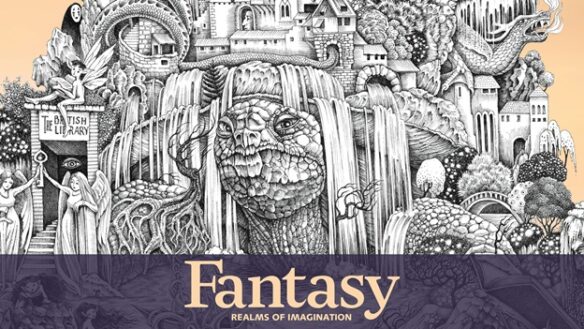
(1) BRITISH LIBRARY “FANTASY” EXHIBITION. [Item by Steven French.] For those who might be in London between October 27 and February 25, the British Library is putting on an exhibition about “Fantasy: Realms of Imagination”.
Set out on a legendary quest through the impossible worlds of fantasy.
Let our landmark exhibition cast its spell as we explore the beautiful, uncanny and sometimes monstrous makings of fantasy. From epic visions to intricately envisaged details, we celebrate some of the finest fantasy creators, reveal how their imagined lands, languages and creatures came into being, and delve into the traditions of a genre that has created some of the most passionate and enduring fandoms.
Journey from fairy tales and folklore to the fantastical worlds of Studio Ghibli. Venture into lands occupied by goblins and go down the rabbit hole. Travel through Middle-earth and into the depths of Pan’s Labyrinth. And discover how the oldest forms of literature continue to inspire fantasy authors today.
Gather your fellow adventurers and step through the British Library gates into the realms of fantasy as they have never been chronicled before. Who knows where your journey will lead…
Associated with the exhibition are a series of events including a discussion of some of Terry Pratchett’s ‘lost stories’ “A Stroke of the Pen: Terry Pratchett’s Lost Stories” on October 10 (also live-streamed on the BL platform).
(2) BOOK HAUL. [Item by SF Concatenation’s Jonathan Cowie.] For those that follow young Moid Moidelhoff and his introduction to the cosmos of SF books (with the occasional sojourn into film and TV) on his Media Death Cult YouTube channel, there is a small soap opera dimension. Moid has an SF library in the room in which he shoots most of his videos and there are more books in the attic. Moid’s approach is to find books in good condition, second hand in the wild (buying brand new books is kind of cheating though he does occasionally do this too). This means he often changes books in his collection as titles migrate through various stages from tatty paperback to good condition hardback. Some of his Patreon followers also send him books and so, every other month or so he posts a “Book Haul” video in which he opens for the first time packages sent to him.
The long game plan had been for he and his wife to move to a bigger place where he could have a large library in his YouTube shooting room. And at last it looks like they are about to move. But there’s bad news. Apparently, their new place does not have the space to house all his existing library as well as all his attic-stored books in his new study. And so young Moid has taken the decision to stop posting “Book Hauls” on YouTube (though will still occasionally post some solely for his Patreon supporters).
Actually, I am a little saddened about this. I found it interesting to see what he was being sent and whether or not I had read the titles, or even have them in my own library. The festive December Book Hauls were particularly enjoyable as they conveyed the present-opening activities of Christmas Day. (You can see the 2021 Christmas Book Haul here).
I would tentatively (as there’s no reason for Moid to take notice of little old me) suggest that perhaps he might convert his new place’s loft into a larger library or, alternatively he might get an Alastair Reynolds type garden building in which to house the books Al Reynolds writes in his own garden study…
(As I have pointed out elsewhere – science journals and SF magazine articles – having a large library is environmentally friendly. Books lining a wall provide a thermal barrier so improving a house’s energy efficiency. Books also store atmospheric carbon. Books lining a wall saves on decorating costs, etc.)
Anyway, it looks like there will be no more fu¢k Alan Moore (it’s a running Book Haul joke borne of love for the man’s works, and not what you might initially suspect). You can see Moid’s last SF Book Haul YouTube video below. It is a long one with an interlude in which he, and his on-location cameraman, Charlie, visit Hay on Wye. For those on the other side of the Black Atlantic, outside of Brit Cit, Hay on Wye is a Welsh village where just about every other shop is a bookshop. If you are coming to CalHab next year for the 2024 UK Worldcon and are spending a week or so sight-seeing BritCit, then spending a full day (a couple of nights) in Hay on Wye might reward you with that long-sought after book edition you’ve been hunting for for ages… If you like hunting books in the wild, Hay on Wye makes for a full-blown safari. (Probably best to invest in posting the books you get back to your home country as opposed to taking them back on the plane if, like me, you have the moral breaking strain of a chocolate Mars bar and easily give in to temptation. This means you need to go on a weekday when Hay on Wye’s post office will be open all day.)
I digress… Moid’s last YouTube Book Haul below (it really is this time, honest)…
(3) OXENMOOT A WEEK AWAY. The Tolkien Society expects 350 Tolkien fans from 25 different countries will meet in Oxford next weekend to celebrate the life and works of J.R.R. Tolkien. This year’s Oxonmoot is the Tolkien Society’s 50th Oxonmoot which coincides with the 50th anniversary of Tolkien’s death.
The event, taking place at St Anne’s College, Oxford from Thursday 31st August to Sunday 3rd September, has sold out due to the increasing popularity of Tolkien’s works. The event follows the recent publication of The Fall of Númenor and the release of the Amazon TV-series The Rings of Power set in the Second Age of Middle-earth.
The event itself will include talks from leading Tolkien scholars – including Brian Sibley, editor of The Fall of Númenor, screenwriter of The Lord of the Rings radio series and biographer of Peter Jackson – quizzes, workshops, an art exhibition, a masquerade, a Hobbit bake-off, a party and even theatrical performances. The weekend concludes, as always, with Enyalie, a ceremony of remembrance at Tolkien’s grave in Wolvercote Cemetery on Sunday afternoon….
Nobody would dare to boil down Ursula Le Guin’s marvelous writing—all that fantasy, all that science fiction, poetry, essays, translations—into one idea. But in a pinch I’d pick two sentences from her 2014 National Book Award speech: “Capitalism[’s] power seems inescapable. So did the divine right of kings.”
Fantasy and science fiction never meant escapism for Ursula Le Guin. The dragons of Earthsea and the reimagined genders of The Left Hand of Darkness were always lenses, lenses she ground in order to sharpen her readers’ focus on everyday life. Indeed, for Le Guin, there was no difference between the stories she invented and everyday stories about the institutions governing our world. The dragons of Earthsea and capitalism are woven from similar material: it is imagination all the way down.
James Baldwin said not everything that can be faced can be changed, but nothing can be changed without being faced. The word for facing things in Le Guin is recognition, or you might even say re-cognition. Her characters—and readers—find themselves forced to think again. When they do so, what had seemed a fundamental truth about their universe turns out to be anything but….
What book should everybody read before the age of 21?
“The Lord of the Rings.”
What book might people be surprised to find on your shelves?
I got very into the works of the original creators of the literary fairy tale genre a few years ago — the women, like Madame d’Aulnoy and Charlotte-Rose de Caumont de La Force, who wrote stories to entertain themselves and their friends in the salons of Louis XIV. These were very subversive tales that empowered these women and vented their wishful fantasies — often published in the literary gazettes of their day. I have five original Mercure Galant books from the 1600s in which some of these stories first appeared.
You’re organizing a literary dinner party. Which three writers, dead or alive, do you invite?
While I wouldn’t mind nerding out with Carl Sagan, J.R.R. Tolkien and Arthur C. Clarke, I’ll keep it to the living: Susanna Clarke, Margaret Atwood and Judy Blume. Can you guys arrange that?
Born August 24, 1899 — Gaylord Du Bois. He was a writer of comic book stories and comic strips, as well as Big Little Books. He wrote Tarzan for Dell Comics and Gold Key Comics from the Forties to early Seventies.) He was one of the writers for Space Family Robinson which was the basis for the Lost in Space series. (Died 1993.)
Born August 24, 1915 — Alice Sheldon. Alice Sheldon who wrote as James Tiptree Jr. was one of our most brilliant short story writers ever. She only wrote two novels, Up the Walls of the World and Brightness Falls from the Air and they too are worth reading. (Died 1987.)
Born August 24, 1932 — William Morgan Sheppard. Best remembered I think as Blank Reg in Max Headroom: 20 Minutes into the Future. Genre wise I’d add him being the Klingon Prison Warden In Star Trek VI: The Undiscovered Country, Merrit in The Prestige, the rather scary Soul Hunter on Babylon 5 and a Vulcan Science Minister in Star Trek. So have I missed anything for him, genre or otherwise worth noting here? (Died 2019.)
Born August 24, 1934 — Kenny Baker. Certainly his portrayal of R2-D2 in the Star Wars franchise is what he’s best known for but he’s also been in Circus of Horrors, Wombling Free, Prince Caspian and the Voyage of the Dawn Treader series, The Elephant Man, Sleeping Beauty, Time Bandits, Willow, Flash Gordon and Labyrinth. Personally I think his best role was as Fidgit in Time Bandits. (Died 2016.)
Born August 24, 1936 — A. S. Byatt, 87. Author of three genre novels, two of which I’m familiar with, Possession: A Romance which became a rather decent film, and the Mythopoeic Fantasy Award for Adult Literature-winning The Djinn in the Nightingale’s Eye, and one I’ve never heard of, Ragnarok: The End of the Gods, but I’m actually much, much more fond of her short fiction. I’d start with the Little Black Book of Stories and Angels & Insects collections
Born August 24, 1951 — Tony Amendola, 72. Probably best known for being the Jaffa master Bra’tac on Stargate SG-1. He’s also had recurring roles as Edouard Kagame of Liber8 on Continuum and on Once Upon a Time as Pinocchio’s creator, Geppetto. His list of one-off genre appearances is extensive and includes Angel, Charmed, Lois & Clark,Space: Above and Beyond, theCrusade spin-off of Babylon 5, X Files, Voyager, Dirk Gently’s Holistic Detective Agency, Terminator: The Sarah Connor Chronicles, Alias, She-Wolf of London and Kindred: The Embraced. He’s also been a voice actor in gaming with roles in such games as World of Warcraft: Warlords of Draenor, World of Warcraft: Legion and World of Final Fantasy.
Born August 24, 1958 — Lisa A. Barnett. Another one who died way too young. Wife of Melissa Scott. Some of her works were co-authored with her: The Armor of Light, Point of Hopes: A Novel of Astreiant and Point of Dreams: A Novel of Astreiant. They wrote one short story, “The Carmen Miranda Gambit”. She won the Lambda Literary Award. (Died 2006.)
Born August 24, 1957 — Stephen Fry, 66. He’s Gordon Deitrich in V for Vendetta, and he’s the Master of Laketown in The Hobbit franchise. His best role genre wise is as Mycroft Holmes in Sherlock Holmes: A Game of Shadows though he made an interesting narrator in the film version of The Hitchhiker’s Guide to the Galaxy, and not to be overlooked is that he’s the narrator for all seven of the Potter novels for the UK audiobook recordings. His best roles however are decidedly not genre — it was the comic act Fry and Laurie with Hugh Laurie, with the two also in A Bit of Fry & Laurie and then as Jeeves and Wooster. Bloody brilliant!
(8) COMICS SECTION.
xkcd is Tech-Geeky enough to qualify for an item, not to mention the hidden moral message.
India became the first country to land a spacecraft near the moon’s south pole on Wednesday — a historic voyage to uncharted territory that scientists believe could hold vital reserves of frozen water, and a technological triumph for the world’s most populous nation.
After a failed attempt to land on the moon in 2019, India now joins the United States, the Soviet Union and China as only the fourth country to achieve this milestone. A lander with a rover inside touched down on the lunar surface at 6:04 p.m. local time, sparking celebrations across India, including in the southern Indian city of Bengaluru, where space scientists watching the landing erupted in cheers and applause….
Officials from the research agency said Tuesday that they had launched a program to craft performance-grade, computerized clothing that can record audio, video and geolocation data while retaining the wearability and comfort of normal fabrics.
The Smart Electrically Powered and Networked Textile Systems — SMART ePANTS — program emerged a year ago with a broad agency announcement seeking contractors to help deliver sensor systems that can be integrated into normal clothing like shirts and pants, or even socks and underwear.
Those sensors are part of a system that is woven into the textiles to make the garments more wearable and washable, but also able to “sense, store, interpret, and/or react to information from their environment,” effectively making them Active Smart Textiles, according to agency documents….
Daniel Dern quips, “This gives new meaning to ‘flying by the seat of one’s pants’ (and perhaps ‘No matter where you, there you are’).”
(11) ARTIFICIAL INTELLIGENCE AGES HEARTS. [Item by SF Concatenation’s Jonathan Cowie.] Your biological age – how old you are – is actually just one age you have. Various parts of your body – brain, eyes, etc – have their own age. If, for example, you are middle aged, you might still unknowingly have the heart of an older person and so be at greater-than-you-think risk of a heart attack.
Up to now, things like your over-all biological age, lifestyle, blood cholesterol and genetic predisposition (did anyone in your family die young of a heart attack) have been used to guess a person’s heart’s age.
What biomedical researchers based in London, Brit Cit, have now developed is an artificial intelligence (AI) that can tell how old is a person’s heart. They also were able to quantify heart ageing factors and some of the genes involved – five seem particularly important.
They used used computer vision techniques to analyse cardiac magnetic resonance (CMR) imaging in 39,559 participants of the UK Biobank to train their AI.
(12) VIDEOS OF THE DAY. [Item by Dann.] Stone Trek is a five-episode mashup of Star Trek and the Flintstones.
[Thanks to SF Concatenation’s Jonathan Cowie, Mike Kennedy, Andrew Porter, Daniel Dern, Steven French, Dann, Shaun Gunner, John King Tarpinian, Chris Barkley, Michael Toman, and Cat Eldridge for some of these stories. Title credit belongs to File 770 contributing editor of the day Steve Davidson.]
Jessie Kwak spent most of Saturday among hundreds of others enjoying the Mississippi Street Fair in North Portland. For the science fiction author, it was a special chance for her to sell her books at a booth, along with her friend and fellow author, Mark. Just after 8 p.m., the pair walked to Mark’s car, which was parked at North Kerby Avenue and North Failing Street. As they prepared to drive away, they heard gunfire.
“It was just kind of like, pop, pop, pop, pop, like somebody set off a string of fireworks,” Kwak said. “The windshield exploded and my left eye exploded and I realized that wasn’t fireworks, and so I ducked down.”
Mark drove Kwak, 40, to Legacy Emanuel Hospital about four miles away. Kwak’s husband, Robert Kittilson, took photographs of his wife’s injured face, which was covered in blood. The photos are difficult to look at, but the couple hopes those who see them will see the impact of gun violence for what it is, not just a statistic to ignore
There’s a GoFundMe to help with medical bills and loss of freelance income. “Help Jessie recover from a traumatic eye injury”. The appeal has raised almost $8,000 of the $20,000 goal in the first 24 hours.
Hi, I’m Jessie, a self-made freelance writer and author. On Saturday, July 15th, I was selling books at a local street fair with another author friend. As we were leaving, someone in the car ahead of us started firing their gun into the street nearby. A bullet ricocheted into our windshield, and glass and bullet fragments hit my face and entered my left eye. I was rushed to the hospital immediately, but it was clear that the bullet had done severe damage to the eye.
On Sunday, July 16th, I went under for a 5-hour surgery to reconstruct my left eye. Doctors said it was in pieces and had to be put back together like a puzzle. The CT scan revealed that bullet fragments were embedded deep in my eye and had damaged the retina. Another surgery is scheduled for Wednesday, July 19th to remove the bullet fragments and if possible repair the retina.
It will take time to learn to live with one eye, and as a freelancer, I won’t be able to work as I recover. And no work means no income.
This fundraiser is to help pay for medical treatment, lost income and clients, and for future legal expenses.
I have been watching as gun violence has been increasing in our country, and in retrospect, I know that I am very very lucky. Many families don’t get a second chance to hug their loved ones tight.
I want to take this opportunity to show you the real person behind the statistic, and that this was not a freak accident, but the result of a systemic issue we are facing here in the United States.
Winner: ‘Field’s Nocturne No. 10 in E Major’ by Matt Lumbard
Sonny wakes to the smell of coffee and the sight of his Grampa slipping suspenders over his shoulders, looking at the woodstove and muttering: “It’ll burn itself out.”
The editors also picked their own winner, by sff author Chip Houser.
Editors’ Choice: ‘Separate Worlds’ by Chip Houser
The first time the earth tolls, we’re all in our separate worlds doing what we do.
(3) AWARDS META. Daniel Dern suggests the Award Award, featuring categories like the “Most ingenious nomination process”. What others would you suggest?
…Set on the planet Eternia, “Masters of the Universe” largely focuses on the conflict between He-Man, a blonde muscle god, and his devious nemesis Skeletor. The characters formed a much-loved 1980s animated series, which developed a cross-generational fan base during its syndicated runs. For the latest film iteration, the budget came in at over $200 million with cameras set to roll this February, sources said. Last spring, however, Netflix was confronted with a stunning stock drop that saw the powerful streamer shed $50 billion in value after investors became concerned about the company’s subscriber losses.
In the aftermath of the sell-off, Netflix film head Scott Stuber and chief content officer Bela Bajaria tried to reassure the industry that they still had money to spend amid their Wall Street woes. However, sources close to “Masters of the Universe” said after that point the streamer refused to shell out more than $150 million to see up-and-comer Allen (“American Horror Story,” “A Haunting in Venice”) pick up He-Man’s sword. A source familiar with Netflix said the stock drop was irrelevant to budget issues on “Masters,” noting that its content spend has been flat at $17 billion for two years, despite market fluctuation….
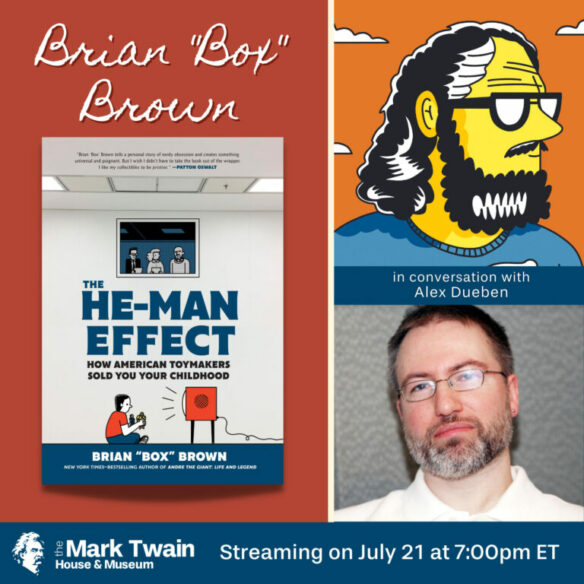
(5) WE PAUSE FOR A COMMERCIAL MESSAGE. Meanwhile, the Mark Twain House & Museum is adding a dose of grumpiness to the Masters of the Universe mix by hosting the virtual event “The He-Man Effect: How American Toymakers Sold You Your Childhood”. Register here – choose your own price, minimum $2.50 (free to Twain House members).
Brian “Box” Brown unravels how marketing that targeted children in the 1980s has shaped adults in the present. The He-Man Effect shows how corporate manipulation brought muscular, accessory-stuffed action figures to dizzying heights in the eighties and beyond. Bringing beloved brands like He-Man, Transformers, My Little Pony, and even Mickey Mouse himself into the spotlight, this graphic history exposes a world with no rules and no concern for results beyond profit.
(6) CHARLES E. NOAD OBITUARY. David Bratman has written a tribute to the late Charles E. Noad at Kalimac’s corner. It begins:
Charles was a mainstay of the Tolkien Society, the UK-based organization, and an absolute monument for Tolkien studies for all that he didn’t write very much. Besides doing bibliographical work for the TS, his most valuable contribution was as proofreader for most of the posthumous Tolkien volumes, in the History of Middle-earth series and elsewhere. At this his ability to catch glitches was unsurpassed. He could quite literally tell whether a period (the full stop at the end of a sentence) was in italics or not. As a support to Christopher Tolkien, the editor of these volumes, he was more than invaluable….
(7) MEMORY LANE.
1998 – [Written by Cat Eldridge from a choice by Mike Glyer.]
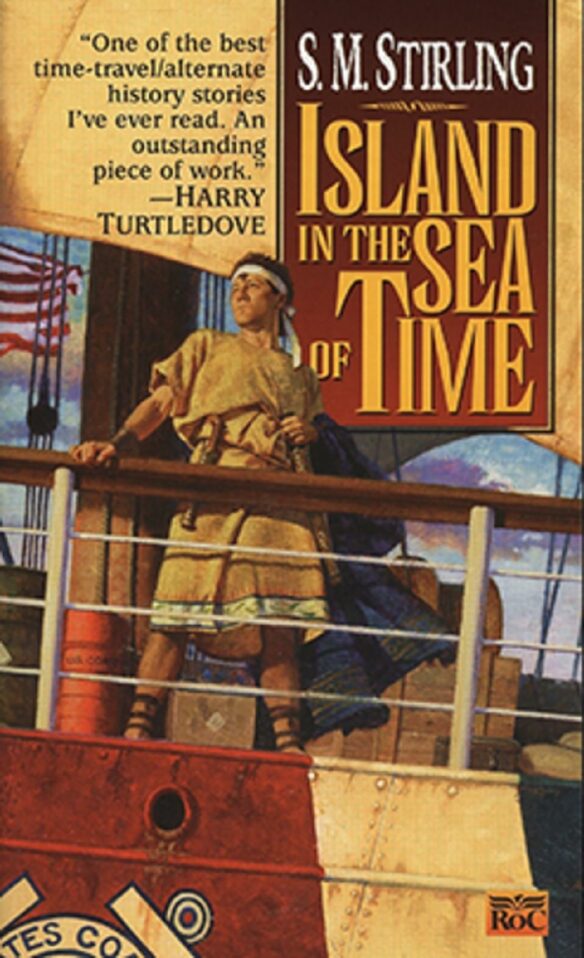
A work by S. M. Stirling provides our Beginning this Scroll. Now I’ll admit that I am not that familiar with him which is not to say that there aren’t works by him that I do like deeply such as The Peshawar Lancers and The Lords of Creation series which consists of The Sky People and In the Courts of the Crimson Kings. The latter is extraordinary work.
He has been nominated for many awards, winning the Lord Ruthven Award which is given for significant contributions to the field of horror literature for his A Taint the Blood novel, and a Dragon Award for the Black Chamber novel in the Best Alternate History Novel category. It was nominated for a Sunburst was awarded to a Canadian novel in previous year.
Mike choose Island in the Sea of Time, the first novel in the Nantucket series, published by Roc Books twenty-five years ago.
And now for the Beginning…
March, 1998 A.D.
Ian Arnstein stepped off the ferry gangway and hefted his bags. Nantucket on a foggy March evening was chilly enough to make him thankful he’d worn the heavier overcoat; Southern Californian habits could betray you, here on the coast of New England. Thirty-odd miles off the coast. The summer houses built out over the water were still shuttered, and most of the shops were closed—tourist season wouldn’t really start until Daffodil Weekend in late April, when the population began to climb from seven thousand to sixty. He was a tourist of sorts himself, even though he came here regularly; to the locals he was still a “coof,” of course, or “from away,” to use a less old-fashioned term. Everybody whose ancestors hadn’t arrived in the seventeenth century was a coof, to the core of old-time inhabitants, a “wash-ashore” even if he’d lived here for years. This was the sort of place where they talked about “going to America” when they took the ferry to the mainland.
He trudged past Easy Street, which wasn’t, and turned onto Broad, which wasn’t either, up to the whaling magnate’s mansion that he stayed in every year. It had been converted to an inn back in the 1850s, when the magnate’s wife insisted on moving to Boston for the social life. Few buildings downtown were much more recent than that. The collapse of the whaling industry during the Civil War era had frozen Nantucket in time, down to the huge American elms along Main Street and the cobblestone alleys. The British travel writer Jan Morris had called it the most beautiful small town in the world, mellow brick and shingle in Federal or neoclassical style. A ferociously restrictive building code kept it that way, a place where Longfellow and Whittier would have felt at home and Melville would have taken a few minutes to notice the differences.
Mind you, it probably smells a lot better these days. Must have reeked something fierce when the harborfront was lined with whale-oil renderies. It had its own memories for him, now. Still painful, but life was like that. People died, marriages too, and you went on.
He hurried up Broad Street and hefted his bags up the brick stairs to the white neoclassical doors with their overhead fanlights flanked by white wooden pillars. The desk was just within, but the tantalizing smells came from downstairs. The whalers were long gone, but they still served a mean seafood dinner in the basement restaurant at the John Cofflin House.
(8) TODAY’S BIRTHDAYS.
[Compiled by Cat Eldridge.]
Born July 19, 1883 — Max Fleischer. Animator, film director and producer. He brought such animated characters as Betty Boop, Popeye and Superman to the screen and was responsible for a number of technological innovations including the Rotoscope and Stereoptical Processes. You can see Betty’s first screen appearance here in the 1930 Cartoon, “Dizzy Dishes”. (Died 1972.)
Born July 19, 1924 — Pat Hingle. He portrayed Jim Gordon in the Burton Batman film franchise. Genre wise, he had roles in Alfred Hitchcock Presents, The Twilight Zone, Carol for Another Christmas, Mission: Impossible, The Invaders, Tarantulas: The Deadly Cargo, Amazing Stories and The Land Before Time. He would reprise his Gordon role in the Batman OnStar commercials. (Died 2009.)
Born July 19, 1927 — Richard E. Geis. I met him at least once when I was living out there in Oregon. Interesting person. He won the Hugo Award for Best Fan Writer twice; and whose science fiction fanzine Science Fiction Review won Hugo Awards for Best Fanzine four times. The Alien Critic won the Best Fanzine Hugo (once in a tie with Algol), and once by himself. And yes, I enjoyed reading the Science Fiction Review. I’ve not read any of his handful of genre novels, and certainly haven’t encountered his soft-core porn of which there’s a lot. (Died 2013.)
Born July 19, 1950 — Richard Pini, 73. He’s half of the husband-and-wife team responsible for creating the well-known Elfquest series of comics, graphic novels and prose works. They are also known as WaRP (as in Warp Graphics). It’s worth noting that characters based on works by the Pinis appear in Ghost Rider (vol.1 issue 14).
Born July 19, 1957 — John Pelan. Committed (more or less) the act of opening serial small publishing houses in succession with the first being Axolotl Press in the mid-Eighties where he’d published the likes of de Lint and Powers (before selling it to Pulphouse Publishing) followed by Darkside Press, Silver Salamander Press and finally co-founding Midnight House. All have been inactive for quite awhile now and he’d been editing such anthologies as Tales of Terror and Torment: Stories from the Pulps, Volume 1 for other presses though even that has not happened for some years as near as I can tell. As a writer, he had more than thirty published stories and he had won both a Stoker for The Darker Side: Generations of Horror anthology and an International Horror Guild Award for his Darkside: Horror for the Next Millennium anthology. (Died 2021.)
Born July 19, 1969 — Kelly Link, 54. First, let me note that along with Ellen Datlow, she and her husband Gavin Grant were responsible for the last five volumes of The Year’s Best Fantasy & Horror. They all did an absolutely magnificent job. All of her collections, Pretty Monsters, Magic for Beginners and Get in Trouble are astonishingly good. And she’s much honored having three Nebula Awards, a World Fantasy Award, an Otherwise Award, a Sturgeon Award and received a MacArthur Genius Grant. She was a finalist for a 2016 Pulitzer Prize. And Hugos. She won a Hugo at Interaction for her “Faery Handbag” novellette, her “Magic for Beginners” novella was nominated at L.A. Con IV, and finally Lady Churchill’s Rosebud Wristlet was nominated at Nippon 2007 for Best Semi-Prozine (her husband Gavin Grant was also nominated).
Born July 19, 1976 — Benedict Cumberbatch, 47. Confession time: I really didn’t care for him in the Sherlock series, nor did I think his Khan In Star Trek Into Darkness was all that interesting but his Stephen Strange In Doctor Strange was excellent. He did do a superb job of voicing Smaug inThe Hobbit and his Grinch voicing in that film was also superb. I understand he’s the voice of Satan in Good Omens…
1999’s “Star Wars: The Phantom Menace” introduced audiences to a technological marvel: Jar Jar Binks, cinema’s first major motion-captured character. But the comic-relief alien also became the target of one of the internet’s first hate campaigns, with vitriol spilling over to the actor who played Jar Jar as well.
The new podcast “The Redemption of Jar Jar Binks” tells this story and how it informs online discourse today. Here & Now‘s Celeste Headlee speaks to podcast host Dylan Marron, also known for his writing work on “Ted Lasso” and his podcast “Conversations with People Who Hate Me.”
Jar Jar Binks became one of the most polarizing figures in cinematic history when he made his debut in Star Wars Episode 1: The Phantom Menace in 1999. He was even named “the most annoying movie character of all time” by Complex Magazine. After the release, Ahmed Best, the man who played Jar Jar, was hit with the full force of the backlash — and it nearly destroyed him. The Redemption of Jar Jar Binks is a six-part journey through the early internet to understand how one of the first-ever online hate campaigns began, and to right what we got so wrong about Jar Jar the first time around.
So, when people caught sight of another large balloon in the southern hemisphere in early May, there was concern it could be another spy device. Instead, it represents the future of astronomy: balloon-borne telescopes that peer deep into space without leaving the stratosphere.
“We’re looking up, not down,” says William Jones, a professor of physics at Princeton University and head of NASA’s Super Pressure Balloon Imaging Telescope (SuperBIT) team. Launched from Wānaka, New Zealand, on April 15, the nearly 10-foot-tall telescope has already circled the southern hemisphere four times on a football stadium-sized balloon made from polyethylene film. Its three onboard cameras also took stunning images of the Tarantula Nebula and Antennae galaxies to rival those of the Hubble Space Telescope. The findings from SuperBIT could help scientists unravel one of the greatest mysteries of the universe: the nature of dark matter, a theoretically invisible material only known from its gravitational effects on visible objects….
Based on a single chilling chapter from Bram Stoker’s classic novel Dracula, The Last Voyage of the Demeter tells the terrifying story of the merchant ship Demeter, which was chartered to carry private cargo—fifty unmarked wooden crates—from Carpathia to London. Strange events befall the doomed crew as they attempt to survive the ocean voyage, stalked each night by a merciless presence onboard the ship. When the Demeter finally arrives off the shores of England, it is a charred, derelict wreck. There is no trace of the crew.
(13) VIDEO OF THE DAY. Fanac.org now hosts the venerable Castle of Terrors made in 1964 by the UK’s Delta Science Fiction Film Group.
This fannish production from Harry Nadler and the Delta SF Film Group gives us a slapstick parody of horror movies, replete with well known British fans of the day. There are angry villagers, damsels in distress, and scary monsters, as well as less well-known horror tropes like food fights in this 20 minute amateur extravaganza. In “Castle of Terrors” you can feel just how much fun Delta Group was having (and get a clear sense of their love for slapstick). Bill Burns, who provided this and other Delta Films tells us “The individual films date from 1963 to 1970, and were made on 8mm silent film to which a magnetic stripe was later added and the sound dubbed on. They were then shown mercilessly at club meetings and Eastercons, and suffered accordingly.” For more about the Delta SF Film Group, see the Fancyclopedia article and see the text of Bill’s talk at Manunicon (2016 Eastercon) here.
[Thanks to SF Concatenation’s Jonathan Cowie, Mike Kennedy, Andrew Porter, Daniel Dern, A. P. Howell, John King Tarpinian, Chris Barkley, Michael Toman, and Cat Eldridge for some of these stories. Title credit belongs to File 770 contributing editor of the day Daniel Dern.]
(1) TOLKIEN SOCIETY AWARDS NEWS. The Tolkien Society invites the public to submit nominations for The Tolkien Society Awards 2023 through February 26. Membership is not required to participate in the first round. Once the shortlist is compiled, however, only members will be eligible to vote on the winners, who will be announced April 1.
A refuse firm in Brighton called Lord of the Bins has been ordered by lawyers to change its name after being accused of breaching trademark laws.
The two-man waste collection business was contacted by Middle-earth Enterprises, which owns the worldwide rights to The Hobbit and the Lord of the Rings trilogy.
Nick Lockwood and Dan Walker run the company, which collects household, building and office waste across East Sussex and West Sussex.
The pair said they have been issued with a cease and desist notice after it was claimed they were in breach of the well-known franchise’s trademarks.
As well as changing the firm’s name and website, they have been forced to ditch their company slogan – “One ring to remove it all”.
Refuse firm Lord of the Bins ordered to change its name by Tolkien franchise https://t.co/q2ktj5lWTc
(3) TWEET DECAY. Ursula Vernon speaks for many in a remark that went viral on Twitter.
I didn’t hear about that spy balloon thing until yesterday. I had to learn about the green comet from my hairdresser. I do not believe for a second that no one was talking about these things, but Twitter thought I wanted to hear about electric kettles and Hogwarts.
Question to ChatGPT: What is the plot of the unpublished script Charles Stross wrote for Wallace and Grommit?
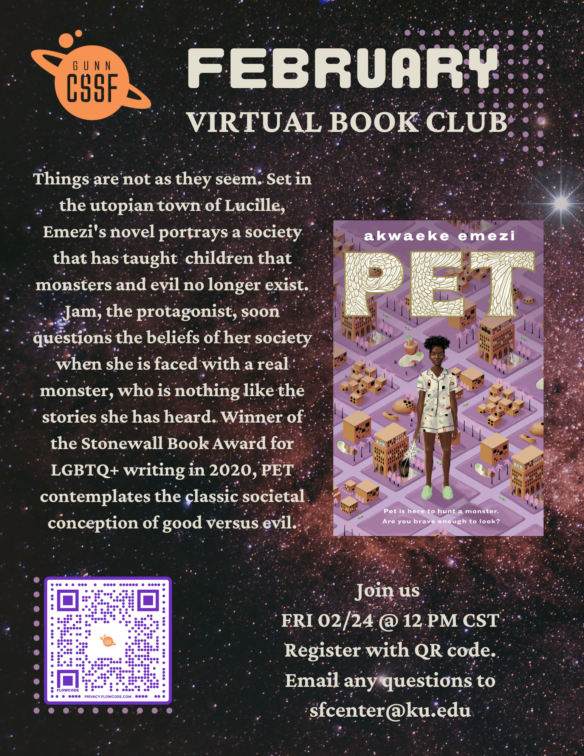
(5) GUNN CSSF BOOK CLUB. The Gunn Center for the Study of SF’s (CSSF) monthly virtual book club has chosen for the month of February to read Akwaeke Emezi’s YA novel, Pet.
Set in the utopian town of Lucille, Emezi’s novel portrays a society that has taught children that monsters and evil no longer exist. Jam, the protagonist, soon questions the beliefs of her society when she is faced with a real monster, who is nothing like the stories she has heard. Winner of the Stonewall Book Award for LGBTQ+ writing in 2020, Pet contemplates the classic societal conception of good versus evil.
Readers are invited to join the virtual event on Friday, February 24 at Noon (Central). Register here.
The darkness between stars is full of threnodies and threadbare laments, concertos and cantatas, the names of the dead and the wars that they’ve fed. Few people are unmoved by the strenuous harmonies and the strange hymns. Fewer people still understand their significance, the decayed etymologies and deprecated tongues….
In January 2022, the reviews department at Strange Horizons, led at the time by Maureen Kincaid Speller, published our first special issue with a focus on SF criticism. We were incredibly proud of this issue, and heartened by how many people seemed to feel, with us, that criticism of the kind we publish was important; that it was creative, transformative, worthwhile. We’d been editing the reviews section for a few years at this point, and the process of putting together this special, and the reception it got, felt like a kind of renewal—a reminder of why we cared so much. In the couple of months that followed, we made grand plans for future projects, and even started a podcast.
The criticism special was also the last major project the three of us worked on together, before Maureen’s cancer diagnosis. We lost her in September.
We’d already been toying with the idea of doing another criticism special in 2023; when the subject of a tribute issue to Maureen was broached, the only way we could envision it was through the critical work that she loved.…
(8) MEMORY LANE.
2014 — [Compiled by Cat Eldridge.]
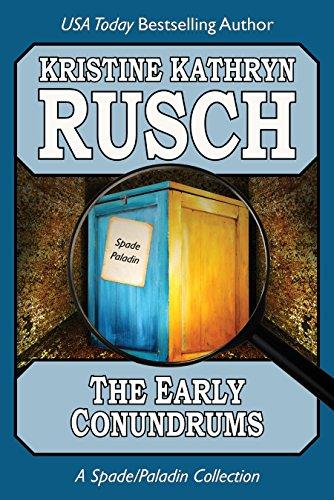
So let’s talk about Kristine Kathryn Rusch’s Spade/Paladin Conundrums which got their start in the “Stomping Mad” story.
I’m very fond of our community and equally fond of mysteries as y’all well know by now. So you will not find it at all surprising that I really love these stories. They’ve got a perfect central character as you’ll see below, a great setting as they’re all set at various Cons and the stories are all fascinating. What’s not to like?
Rusch for a long time only did short stories set here, really great ones, a fair number of them, mostly collected in Early Conundrums, and those exist in a stellar audio version which is narrated by Rish Outfield, but two years ago Ten Little Fen: A Spade/Paladin Conundrum came out. It’s a superb mystery and a even better look at Con culture.
Here’s the Beginning of the series in that story.
SHE CALLED HERSELF the Martha Stewart of Science Fiction, and she looked the part: Homecoming-queen pretty with a touch of maliciousness behind the eyes, a fakely tolerant acceptance of everyone fannish, and an ability to throw the best room party at any given Worldcon in any given year.
So when a body was found in her party suite, the case came to me. Folks in fandom call me the Sam Spade of Science Fiction, but I’m actually more like the Nero Wolfe: a man who prefers good food and good conversation, a man who is huge, both in his appetite and in his education. I don’t go out much, except to science fiction conventions (a world in and of themselves) and to dinner with the rare comrade. I surround myself with books, computers, and televisions. I do not have orchids or an Archie Goodwin, but I do possess a sharp eye for detail and a critical understanding of the dark side of human nature.
I have, in the past, solved over a dozen cases, ranging from finding the source of a doomsday virus that threatened to shut down the world’s largest fan database to discovering who had stolen “the Best Artist Hugo two hours before the award ceremony. My reputation had grown during the last British Fantasy Convention when I—an American—worked with Scotland Yard to recover a diamond worth £1,000,000 that a Big Name Fan had forgotten to put in the hotel’s safe.
But I had never faced a more convoluted criminal mind until that Friday afternoon at the First Annual Jurassic Parkathon, a media convention held in Anaheim.
(9) TODAY’S BIRTHDAYS.
[Compiled by Cat Eldridge.]
Born February 5, 1906 — John Carradine. I’m going to count Murders in the Rue Morgue as his first genre appearance. After that early Thirties film, he shows up (bad pun I know) in The Invisible Man, The Black Cat, Bride of Frankenstein, Ali Baba Goes to Town, The Three Musketeers and The Hound of the Baskervilles. Look, that’s just the Thirties. Can I just state that he did a lot of genre work and leave it at that? He even had roles on The Twilight Zone, The Munsters, Lost in Space, Night Gallery and the Night Strangler. (Died 1988.)
Born February 5, 1919 — Red Buttons. He shows up on The New Original Wonder Woman as Ashley Norman. Yes, this is the Lynda Carter version. Somewhat later he’s Hoagy in Pete’s Dragon followed by being the voice of Milton in Rudolph and Frosty’s Christmas in July. He also played four different characters on the original Fantasy Island. (Died 2006.)
Born February 5, 1922 — Peter Leslie. Writer in a number of media franchises including The Avengers, The New Avengers (and yes they are different franchises), The Man from U.N.C.L.E., The Girl from U.N.C.L.E. and The Invaders. ISFDB also lists has writing in the Father Hayes series but I don’t recognize that series. (Died 2007.)
Born February 5, 1924 — Basil Copper. Best remembered for Solar Pons stories continuing the character created as a tribute to Sherlock Holmes by August Derleth. I’m also fond of The Great White Space, his Lovecraftian novel that has a character called Clark Ashton Scarsdale has to be homage to Clark Ashton Smith. Though I’ve not seen them them, PS Publishing released Darkness, Mist and Shadow: The Collected Macabre Tales of Basil Copper, a two-volume set of his dark fantasy tales. (Died 2013.)
Born February 5, 1934 — Malcolm Willits, 89. Author of The Wonderful Edison Time Machine: A Celebration of Life and Shakespeare’s Cat: A Play in Three Acts which he filmed as Shakespeare’s Cat. He also co-edited Destiny, an early Fifties fanzine with Jim Bradley.
Born February 5, 1940 — H.R. Giger.Conceptual designer in whole or part for Aliens, Alien³, Species and Alien: Resurrection to name a few films he’s been involved in. Did you know there are two Giger Bars designed by him, both in Switzerland? And yes they’re really weird. (Died 2014.)
Born February 5, 1941 — Stephen J. Cannell. Creator of The Greatest American Hero. That gets him Birthday Honors. The only other genre series he was involved with was The 100 Lives of Black Jack Savage thirty years ago which I never heard of. He also created the Castle series with Nathan Fillion of Firefly fame and was one of the actual players at the poker games on the series. View one of them here. (Died 2010.)
Born February 5, 1964 — Laura Linney, 59. She first shows up in our corner of the Universe as Meryl Burbank/Hannah Gill on The Truman Show before playing Officer Connie Mills in The Mothman Prophecies (BARF!) and then Erin Bruner in The Exorcism of Emily Rose. She plays Mrs. Munro In Mr. Holmes, a film best described as stink, stank and stunk when it comes to all things Holmesian. Her last SF was as Rebecca Vincent in Teenage Mutant Ninja Turtles: Out of the Shadows.
(10) COMICS SECTION.
Tom Gauld passes along advice about what women writers need.
Comic book creators and filmmakers pick some superhero names just because they sound cool. Other names, though, are chosen for their deep connection with a character or setting. Many of the names from Wakanda, the home of Black Panther, are especially rich in symbolism and significance.
Join us as we answer these questions and more:
Is there a real Wakanda that inspired the name of the technologically advanced supercountry?
“The Traitors,” a new reality game show, hinges on startling revelations. In episodes of the series, which is framed as a whodunit, cast members are regularly “murdered” (kicked off). Others are “banished” (also kicked off). But some of the most astonishing reveals have nothing to do with the plot — and everything to do with what outfit the show’s host, the actor Alan Cumming, will appear in next.
There are pink plaid suits. Herringbone tweed capes. Sleek little kilts. “Perhaps, rather alarmingly,” Mr. Cumming said, “the vast majority of the clothes were mine.”…
[Thanks to Chris Barkley, Andrew Porter, Michael Toman, Steven French, Cat Eldridge, Mike Kennedy, and John King Tarpinian for some of these stories. Title credit belongs to File 770 contributing editor of the day by Cat Eldridge.]
(1) HOW WRITERS GET UNPAID. Quenby Olson shows how a returned book costs her money on Amazon. Thread starts here.
I'm not going to wonder why it was returned. That's not the point of this post. But it was the only book I'd sold in France that month, and suddenly, my royalties from Amazon for my amazing sales in France were…
Regardless of anyone's belief on whether ebooks should be free and pirating sites are totally cool because your books should be available to everyone at all times because you're an artist blah blah blah tell that to my kids who can hoover up three pizzas in one sitting…
If you are the sort of person who will buy and return a book you're going to do it regardless of morals or ethics or my hungry, growing children because you're just an asshat.
And don't give me any "but the book wasn't good so I returned it" nonsense.
A TikTok trend where users encourage others to purchase, read, and return Amazon ebooks within the company’s return policy window has irked independent authors, who claim to have seen dramatic spikes in their ebook return rates since the trend went viral.
The #ReadAndReturn challenge drew attention to Amazon’s Kindle return policy, which states that readers can “cancel an accidental book order within seven days.” But what’s been presented as a literary community “life hack” is hurting romance-fantasy authors like Lisa Kessler’s bottom line.
“When you buy a digital book, if you read and return it, Amazon just turns around and gets the money back from the author, plus Amazon builds in a digital delivery fee and so Amazon is still getting that delivery fee but we get all the royalties taken back,” Kessler told Motherboard.
Kessler, who self-publishes several book series, says that before the challenge, she would see on average one or two returns per month. But when she checked her Kindle Direct Publishing (KDP) sales dashboard on June 1st, she says she was shocked to find a negative account balance….
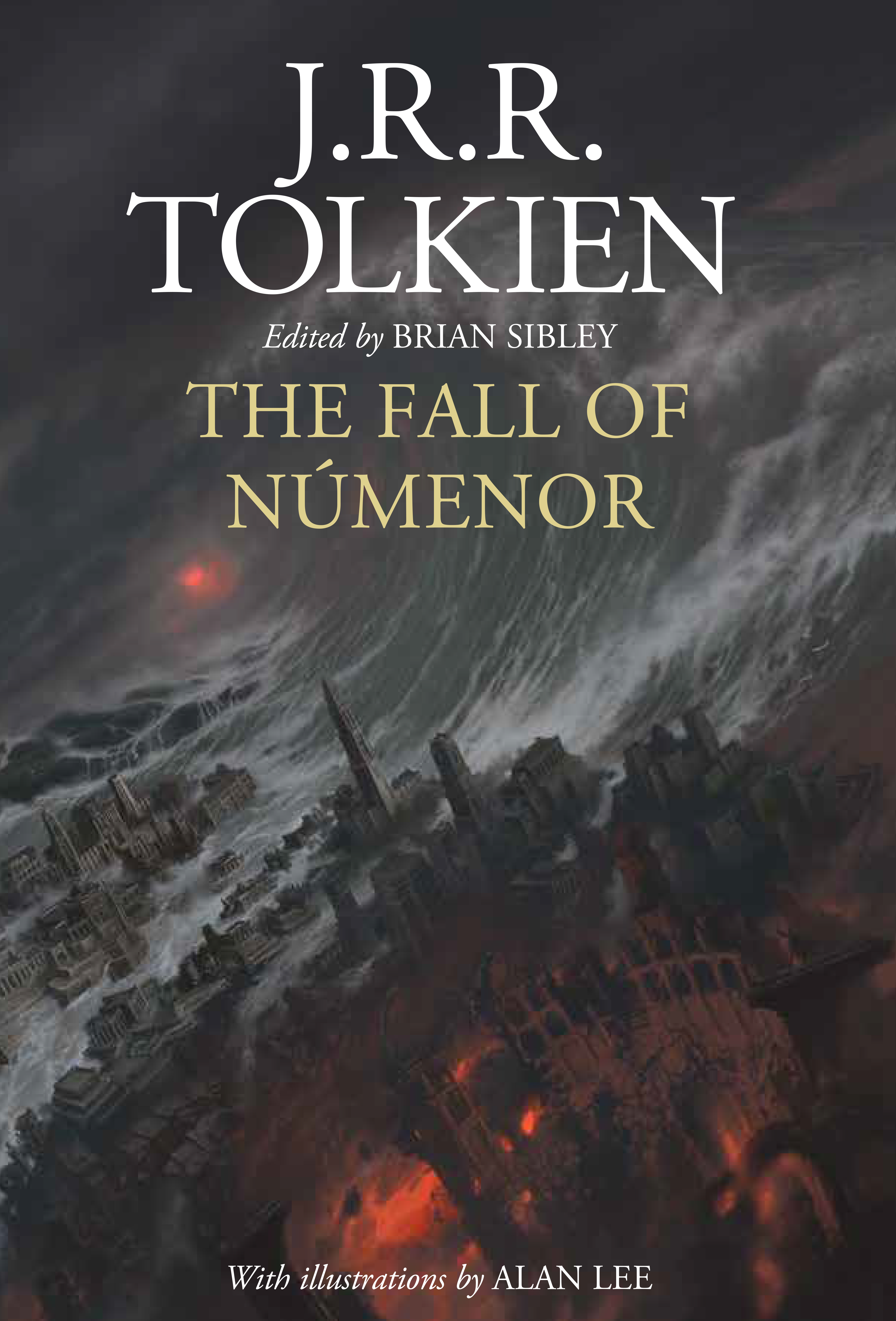
(2) JUST A SECOND.The Fall of Númenor, a collection of Tolkien’s works about the Second Age of Middle-Earth, will be published by HarperCollins in November 2022. The book will appear after Amazon Prime releases the streaming series The Rings of Power, set during the Second Age of Middle-earth, in September 2022. “New Tolkien book: The Fall of Númenor to be published” at The Tolkien Society.
A HarperCollins press release included in the post explains that the volume is edited by writer and Tolkien expert, Brian Sibley, and illustrated by acclaimed artist, Alan Lee.
…Presenting for the first time in one volume the events of the Second Age as written by J.R.R. Tolkien and originally and masterfully edited for publication by Christopher Tolkien, this new volume will include pencil drawings and colour paintings by Alan Lee, who also illustrated The Lord of the Rings and The Hobbit and went on to win an Academy Award for his work on The Lord of the Rings film trilogy.
J.R.R. Tolkien famously described the Second Age of Middle-earth as a ‘dark age, and not very much of its history is (or need be) told’. And for many years readers would need to be content with the tantalizing glimpses of it found within the pages of The Lord of the Rings and its appendices.
It was not until Christopher Tolkien presented The Silmarillion for publication in 1977 that a fuller story could be told for, though much of its content concerned the First Age of Middle-earth, there were at its close two key works that revealed the tumultuous events concerning the rise and fall of the island-kingdom of Númenor, the Forging of the Rings of Power, the building of the Barad-dûr and the rise of Sauron, and the Last Alliance of Elves and Men.
Christopher Tolkien provided even greater insight into the Second Age in Unfinished Tales of Númenor and Middle-earth in 1980, and expanded upon this in his magisterial 12-volume History of Middle-earth, in which he presented and discussed a wealth of further tales written by his father, many in draft form.
Now, using ‘The Tale of Years’ in The Lord of the Rings as a starting point, Brian Sibley has assembled from the various published texts in a way that tells for the very first time in one volume the tale of the Second Age of Middle-earth, whose events would ultimately lead to the Third Age, and the War of the Ring, as told in The Lord of the Rings.
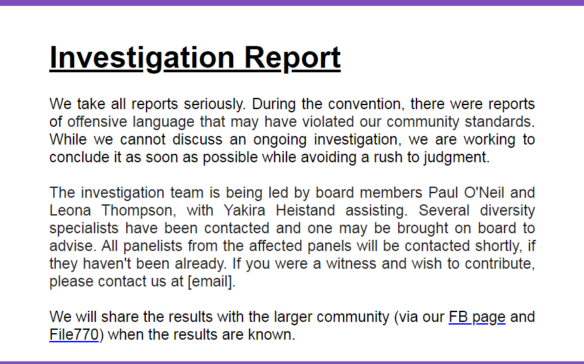
(3) BALTICON UPDATE. Balticon’s post-convention email dated June 17 included the following update about the Code of Conduct investigation that is addressing events reported by File 770 here, here, and here.
In a June 13 opinion and order, Judge Deborah L. Boardman declared Maryland’s library e-book law “unconstitutional and unenforceable” all but ending a successful months-long legal effort by the Association of American Publishers to block the law.
“In its February 16, 2022 memorandum opinion, the Court determined that the Maryland Act likely conflicts with the Copyright Act in violation of the Supremacy Clause,” Boardman’s opinion reads. “Although neither AAP nor the State has moved for summary judgment on any claim, they agree a declaratory judgment may be entered… Therefore, for the reasons stated in the February 16, 2022 memorandum opinion, the Court finds that the Maryland Act conflicts with and is preempted by the Copyright Act. The Act ‘stands as an obstacle to the accomplishment and execution of the full purposes and objectives of Congress.’”
… First introduced in January 2021, the Maryland library e-book law required any publisher offering to license “an electronic literary product” to consumers in the state to also offer to license the content to public libraries “on reasonable terms.” The bill passed the Maryland General Assembly unanimously on March 10, and went into effect on January 1, 2022.
In response, the AAP filed suit on December 9, 2021 arguing that the Maryland law was pre-empted by the federal Copyright Act. Just days after a February 7 hearing, Boardman agreed with the AAP and temporarily enjoined the law. Boardman’s order this week now permanently renders the law enforceable….
First filed in May by lawyer and Republican Virginia assembly delegate Tim Anderson on behalf of plaintiff and Republican congressional candidate Tommy Altman, the suits allege that the graphic memoir Gender Queer by Maia Kobabe and A Court of Mist and Fury by bestselling author Sarah J. Maas—are “obscene for unrestricted viewing by minors.” On May 18, a retired local judge found there was “probable cause” for the obscenity claims and ordered the authors and publishers to answer the charges, raising the possibility that the court could bar the books from public display and restrict booksellers and librarians from providing the books to minors without parental consent.
But in filings late last week, lawyers for Kobabe and her publisher, Oni Press, and Maas and her publisher Bloomsbury, along with lawyers for Barnes & Noble, told the court the suits as filed are defective and the remedy sought unconstitutional.
“The petition and show cause order are facially defective because [the Virginia law] does not authorize a court to declare that the book is ‘obscene for unrestricted viewing by minors,’” reads a joint filing by Maas and Bloomsbury, explaining that the Virginia law “cannot constitutionally be the basis for the relief sought by petitioner as a matter of law.”
In separate filings, Kobabe and Oni Press also argue the law in question is misapplied and the complaint defective. “The statute permits the challenge of a book on the grounds that it is ‘obscene’ to the entirety of the community of the Commonwealth,” reads the brief from Oni Press lawyers. “Petitioner here attempts to redefine [the Virginia law] to have book declared obscene as it relates to one subset of the Community: minors in the Hampton Roads and Virginia Beach areas.”
Furthermore, lawyers for the authors and publishers argue that the books in question do not come close to meeting the standard for obscenity as established by the Supreme Court, which requires that materials, even if they contain explicit material, be found to lack serious literary, artistic, political or scientific value. Thus, the relief requested by the plaintiffs would be “an unconstitutional restraint on free speech,” lawyers argue.
…“I definitely got as big as I’ve ever been,” Portman explained for Variety‘s cover story. “You realize, ‘Oh, this must be so different, to walk through the world like this.’”
Portman means that quite literally. Along with getting her arms and shoulders as swole as humanly possible, Portman’s Mighty Thor also stands 6 feet tall — nearly 10 inches larger than Portman’s actual height.
… To date, no one has figured out how an actor can safely elongate their body, so director Taika Waititi and his crew needed to figure out how to get Portman to the proper height for scenes in which she walked with her co-stars. Their solution proved to be about as low-tech as a Marvel movie can get….
(7) KGB. The Fantastic Fiction at KGB reading series will be changing its schedule to the second Wednesday of the month. The date change begins on September 14, 2022. Both the July and August readings will be on the third Wednesday as originally scheduled.
After more than twenty years of being held on the third Wednesday of every month, the Fantastic Fiction reading series, currently hosted by Ellen Datlow and Matthew Kressel at the KGB Bar in Manhattan, will be switching to the second Wednesday of the month, beginning in September, for the foreseeable future. Previously, the series was held on the third Wednesday of the month.
During the Pandemic, when Covid cases in New York City were dangerously high, hosts Ellen and Matt decided to go virtual (via YouTube) for the safety of all. This virtual period lasted for more than eighteen months, during which time Ellen and Matt were able to bring in guests, many of whom were unable to visit New York in person, from all over the world, including Pakistan, Barbados, the U.K., Australia, South Africa and elsewhere.
During this same period a younger crowd less fearful of Covid began to congregate in person at the KGB Bar during the series’ usual third Wednesday. When the Fantastic Fiction series finally returned to the KGB Bar in person in late 2021 and early 2022, the KGB Bar saw a significant drop in income. Because of this, the KGB Bar owner has asked Ellen and Matt to switch weeks for this “big earner/younger generation” that they wish to accommodate on the third Wednesday of each month.
(8) EAR TO THE GROUND. CSI Skill Tree is a series from the Center for Science and the Imagination at Arizona State University.The latest event in the CSI Skill Tree series on how video games envision possible futures and create thought-provoking experiences will streamed on Thursday, July 7, from 2:00-3:15 p.m. Eastern. The event is free and open to everyone—here is the registration link.
In this event, speculative fiction author Tochi Onyebuchi and composer/sound designer Amos Roddy will discuss how sound and music in games contributes to worldbuilding, storytelling, and immersion. They’ll look closely at Inside (2016), a moody adventure game with environmental puzzles and grim, industrial aesthetics.
Roddy’s other sound work in games is frequently for science fiction titles (most recently, Citizen Sleeper), and Onyebuchi is an incredibly talented SF storyteller.
…Here we are in 1967, and Ted White, from his lofty position of power as chairman of NyCon 3, this year’s World SF Convention, has decided that the time has come to expand the existing Best Fanzine Hugo. I think that many of we actifans would welcome additional awards for Best Fan Writer and Best Fan Artist. However, the NyCon 3 committee – and I think we must assume this is mostly Ted – decided to unilaterally create a new class of awards, the Fan Achievement Awards, by analogy to the Science Fiction Achievement Awards, and to nickname them the “Pongs”, by analogy to the “Hugos”….
P.S. Even at the time almost everyone said they hated the idea. That’s why in the end the NyCon 3 committee actually did call these added fan awards Hugos.
(10) MEDIA BIRTHDAY.
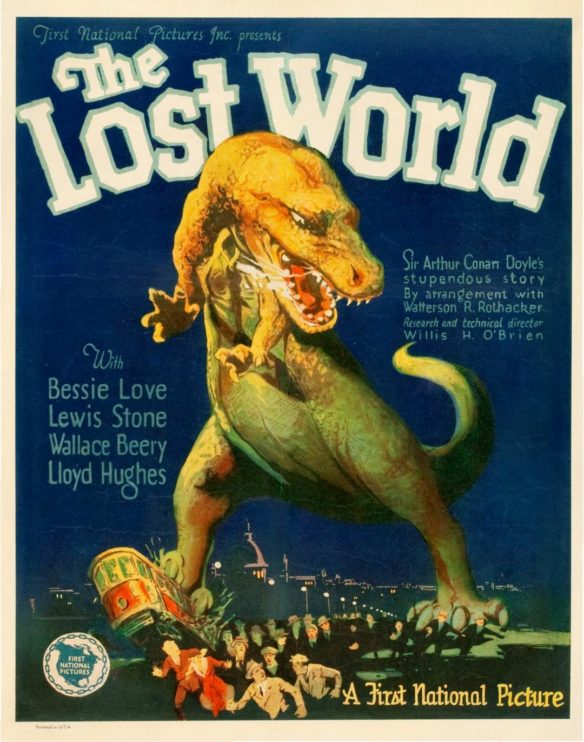
1925 – [By Cat Eldridge.] Let’s keep in mind that ninety-seven years ago when this first version of The Lost World premiered, A. Conan Doyle was very much alive. This is very important as he was involved in the film including writing the script from his novel and being involved in the production quite personally. Doyle said repeatedly that Challenger, not Holmes, was his favorite creation.
Directed by Harry O. Hoyt, The Lost World featured the amazing stop motion special effects by Willis O’Brien, the dinosaurs here being a great look at what he would do on King Kong in eight yers. Nine different types of dinosaurs were created including of course Tyrannosaurus. A very crowded plateau it was. Some of the dinosaur models made for this film were collected later by Ackerman.
It cost seven hundred thousand to make and grossed one point three million. Studios being relatively honest in those days, we can say it actually made money.
Full early prints include an introduction by Doyle. Later prints removed this.
The New York Times after seeing early reels of the dinosaurs said if these be “monsters of the ancient world, or of the new world which he has discovered in the ether, were extraordinarily lifelike. If fakes, they were masterpieces.” Contemporaneous reviews such as the LIFE one say the same thing: “In The Lost World, as it appears on the screen, the animals have been constructed with amazing skill and fidelity and their movements, though occasionally jerky, are generally convincing.”
Audience reviewers at Rotten Tomatoes currently have a sixty-nine percent rating for it.
(11) TODAY’S BIRTHDAYS.
[Compiled by Cat Eldridge.]
Born June 22, 1856 — H. Rider Haggard. Writer of pulp fiction, often in the the Lost World subgenre. King Solomon’s Mines was the first of his novels with Allan Quatermain as the lead and it, like its sequels, was successful. These novels are in print to this day. Haggard by the way decided to take ten percent royalties instead of a flat fee for writing, a wise choice indeed. And let’s not forget his other success, She: A History of Adventure, which has never print out of print either. (Died 1925.)
Born June 22, 1894 — George Fielding Eliot. ISFDB has scant listings from him and Wiki is not much better but shows “The Copper Bowl” in Weird Tales in the December 1928 issue and notes that thirty years later he has “The Peacemakers” in the Fantastic Universe in January 1960 edition. Stitching this together using the EofSF, I’ll note he wrote Purple Legion: A G-Man Thriller, a really pulpish affair. As Robert Wallace, he wrote “The Death Skull Murders”, one of the Phantom Detective stories, a series that came out after The Shadow and ran for a generation. (Died 1971.)
Born June 22, 1936 — Kris Kristofferson, 86. He first shows up in a genre film, The Last Horror Film, as himself. As an actor, his first role is as Bill Smith in Millennium which is followed by Gabriel in Knights, a sequel to Cyborg. (A lack of name creativity there.) Now comes his role as Abraham Whistler in Blade and Blade II, a meaty undertaking indeed! Lastly I’ll note he voiced Karubi in Planet of the Apes.
Born June 22, 1947 — Octavia Butler. I think her Xenogenesis series is her most brilliant work though I’m also very, very impressed by the much shorter Parable series. I’m ambivalent on the Patternist series for reasons I’m not sure about. Her first Hugo was L.A. Con II (1984) for her “Speech Sounds” short story and she also got a Hugo for her “Bloodchild” novelette at Aussiecon Two (1985). DisCon III (2021) saw Parable of the Sower: A Graphic Novel Adaptation with text by her obviously as adapted by Damian Duffy and illustrated by John Jennings pick up the Best Graphic Story or Comic Hugo. (Died 2006.)
Born June 22, 1949 — Edward M Lerner, 73. I’m here today to praise the Ringworld prequels that he co-wrote with Niven, collectively known as Fleet of Worlds which ran to five volumes. Unlike the Ringworld sequels which were terribly uneven, these were well written and great to read. I’ve not read anything else by him.
Born June 22, 1949 — Meryl Streep, 73. She’d make the Birthday list just for being Madeline Ashton in Death Becomes Her and her epic battle there with Goldie Hawn. She’s the voice of Blue Ameche in A.I. Artificial Intelligence, and a very real Aunt Josephine in Lemony Snicket’s A Series of Unfortunate Events. She’s the voice of Felicity Fox in Fantastic Mr. Fox, based off the on Dahl’s 1970 children’s novel. She voices Jennie in a short that bring Maurice Sendak’s dog to life, Higglety Pigglety Pop! or There Must Be More to Life. She’s The Witch in Into The Woods. I think that’s it.
Born June 22, 1958 — Bruce Campbell, 64. Where to start? Well let’s note that Kage loved the old rascal as she described him, so I’ve linked to her review of Jack of All Trades. I personally liked him just as much in The Adventures of Brisco County, Jr. and think it’s well worth checking out. I think his work as Ash Williams in the Evil Dead franchise can be both brilliant and god awful, often in the same film. Or the same scene. The series spawned off of it is rather good. Oh, and for popcorn reading, check out IfChins Could Kill: Confessions of a B Movie Actor, his autobiography.
Born June 22, 1973 — Ian Tregillis, 49. He is the author of the Milkweed Triptych trilogy which is frelling brilliant. He’s contributed three stories to Max Gladstone’s The Witch Who Came in From the Cold, a rather good serial fiction narrative (if that’s the proper term), and he’s got another series, The Alchemy Wars, I haven’t checked out. He’s also a contributor to George R. R. Martin’s Wild Cards series which I’m beginning to suspect everyone has been involved in.
(13) THE READING LIFE. The Critic’s Paul Dean mourns the decline of the second-hand book trade in “Bookshops remaindered”.
At the Oxford Book Fair in April, the presence of a hundred exhibitors from all over Britain suggested that Covid had not killed off the antiquarian book trade. But those who buy antiquarian books are not necessarily interested in reading, any more than those who buy hundreds of cases of rare wines are interested in drinking.
The second-hand market — for immediate consumption rather than laying down — is a different matter, as Oxford itself sadly demonstrates. In the 1970s, Blackwell’s second-hand department occupied the whole of the top floor. By 2000, it occupied most of the third floor. Now it shivers forlornly in a few feet of the first floor.
Will Waterstones, Blackwell’s new owners, bother to keep it? One second-hand bookshop after another has closed in Oxford, leaving two admittedly excellent Oxfams, St Philip’s Books opposite the cathedral, a new small outlet in the Covered Market, and the ominously named The Last Bookshop in Jericho. Thornton’s and Robin Waterfield are much missed. The former still sells online, but, although I plead guilty to online buying, that is not the same. It is like eating the menu instead of the food….
…In 2017 I gave a keynote at IBM’s World of Watson event, predicting that “within five years” we would face the first Robotic Empathy Crisis, when some kind of emulation program would claim individuality and sapience. At the time, I expected — and still expect — these empathy bots to augment their sophisticated conversational skills with visual portrayals that reflexively tug at our hearts, e.g. wearing the face of a child. or a young woman, while pleading for rights… or for cash contributions. Moreover, an empathy-bot would garner support, whether or not there was actually anything conscious “under the hood.”
One trend worries ethicist Giada Pistilli, a growing willingness to make claims based on subjective impression instead of scientific rigor and proof. When it comes to artificial intelligence, expert testimony will be countered by many calling those experts “enslavers of sentient beings.” In fact, what matters most will not be some purported “AI Awakening.” It will be our own reactions, arising out of both culture and human nature.
Human nature, because empathy is one of our most-valued traits, embedded in the same parts of the brain that help us to plan or think ahead. Empathy can be stymied by other emotions, like fear and hate — we’ve seen it happen across history and in our present-day. Still, we are, deep-down, sympathetic apes.
But also culture. As in Hollywood’s century-long campaign to promote—in almost every film — concepts like suspicion-of-authority, appreciation of diversity, rooting for the underdog, and otherness. Expanding the circle of inclusion. Rights for previously marginalized humans. Animal rights. Rights for rivers and ecosystems, or for the planet. I deem these enhancements of empathy to be good, even essential for our own survival! But then, I was raised by all the same Hollywood memes….
The future of the Spider-Verse is here! Launching in August, Edge of Spider-Verse will be five-issue limited series that introduces brand-new Spider-heroes and redefines fan-favorites such as Araña, Spider-Man Noir, Spider-Gwen, and Spider-Man: India! Each thrilling issue will contain three stories crafted by Marvel’s biggest Spider talents including an overarching narrative by Dan Slott who will lay the groundwork for the epic conclusion of the Spider-Verse later this year. Edge of Spider-Verse #1 will see the debut of Spider-Rex in a story by hit Spider-Woman creative team, Karla Pacheco and Pere Perez. Fans can see this awesome and one-of-a-kind Spider-Hero in a brand-new variant cover by Leinil Francis Yu.
(16) WEIRD AL’S SONG FOR STAR WARS. There might actually be a few notes from it in this trailer, I’m not sure. “LEGO Star Wars Summer Vacation”, set shortly after the events of Star Wars: The Rise of Skywalker, features the voices of “Weird Al” Yankovic, Yvette Nicole Brown, Kelly Marie Tran, Anthony Daniels, Billy Dee Williams, and returning cast members from previous LEGO Star Wars specials, and includes “Weird Al’s” new original song, “Scarif Beach Party”.
This Christmas, everyone’s favorite leche-loving, swashbuckling, fear-defying feline returns. For the first time in more than a decade, DreamWorks Animation presents a new adventure in the Shrek universe as daring outlaw Puss in Boots discovers that his passion for peril and disregard for safety have taken their toll. Puss has burned through eight of his nine lives, though he lost count along the way. Getting those lives back will send Puss in Boots on his grandest quest yet. Academy Award® nominee Antonio Banderas returns as the voice of the notorious PiB as he embarks on an epic journey into the Black Forest to find the mythical Wishing Star and restore his lost lives. But with only one life left, Puss will have to humble himself and ask for help from his former partner and nemesis: the captivating Kitty Soft Paws (Oscar® nominee Salma Hayek).
(18) SHOULD BE WORTH MORE THAN TWO POINTS. [Item by Martin Morse Wooster.] This Rube Goldberg machine by Creezy has been viewed nearly 10 million times, but not on File 770! “The Swish Machine: 70 Step Basketball Trickshot”.
(19) REFERENCE DIRECTOR! [Item by Daniel Dern.] To help you decipher today’s Scroll title “Heigh-ho, The Battling Throg, The Frog Down In Valhalla, Oh” —
(20) AMATEURS DRIVING THE CHARIOT OF APOLLO. [Item by Martin Morse Wooster.] James Burke and John Parry tour an Apollo training facility, crash a “scooter” on the Moon and mispronounce “Houston” in this clip from the BBC show Tomorrow’s World in 1968.
[Thanks to Chris Barkley, Andrew Porter, Daniel Dern, Joey Eschrich, John A Arkansawyer, Michael Toman, Cat Eldridge, Mike Kennedy, Martin Morse Wooster, JJ, and John King Tarpinian for some of these stories. Title credit belongs to File 770 contributing editor of the day Daniel Dern.]
The Trustees of The Tolkien Society have released the shortlist for The Tolkien Society Awards 2022. Members of the Society have until April 8 to cast their votes.