By Allen Steele: I was notified about Greg Benford’s stroke on Dec. 28, a few days after it happened, by Naomi Fisher, his close friend and now caregiver, who was with Greg when the stroke happened. Although most of the SF community has been kept in the dark about this, mainly to give Greg the distance he and Naomi both need during this time, I’ve been in constant touch with Naomi since the last days of December, and just last night I talked with Greg himself for an hour or so, the first time we’ve had a conversation since the stroke. So I’m in a position to clarify things a bit.
First: Greg is not dying. He’s actually doing much better than he was only last week, when he was still in the hospital. He has been transferred to a rehabilitation center — “hey, they finally sent me to rehab” was one of the first things he said to me; when I heard that, I knew he was getting better — and although it’s likely that he’ll be there for awhile, he’s a long, long way from where he was seven weeks ago when things really were dicey. Alcor isn’t getting his noggin yet.
Second: Greg is not incoherent, nor is he in any sort of daze or unable to understand what’s spoken to him. As I said, we spent an hour on the phone (thus saving me from America’s annual exercise in boredom that we call the Super Bowl) and although he’s still a bit hoarse from being intubated for a long time, I understood everything he said to me and he understood everything I said to him. He even got it when I commented that where he is now is at least better than being in Cleveland.
And third, Greg is in good hands. Naomi Fisher, whom I’ve also known for years and years, has been with Greg constantly. As I mentioned earlier, she is responsible for his survival; if Naomi hadn’t been downstairs when she heard him fall in the shower, Greg would have died then and there. The lady is a brick; she deserves no end of gratitude for him surviving what would have doubtless been a fatal medical emergency
While they’re grateful for the public concern and support, what Greg really wants and needs just now is breathing room, a chance to step away for a while and quietly heal. He’ll be back, folks; my friend is tough, and he’s not leaving us yet.
[Steele’s update, initially left as a comment on File 770’s report about the December 22 stroke, has been published as a post with his permission.]
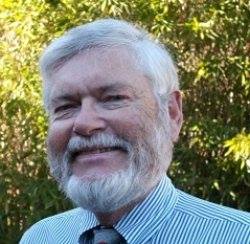
Gregory Benford, who turned 82 last month, suffered a major stroke on December 22.
His twin brother, Jim Benford, told the sff community today:
I flew down south immediately and the Doctors told me they didn’t expect him to live. However, he did survive and since has been very slowly recovering. He is paralyzed on his left side, can’t see the left side of his visual field. A psychiatrist has determined that he is not competent to make any decisions.
I’ve spoken with him, but mostly at him, via FaceTime and, although everyone thinks he’s improving, it seems to me that there’s something missing. My intuition is that he’s not entirely there, as of now. Deep down, he’s confused.
Gregory Benford is the author of Timescape, winner of the 1981 Nebula, British Science Fiction Association, Ditmar, and John W. Campbell Memorial Awards. His work has been nominated for a total of 13 Nebulas (winning twice), and four Hugos.
(1) PRESIDENT’S DAY WEEKEND. Get ready for Boskone 60, coming February 17-19, 2023 in Boston – and via the internet. The convention’s guests are Nalo Hopkinson – Guest of Honor; Victo Ngai – Official Artist; Tui T. Sutherland – Special Guest; and Dave Clement – Musical Guest. Full information at the link.
Boskone 60 will be held in person at The Westin Boston Seaport District hotel, 425 Summer Street, Boston, MA. You can also attend in person at our incredible 3-day convention, starting in the afternoon on Friday, February 17, 2023, at 2:00 pm (U.S. Eastern Standard Time) and running through Sunday, February 19. We are also planning to make a portion of our programming available for virtual members and virtual program participants.
You can experience Boskone virtually for only $24.60!
(2) MEDICAL STRUGGLE. [Item by Danny Sichel.] Kelly Barnhill, winner of the 2016 World Fantasy Award for Best Novella, is marking one year since she missed a step, hit her head, fell down a flight of stairs, and was unconscious for 15 minutes.Recovery from concussion is slow; as a result, she says, writing fiction is not currently possible. Thread starts here. Some excerpts:
…The comments accusing Tor of using AI art in Christopher Paolini‘s follow-up to To Sleep in a Sea of Stars, Fractal Noise, came as early as November (when the cover was revealed), but it wasn’t until December when more people realized what happened. Around December 9, pressure had built up, and those concerned demanded an answer from Tor and Paolini. On December 15, Tor released this statement on their social media:
“Tor Books designed the cover for Fractal Noise by Christopher Paolini. During the process of creating this cover, we licensed an image from a reputable stock house. We were not aware that the image may have been created by AI. Our in-house designer used the licensed image to create the cover, which was presented to Christopher for approval. Due to production constraints, we have decided to move ahead with our current cover. Tor Publishing Group has championed creators in the SFF community since our founding and will continue to do so.”
At first glance, it’s easy to take at least the first part of this as truth. As far back as September, stock websites and individuals began to host AI art for licensing purposes. Since then, it’s only grown, with Adobe Stock and the portfolio site Artstation catering to AI art. Shutterstock even inked a deal with AI generators in October. Between the sites hosting the images and the companies (like Tor) using them, there are no guidelines for even labeling AI art. It’s being mixed in with human-made art. The AI image created (from stolen images) for the base of Fractal Noise is not even labeled as AI created on Shutterstock.
… Tor knew they would continue to get backlash because, in that tweet, they turned off replies. Most of the people talking about it are retweets, and the conversation continues in those replies….
… Paolini has given mixed responses to the whole situation and has been tweeting (and replying) a lot. He spoke about the value of an artist in the book illustration process and how he’s always shared fan art of his works. Paolini commissioned work from artists and illustrated many elements of his Inheritance Saga (Eragon, etc.), including the map of Alagaësia. He also stated that this AI art situation is not ideal. Most other comments from the author remain neutral.
This is disappointing, as a reader of his books and as an artist, not to see him take a stronger stance on this, at least in a professional setting….
(4) CRICHTON, POURNELLE, AND BENFORD IN 2005. Camestros Felapton resumes following strands of right-wing and reactionary thought within science fiction in a new series “Contrarian Cli-Fi” about sff writers who took a contrarian view of climate change. The latest chapter, “Contrarian Cli-Fi 0.07: Aftermath 2005”, makes a real effort at fairness, it seemed to me, at a time when the internet gives no cookies for such efforts.
…A great deal about science communication had changed over the intervening time between Fallen Angels and State of Fear. Whereas in past decades science magazines and hybrid sci-fi/science magazines like Analog or OMNI were a key part of science communication to a broader audience of people interested but not experts in science, in the 2000s science blogging was a growing channel between actual scientists and the public.
Michael Crichton’s novel State of Fear also helped spur actual climate scientists to counter Crichton’s views (and doubts about global warming more generally) directly on the web. One of the most interesting exchanges in the wake of State of Fear was, unsurprisingly, on Pournelle’s own blog in 2005.
I’ve cast Pournelle as a right-wing ideologue pushing the contrarian view on climate change but he also manifestly had a genuine interest in climate science. He absolutely wanted to understand the scientific debate if only to refute it on its own terms. In the wake of the State of Fear discussion about global warming and global cooling would be a major topic on his blog. In part that debate was fuelled by reactions to Crichton’s novel in science and science fiction communities.
One obvious overlap between State of Fear, scientists and science fiction writers was author and physicist Gregory Benford. In a 2003 speech by Crichton that presaged the sceptical position of his novel, Crichton had quoted a paper by a panel that included Benford published in Science[1]: …
…Benford responded in a column in the San Diego Tribune published in 2005 taking apart many of Crichton’s claims and misleading statements. Benford unequivocally stated that Crichton was getting his science wrong, relying on secondary sources and misunderstanding those sources….
Earlier this month, Washington Post publisher Fred Ryan and a handful of executives traveled to Seattle for a budget meeting with owner Jeff Bezos. The paper’s executive editor Sally Buzbee was not in attendance, according to two people with knowledge of the meeting.
Turmoil back in Washington, DC has followed. Ryan abruptly announced a round of layoffs. Buzbee appeared to distance herself from her publisher. The Post and Buzbee did not respond to requests for comment.
And employees and observers of the Post alike were left wondering what Bezos is doing with the publication….
…To address the Commission’s competition concerns in relation to both investigations, Amazon initially offered the following commitments:
– To address the data use concern, Amazon proposed to commit:
not to use non-public data relating to, or derived from, the independent sellers’ activities on its marketplace, for its retail business. This applies to both Amazon’s automated tools and employees that could cross-use the data from Amazon Marketplace, for retail decisions;
not to use such data for the purposes of selling branded goods as well as its private label products.
– To address the Buy Box concern, Amazon proposed to commit to:
treat all sellers equally when ranking the offers for the purposes of the selection of the Buy Box winner;
display a second competing offer to the Buy Box winner if there is a second offer from a different seller that is sufficiently differentiated from the first one on price and/or delivery. Both offers will display the same descriptive information and provide the same purchasing experience.
– To address the Prime concerns Amazon proposed to commit to:
set non-discriminatory conditions and criteria for the qualification of marketplace sellers and offers to Prime;
allow Prime sellers to freely choose any carrier for their logistics and delivery services and negotiate terms directly with the carrier of their choice;
not use any information obtained through Prime about the terms and performance of third-party carriers, for its own logistics services.
Between 14 July 2022 and 9 September 2022, the Commission market tested Amazon’s commitments and consulted all interested third parties to verify whether they would remove its competition concerns. In light of the outcome of this market test, Amazon amended the initial proposal and committed to:
Improve the presentation of the second competing Buy Box offer by making it more prominent and to include a review mechanism in case the presentation is not attracting adequate consumer attention;
Increase the transparency and early information flows to sellers and carriers about the commitments and their newly acquired rights, enabling, amongst others, early switching of sellers to independent carriers;
Lay out the means for independent carriers to directly contact their Amazon customers, in line with data-protection rules, enabling them to provide equivalent delivery services to those offered by Amazon;
Improve carrier dataprotection from use by Amazon’s competing logistics services, in particular concerning cargo profile information;
Increase the powers of the monitoring trustee by introducing further notification obligations;
Introduce a centralised complaint mechanism, open to all sellers and carriers in case of suspected non-compliance with the commitments.
Increase to seven years, instead of the initially proposed five years, the duration of the commitments relating to Prime and the second competing Buy Box offer.
The Commission found that Amazon’s final commitments will ensure that Amazon does not use marketplace seller data for its own retail operations and that it grants non-discriminatory access to Buy Box and Prime.
(7) HENRY MORRISON OBIT. Literary agent Henry Morrison died November 2 at the age of 86. The Publishers Weekly noted his sff connections.
…Morrison struck out on his own before he turned 30.
For the next 55 years, characters and storylines in the books and films whose rights Morrison sold became household American names, Robert Ludlum’s Jason Bourne and David Morrell’s Rambo among them. A particularly prolific agent in the crime and thriller genres, other authors in the space Morrison represented included Brian Garfield, Dean Koontz, Eric van Lustbader, Matt Scudder, and Donald E. Westlake. He also represented the science fiction writers Samuel R. Delany (one of his earliest clients) and Roger Zelazny. His well-rewarded midlist writers won multiple Edgars and served as Mystery Writers of America presidents, Grandmasters, and International ThrillerMasters….
(8) MEMORY LANE.
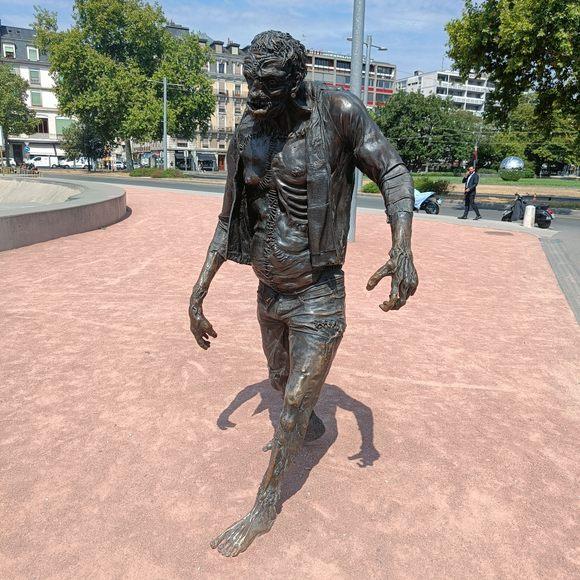
2014 — [By Cat Eldridge.] Frankenstein in Geneva
Tonight’s creature is one that y’all will now very well, that of Frankenstein’s monster, though almost everyone now calls it Frankenstein. Philistines.
While the writer was English, the story was written and takes place in Geneva, Switzerland where this statue is placed in the spot where it goes on a rampage and kills his creator’s brother.
KLAT, a Geneva artist collective, so there was no individual sculptor listed for this work, created this nearly eight-foot-tall cast bronze sculpture. “Franc” as they call him, is dressed in ragged clothes, which represents not the character from the novel, but “the figure of the vagrant or the marginal”. With his hunchback, his scars including those of face and hooded sweatshirt and old jeans cut at the knees, it is not at all in keeping with Shelley’s original description of the monster in her novel, but more in line with the modern interpretation of a zombie-like creature.
The statue was unveiled in May 2014, and is part of the collection of the Contemporary Art Fund of the City of Geneva. That unveiling was — shall we say? — quite electrifying?
(9) TODAY’S BIRTHDAYS.
[Compiled by Cat Eldridge.]
Born December 20, 1838 – Edwin Abbott Abbott. Author of the Flatland: A Romance of Many Dimensions, an 1884 novella that has come to be adopted as SF even though it’s really mathematical fiction. Go ahead, argue with me. (Died 1926.)
Born December 20, 1925 — Nicole Maurey. She appeared in The Day of the Triffids as Christine Durrant, and was Elena Antonescu in Secret of the Incas, a film its Wiki page claims was the inspiration for Raiders of the Lost Ark. I can’t find proof anywhere else that it is… (Died 2016.)
Born December 20, 1943 — Jacqueline Pearce. She’s best known as the villain Servalan on Blake’s 7. She appeared in “The Two Doctors”, a Second and Sixth Doctor story as Chessene, and she’d voice Admiral Mettna in “Death Comes to Time”, a Seventh Doctor story. I’d be remiss not to note her one-offs in Danger Man, The Avengers, The Chronicles of Young Indiana Jones and The Rivals of Sherlock Holmes. (Died 2018.)
Born December 20, 1951 — Kate Atkinson, 71. A strong case can be made that her Jackson Brodie detective novels are at least genre adjacent with their level of Universe assisting metanarrative. The Life After Life duology is definitely SF and pretty good reading. She’s well stocked on usual suspects.
Born December 20, 1952 — Jenny Agutter, 70. Her first SF role was Jessica 6, the female lead in Logan’s Run. Later genre roles include Nurse Alex Price In An American Werewolf in London (fantastic film), Carolyn Page in Dark Tower which is not a Stephen King based film, an uncredited cameo as a burn doctor in one of my all time fave films which is Darkman and finally she was Councilwoman Hawley in The Avengers and The Winter Soldier.
Born December 20, 1960 — Nalo Hopkinson, 62. First novel I ever read by her was Brown Girl in The Ring, a truly amazing novel. Like most of her work, it draws on Afro-Caribbean history and language, and its intertwined traditions of oral and written storytelling. I’d also single out the Mojo: Conjure Stories and Falling in Love With Hominids collections as they are both wonderful and challenging reading. Worth seeking out is her edited Whispers from theCotton Tree Root: Caribbean Fabulist Fiction.
Born December 20, 1970 — Nicole de Boer, 52. Best remembered for playing the trill Ezri Dax on the final season of Deep Space Nine, and as Sarah Bannerman on The Dead Zone. Well maybe not the latter I’ll admit. She’s done a number of genre films including Deepwater Black, Cube, Iron Invader, and Metal Tornado, and has one-offs in Beyond Reality, Forever Knight, TekWar, Outer Limits, Poltergeist: The Legacy, Psi Factor and Stargate Atlantis. Did I mention she’s Canadian?
Born December 20, 1984 — Ilean Almaguer, 38. Here for her role as Illa on the most excellent Counterpart series. If you’ve not seen it, I highly recommend it. To my knowledge, none of many the Spanish-language Mexican telenovelas she appeared in had the slightest genre element.
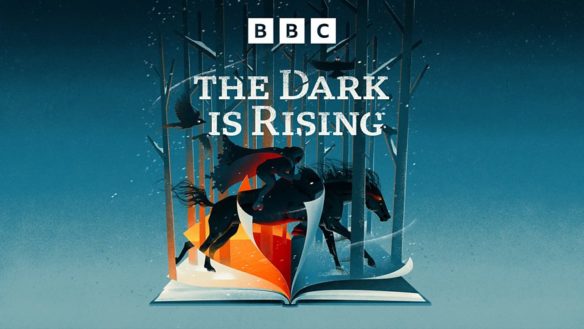
(11) TUNE IN. The BBC World Service is airing a production of Susan Cooper’s “The Dark Is Rising”.
A young boy’s time-travelling fight against ancient evil. When the Dark comes rising, who will hold it back? This dramatisation of Susan Cooper’s cult novel is a magical journey into the supernatural.
(12) IRON MAN BACK TO THE PRESS. Gene Wolfe said in his 1985 Worldcon guest of honor speech that the difference between a professional publisher and a fanzine publisher is that if a fanzine sells out, the editor will print more. So what are we to make of Marvel’s enthusiastic announcement that Iron Man #1 is getting a second printing?
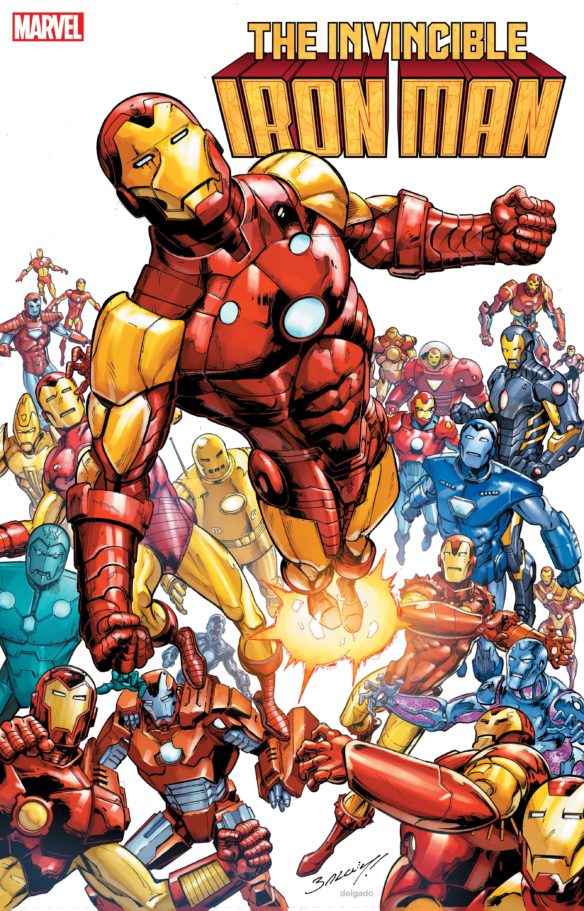
This past Wednesday, fans witnessed the beginning of an all-new era for Tony Stark in Invincible Iron Man #1! Writer Gerry Duggan and artist Juan Frigeri have taken over the armored Avenger’s adventures and didn’t pull any punches in their explosive first issue, which sold out and will return in February with a second printing!
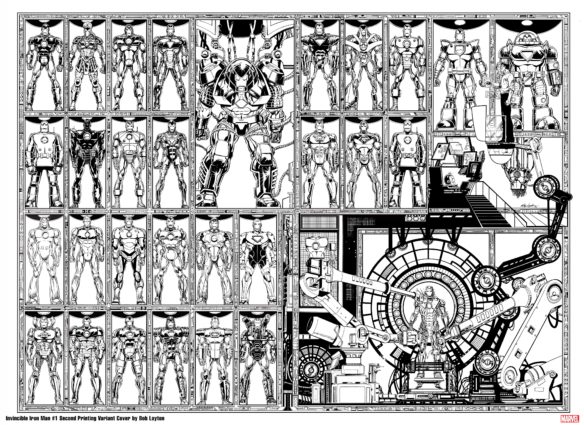
Invincible Iron #1 will receive two new second printing covers, both of which celebrate the character’s iconic legacy by showcasing the many armors Tony has suited up in over the years: A brand-new piece by superstar artist Mark Bagley and definitive Iron Man artist Bob Layton’s showstopping connecting piece in all its glory.
Invincible Iron Man #1 ended with Tony Stark hitting rock bottom, having lost it all: his wealth…his fame…his friends. But don’t count Stark out just yet. In upcoming issues, Stark will navigate his new status in the Marvel Universe in surprising ways. Readers will see Iron Man court new allies, embrace bold solutions, and make startling moves that will affect his relationships with the Avengers and mutantkind. Is he building towards a brighter future or will he be the architect of further destruction?
(13) OH SNAP! SNAP![Item by Daniel Dern.] If (movie version) Thanos sang or hummed along to the Addams Family theme song, would that quantumize 2x 50% or 50% of 50%?
…Most of these are longform essays on music, arts, and culture—because those are matters I think about (and worry about) every day. But I don’t impose any arbitrary limits here. If the article is good enough, I include it, no matter what the subject….
Welcome to my Porsche 914. I imagine that at this point (having found the door unlocked) your intention is to steal my car. Don’t be encouraged by this; the tumblers sheared off in 1978. I would have locked it up if I could, so don’t think you’re too clever or that I’m too lazy. However, now that you’re in the car, there are a few things you’re going to need to know. First, the battery is disconnected, so slide-hammering my ignition switch is not your first step. I leave the battery disconnected, not to foil hoodlums such as yourself, but because there is a mysterious current drain from the 40-year-old German wiring harness that I can’t locate and/or fix….
(15) VIDEO OF THE DAY. “Honest Game Trailers: The Game Awards” sends up an awards show which finds it impossible to live up to its pretentions, saying it’s “an award show that wants to be taken as seriously as the Oscars except that every single year something absolutely ridiculous happens.” Mistakes were made, birds were flipped.
[Thanks to Andrew Porter, Michael Toman, Cat Eldridge, Danny Sichel, Todd Mason, Daniel Dern, Mike Kennedy, John King Tarpinian, and Chris Barkley for some of these stories. Title credit belongs to File 770 contributing editor of the day Joe H.]
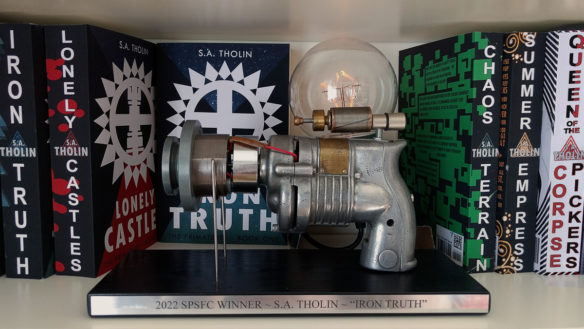
(1) EYE ON THE PRIZE. Iron Truth author Sofie Tholin, winner of the first Self-Published Science Fiction Competition, has received her trophy from Hugh Howey.
(3) PAWS FOR GENRE. [Item by Daniel Dern.] Over on a mailing list, a (so far) brief discussion of “grinning like a Cheshire cat” came up.
In the 150th anniversary version of The Annotated Alice, a page-and-a-half comment discussion on this starts on page 73. (Other CC-related annotations show up a few pages later.) (If you’ve got the original hardcover Annotated Alice, from 1960, like the one I won at summer camp either in 1962 or 1963, there’s a much shorter annotation comment on page 83.)
“The term grin like a Cheshire cat predates the publication of Alice’s Adventures in Wonderland by at least seventy-five years, if not longer”
along with this suggestion/explanation for the idiom:
“Cheshire is a county in England that is known for its milk and cheese products, surely a reason for Cheshire cats to smile….The most intriguing story may be that at one time a cheese was manufactured in Cheshire county that was shaped like a cat. The cheese was eaten from tail to head, leaving the cat’s smile as the last part of the cheese to be consumed”
“the phrase crops up in English literature as early as 1788, where it appears an entry in a sort of slang dictionary of the time, Francis Grose’s A Classical Dictionary of the Vulgar Tongue.”
Playlist/Lagniappe: And here’s Sammy Davis Jr, who voiced The Cheshire Cat in the 1966 Hanna Barbara ABC-TV animated movie, singing “What’s A Nice Kid Like You Doing In A Place Like This?”
(4) PUBLISHER REBRANDS. Tom Doherty Associates has rebranded itself Tor Publishing Group, effective immediately. Tor president and publisher Devi Pillai said in the announcement, “Although the Tor name has always been associated with science fiction and fantasy, our list has included titles beyond that genre since our inception. With this name change and continued growth, the Tor name will now stand for quality in various types of genre publishing, with each imprint representing a distinct voice.” “Tom Doherty Associates Is Now Tor Publishing Group” at Tor.com.
(5) ALAMAT. [Item by Chris Garcia.] We here at Journey Planet have been working hard as we barrel towards Worldcon where many of us will be seeing one another for the first time since 2019-ish. Chris and James are joined by 2022 Hugo nominees Jean Martin and Chuck Serface for an issue looking at Filipino myth, legend, and folklore, alamat in Tagalog.
Jean provides an excellent introduction to the zine and her journey into myth and legend, and writers Pat M. Yulo, Karl Gaverza, Claire Mercado-Obias, Gerard Galo, Jimuel Villarosa Miraber, and James Bacon provide fine words on the subject.
Art from Franz Lim, Diana Padullo, Leandro Geniston, Clair Mercado-Obias, Alfred Ismael Galaroza, and Jimuel Villarosa Mirabar is also joined by a couple of pieces from the AI art-generator DALL*E 2, and graphic design elements from Chris’ 1960s airline menu collection!
(6) ATOMIC PILES. First Fandom Experience’s latest post in support of the “1946 Project” at Chicon 8 is “The Fan Cave, c1940s”. They’ve reproduced “narrative tours” of the dedicated fan spaces created by Bob Tucker, Harry Warner Jr., and Ron Holmes.
The “experience” component of “First Fandom Experience” conveys our desire to capture what it was like to be an early fan. To date we’ve dedicated the most space to fannish interactions — clubs, correspondence, conventions, conflicts. But fans spent most of their time at home. Those fortunate enough to have even a semi-permanent residence literally papered their walls with the accumulated evidence of their devotion to science fiction….
(7) FREE READ. The Sunday Morning Transport offers Michael Swanwick’s “The Warm Equations”.
Welcome to the first, free-to-read Sunday Morning Transport story for August: science fiction from Michael Swanwick. Concise and epic, “The Warm Equations,” explores a different side of the choices we may make in space. ~ Fran Wilde, August 7, 2022.
(8) PRINCE AND REPRINTS. Jason Sanford has written a follow-up Twitter thread about the SF Insiders post commenting on Best Editor Short Form finalist Oghenechovwe Donald Ekpeki (who they ranked last) and the merits of reprint anthology work. The thread starts here.
These types of Year's Best anthologies are very important guideposts for the SF/F genre, and can also help authors attain attention and respect for their work. The importance of these types of anthologies to the genre should not be dismissed or underplayed. 4/
Jeff VanderMeer also drew on his experience in a comment to Sanford:
Yes, from my perspective editing both original and reprint anthos, objectively more important than most original anthos–incl for, ex, the original pirate stories antho we edited back in the day. ???? Also, tho varies, I'd say our reprint anthos took more work than our originals
“The Orville” honored Norm Macdonald in a tribute video posted Friday showcasing the late comedian and actor’s moments on the show as lovable Gelatin Lieutenant Yaphit….
In loving memory of Norm Macdonald. Thanks for your continuous laughs and allowing us to be part of your fleet. – The Orville Crew pic.twitter.com/tz4GODfaUk
(10) OLIVIA NEWTON-JOHN (1948-2022). Actress and singer Olivia Newton-John died August 8 at the age of 73. Her husband made the announcement on Facebook. Her genre credits include the movies Xanadu and Sharknado 5: Global Swarming.
(11) MEMORY LANE.
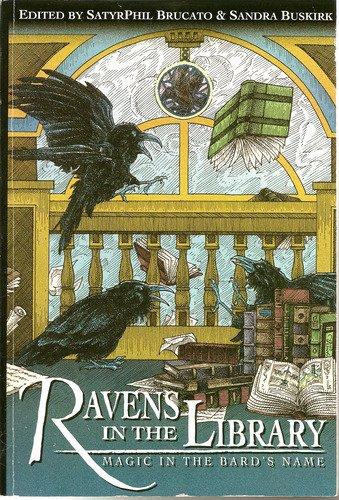
2009 – [By Cat Eldridge.]Ravens in the Library: Magic in the Bard’s Name (2009)
I get a lot of personally signed books and Ravens in The Library showed up in the post some thirteen years ago with a note asking if Green Man would review it. I already knew of SJ Tucker, a singer-songwriter who does a lot of filk, sort of filk and of course straight singer-songwriter material. You can hear her doing Catherynne Valente’s “A Girl in The Garden” here, riffing The Orphan’s Garden as she gave it to Green Man.
She also writes children’s books and we reviewed one here, Rabbit’s Song, she wrote with Trudy Herring.
Sadly she got a severe illness starting in 2008 caused her to have a very long hospital stay and related surgery, and left her to recover under the weight of massive medical bills. As you well know, independent musicians don’t have deep pockets, so her friends launched a number of projects to generate the needed monies.
So what did they do? Well the most successful project is sitting on my desk, The Ravens in the Library anthology. Three hundred and seventy pages of ballads, poems, songs and stories amply illustrated by far too many stellar artists too note here. The great cover which you can see below is James A. Owen
The writers here are, well, let’s just say I was gobsmacked. Charles de Lint, and Terri Winding, and Neil Gaiman. Ari Berk usually known for his illustrations does a story too, as does Catherynne Valente, Holly Black, and, of course, S.J. Tucker contribute excellent work too. It would be wrong to overlook the work by writers that I’ve never heard of, most likely from the fan community, who are just as great.
So how successful was it? This anthology in less than a week paid off all of her considerable medical bills. Very impressive!
I’d be remiss not to mention the excellent editing work of Phil Brucato and Sandra Buskirk.
(12) TODAY’S BIRTHDAYS.
[Compiled by Cat Eldridge.]
Born August 8, 1905 — Reginald Lal Singh. Indian-born actor. He portrayed Captain Chandra in Star Trek’s “Court Martial”. He can also be seen by use of archival footage from The Day the Earth Stood Still in the Star Trek: Strange New Worlds’ “Strange New Worlds” episode. He was a military officer in the fifties War of the Worlds. (Died 1970.)
Born August 8, 1919 — Dino De Laurentiis. Responsible for the first Dune obviously (it’s odd to have to state that it’s the first Dune, for decades there was only one) but less obviously also a lot of other genre including two Conan films, Flash Gordon, King Kong, Halloween II and Halloween III, Dead Zone and The Last Legion. His company even made Army of Darkness! (Died 2010.)
Born August 8, 1920 — Jack Speer. He is without doubt one of the founders of fandom and perhaps the first true fan historian having written Up to Now: A History of Science Fiction Fandom covering up to 1939 as well as the first Fancyclopedia in 1944. Filking and costume parties are also widely credited to him as well. Mike has a proper remembrance here. (Died 2008.)
Born August 8, 1930 — Terry Nation. Best known as scriptwriter for Doctor Who and creator of the Daleks. He later created Blake’s 7. He would also write scripts for Department S, The Avengers,The Champions and MacGyver. He both Davros and the Daleks on Who. He died from emphysema in Los Angeles aged 66, as he working with actor Paul Darrow who played Kerr Avon on Blake’s 7 in an attempt to revive that series. (Died 1997.)
Born August 8, 1935 — Donald P. Bellisario, 87. His genre shows include Tales of the Gold Monkey, Airwolf, Magnum P.I. (according to some of you) and of course that truly amazing show Quantum Leap. He was a writer and producer on the original Battlestar Galactica.
Born August 8, 1937 — Dustin Hoffman, 85. Ahhh Captian Hook, the man who got figuratively swallowed by the vast crocodile in Hook. Yeah I like that film a lot. But then I like the novel very much, too. By no means his only genre appearance as he was Mumbles, Caprice’s fast-talking henchman in Dick Tracy (a film I actually find rather odd), Mr. Edward Magorium in Mr. Magorium’s Wonder Emporium and the voice of Master Shifu in Kung Fu Panda.
Born August 8, 1961 — Timothy P. Szczesuil, 61. Boston-based con-running fan who chaired Boskone 33 and Boskone 53. He’s also edited or co-edited several books for NESFA, Strange Days: Fabulous Journeys with Gardner Dozois and His Share of Glory: The Complete Short Science Fiction of C. M. Kornbluth.
Born August 8, 1987 — Katie Leung, 35. She played Cho Chang, the first love interest for Harry in the Potter film series. Her only other genre appearance to date is as Dou Ti in Snow in Midsummer at the Swan Theatre, Stratford-upon-Avon. Dou E Yuan, often also translated as The Injustice to Dou E, is a Chinese play written by Guan Hanqing (c. 1241–1320) during the Yuan dynasty with serious bloody magic realism in it. End of your history lesson.
(13) COMICS SECTION.
Breaking Cat Newsran a series where the cats play an RPG. The first post is on June 20 and it runs through July 9.
…Now, Rolling Stone Australia reports that another DC superhero movie is dead, this time, it is Supergirl who will fly no more.
…insiders at Warner Bros. have also said the currently in-development Supergirl film is next to be canceled. The film was planned as a spin-off from the upcoming The Flash, starring Ezra Miller. Supergirl is set to be introduced in The Flash when it is released in 2023, with actress Sasha Calle portraying the blue-suited heroine.
It should come as no surprise that Supergirl is the next DC superhero project to be retired by the newly cutthroat Warner Bros. Discovery regime and it is likely that it has nothing to do with Batgirl. So far, The Flash has constantly been suffering bad press thanks to its lead actor Ezra Miller. Miller has been embroiled in several criminal charges and allegations over the past year and Warner Bros. has already stated the actor no longer has a future in the DC franchise beyond The Flash. With Miller out of the picture, it is safe to assume any spin-offs related to their lead role will follow suit. It’s worth mentioning that Michael Keaton’s return as Batman in The Flash was also set to be complemented by his appearance as the iconic character in Batgirl….
First, to the many nervous fans of The Sandman among you:
Relax. They nailed it.
Yeah, it took forever, and a slew of assorted aborted attempts, but the Netflix adaptation of the landmark comic book series just … works.
It succeeds as a faithful presentation of the look, feel and story of the Lord of Dreams as presented in the comics, which was written by Neil Gaiman, with art by Sam Kieth, Mike Dringenberg and many other pencilers and inkers over the years.
Far more importantly, however, it succeeds as a work of adaptation.
Where recent audiobook versions strictly adhered to every infinitesimal detail of the 1989-1995 comic run (and as a result ended up feeling both dated and overwritten), the Netflix series’ grip on the source text is gratifyingly looser. It breathes.
Changes, big and small, have been made to characters and storylines that streamline, update and focus the narrative, now honed to fit the specific propulsive demands of serialized television….
…Those elements started with the Bridge, which already made its debut during the second season of “Star Trek: Discovery.” But now that Pike’s Enterprise was getting its own show — one that will hopefully (and boldly) go the distance with a five-year mission — that called for significant revisions to the nerve center of the Enterprise.
“We’ve taken the set that we’ve inherited, but we did a great deal of work,” Lee said. “[Executive Producer] Akiva Goldsman briefed me to bring it back to ‘The Original Series.’ We had to move things around a little bit. We moved the captain’s chair around so that Captain Pike could throw a look to helm and navigations really easily, and that would work with the camera.” And since the viewscreen that was seen in “Discovery” was depicted using visual effects, a physical representation of the viewscreen was designed and added to the Bridge set for “Strange New Worlds.”
Lee also changed the color language from the “Discovery” version of the Enterprise. “It was quite cool with blues and greens and cool yellows. I said, the Bridge must feel warmer, particularly the motion graphics on all the monitors. When you see the before and after, it’s pretty dramatically different, but it’s much more intimate, and it feels more like our show.”
Growing up in Fairhope, Alabama, in the mid-20th century, Gregory Benford engaged in more than his share of character-building employment. In sun-parched farm fields, he chopped sugar cane and bagged potatoes. On shrimping and fishing boats operating out of Mobile Bay, he hauled in nets laden with the ocean’s produce.
Those years of toil on the land and water planted a seed in Benford’s young brain that would, decades later, sprout into CROPS, a nascent commercial enterprise he co-founded that may prove to be one of the most practicable and effective approaches to solving climate change ever devised.
Crops Residue Oceanic Permanent Sequestration is a method of atmospheric carbon dioxide removal that’s simple, straightforward and globally scalable. It relies on the seasonally regulated natural processes of our planet combined with readily available farm labor and unremarkable, centuries-old equipment such as baling wire, trucks and barges. Essentially, CROPS involves bundling agricultural waste into half-ton cubes and transporting them out to the deep sea, where gravity will take them to the ocean floor. Here, the carbon that was once in the air will sit unperturbed for millennia…
…Jane Rigby patiently walked me through what the Webb can and can’t do. One thing I learned: Even a million miles from Earth, with that sun shield providing the equivalent of SPF 1 million, the Webb isn’t in total darkness. The heavens glow in the infrared part of the spectrum because of sunlight bouncing off dust.
“It’s our stupid solar system,” Rigby said. “It’s the zodiacal cloud. It’s the light from our own solar system. We’re stuck in our solar system, and we can’t get out of it.”
The Webb probably won’t be able to see the very first stars, she said, “unless they’re kind enough to blow up for us.” But already, the Webb has detected a galaxy that emitted its light just 300 million years after the big bang — easily a record. The instruments on the telescope can do spectroscopy on that light to see what elements are present….
(19) STATE OF THE ART! ATARI 800. Paul Daniels discuses how he programmed an Atari 800 to create a computer game in this 1983 clip from the BBC that dropped today.
“The massive problem with all of this is that it’s not written for ordinary people, and it’s a shame. The magazines and the manuals are completely non-understandable, it’s gobbledygook.” – Paul Daniels Micro Live takes a trip to Blackpool, where magician, presenter and self-taught computer programmer Paul Daniels is hard at work coding his first computer game – Paul Daniels’ Magic Adventure – on the Atari 800. Will you like it? Daniels feels that the unnatural language surrounding computers and their associated literature is a huge barrier to entry for many potential users.
(20) VIDEO OF THE DAY. [Item by Martin Morse Wooster.] Emory Allen asks, “What if you could change your head as easily as you change your clothes? “Detached”.
[Thanks to JJ, John King Tarpinian, Andrew Porter, Chris Barkley, Soon Lee, Cath Jackel, Arnie Fenner, Daniel Dern, Michael Toman, Cat Eldridge, Mike Kennedy, Martin Morse Wooster for some of these stories. Title credit belongs to File 770 contributing editor of the day Camestros Felapton.]
(1) ANOTHER BURKE CO-PANELIST MAKES A STATEMENT. Shahid Mahmud, Arc Manor Books publisher, who was one of the panelists on “Diversity Readers and Why You Need Them” at Balticon 56, today told Facebook readers that he and Stephanie Burke “got into a heated discussion” but that Burke did “nothing that warranted her treatment” or expulsion from program afterwards.
…One of the panels that keeps getting referred to is a panel I was on with Stephanie, the one on Sensitivity Readers. Not only that, but I was also the one who got into a heated discussion with her on the panel.
As a fellow panelist (particularly one who got into that that discussion with her) I would like to, in no uncertain terms, make it clear that Stephanie NEVER crossed the ‘line.’ I found her charming, informative, and forceful (in a good way).
At one point I did turn to the audience and apologized for us having hijacked the discussion for the last few minutes and several of them pointed out how refreshing it was to hear different sides of the issue (a couple of them reiterating it after the panel as well).
After the panel ended, Stephanie and I did chat briefly and both of us indicated to the other how much we had enjoyed the discussion even though we disagreed with each other.
So, imagine my shock when I found out that she had been kicked off panels. Even more so, since no from Balticon bothered to contact me about the panel (and no one still has).
Anyway, as a fellow panelist on the panel that is being cited as the reason for her expulsion, I want to make it absolutely clear that Stephanie did nothing that warranted her treatment.
What I find incredulous is that someone at Balticon took it upon themselves to treat another person like that without even bothering to find out what happened or having any investigation of a any kind. Escorting someone out of a panel is pretty extreme. I do think Yakira (the Balticon Chair) is trying to set it right to the extent she can (she has publicly apologized and is now leading an investigation into the incident). I hope the investigation also focuses on Lisa Adler-Golden (the program chair, and I believe the person behind the expulsion) and her actions, motivations and suitability for participation in future Balticons.
David Weber responded at length in comments (here and here), saying in part:
…I’m waiting to see how this all works out, and I hope the con chair is able (and willing) to tell the world what really happened and issue a very sincere and public apology (if appropriate) based on the results of her investigation.
If, as I suspect from all I have heard so far, an apology IS appropriate, I think it should be accompanied with an invitation to return as a special guest and, particularly, for a panel on just how destructive this sort of thing is for the fan community as a whole, and not just for the pros/guests immediately affected by it. It’s an issue that needs to be dragged out into the daylight and confronted, without accepting it as long as it only happens to people WE don’t like, and without degenerating into fruitless rounds of whataboutism. This is goring ALL our oxen. It needs to stop, and I hope one response to this fiasco is that Balticon will tell us how IT intends to prevent it going forward….
(2) THE MESSAGE RECEIVED VARIES WITH THE READER. Jeff VanderMeer addresses the question if “Le Guin’s ‘The Left Hand of Darkness’ is a classic for its portrayal of gender, but is it also sometimes, for the modern reader, a climate change parable?” in “Landscape, Change, and the Long Road Ahead” at Orion Magazine.
…Le Guin, in creating both this world and this situation, meant to interrogate the politics and logic of countries, and how societies deal with the outsider. Even the long, harrowing journey by Genly and his erstwhile friend from Winter, Estraven, across barren ice can be interpreted as a traditional Jack Londonesque extreme wilderness survival tale, rather than anything more modern.
Yet, the reader changes a book because the world changes, and so when I read of the “facts” of Genly being disputed in Orgoreyn, I could not help but think about the “disputed” facts and proofs of the climate crisis.
Climate crisis is about extremes, and in The Left Hand of Darkness cultures are shaped by an immeasurably hostile physical environment. The coldness of the place, which forces adaptation to its conditions and discourages certain kinds of risk. The fact the nations of Winter do not engage in war constitutes one unique manifestation of this adaptation to an extreme environment. Full-scale conflict, as opposed to minor sorties, skirmishes, individual feuds, simply seems alien to the nations of Winter….
Genly describes war as “the opposite of civilization,” and this is literally true on Winter—if not on our Earth. The planet’s inhabitants cannot afford the destructiveness of war or risk Death by Planet, by diverting or destroying resources needed for survival. They do not have the luxury of surviving both the climate and war….
…We have heard back from the grants from this cycle, and we’ve gotten quite a few of them. A few were contingent on holding a convention and I’ll get into the disposition of each of those.
The big news is that we got $15,000 from the City of Boston! This is $10,000 for COVID relief and $5,000 in general operating support. We can use this money to pay organizational expenses such as rent, which comes to $15.600 per year.
We got a grant for $2,275 from SFWA for convention expenses and we can use this for expenses the convention had even though it didn’t actually happen. We have easily enough eligible expenses to get the access grant and $2500 for organizations that did. This appears to be what happened, as we were approved for $2500 for training. We have heard back from the grants from this cycle, and we’ve gotten quite a few of them. A few were contingent on holding a convention and I’ll get into the disposition of each of those.
…We proposed to use this general staff anti-racism training, and I also requested in the application to be able to use the money for board training, in case we get other funding for anti-racism trainings. I believe the Anti-Racism Committee is working on specifics for this training.
We got $3000 for CART from the Universal Participation Fund and the expenses didn’t happen. This is the grant that we qualify for because of Card to Culture. I don’t know if the money can be repurposed, or if so how.
Speaking of Card to Culture, we had 12 people registered for A22 via Card to Culture, vs. 3 in 2021. I am hopeful that we get even more in 2023.
Finally, we have gotten about $4,000 in donations, with one large donation pending in an unknown amount.
This is a total of almost $24,000 not including the access grant. Our annual expenses are a little over $19,000 and the convention had $6,000 in expenses that can’t be passed on to Arisia 2023, plus one of the grants obliges us to spend money on training that we might not have spent otherwise. So we aren’t quite square, but we’re pretty close….
Library groups this week joined with booksellers, publishers, and public advocacy groups in sounding the alarm over a lawsuit in Virginia in which two popular authors and their publishers have been ordered to defend their works against obscenity charges.
The legal action was filed last month by Virginia Beach lawyer and delegate in the Virginia Assembly Tim Anderson (on behalf of local plaintiff and congressional candidate Tommy Altman), citing an obscure state obscenity law. It alleges that two books for sale in a Virginia Beach Barnes & Noble—Maia Kobabe’s popular graphic memoir Gender Queer (Oni Press) and A Court of Mist and Fury (Bloomsbury) by bestselling author Sarah J. Maas—are “obscene for unrestricted viewing by minors.”
According to the Mercury, the judge who issued the order, Pamela Baskervill, is “a retired Petersburg-area judge,” who is handling the case because “all other judges in Virginia Beach recused themselves.”
The court’s order raises the possibility that the court could issue a restraining order barring the books from public display and restraining booksellers and libraries from selling or loaning the books to minors without parental consent. In a Facebook post, Anderson hailed the judge’s order as “a major legal victory” and laid out the playbook for those seeking to restrict access to materials they find objectionable: “Suits like this can be filed all over Virginia,” Anderson wrote. “There are dozens of books. Hundreds of schools.”…
Can a book change a young woman’s life? Kim Chakanetsa talks to two women in the publishing world about the importance of writing stories that inspire and empower girls.
Nnedi Okorafor is an award-winning Nigerian-American writer of fantasy and science fiction for both children and adults. Her books have strong female leads and draw inspiration from her Nigerian roots. Nnedi has also written comics for Marvel: she was the first woman to write the character of T’challa, the Black Panther, and she wrote a series about his tech loving sister, Shuri. She is a recipient of the World Fantasy, Hugo and Nebula Awards.
Mel Mazman is the chief product officer at Rebel Girls, a franchise publishing books and digital content aimed at empowering young women. The company started in 2016, with a crowdfunding campaign for Good Night Stories for Rebel Girls, a book featuring the stories of 100 inspirational women. Since then, they sold 7.5 million books in over 100 countries. Mel shares her insights on how the publishing industry is changing to cater for the needs and interests of younger generations of readers.
(7) BREAKFAST WITH TIFFANYS. [Item by Martin Morse Wooster.] Jo Walton talks to Helen Zaltzman about what she calls “The Tiffany Problem, or how do you tell readers that the “anachronisms” they find in novels aren’t actually anachronistic. “Tiffany” is an authentic 12th century name (ultmately derived from “Epiphany”) but use it in a historical novel and readers complain, Walton discusses how she handles this problem in her novels. “The Tiffany Problem” at The Allusionist podcast.
(8) KEN KELLY (1946-2022). Prolific genre and album artist Ken Kelly died June 3 at the age of 76. He was particularly known for his sword & sorcery cover art. He depicted Conan the Barbarian, Tarzan and the rock acts KISS, Manowar, Sleepy Hollow, Rainbow, and Ace Frehley.
(8) MEDIA BIRTHDAY.
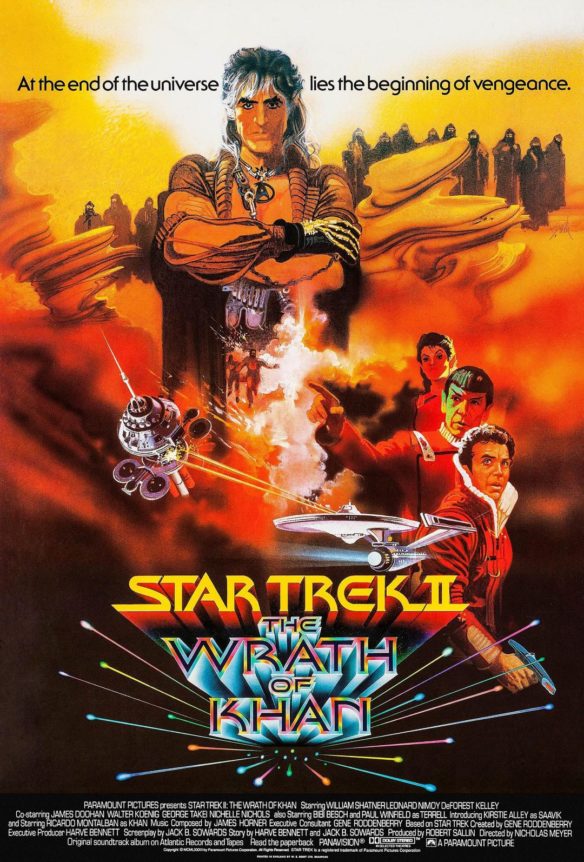
1982 – [By Cat Eldridge.] On this day forty years ago, my favorite Trek film by far, Star Trek II: The Wrath of Khan, premiered. As I noted yesterday in my essay on the ending of the original series, there have been thirteen films so far — the good, the bad and the just plan forgettable. Star Trek II: The Wrath of Khan is in my opinion stellar.
Now I’ll admit that the episode that spawned it, “Space Seed”, isn’t one of my favorite episodes, but the screenwriter for this film, Jack B. Sowards, who based it off a story by him and Harve Bennett, created a story here that is fantastic. Neither had any genre background so Bennett watched all of the original series after being hired by Paramount and decided to do a film off the “Space Seed” story.
Damn, they did a great job. From the Kobayashi Maru simulation (named after Soward’s neighbor) to the over-the-top villain that Ricardo Montalbán is here (far more than he was in “Space Seed”), there is nothing that is not completely entertaining here. Most of these Trek films have a spot or two where I want to say to the editor why is that scene in here, but not in this film. I loved it from beginning to end unreservedly.
(Roger Ebert in his review had an interesting point about Khan: “Khan is played as a cauldron of resentment by Ricardo Montalban, and his performance is so strong that he helps illustrate a general principle involving not only Star Trek but ‘Star Wars’ (1977) and all the epic serials, especially the ‘James Bond’ movies: Each film is only as good as its villain.”)
(Some of them are entirely like that.)
They were given a lousy budget, just twelve million, as Paramount really didn’t believe the film was going to do crap. It did as it made ninety million.
What did the critics think? If they were Trekkies, they liked it. If they weren’t, they didn’t.
Kevin Thomas of the L.A. Times definitely liked it: “In this new film there’s no feeling that its makers are straining to compete with ‘Star Wars’ and other special-effects spectaculars, instead, they’re attempting to recapture the spirit of the beloved TV series. (It is, in fact, probably a plus that the film actually began production intended for TV.) The result is a brisk, handsomely designed film in which its hardware, sturdy as it is, never overwhelms its humanity.”
Whereas David Khmer of the Chicago Reader wasn’t impressed: “In this second Star Trek feature (1982), the crew of the Enterprise confronts middle age in a plot that makes very little literal sense but is packed with pertinent life-out-of-death, Waste Land imagery: a 200-year-old heavy (Ricardo Montalban) living on a barren planet, a secret project code-named ‘Genesis’ that can turn deserts into tropical jungles, Captain Kirk wearing specs and rediscovering his long-lost family. If only director Nicholas Meyer had grasped the implications of his tale more fully and enthusiastically, this might have become a classic piece of cornball SF poetry, but as it stands the tepid acting and one-set claustrophobia take a heavy toll.”
It was nominated for a Hugo at ConStellation losing out to Blade Runner. Rotten Tomatoes reviewers really like giving a ninety percent rating.
(9) TODAY’S BIRTHDAYS.
[Compiled by Cat Eldridge.]
Born June 4, 1951 — Wendy Pini, 71. With husband Richard, responsible for Elfquest which won them a Balrog. Over the years Elfquest has been self-published by the Pinis through their own company Warp Graphics, then Marvel Comics, then the Pinis again, more recently DC Comics and then Dark Horse Comics. Everything prior to 2013 is free online at the Elfquest Comic Viewer. Be prepared to spend hours lost in great reading!
Born June 4, 1960 — Kristine Kathryn Rusch, 62. If you’ve not discovered the delights of her Diving Universe series, you’re in for a treat — it’s that good. Her Retrieval Artist series is one that can be read in no particular order so is great deal of fun no matter where you start. And her Spade / Paladin series of which the first novel just came out, Ten Little Fen, is absolutely delightful. Oh, and she won the Astounding Award for Best New Writer. Her website is here; don’t miss her appreciation of A.J. Budrys.
Born June 4, 1960 — Bradley Walsh, 62. His first genre was on The Sarah Jane Adventures as Odd Bob Elijah Spellman aka The Pied Piper in “The Day of the Clown” story. His major genre role video wise however is Graham O’Brien, companion to the Thirteenth Doctor. Now it’s worth noting that he has a lot of theatre experience that is genre having appeared in multiple versions of Aladdin, Cinderella, Jack & the Bean Stalk, Peter Pan and Snow White.
Born June 4, 1964 — Sean Pertwee, 58. Let’s see, where did I see him first? Oh, of course, playing Sheriff Hugh Beringar on Cadfael but that’s not genre, is it? Captain Heinz in “Trenches of Hell, Part 2 “, on The Young Indiana Jones Chronicles which was his first genre role followed being Pilot Smith on Event Horizon and Macbeth in a UK film of that name the same year. He did a bit of low-budget horror playing Bradley Cortese in Tale of the Mummy and likewise in being Sergeant Harry G. Wells in Dog Soldiers. There were some fairly low budget SF as well, say Father in Equilibrium. Not to mention Brother Proteus in Ultramarines: A Warhammer 40,000 Movie which I dearly want to see! All of which gets redeemed by his Inspector Lestrade in Elementary, a stunning take on that character. And then there’s his Alfred in Gotham.
Born June 4, 1969 — Julie Gardner, 53. She was executive producer on the revival of Doctor Who and the spin-offs of Torchwood and Sarah Jane Adventures. She co-founded with Julie Tranter Bad Wolf, best known for the BBC TV series His Dark Materials and A Discovery of Witches on which she serves as an executive producer.
Born June 4, 1972 — Joe Hill, 50. I’ve met him once or twice down the years as he shows up here in Portland for signings at both book shops and comic shops pre-Pandemic. Really nice guy like his father. Actually the whole family is amazingly nice. Locke & Key is a superb graphic novel series and I’m fond of all of his short stories, particularly those collected in 20th Century Ghosts, and his collection Full Throttle. I notice that though he’s not yet won a Hugo, he’s won a fistful of Stokers, many BFAs, a World Fantasy Award and even an International Horror Guild Award.
Born June 4, 1975 — Angelina Jolie, 47. I really liked her two Tomb Raider films and thought Sky Captain and the World of Tomorrow was a really cool film with her role being quite magnificent. I never saw her early Cyborg 2 undertaking but think Hackers and her role as Kate “Acid Burn” Libby was rather good. I’ve not seen her Maleficent films.
Born June 4, 1991 — Jordan Danger, 31. She is best known for her role as Zoe Carter on Eureka. (Now inexplicably renamed A Town Called Eureka in syndication but not on Peacock which is streaming it now along with Warehouse 13.) She also showed up in Ragin Cajun Redneck Gators which as horror is genre of sorts, plus the SF films, Higher Power and Beyond the Sky. And even a vampire film, Living Among Us. All low budget, all straight to DVD productions.
The Far Side reveals a fine point in fantasy cuisine.
(11) COWL SCOWL. In “What Is Batman” the Pretty Much Pop podcast shares its taxonomical theories.
In light of the recent release of Matt Reeves’ film The Batman, we consider the strange alternation of darkness and camp that is Batman. Is he even a super hero? What’s with his rogues’ gallery? What’s with DC’s anti-world-building?
Your Pretty Much Pop host Mark Linsenmayer is joined by philosophy prof/NY Times entertainment writer Lawrence Ware, improv comedian/educator Anthony LeBlanc, and Marketing Over Coffee hostJohn J. Wall, all of whom are deeply immersed in the comics, and we touch on other recent shows in the Batman universe.
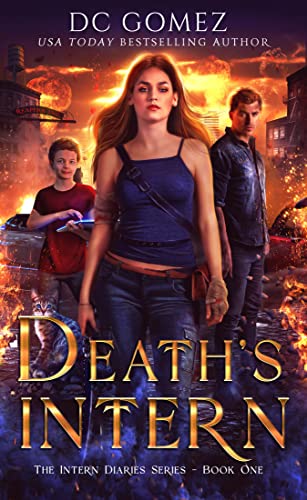
(12) HUMOR IN THE DARKNESS. Death’s Intern by D.C. Gomez is the debut novel in the Intern Diaries series launched in 2017.
A talking cat, a boy genius, missing people, and an untrained Intern for Death. What could possibly go wrong?
Did that really happen?
There’s no way Death offered me a job. I’m a musician that makes her living as a waitress, with absolutely no training in the supernatural world. This is all a very bad dream.
But Bob has been kidnapped, and I can’t possibly lose the only friend I have.
Bob, you’d better be alive. Because if I just gave my soul to Death for nothing, I will personally kill you. Not to mention, it seems Death’s Interns have fairly short life expectancies.
God, don’t let me die.
D. C. Gomez was born in the Dominican Republic, and grew up in Salem, Massachusetts. She study film and television at New York University. After college she joined the US Army, and proudly served for four years. Those experiences shaped her quirky sense of humor. D.C. has a love for those who served and the families that support them. She currently lives in the quaint city of Wake Village, Texas, with her furry roommate, Chincha.
One of D. C.’s passions is helping those around her overcome their self-limiting beliefs. She writes both non-fiction and fiction books, ranging from Urban Fantasy to Children’s Books. To learn more about her books and her passion, you can find her at www.dcgomez-author.com.
(13) SCIENCE TAKES A HOLIDAY. [Item by SF Concatenation’s Jonathan Cowie.] You don’t know what it has been like the past few days as you are a citizen living in a flawed democracy, conversely, I am a subject living in a full democracy kingdom. Anyway, our Queen has ruled that we must have four days celebrating 70 years of her reign. So it has been street parties, barbecue, coronation chicken and a right old national knees-up this side of the Pond. It is a tough life, but we Brits are used to it.
It has also meant that, with the exception of this morning, the library cybercafés have been closed, hence no science news until now.
More than fifteen months after landing in Jezero Crater on Mars, NASA’s Perseverance rover has finally begun its hunt for ancient life in earnest.
On 28 May, Perseverance ground a 5-centimetre-wide circular patch into a rock at the base of what was once a river delta in the crater. This delta formed billions of years ago, when a long-vanished river deposited layers of sediment into Jezero, and it is the main reason that NASA sent the rover here. On Earth, river sediment is usually teeming with life.
Images of the freshly ground spot show small sediment grains, which scientists are hoping will contain chemical or other traces of life. Poet William Blake’s “‘To see a world in a grain of sand’ comes to mind,” wrote Sanjeev Gupta, a planetary geologist at Imperial College London, on Twitter….
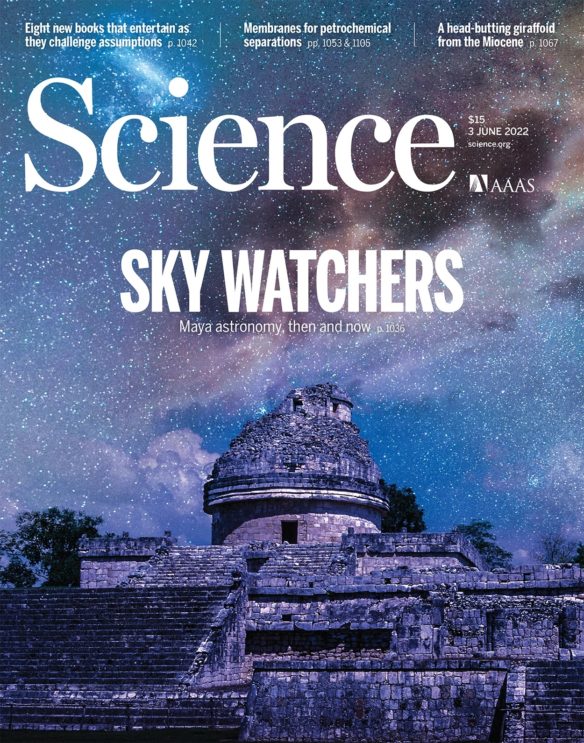
Meanwhile, the journal Science has been looking at Mayan astronomy and this features on their cover: “The Stargazers”.
The historic Maya oriented their lives by the heavens. Today, their descendants and Western scholars team up to understand their sophisticated astronomy
In the past few years, slowly converging lines of evidence have been restoring the clearest picture yet of the stargazing knowledge European colonizers fought so hard to scrub away…
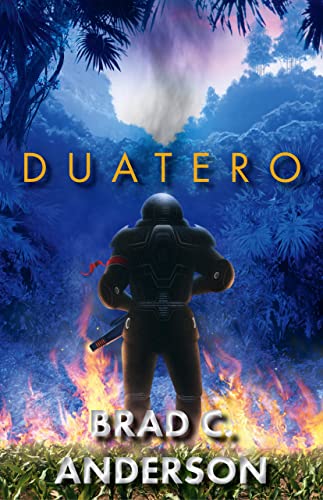
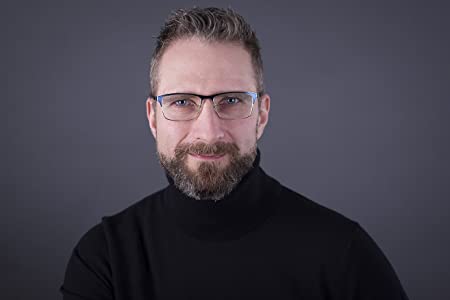
(14) SHADOWPAW PRESS MAKES DUOTERO AVAILABLE AGAIN. Duatero by Vancouver author Brad C. Anderson, a searing far-future science fiction novel about the struggles of an abandoned human colony to survive on a hostile alien world, is back in print in a new edition from Shadowpaw Press after being orphaned by the closing of its original publisher, Bundoran Press.
Majstro Falchilo Kredo has devoted his life to protecting the abandoned Earth colony of Duatero from Malamiko, the indigenous ecosystem that makes their crops fail and whose contamination turns humans into mindless monsters.
But Malimiko is changing, becoming more dangerous, more aware, even as the ancient technology the humans use to combat it fails piece by precious piece. Kredo and his fellow soldiers must risk everything or see all they hold precious wiped away and forgotten.
Kredo is prepared to sacrifice himself—and anyone around him—to do his duty. But what if the price demanded is even higher?
“Duatero is a powerful work of science fiction that confronts issues of morality and survival head-on in a carefully thought-out and terrifying alien world,” said Edward Willett, editor and publisher of Shadowpaw Press. “It deserves to find many new readers, and I’m thrilled to be able to give it that opportunity.”
Duatero can be bought directly from the publisher or from most online bookstores in both ebook and print and can also be ordered through any brick-and-mortar bookstore. This handy URL provides links to multiple online sources: https://books2read.com/duatero/
“Like a lot of folks, I look forward to the competition every year and am excited to be a part of this wonderful tradition that celebrates excellence,” he said….
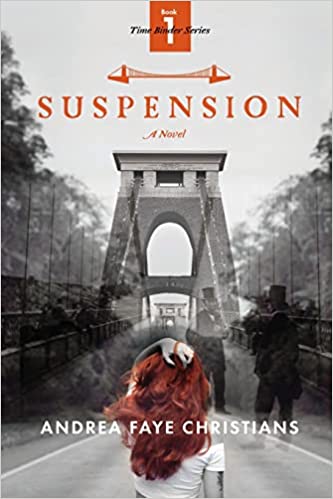
(16) IT’S ALMOST TIME. Suspension by Andrea Faye Christians – “a time travel tale of epic proportions” — is Book One of the Time Binder Series.
When Carla Thompson falls asleep and doesn’t wake up, she is shocked to discover what destiny has in store for her. Suspended between two worlds, she meets Isambard Brunel, the legendary eighteenth-century civil engineer, who built the Clifton Suspension Bridge in Bristol, England, and who now serves as guardian of its secrets. Historical events intertwine with Carla’s current reality and along the way she discovers a murder, encounters a host of characters including Jamaican psychic, Matilda, and engages in verbal banter with literary legend, Ernest Hemingway. Her adventures lead her to a startling revelation about why she was chosen for her strange new role. In death Carla realises she has never felt more alive.
Andrea Faye Christians was born and raised in Swansea, South Wales. Following a successful career in British radio including the BBC, she moved to the southern Mediterranean island of Malta to pursue her dream of becoming a freelance writer. A decade later she bought a farm in the Madonie Mountains of Sicily where a menagerie of rescue animals found their way to her. With a son in Malta and a daughter in Sicily, Andrea has a home and her heart in both places, and she now divides her time between the neighboring islands.
Neils Bohr said, “It is wrong to think that the task of physics is to find out how Nature is. Physics concerns what we can say about Nature.” Well it turns out that if we pay attention to this subtle difference, some of the most mysterious aspects of nature make a lot more sense.
[Thanks to JJ, John King Tarpinian, Chris Barkley, Andrew Porter, SF Concatenation’s Jonathan Cowie, Michael Toman, Cat Eldridge, Mike Kennedy, and Martin Morse Wooster for some of these stories. Title credit belongs to File 770 contributing editor of the day Tom Becker.]
By John Hertz: In one of Forry Ackerman’s more inspired puns, he called us the Imagi-Nation.
We make things up.
Of course all art does. Maybe all life does.
I knew people with a bookshop that had two names, “Bookfellows” and “Mystery and Imagination”. I told them I liked “Bookfellows” better because all books were mystery and imagination.
SF is particularly hard. If it’s just like what we already know, it’s only mainstream. If it’s too unlike what we know, how are we going to engage with it?
I’ve mentioned C.S. Lewis’ advice I call the One Strange rule: ordinary people in extraordinary circumstances, or extraordinary people in ordinary circumstances.
Ambitious SF authors may try both.
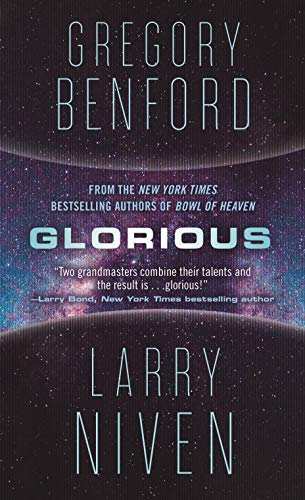
Glorious, the Greg Benford – Larry Niven novel appearing last year, is one of the more ambitious SF stories. It’s third in a series. I didn’t re-read the first two before reading it. I don’t think you’ll have to.
It’s an interstellar-travel book. To manage that, some authors make up a way to go faster than light. So far as present-day science knows, it can’t be done (yes, I’ve heard of the Alcubierre drive; even if it’s possible we can’t build it now). There’s no faster-than-light drive in Glorious. There are no generation ships. There’s suspended animation – “cold sleep”. The authors don’t suppose that will be easy or simple. There’s a lot of high-power computing machinery – artificial intelligence.
I don’t know if AI, cold sleep, or FTL will prove achievable. A century or a millennium from now any might have been demonstrated to be fantasy. Meanwhile a story treating any well is science fiction.
Some of Glorious might contradict some people’s religious faith. That faith might be right and Glorious wrong. But faith – I have some – isn’t science. It isn’t less valid – or so I believe – just different. Science is based on things that can be detected and measured in certain ways. Faith doesn’t have those limitations – so it has other limitations. I happen to believe some of Glorious is wrong. But I don’t read books to be agreed with.
Colonists in Glorious think they’re high-tech. They’ve left Earth, and found what looks like a suitable place far enough away. It would be only a short hop in an E.E. Smith book, or a Larry Niven Known Space book, but this isn’t one of those.
Colonists try to prepare for surprises. History shows and SF tells they’re surprised anyway.
People in Glorious get downloaded – if I were writing a few decades ago I’d have had to explain that – into bodies and even machines. That’s almost trivial – I did say almost – compared to what these colonists have to face.
They also have to find how to perceive what they’re facing.
We’ve had stories like A Connecticut Yankee in King Arthur’s Court with protagonists on the high-tech side. Oh, look at those benighted creatures over there. In Glorious the sucker is on another tentacle.
There’s some reason to believe the Glorious protagonists are being played for suckers.
Benford is known for imagining physics. Niven is known for imagining aliens. Plenty of both in Glorious. There’s poetic writing too. It isn’t quite like either of them. This is a collaboration.
The landing team arrives. We’re a quarter of the way into the book.
The long meadow before them lay quiet and placid.
No greeting party.
No sign of any reception at all.
Not what any of them had planned.
…. a forest that seemed a writhing mass of wide, hollow limbs. Every living thing seemed endowed with light, airy mechanics. Translucent spiked leaves wove in an easy breeze, and diaphanous flowers of a shiny blue and golden yellow…. Beth knew that this plain was underpinned by struts, and so was clinging to a silvery tether trellis [p. 119].
Things will get more beautiful and more strange.
In another ambitious feature of this book, it has illustrations. The graphic artists are Don Davis and Brenda Cox Giguere. That hasn’t been an ordinary part of novels for adults in quite a while. The pictures are monochrome. They aren’t captioned. Like the words, they result from and invite imagination. I thought this had better not go without saying. Getting there took me a while.
Much farther along an alien being says,
“You have encountered our transmitter, which distorts space-time. You correctly deduce that we use this channel to speak with distant minds that carry out large, powerful experiments.”
“Look,” Viviane said, “we came here to communicate and colonize, if you will be so kind. Not about physics and such, at least not right away.”
Redwing whispered to her… “Let Twisto go on. It wants something from us [p. 354].”
If the space – land-space – or something – isn’t unoccupied, and if the people (“Science fiction is about people. Some of the people are aliens”) are higher-tech than our protagonists, how can colonization be possible – if they will be so kind? Must our protagonists, or anyone, be careless, arrogant, or worse?
(1) EVERYBODY COMPLAINS ABOUT THE WEATHER. And they complain even more if somebody does something about it. Sierra Garcia points to research about “How Early Sci-Fi Authors Imagined Climate Change” at JSTOR Daily.
More than a century before melting polar ice caps, geoengineering schemes, and soaring greenhouse gas emissions became the norm, humans causing climate change was the stuff of science fiction.
For a few decades in the late nineteenth and early twentieth centuries, authors from across ideologies and genres published stories that today would be called “cli-fi,” or climate fiction. French author Jules Verne, best known for popular adventure stories like Around the World in 80 Days and Twenty Thousand Leagues Under the Sea, penned a novel in 1889 called Sans Dessus Dessous about capitalists intentionally heating the Arctic to extract coal reserves. Mark Twain included a subplot of selling warm climates in his 1892 novel The American Claimant. Recently, literary scholar Steve Asselin reexamined these and dozens of other early cli-fi stories, finding several disquieting themes relevant to how we think about modern-day climate change.
…First the why: [Jude] Doyle says they left Substack because they were upset that Substack was publishing — and in some cases offering money upfront to — authors they say are “people who actively hate trans people and women, argue ceaselessly against our civil rights, and in many cases, have a public history of directly, viciously abusing trans people and/or cis women in their industry.”
Substack’s main business model is straightforward. It lets newsletter writers sell subscriptions to their work, and it takes 10 percent of any revenue the writers generate (writers also have to fork over another 3 percent to Stripe, the digital payments company).The money that Substack and its writers are generating — and how that money is split up and distributed — is of intense interest to media makers and observers
But in some cases, Substack has also shelled out one-off payments to help convince some writers to become Substack writers, and in some cases those deals are significant….
(3) CUT TO THE CHASE. In the Washington Post, David Betancourt interviews Zack Snyder and Deborah Snyder about the release of Zack Snyder’s Justice League, with Deborah Snyder saying “the fans got a huge corporation to listen to them and make this (Snyder cut) a reality,” but with Betanourt noting the release of the Snyder cut is also because HBO Max is hungry for superhero content to compete with Disney. “’Zack Snyder’s Justice League’ is what the director really wanted all along”.
… Knowing the Snyder Cut would be a streaming experience and not a theatrical one allowed it to grow. The film is four hours and two minutes, twice as long a the original. HBO Max’s hunger to have game-changing new superhero content to compete with Netflix and Disney Plus — not to mention a pandemic making everyone eager for more at-home offerings — created a golden opportunity for all involved.
“What the streaming services have done is allowed a lot more risks to be taken,” Deborah [Snyder] said. “There’s movies getting made — and [the Snyder Cut] is a perfect example — that wouldn’t be made if it wasn’t for the streamers. As a filmmaker and as a producer, that is exciting to me. I want to see the envelope being pushed and risks to be taken.”
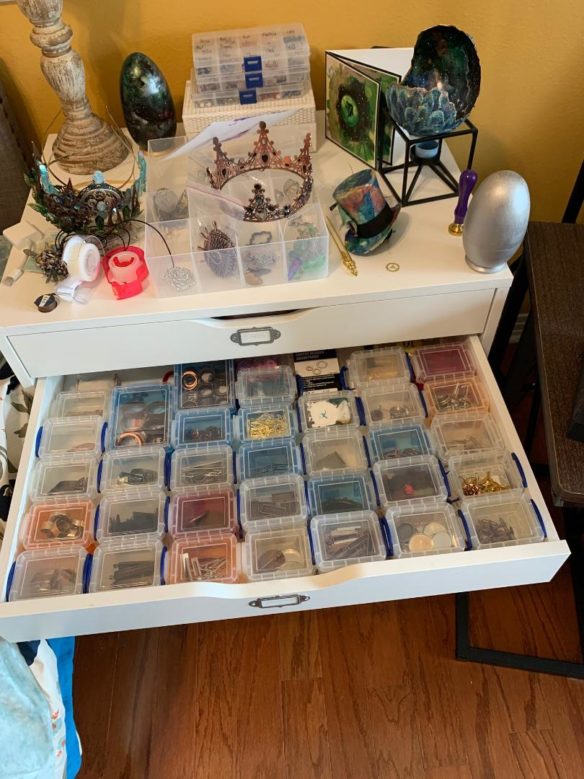
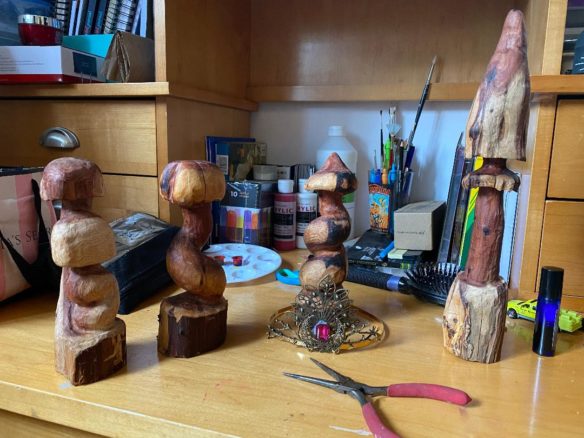
(4) JOURNEY PLANET IS GETTING CRAFTY! They’re looking for a few good crafters… or any crafters really. Team Journey Planet (this time being James Bacon, Sara Felix, and Chris Garcia) is putting together a Crafting in the Time of COVID-19 theme issue that will explore the DIY methods that people tried to pass the time they would normally spend out in the world. They’re looking for stories of hobbies taken up or re-kindled, photos of crafts managed, art cars or campers created, art you might have created during lockdown, and much more.
Did you build a rudimentary lathe and start turning artisanal batbase bats? We wanna hear about it. Did you start painting alternate bookcovers for your favorite novels? We wanna see ’em? Take up bookbinding, or clockmaking, or knitting, crocheting or tiara-making? Share ’em with us.
Deadline is March 31 — send any submissions or questions to [email protected]
China told local media not to broadcast next month’s Oscars ceremony in real time and to play down coverage of the awards, according to people familiar with the matter, after a documentary on the Hong Kong protests was nominated and amid concern over the political views of Best Director contender Chloe Zhao.
…“Do Not Split,” nominated for best short documentary, chronicles the anti-Beijing demonstrations that took hold in Hong Kong in mid-2019 and China’s growing power and influence in the former British territory.
…While initially lauded in the Chinese press for the success of her naturalistic film “Nomadland,” Zhao — who won the Golden Globe for Best Director last month — has since attracted criticism for a 2013 interview where she is said to have described China as “a place where there are lies everywhere.”…
(6) FRANK THORNE OBIT. Frank Thorne (1930-2021), artist of the Red Sonja comics of the 1970s has died. Heavy Metal pays tribute:
… Red Sonja, a character from the Conan-verse created by Robert E. Howard, made her Marvel Comics debut in Marvel Feature #1, penciled by Dick Giordano. Thorne took over as artist in the second issue, and remained Red Sonja’s artist through the title’s seventh and final issue, dated November 1976. Red Sonja got her own title beginning in January 1977, illustrated by Thorne (he did it all — pencils, inks, colors and lettering, and cover art) through issue 11.
Thorne clearly relished Red Sonja; his association with the title went beyond a job and became part of his identity. There was also a performative aspect — Thorne would show up at conventions dressed in a wizard costume, accompanied by a model or few (calling themselves “The Hyborean Players”) wearing the famous scale-mail bikini of Red Sonja. One of the Red Sonja models was Wendy Pini, who managed to make conventions and photo shoots when she wasn’t illustrating the series that would make her famous in the comics world: ElfQuest. Yup, that Wendy Pini….
(7) MEDIA BIRTHDAY.
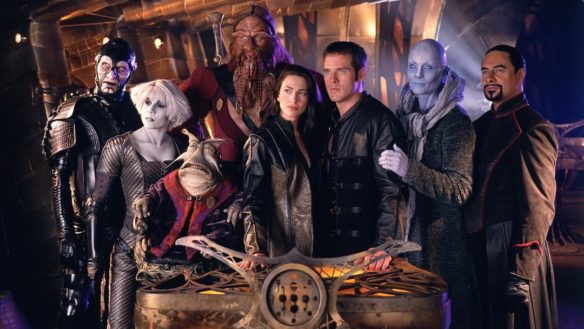
March 19, 1999 — On this day in 1999, Farscape premiered on Syfy. The series was conceived by Rockne S. O’Bannon and produced by The Jim Henson Company and Hallmark Entertainment. The Jim Henson Company was responsible for the various alien make-up and prosthetics, and two regular characters, Rygel and Pilot were completely Creature Shop creations. Filmed in Australia by Network Nine, it would would last for four seasons ending in The Peacekeeper Wars which is considered the fifth season.
(8) TODAY’S BIRTHDAYS.
[Compiled by Cat Eldridge and John Hertz.]
Born March 19, 1821 — Sir Richard Francis Burton KCMG FRGS. He was a geographer, translator, writer, soldier, cartographer, ethnologist, spy, linguist, poet, fencer and diplomat. He worked on the translation of an unexpurgated version of One Thousand and One Nights. Also, Vikram and the Vampire or Tales of Hindu Devilry. Mind you, he was also the publisher of both Kama Sutra and The Perfume Garden. Philip Jose Farmer made him a primary character of the Riverworld series. (Died 1890.) (CE)
Born March 19, 1894 – Lilith Lorraine. Author of poetry and otherwise, editor, radio lecturer, under various names. Half a dozen short stories, a hundred poems. Founded Avalon poetry ass’n; The Avalonian carried Robert Silverberg’s first paid story. Time Grows Thin posthumous coll’n of poetry (so consider the title!) has an introduction by Steve Sneyd. (Died 1967) [JH]
Born March 19, 1926 — Joe L. Hensley. He was a First Fandom Dinosaur which is to say he was active in fandom prior to July 4, 1939 and he received the First Fandom Hall of Fame Award. He is also a published genre author with ”And Not Quite Human” in the September 1953 issue of Beyond Fantasy Fiction being his first published work, and The Black Roads being his only genre novel. It does not appear that his genre works are available in digital editions. (Died 2007.) (CE)
Born March 19, 1928 — Patrick McGoohan. Creator along with George Markstein of The Prisoner series with him playing the main role of Number Six. I’ve watched it at least several times down the years. It never gets any clearer but it’s always interesting and always weird. Other genre credits do not include Danger Man but do comprise a short list of The Phantom where he played The Phantom’s father, Treasure Planet where he voiced Billy Bones and Journey into Darkness where he was The Host. (Died 2009.) (CE)
Born March 19, 1936 — Ursula Andress, 85. I’m sure I’ve seen all of the original Bond films though I’ll be damned I remember where or when I saw them. Which is my way of leading up to saying that I don’t remember her in her roles as either as Honey Ryder in the very first Bond film, Dr. No, or as as Vesper Lynd in Casino Royale. Bond girls aren’t that memorable to me it seems. Hmmm… let’s see if she’s done any other genre work… well her first was The Tenth Victim based on Sheckley’s 1953 short story “Seventh Victim”. She also appeared in The Mountain of the Cannibal God, The Fifth Musketeer, Clash of the Titans where she played of course Aphrodite, on the Manimal series, The Love Boat series and the two Fantaghirò films. (CE)
Born March 19, 1946 – John Gribbin, Ph.D., age 75. Eight novels, a score of shorter stories; columnist, correspondent, reviewer for Analog, Omni, Vector; fourscore books of nonfiction e.g. Almost Everyone’s Guide to Science (with wife Mary Gribbin); Hyperspace, Our Final Frontier; biographies of Einstein, Feynman, Schrödinger. Lifetime Achievement Award from Ass’n of British Science Writers. [JH]
Born March 19, 1953 – Laurie Sutton, age 68. A dozen novels. Worked for the Comics Code Authority awhile; “I never considered my job to be one of censorship…. being a comic book fan.” Then comics for DC (including Adam Strange) and Marvel (including Star Trek); introduced Frank Miller to Japanese comics. Publishing Innovation Award. [JH]
Born March 19, 1955 — Bruce Willis, 66. So do any of the Die Hard franchise count as genre? Setting them aside, he has a very long genre list, to wit Death Becomes Her (bit of macabre fun), 12 Monkeys (weird shit), The Fifth Element (damn great), Armageddon (eight tentacles down), Looper (most excellent), The Sixth Sense (not at all bad), Sin City (typical Miller overkill) and Sin City: A Dame to Kill For (yet more Miller overkill). (CE)
Born March 19, 1960 – Karen Cooper, age 61. Chaired Ditto 12 (fanziners’ con; Ditto, a brand of spirit duplicator). Long-time member of Minn-Stf. Her Minicon 34 Restaurant Guide (with husband Bruce Schneier) was a Hugo finalist for Best Related Book (as the category then was, now “Best Related Work”). Fan Guest of Honor at WindyCon 40. [JH]
Born March 19, 1964 — Marjorie Monaghan, 57. JoJo on all six episodes of Space Rangers. My brain keeps insisting it lasted much, much longer. She also was on Babylon 5 as the Mars Resistance leader during the Earth Alliance Civil War, where she was known as Number One. She’s also appeared on Quantum Leap, in the cyberpunk Nemesis film, in The Warlord: Battle for the Galaxy film, on Andromeda series and on The Great War of Magellan film. (CE)
Born March 19, 1970 – Kimberly Sabatini, age 51. One novel so far. Alice Curtis Desmond Award. When her father died, she “discovered … she’s full of questions that need to be answered.” Has read Endurance (Scott Kelly), The Wonderful Wizard of Oz, Hidden Figures, Frankenstein, Nothing Stopped Sophie (Sophie Germain), Seabiscuit, Gone With the Wind. [JH]
Born March 19, 1973 – Josh Rountree, age 48. One novel, twoscore shorter stories including “The Review Lester Bangs Would Have Written for the New Stones Album if He’d Lived Long Enough to Witness the Fall of Humanity and the Rise of the Other”. Seen in Andromeda Spaceways, Beneath Ceaseless Skies, Daily SF, Electric Velocipede, Realms of Fantasy. [JH]
Of the seemingly thousands of Pop figures that Funko has made, it’s weird to think that the company has only released six from Star Trek: The Original Series, way back in 2013. Sure, it’s made characters from The Next Generation, the Star Trek Beyond movie, and even put the cast of The Big Bang Theory in Trek uniforms since then. But Funko will finally right this wrong later this year with eight new figures from TOS.
The original six Pop figures included Kirk, Spock, Scotty, a Klingon, an Andorian, and an Orion Slave Girl. It shouldn’t be surprising that after so long, as StarTrek.com reports, the new series also contains a Kirk and Spock, but now the former is sitting in his captain’s chair, while Spock is, uh… holding a cat…
Spock with Gary Seven’s familiar from “Assignment: Earth”
The Scottish National Gallery of Modern Art has turned its Ray Harryhausen tribute into a “virtual experience” after spending years working on the exhibition with the legendary movie-maker’s family.
A £10 pass, which is available from today, will offer unlimited access to the online incarnation of the exhibition, which explores how Harryhausen inspired cinematic legends like Steven Spielberg, George Lucas and Peter Jackson thanks to his groundbreaking work on Jason and the Argonauts, Clash of the Sitans, Earth vs the Flying Saucers and the Sinbad series.
They will be able to secure glimpses of rarely-seen models, drawings, sketches, photographs, posters and storyboards drawn from the archives of the Ray and Diana Harryhausen Foundation, which is run by the family of the Californian-born special effects legend and his wife, who both passed away in 2013.
(11) ZOOMING WITH THE BENFORDS. Fanac.org’s next FanHistory Zoom will be “The Benford Twins, Fandom and the Larger Universe” on March 27, 2021, 2 pm Eastern. To receive a Zoom link, please RSVP to [email protected].
Jim and Greg Benford (founding editors of the legendary fanzine Void) became fans in the 1950s, and throughout a lifetime of science, professional writing, and extensive accomplishments, they have remained fans. In this Zoom session, they’ll talk about their introduction into fandom, their fandom over the years, and tell stories about the important and interesting people they’ve met. What influence has fandom had on them? Did relocation change their interactions with fandom? How have their professional lives influenced their fandom? Join us and find out (and expect a few surprises.)
The current schedule of future Fan History zoom sessions is available here.
NASA completed an engine test firing of its moon rocket Thursday, after the first attempt in January ended prematurely.
This time, the four main engines of the rocket’s core stage remained ignited for the full eight minutes. Applause broke out in the control room at Mississippi’s Stennis Space Flight Center once the engines shut down on the test stand.
NASA officials called it a major milestone in sending astronauts back to the moon, but declined to say when that might occur or even whether the first test flight without a crew would occur by year’s end as planned.
Our solar system’s first known interstellar visitor is neither a comet nor asteroid as first suspected and looks nothing like a cigar. A new study says the mystery object is likely a remnant of a Pluto-like world and shaped like a cookie.
Arizona State University astronomers reported this week that the strange 148-foot (45-meter) object that appears to be made of frozen nitrogen, just like the surface of Pluto and Neptune’s largest moon Triton.
The study’s authors, Alan Jackson and Steven Desch, think an impact knocked a chunk off an icy nitrogen-covered planet 500 million years ago and sent the piece tumbling out of its own star system, toward ours. The reddish remnant is believed to be a sliver of its original self, its outer layers evaporated by cosmic radiation and, more recently, the sun.
(15) VIDEO OF THE DAY. “MCI Commercial With Leonard Nimoy, TOS Cast, and Jonathan Frakes” on YouTube reveals that in 1993 the original Star Trek cast was eager to call 1-800-3BEAMUP to get 20 percent off the MCI Friends and Family Plan. But who invited Jonathan Frakes to the party?
[Thanks to John King Tarpinian, Cora Buhlert, Mike Kennedy, Andrew Porter, Martin Morse Wooster, JJ, Cat Eldridge, John Hertz, and Michael Toman for some of these stories. Title credit belongs to File 770 contributing editor of the day Nicole J. LeBoeuf-Little.]
(1) BUTLER HONORED. GeekWire, a site with roots in Seattle, took a strong interest in today’s news of a “Mars rover landing site named after Octavia E. Butler” because Butler spent her last years living in the Seattle area.
Alan Boyle, who wrote the story, is a long-time science fiction fan as well and hosts a relatively new science fiction podcast, Fiction Science, which looks at the intersection of science/technology and science fiction. His co-host is writer and Clarion West graduate Dominica Phetteplace. Alan’s also written about Butler before.
Fifteen years after her death, Seattle science-fiction author Octavia E. Butler has joined an exclusive pantheon of space luminaries memorialized on Mars.
Today NASA announced that the Red Planet locale where its Perseverance rover touched down last month is called Octavia E. Butler Landing, in honor of a Black author who emphasized diversity in tales of alternate realities and far-out futures.
“Butler’s protagonists embody determination and inventiveness, making her a perfect fit for the Perseverance rover mission and its theme of overcoming challenges,” Kathryn Stack Morgan, deputy project scientist for Perseverance, said in a news release. “Butler inspired and influenced the planetary science community and many beyond, including those typically under-represented in STEM fields.”
Butler died unexpectedly in 2006 at the age of 58, after sustaining a head injury in a fall on a walkway outside her home in Lake Forest Park, Wash. She had moved to the Seattle area in 1999 from her native Southern California….
…One of host Tonya Mosley’s neighbors makes it a point to walk clear across Los Angeles every once in a while to free his mind and find inspiration in his surroundings. Mosley isn’t quite there, but she does enjoy a daily stroll along the majestic, tree-lined streets of Pasadena, California. Walking the same route every day is an exercise in staying present.
Pasadena is the kind of place where kids ride their bikes in the middle of the street and the manicured lawns and shrubs rival those of the Midwest. For Octavia Butler, one of the most celebrated science fiction writers of our time, Pasadena was the spark that lit her flame.
“There is something about this mix of urban and wild,” journalist Lynell George says. “[Butler] was constantly looking at these interactions of how we use, you know, wilderness in space and nature.”
The title of George’s book “A Handful of Earth, A Handful of Sky: The World of Octavia Butler” comes from Butler’s description when asked what it takes to write science and speculative fiction. The book explains that early on in Butler’s life, she used the limited world around her — only where she could get by on foot or by bus — to create new worlds and possibilities.
An “avid walker,” Butler journeyed around Pasadena and wrote down what she called “walk thoughts” in a notebook, George says. Butler examined the climate and noted small changes over time.
(3) JOHN VARLEY UPDATE. Now that John Varley is out of the hospital his partner, Lee Emmett, has added a several paragraph long update to “Sending Prayers to the Cosmos”.
John was discharged from the hospital February 28 with many instructions… Also included in his discharge package was a booklet, Heart Surgery Care Guide, with all the no no’s: No lifting more than 5 pounds; No using arms to push or pull; No lifting elbows above shoulder height; No reaching behind your back, above waist level; No driving.
He has a red heart-shaped pillow that he hugs to his chest when he coughs, sneezes, burps, laughs, hiccups, gets in and out of bed, stands up, or rides in a car in the backseat behind the front passenger….
Varley added a note of his own:
This will be brief as it is still hard for me to sit in a typing position, and my left arm doesn’t work very well. Since I’m a lefty this is a bigger problem for me than it probably is for you. They say it will get better.
I just wanted to add my thanks to the excellent report and appreciation Lee wrote, above. I thank you for the good vibes and wishes and karma sent my way during my recent travails. Yes, and your prayers as well, though I’m an atheist and don’t know quite what to do with them. Is anyone really listening? Maybe so. Can’t hurt to pray, anyhow.
I also need to send a special thank you to those who sent small donations along with the wishes. As you know, in the USA we have easily the best health care in the world … if you can afford it. I got wonderful care every moment I was at PeaceHealth hospital. Now the bills will start coming in. We pay for insurance (more than we can afford) but the co-pays can sometimes be deadlier than COVID. (For which we still haven’t been able to find a vaccination appointment.)
That’s all I can do now. I will have some observations and such a little later, when my arm stops trembling.
(4) ZOOMING THROUGH FANHISTORY. Fanac.org’s FanHistory Project Zoom Session for March 27 will bring you face-to-face with “The Benford Twins, Fandom and the Larger Universe with Greg and Jim Benford.”
Jim and Greg Benford became fans in the 1950s, and throughout a lifetime of science, professional writing, and extensive accomplishments, they have remained fans.
In this Zoom session, they’ll talk about their introduction into fandom, their fandom over the years, and tell stories about the important and interesting people they’ve met. What influence has fandom had on them? Did relocation change their interactions with fandom? How have their professional lives influenced their fandom? Join us and find out (and expect a few surprises)!
(5) ADVICE FROM COURTNEY MILAN. Clarion West will host a free online workshop — “When and How To Quit Your Day Job with Courtney Milan” – on March 9. However, it’s probably too late to get in on it — when I checked the registration page there was a “sold out” message.
Quitting your day job is one of the biggest decisions you can make as a writer. How do you know if you’re ready? What if you make a mistake and you don’t have enough money? How stable do you need to be? What if you’re fired and don’t have a choice? What do you need to know beyond finances? This workshop addresses these questions (and brings up points you may not have considered) as well as common issues that arise when you transition from a day job that provides structure into freelance work where you’re the only boss.
…”Celebrity flare-ups on Twitter typically follow a couple of courses,” said Charles King, principal analyst at Pund-IT. “Some are personal brand-building efforts, which aim to draw attention to someone who believes the spotlight is passing them over by theatrically taking on someone with a far higher profile. Others seem more ethically-aimed, like historian Kevin M. Kruse’s takedowns of historical falsehoods that various public figures claim are true. Over time, such exchanges mostly follow highly predictable courses though the verbal slap-downs seem to keep people coming back. If it worked for Don Rickles, maybe Scott Baio can make a go of it.”
King references Scalzi in this article, which naturally caught John’s eye:
Finally, after 51 years, I am recognized as "practical and adult"!
(Celebrates with a 30-second extrusion of Cheez Whiz directly into my mouth)
(7) ADKISSON OBIT. Michael George Adkisson (1955-2021) died February 7. The family obituary is here. He was editor/publisher of New Pathways magazine from 1986-1992.
…Mike as everyone calls him, has a brilliant mind, loves art, writing, movies and science fiction. He was the founder, owner, editor and publisher of the science fiction magazine, New Pathways. The magazine got published from March 1986 to Winter of 1992. Being an artist himself, he provided much of the magazine’s artwork in the early issues….
…The last issue appeared a year after the previous one and the magazine ceased at the height of its influence. It held a crucial place in the 1980s in providing a market for the alternate view of sf and Speculative Fiction. It was part of an evolution flowing from Scott Edelman’s Last Wave and on to David Memmott’s Ice River, C J Cypret’s Nonstop Magazine and Steve Brown’s Science Fiction Eye.
(8) MEDIA BIRTHDAY.
March 5, 1938 — On this day in 1938, RKO first aired “The Bride of Death” with Orson Welles as The Shadow. Welles prior to his War of The Worlds broadcast would play the role for thirty three episodes in 1937 and 1938 with Blue Coal being the sponsor. You can download it here. (CE)
(9) TODAY’S BIRTHDAYS.
[Compiled by Cat Eldridge and John Hertz.]
Born March 5, 1853 – Howard Pyle. Five novels touchng the Matter of Arthur (here’s one), another about Robin Hood; some folks groan HP toned fables down to make them suitable for children, others applaud his artistry as a retelling fabulist (in the original sense, not the later meaning a liar). Twenty-four tales in The Wonder Clock, one for each hour, with poems by sister Katherine Pyle. Illustrator, of his own books and e.g. two by Woodrow Wilson while WW was a history professor; here is a Story of Siegfried – no, not by that James Baldwin. Here is a mermaid. (Died 1911) [JH]
Born March 5, 1936 — Dean Stockwell, 85. You’ll do doubt best remember him as Al the hologram on Quantum Leap. He had one-offs on Mission Impossible, The Night Gallery, A Twist in The Tale, Orson Welles’ Great Mysteries and The Twilght Zone. Anything I’ve overlooked? (CE)
Born March 5, 1942 — Mike Resnick. Damn, it still losing him hurts. It’s worth noting that he’s has been nominated for thirty-seven Hugo Awards, which is a record for writers, and won five times. Somewhat ironically nothing I’ve really enjoyed by him has won those Hugos. The novels making my list are his John Justin Mallory detective novels, The Red Tape War (with Jack L. Chalker & George Alec Effinger), and, yes it’s not really genre, Cat on a Cold Tin Roof. (Died 2020.) (CE)
Born March 5, 1952 — Margaret Astrid Lindholm Ogden, 69. She’s better known by her pen names of Robin Hobb and Megan Lindholm. I’m reasonably sure the first thing I read and enjoyed by her was Wizard of the Pigeons, but The Gypsy with Steven Brust was equally enjoyable and had the added bonus of a Boiled in Lead soundtrack. What’s she done recently that I should think of reading? (CE)
Born March 5, 1946 – Phil Jennings, age 75. Seven novels, seventy shorter stories. His work has been called “pyrotechnical … [his] exuberance is intermittently chaotic.” [JH]
Born March 5, 1955 — Penn Jillette, 66. Performed on Babylon 5 in the episode scripted by Neil Gaiman titled “Day of The Dead” as part of Penn & Teller who portrayed comedians Rebo and Zooty. It’s one of my favorite episodes of the series. Also he had a recurring role on Sabrina the Teenage Witch as Drell, the head of the Witches’ Council. He’s been in Fantasia 2000, Toy Story, Futurama: Into the Wild Green Yonder, Sharknado 3: Oh Hell No!, Lois & Clark: The New Adventures of Superman, VR.5, Space Ghost Coast to Coast and most recently Black Mirror. (CE)
Born March 5, 1955 – Hejja Attila. (Personal name last, Hungarian style.) Twoscore covers, a few interiors. Here is The Hugo Winners, vol. 1. Here is The Web Between the Worlds. Here is Stepsons of Terra.Here is The Wrong End of Time. (Died 2007) [JH]
Born March 5, 1959 – Howard Hendrix, Ph.D., age 62. Six novels, twoscore shorter stories, half a dozen poems (one had a Dwarf Star Award from SF Poetry Ass’n); three anthologies; book reviews in NY Review of SF. Professor of English at Cal. State Univ., Fresno. [JH]
Born March 5, 1974 — Matt Lucas, 47. He played Nardole, a cyborg, who was a companion to the Twelfth Doctor. He is the only regular companion introduced under Steven Moffat to have never died on screen. He provided the voice of Sparx on Astro Boy, and was Tweedledee and Tweedledum in Alice through the Looking Glass. (CE)
Born March 5, 1976 – Katy Stauber, age 45. Three novels, two shorter stories; two anthologies with Chester Hoster (Futuristica vols I & II). Has read Ivanhoe, The Jungle Book, Don Quixote, Lucifer’s Hammer, Metamorphoses, The Aeneid, four Shakespeare plays, three books by Dickens, two by Stevenson, five by Vonnegut, eighteen by Wodehouse (that’s not too many), The Stranger. [JH]
Born March 5, 1984 – Ashley Hope Pérez, Ph.D., age 37. Professor of world literatures at Ohio State Univ. One novel for us, two others (Out of Darkness a School Lib’y Journal and Kirkus Reviews Best Book of the Year; Printz Honor, Tomás Rivera Mexican-American Children’s Book Award) . She says “I believe in writing that reflects the uniqueness and diversity of lives lived in any given community, regardless of the background of the author.” [JH]
Born March 5, 1986 — Sarah J. Maas, 35. Author of the Throne of Glass series wherein Cinderella is stone cold assassin, and one I‘ve not sampled yet. If you’re so inclined, there’s A Court of Thorns and Roses Coloring Book. Really. Truly. (CE)
Wrong Hands analyzes a photo to show that the moon landing was faked.
Also recommended, Wrong Hands’ list of “nonspecific editions.”
(11) KICKSTARTER IS IMMINENT. Edward Willett is launching a Kickstarter March 9 to fund Shapers of Worlds: Volume II, an anthology featuring top talents in the industry including Kelley Armstrong, Marie Brennan, Garth Nix among others who were guests during the second year of Edward Willett’s podcast, The Worldshapers. The appeal launches March 9 at 12 noon CST – interested fans can go to the pre-launch page (which will become the project page) to sign up to be notified when it opens.
If it funds, Shapers of Worlds Volume II will feature new fiction from Kelley Armstrong, Marie Brennan, Helen Dale, Candas Jane Dorsey, Lisa Foiles, Susan Forest, James Alan Gardner, Matthew Hughes, Heli Kennedy, Lisa Kessler, Adria Laycraft, Ira Nayman, Garth Nix, Tim Pratt, Edward Savio, Bryan Thomas Schmidt, Jeremy Szal, and Edward Willett, plus stories by Jeffrey A. Carver, Barbara Hambly, Nancy Kress, David D. Levine, S.M. Stirling, and Carrie Vaughn. Among those authors are winners and nominees for every major science fiction and fantasy literary award, plus several international bestsellers.
Backers’ rewards offered by the authors include some 100 signed books (including limited editions), Tuckerizations (a backer’s name used as a character name), ready-to-hang photographs, audiobooks, bookplates, and more.
Shapers of Worlds Volume II is a follow-up to Shapers of Worlds, successfully Kickstarted one year ago.
(12) THE CAPITAL OF THE INSUBORDINATION. Denver author team O.E. Tearmann’s work includes the queer cyberpunk Aces High, Jokers Wild series which to date includes five novels and two short story collections. The fifth novel, Draw Dead, was released March 3.
Their books include strong themes of diversity and found family, providing a surprisingly hopeful take on a dystopian future. Bringing their own experiences as a marginalized author together with flawed but genuine characters, Tearmann’s work has been described as “Firefly for the dystopian genre.”
“Aidan Headly never wanted to be the man giving orders. That’s fine with the Democratic State Force base he’s been assigned to command: they don’t like to take orders. Nicknamed the Wildcards, they used to be the most effective base against the seven Corporations owning the former United States in a war that has lasted over half a century. Now the Wildcards are known for creative insubordination, chaos, and commanders begging to be reassigned. Aidan is their last chance. If he can pull off his assignment as Commander and yank his ragtag crew of dreamers and fighters together, maybe they can get back to doing what they came to do: fighting for a country worth living in. Life’s a bitch. She deals off the bottom of the deck. But you play the hands you’re given.“
(13) ON A ROLL. Sff art collector Doug Ellis recalls for Facebook readers details of a delightful six-week run acquiring multiple works by Virgil Finlay.
In last week’s Finlay Friday, I told the tale of how, back in the last week of March 2005, I’d acquired 15 Virgil Finlay originals from “A Midsummer Night’s Dream.” It was an incredible purchase, but within six weeks it led to my acquisition of five more Finlay originals. Needless to say, that six week period was the greatest Finlay run of my collecting career….
…It was the early 1900s, and the driver of this particular car was Thomas Edison. While electric cars weren’t a novelty in the neighborhood, most of them relied on heavy and cumbersome lead-acid batteries. Edison had outfitted his car with a new type of battery that he hoped would soon be powering vehicles throughout the country: a nickel-iron battery. Building on the work of the Swedish inventor Ernst Waldemar Jungner, who first patented a nickel-iron battery in 1899, Edison sought to refine the battery for use in automobiles….
…But more than a century later, engineers would rediscover the nickel-iron battery as something of a diamond in the rough. Now it is being investigated as an answer to an enduring challenge for renewable energy: smoothing out the intermittent nature of clean energy sources like wind and solar. And hydrogen, once considered a worrisome byproduct, could turn out to be one of the most useful things about these batteries….
Conventional batteries, such as those based on lithium, can store energy in the short-term, but when they’re fully charged they have to release any excess or they could overheat and degrade. The nickel-iron battolyser, on the other hand remains stable when fully charged, at which point it can transition to making hydrogen instead.
“[Nickel-iron batteries] are resilient, being able to withstand undercharging and overcharging better than other batteries,” says John Barton, a research associate at the School of Mechanical, Electrical and Manufacturing Engineering, Loughborough University in the UK, who also researches battolysers. “With hydrogen production, the battolyser adds multi-day and even inter-seasonal energy storage.”
Besides creating hydrogen, nickel-iron batteries have other useful traits, first and foremost that they are unusually low-maintenance. They are extremely durable, as Edison proved in his early electric car, and some have been known to last upwards of 40 years. The metals needed to make the battery – nickel and iron – are also more common than, say, cobalt which is used to make conventional batteries….
On a remote peninsular in the Arctic circle, enormous wounds are appearing in the permafrost and have started to worry scientists. Research teams from Russia and the United States are racing to find out what this means for Siberia, and potentially the rest of the world. Based on the BBC Future article ‘The mystery of Siberia’s exploding craters‘.
This Fan History Zoom (February 2021) explores the last 50-60 years of Southern US Fandom, through anecdotes and personal experiences. From Bill Plott with over 60 years of experience to Toni Weisskopf with a mere 40, the speakers share cherished memories and their thoughts on the nature of Southern Fandom. They speak about conventions, both regional and Worldcons, awards and traditions, bigger than life personalities, and fanzines. At the heart of it all, lies the hospitality and inclusiveness of Southern Fandom. There’s also a brief appearance by Jim Benford on the topic of his early fanzines, and an interesting Q&A session with the audience.
Here’s a sample anecdote, about Joe Celko, a Southern fan who shaved his head and wore a goatee one before that was a popular look: “At one party Kelly Freas actually drew on the back of his head his face while he was asleep…”
[Thanks to John King Tarpinian, Mike Kennedy, Rich Lynch, Daniel Dern, Paul Riddell, Michael Toman, JJ, Martin Morse Wooster, Cat Eldridge, John Hertz, Frank Catalano, and Andrew Porter for some of these stories. Title credit belongs to File 770 contributing editor of the day Jack Lint.]
The Science Fiction and Fantasy Writers of America (SFWA) honors one living writer each year with the Damon Knight Memorial Grand Master Award.
The recent deaths of two distinguished sf writers have drawn attention to the award. The late Ben Bova is someone Gregory Benford wished would have gotten it. James Gunn, who passed away last week, deservedly did get it. And he is also now the fifth Grand Master to die in the past four years (preceded by Brian Aldiss, Ursula K. Le Guin, Harlan Ellison, and Gene Wolfe.)
What writers are File 770 readers hoping SFWA will honor in years to come? Give your ideas in a comment.
To start the discussion rolling I asked four writers who they think deserves priority.
Gregory Benford sent a list of five:
Nancy Kress
Bruce Sterling
David Brin
Greg Bear
Steve Baxter
Ursula Vernon says:
Oh lord…my choices might be rather idiosyncratic! But I’d want Terri Windling, Robin McKinley, Diane Duane, Barbara Hambly and Ellen Kushner to all be considered. Terri Windling would probably be top of my list.
Past SFWA President Cat Rambo, who led the selection process during her years in office, sent this overview:
The biggest thing stopping Bova being a candidate — and the reason a lot of my picks didn’t fly — is that there’s been a lot of past “the rule is they can’t be dead” stuff. This leads to some weirdness (IMO), including people factoring in how healthy candidates are. To me it has to be someone who shaped the genre — my picks were Peter Beagle, C.J. Cherryh, Jane Yolen, and Bill Gibson, and I think all of them have a substantial and unquestionable legacy and influence on the field.
I’d love to see the award revamped, and be something that could go to multiple people, living and dead, each year, along the lines of the Science Fiction Hall of Fame. I know top of my list would be Octavia Butler, and there’s some other now-gone folks that I would also put above Bova, although he is certainly worthy.
That last thought about expanding eligibility resonates with Nisi Shawl ’s SFWA Grand Master Wishlist:
I’m surely not the first to name Octavia E. Butler as a priority for the honor of SFWA Grand Master. I mean. I mean come on. She was a MacArthur Fellowship-certified genius who demonstrably changed the field. She was gracious, kind, and charming in person and ruthlessly gorgeous in her prose. She was a tireless worker, a dreamer, a sincere advocate for emerging authors such as myself, and the moment for us to honor her is fast approaching. Or maybe it’s already here.
My other two picks for most-likely-to-make-Grand Master are known primarily for their short stories, a form I feel has gotten much shorter shrift than it deserves.
Nebula-winner Eileen Gunn is a short story writer supreme. Wisewoman and wise-ass, Eileen is generous with that most precious of authorial treasures, her time. She teaches, she critiques, she analyzes, she sets forth on pioneering journeys to the heart of speculation and leaves shining footsteps for us to follow.
And Ted F. Chiang (ask Ellen Klages what the “f” stands for) is a careful, precise giant in this field. His stories are exquisite and true to the core. Long may he live! Long may he reign as Grand Master—and soon!
(1) GIBSON TOPS THIS LIST. The Times of London’s Simon Ings picked the five “Best sci-fi books of the year 2020” (behind a paywall). He rates William Gibson’s Agency the best of the year. The other four you’ll have to pay to find out.
Writer Guest Dr. Gregory Benford, our Artist Guest Jeff Sturgeon, and the Fan Guests of Honor Dennis and Kristine Cherry have all agreed to be there and look forward to next year. Hear from them in our deluxe virtual panel space this year, chatting with Loscon 47 chairman Scott Beckstead and Zoom Elf Susan Fox.
(3) BREEZYCON. Likewise, several of the panels from Breezycon, this year’s online replacement for Windycon, can be found at Windycon’s YouTube channel.
They include: Breezycon Opening Remarks, Software for your Home Rapid Prototyping Technology, 3D Printers and Lasers and CNC Mills, Oh My, Before Hastings, The Worldcon is Coming to Chicago, Ray VanTilburg Studio Tour, Characters Motivations in a Post Scarcity World, and Staying Productive as a Writer Through Lockdown (the last “About the experience of being a writer during the pandemic and its effects on one’s process and work” with panelist: Seanan McGuire and moderator: Evan Reeves.)
(4) WHERE DO YOU GET YOUR IDEAS? This time the author can tell you. “Owl Be Home For Christmas” – Diane Duane had to write it.
Sometimes work and life come at you fast, in tandem.
I was taking a break from work on Tales of the Five 3: The Librarian last week, and (as I do frequently during the day) having a look at Twitter, when something unusual came across my dashboard: this.
Hmm, I see a (forget-the-heartwarming) children’s book in this. (Because that expression says “WTF?? YOU CHOPPED DOWN MY F*CKING TREE!”) So on Christmas Eve, a MILLION OWLS mount a rescue mission from the North, pick up the tree, and take it (and their buddy) home. The End. ?? https://t.co/bRy2rshIin
So: a status report. I’m well into the body of the story now. My estimate at the moment is that it will run about 20.000 words. (If I need more, I’ll take more: but I refuse to push a story into being longer than it needs to for mere length’s sake.)
My intention is to drop the story on both Amazon and at Ebooks.Direct in the early evening (7PM-ish US/EST) of December 2, 2020, to coincide with the lighting of the tree in Rockefeller Center. I’ll tweet the Amazon and EBD links then, and I’ll add purchase links / widgets on this blog post/page: so you might want to bookmark it. If you’re a Twitter user, you can also keep an eye on the #OwlBeHomeForChristmas hashtag there—I’ll use it to post the occasional update between now and Wednesday.
(5) AN INSIDE LOOK WITH JMS. J. Michael Straczynski has started a series of video commentaries about his Babylon 5 episodes for subscribers to his Patreon at the $10/mo and above level.
So despite my utter horror at the prospect of appearing on-camera, because there’s always someone, somewhere (usually in Bolivia) who points at the image and screams, “That’s him! That’s the guy that did it!”, I’ve begun doing exclusive video reactions/commentaries to Babylon 5 episodes for my Patrons at Starfury level or above.
The first to have gone up is “The Parliament of Dreams,” which — because I’m doing a commentary on the full episode, and can’t put that online, has to be done as a home-sync, meaning viewers cue up the episode at home — has gone over remarkably well.
The plan is to do commentaries that are not on the DVDs, but in some cases there will be the same episodes because time has lent a new perspective to the show as I look back on it. So they will be either new or very different from what came before.
Patrons get to vote on which episode I do next. The current poll is Infection, And the Sky Full of Stars, and Signs and Portents.
Should these continue to go well and not lead to unwanted visitations by Homeland Security, I will likely also start to do some on Sense8 and some of the movies.
We been Strolling With the Stars at Worldcon for over a decade now, giving fans a chance to spend some quiet time with their favorite authors, artists and editors, while getting some fresh air.
We still can’t meet in person right now… but we can do what we did in the spring, a daily series of short strolls-at-home here on Facebook Live. Tune in to see what’s up in the lives of some of your favorite sff creators… how they’re dealing with what has sadly become The New Normal.
Join us at 5PM EDT every day, beginning November 27! (Or if you can’t make it live, watch the video right here afterwards.)
Sunday, Nov 29 — Scott Edelman
Monday, Nov 30 — Gerald Brandt
Tuesday, Dec 1 — Toni Weisskopf
Wednesday, Dec 2 — Alex Dawson
Thursday, Dec 3 — Tom Doyle
Friday, Dec 4 —Jody Lynn Nye
Saturday, Dec 5 —John Kessel
Sunday, Dec 6 — Ellen Kushner
Monday, Dec 7 — Justin Barba
Tuesday, Dec 8 — Alma Alexander
Wednesday, Dec 9 — Steven H Silver
Thursday, Dec 10 — Lee Murray
Friday, Dec 11 — Brianna Wu & Frank Wu
Saturday, Dec 12 — Dr. Lawrence M. Schoen
Sunday, Dec 13 — Gay & Joe Haldeman
Monday, Dec 14 — Kate Baker
Tuesday, Dec 15 — Sheila Williams
Wednesday, Dec 16 — Troy Carrol Bucher
Thursday, Dec 17 — TBD
Friday, Dec 18 — Catherynne Valente
Saturday, Dec 19 — Valya Dudycz Lupescu & Stephen Segal
Everyone in the French Quarter of New Orleans traded in bullshit. Not the tourists. Well, yes the tourists too. But whatever self-aggrandizing malarkey they brought to town was drastically upstaged by their stupidity, usually taking form as epic drinking fails.
But this guy… No. He’d been vouched for. He was who he said he was.
“It’s a pleasure to meet you, Mr. Asprin.” I shook his hand in the Quarter bar. He lived in the Quarter; I did too. Nothing to do at night but hit the bars.
It was a little of that slowed-down awe of a car accident. I had shelved this man’s books in bookstores I’d worked in. Now I was waiting tables in the tourist feeding frenzy of pre-Katrina New Orleans. I also wrote, in his same genres. Science fiction, fantasy. It was all I wanted to do with my life. But you don’t say that, not to a man who didn’t have to trade in the local currency of bullshit to amplify himself, who could just be who he was, indisputably. That I hadn’t read his immensely popular humorous Myth or Phule series didn’t matter. I understood his significance, his stature.
I started calling him Bob because everyone else did. Some Quarter bars were for locals, and my wife and I went to these, and Robert Asprin would be there, inhabiting a stool, dishing out jokes, witty banter, stories. I was most interested in the stories, anecdotes populated by other famous writers in the field. Harry Harrison. Spider Robinson.
It eventually came out to Bob that I wrote, that I had a good number of small press sales under my belt. Well, so what, compared to what he’d accomplished? But he expressed an interest. He himself had been out of the game for some while. Years. Writer’s block, issues with the IRS. Nonetheless we sat side by side at the bar—he with Irish whiskey, rum and Coke for me—and I enthused about the wonder of writing, the pure elation of putting words together….
On November 22, 1820, the New York Evening Post ran a perfunctory book ad that was none too particular in its typesetting:
WILEY & HALSTED, No. 3 Wall street, have just received SYMZONIA, or a voyage to the internal world, by capt. Adam Seaborn. Price $1.
As literary landmarks go, it’s not quite Emerson greeting Whitman at the start of a great career. But this humble advert may herald the first American science-fiction novel. Although one might point to the crushingly dull “A Flight to the Moon,” from 1813, that text is more of a philosophical dialogue than a story, and what little story it has proves to be just a dream. “Symzonia; Voyage of Discovery” is boldly and unambiguously sci-fi. The book takes a deeply weird quasi-scientific theory and runs with it—or, more accurately, sails with it, all the way to Antarctica.
(9) MEDIA ANNIVERSARY.
1948 – Seventy-two years ago this month, Against the Fall of Night by Arthur C. Clarke was first published in the short-lived Startling Stories zine which was edited by Sam Merwin, Jr. Earle Bergey provided the cover illustration for this novel which has been continuously in print ever since in both in hard copy and now from the usual digital suspects, in three editions no less. A sequel novel was done in 1990 by him and Gregory Benford called Beyond the Fall of Night.
(10) TODAY’S BIRTHDAYS.
[Compiled by Cat Eldridge and John Hertz.]
Born November 28, 1685 – Gabrielle-Suzanne de Villeneuve. She published La Belle et la Bête in 1740, the oldest known telling of Beauty and the Beast. During her life she was known for other works, particularly The Gardener of Vincennes (1753). In fact, you should pardon the expression, it’s complicated, as Brian Stableford discusses in NY Review of SF 338. (Died 1755) [JH]
Born November 28, 1757 – William Blake. Four dozen of his poems are ours; many of his graphics. Here is The Ancient of Days. Here is the demiurge Urizen praying. Here is Jacob’s Ladder. Here is The Raising of Lazarus. (Died 1827) [JH]
Born November 28, 1783 — Washington Irving. Best remembered for his short stories “Rip Van Winkle” and “The Legend of Sleepy Hollow”, both of which appear in The Sketch Book of Geoffrey Crayon, Gent. collection. The latter in particular has been endlessly reworked downed the centuries into genre fiction including the recent Sleepy Hollow series. (Died 1859.) (CE)
Born November 28,1946 — Joe Dante, 74. Warning, this is a personal list of Dante’s works that I’ve really, really enjoyed starting off with The Howling then adding in Innnerspace, both of the Gremlins films though I think only the first is a masterpiece even if the second has its moments, Small Soldiers and The Hole. For television work, he’s done but the only one I can say I recall and was impressed was his Legends of Tomorrow’s “Night of the Hawk” episode. That’s his work as Director. As a Producer, I see he’s responsible for The Phantom proving everyone has a horrible day. (CE)
Born November 28, 1939 – Walter Velez. A hundred sixty covers, half a dozen interiors. Outside our field, album covers, commercial and fine art. Here is Seetee. Here is Lord Darcy. Here is Demon Blues. Here is How the Ewoks Saved the Trees. Here is The Dual Nature of Gravity. (Died 2018) [JH]
Born November 28,1952 — S. Epatha Merkerson, 68. Both of her major SF roles involve robots. The first was in Terminator 2: Judgment Day as Tarissa Dyson; a year later, she had a recurring role as Capt. Margaret Claghorn in Mann & Machine. And she had a recurring role as Reba on Pee-wee’s Playhouse though I can’t remember if the consensus here was that it was genre or genre adjacent. (CE);
Born November 28,1962 — Mark Hodder, 58. Best known for his Burton & Swinburne Alternate Victorian steampunk novels starting off with The Strange Affair of Spring-Heeled Jack that deservedly garnered a Philip K. Dick Award. He also wrote A Red Sun Also Rises which recreates sort of Victorian London on a far distant alien world. Emphasis on sort of. And then there’s Consulting Detective Macalister Fogg which appears to be his riff off of Sherlock Holmes only decidedly weirder. (CE)
Born November 28, 1979 – Sarah Perry, Ph.D., age 41. For us three novels, one a Waterstones Book of the Year, another an East Anglia Book of the Year; one shorter story. Fellow of the Royal Society of Literature. Outside our field, Naipaul Prize for travel writing. [JH]
Born November 28,1981 — Louise Bourgoin, 39. Her main SFF film is as the title character of Adèle Blanc-Sec in The Extraordinary Adventures of Adèle Blanc-Sec as directed by Luc Besson. Anybody watched the uncensored English version that came out on Blu-ray? She also played Audrey in Black Heaven (L’Autre monde), and she’s the voice heard in the Angélique’s Day for Night animation short. (CE)
Born November 28,1987 — Karen Gillan, 33. Amy Pond, companion to the Eleventh Doctor. Nebula in both of the Guardians of The Galaxy films and in later MCU films, and Ruby Roundhouse in Jumanji: Welcome to the Jungle and Jumanji: The Next Level. Two episodes of Who she was in did win Hugos for Best Dramatic Presentation (Short Form), “The Pandorica Opens/The Big Bang” at Renovation (2011) and “The Doctor’s Wife” at Chicon 7 (2012). (CE)
Born November 28, 1988 – Daniel Cohen, 32. Four novels; Coldmaker an Amazon Best-Seller. Saxophonist. Has read The Old Man and the Sea, The Phantom Tollbooth, The Stars My Destination. [JH]
Born November 28, 1992 – Shelly Li, 28. Arriving from China and learning English, she had seven stories published in Nature, nine more, by the time of this interview during her freshman year at Duke. [JH]
(11) KEEPING THE BLEEP IN TREK. At “Integrated Outtakes”, they “improve” Star Trek episodes by putting back the mistakes. The link is to a playlist. An example is embedded below.
Sometimes bloopers, when edited back into the finished episodes, can add a bit of humanity to characters. Sometimes they just add a bit of absurdity. Both are good.
Between the dark conspiracy theories, violence, global pandemic, and impending apocalypse, it would seem Amazon Prime Video’s Utopia was the wrong show at the exact wrong moment. That, or everyone just had a lot going on this fall. Either way, according to Deadline, the streaming platform has canceled the series, adapted by Gone Girl author and screenwriter Gillian Flynn from the 2013 British series of the same name, after one season. The show premiered on the service on September 25.
(13) YEP, I CLICKED. Jess Nevins shamelessly conflates the ideas of “fandom” and “science fiction fandom” to reassign sf fandom’s origins to the women readers of Wild West pulp magazines. (Thread starts here.) Did Gernsback imitate someone else’s successful magazine marketing idea? That doesn’t mean sf fandom wasn’t started through the efforts of Amazing. Nor should it be overlooked that the idea of “fandom” flows from a whole collection of tributaries (see Teresa Nielsen Hayden, below.)
The accepted wisdom is that Hugo Gernsback invented sf fandom in the Science Fiction League & in the pages of AMAZING STORIES, and that (per Wikipedia) “a wide variety of Western modern organized fannish subcultures originated with science fiction fandom.” LIES! ALL LIES! 1/ pic.twitter.com/5EtSFxgw0N
The first Western pulp was WESTERN STORY MAGAZINE, which debuted in 1919 and would eventually run for 35 years and a very impressive 1,301 issues. Before 1919 WESTERN STORY MAGAZINE was the dime novels BUFFALO BILL STORIES (1901-1912) & NEW BUFFALO BILL WEEKLY (1912-1919). 3/ pic.twitter.com/ndV9pZKWr7
A Dog Pissing at the Edge of a Path has beaten Introducing the Medieval Ass to win the Diagram prize for oddest book title of the year.
Both books are academic studies, with the winning title by University of Alberta anthropologist Gregory Forth. It sees Forth look at how the Nage, an indigenous people primarily living on the islands of Flores and Timor, understand metaphor, and use their knowledge of animals to shape specific expressions. The title itself is an idiom for someone who begins a task but is then distracted by other matters.
Runner-up Introducing the Medieval Ass, sees the University of Melbourne’s medieval historian Kathryn L Smithies explore “the ass’s enormous socio-economic and cultural significance in the middle ages”. Other contenders included Classical Antiquity in Heavy Metal Music, Lawnmowers: An Illustrated History and The Slaughter of Farmed Animals: Practical Ways of Enhancing Animal Welfare.
… “I thought it would be a closer race, but A Dog Pissing is practically a perfect Venn diagram of an ideal winner,” said Tom Tivnan, the prize coordinator and managing editor of the Bookseller. He said it combined “the three most fecund Diagram prize territories: university presses (a tradition dating back to the first champ, 1978’s University of Tokyo-published Proceedings of the Second International Workshop on Nude Mice); animals (like 2012’s Goblinproofing One’s Chicken Coop or 2003’s The Big Book of Lesbian Horse Stories); and bodily functions (such as 2013’s How to Poo on a Date and 2011’s Cooking with Poo).”
Founded by Trevor Bounford and the late Bruce Robertson in 1978 ‘as a way to stave off boredom at the Frankfurt Book Fair,’ the Diagram Prize has had a home at the Bookseller and with legendary diarist Horace Bent since 1982. The winner is decided by a public vote.
(15) VIDEO OF THE DAY. In “Honest Trailers: The Mandalorian” on YouTube, the Screen Junkies note that not only does The Mandalorian have enough comedians in supporting roles to be “the best alternate Saturday Night Live cast ever” but as a bonus you get Werner Herzog playing himself saying, “I see nothing but death and chaos.”
[Thanks to JJ, Mike Kennedy, Michael Toman, Kathryn Sullivan, Martin Morse Wooster, John Hertz, Andrew Porter, Cat Eldridge, Lise Andreasen, Steven H Silver, Danny Sichel, and John King Tarpinian for some of these stories. Title credit goes to File 770 contributing editor of the day Anna Nimmhaus.]