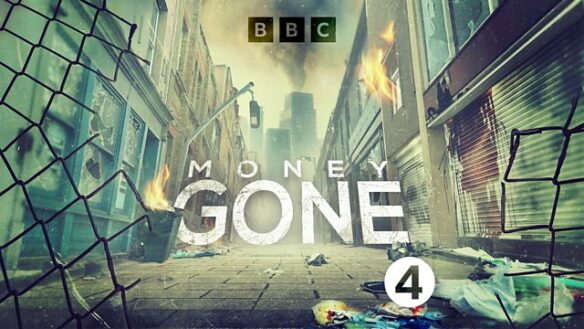
(1) DEAD PLASTIC. [Item by SF Concatenation’s Jonathan Cowie.] What would you do if the world suddenly ran out of digital money?
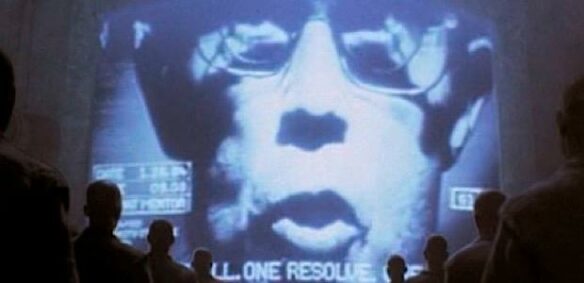
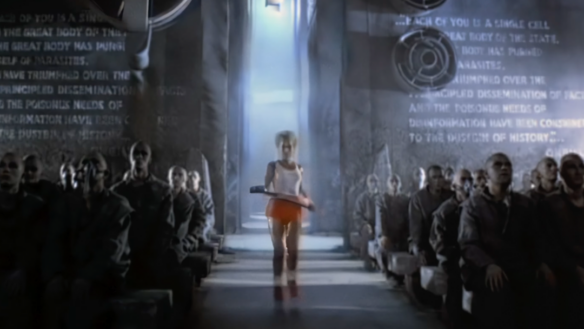
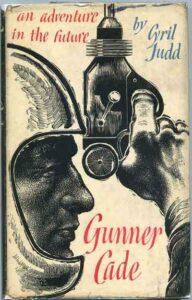
With some parts of Worldcon fandom (such as publications policy increasingly becoming digital myopically to the exclusion of all else), this is a very topical subject. Of course sercon trufans know that the current trend is to be abhorred: they’ve read the likes of Brunner, Gibson and Orwell).
The past couple of decades, SF has on occasion looked at digital privilege, monitoring and so forth, as well as social reactions against it (Max Headroom’s Blank Reg for example). So the new BBC Radio 4 drama series, that had its first episode this week, is timely. It envisages a near-present day in which suddenly all debit and credit cards stop working. The phenomena is not local, or national, but global….!
“Money Gone, Money Gone – 1. ‘Insufficient Funds’” (Episode 1 of 5)
Valentine’s Day 2025. The UK awakes to financial catastrophe and no one can access any money. Ross sees opportunity as the country descends into chaos, but Grace has picked the worst day run away.
A fast-paced satirical drama starring Robert Bathurst (Cold Feet, Toast of London), Charlotte Richie (Ghosts, Call the Midwife), Aaron Heffernan (War of the Worlds, Brassic) and Josette Simon (Wonder Woman, Blakes 7).
(2) HANGING OUT ONLINE. John Scalzi, in “One Year of Bluesky”, assesses the social media platform for his Whatever readers.
…Now, the flip side of this is you can’t just sit back and let Bluesky happen to you. You have to engage with it — actual engagement! Not the kind where an algorithm pokes you with a stick! — or you’re going to be bored. It’s not an endless TikTok firehose where all you have to do is put yourself in its path. It’s a spigot, and you control how much or how little you get. Everyone says they want that, but it turns out a lot of people kinda like the firehose instead.
The other aspect of Bluesky being algorithm-free (and still being relatively small; its user base currently sits at 5.5 million) is that it’s not great for being famous or being an influencer, or being a troll. I think the Bluesky technical and cultural schema confuses the famous and/or influencer and/or shitty people who come onto the service to be famous, or to influence, or to be shitty for clicks. You can’t game an algorithm to go viral, and the sort of marketing that works on other social media works less well on Bluesky, and even if it did work that way, there aren’t hundreds of millions of people to broadcast at. You can try to do all these things on Bluesky, obviously. But Instagram and TikTok and Threads and the former Twitter are all still there, and much easier to game and influence and troll. People who come to Bluesky to do those things don’t seem to stay very long.
Which is a feature, not a bug, for me, and comports with how I want to do social media….
(3) A FURRY APOCALYPSE. Maya St. Clair evangelizes for a comedy film in “Would You Survive HUNDREDS OF BEAVERS?”
…Humanity, thanks to industrialized agriculture and the highway, now possesses the upper hand. But underneath it all, one sometimes senses a vague, sublimated longing to return to more survivalist times. Plexiglass Paul Bunyans and the Giant Musky dot the landscape, standing in shared reverence to older struggles of brute force, consumption, survival. On the radio, Gordon Lightfoot reminds us that even the sunny Great Lakes are biding their time to kill us. And this year we have Hundreds of Beavers, a two-hour slapstick tour de force that gleefully revives the hairy, primordial struggle of the old Midwest. In Moby-Dick, Herman Melville chronicled the “universal cannibalism of the sea”; Hundreds of Beavers brings us, at last, the universal cannibalism of Green Bay, Wisconsin….
“Hundreds of Beavers Official Trailer”.
In this 19th century, supernatural comedy, a drunken applejack salesman must go from zero to hero and become North America’s greatest fur trapper when he loses his whole operation in a fire and is stranded in the wilderness. Now facing starvation, he must survive in a surreal winter landscape surrounded by Hundreds of Beavers – all played by actors in full-sized beaver costumes. Using nothing but his dim wits, he develops increasingly complex traps to battle the beavers and win the hand of a mischievous lover.
(4) RAY DALEY (1969-2024). Author Ray Daley died April 19 following a heart attack on March 28. His earliest sff was self-published beginning in 2012. His work included the collection A Year Of Living Bradbury; 52 Stories Inspired By Ray Bradbury (2014).
His first blog post in 2012 was charmingly frank:
…I can be a bit anal about wanting to be as factual as I can be, to the point where it actually gets in the way of the storytelling. I actually came across this problem when I wrote my first story I decided to sell. I had a great idea but the facts ruined it so I had to go with my own reality on that occasion….
(5) TODAY’S BIRTHDAY.
[Written by Cat Eldridge.]
Born April 27, 1963 — Russell T. Davies, 61. Let’s talk about the man who in large part made the revival of Doctor Who possible, Russell T. Davies.
He was both the showrunner and head writer for the revival of the Doctor Who for the first five years. His last episode was the Tenth Doctor’s “The End of Time” which he wrote and executive produced. He wrote thirty-one episodes during his tenure.
But let’s go back in time to his earlier series.

His Dark Season children’s series had three young teenagers in a contemporary secondary school who discover a plot by the villain Mr Eldritch to take over the world using school computers. The next three episodes focus on a new villain: the archaeologist Miss Pendragon who becomes a part of the ancient supercomputer Behemoth. The two distinct plot elements who later converge when Pendragon crashes through the school stage as Eldritch walks into the auditorium.
Following up on that would be Century Falls which tells the story of teenager Tess Hunter and her mother, who move to the seemingly idyllic rural village of Century Falls, only to find that it hides many powerful secrets. Something dark has happened here and it will take her to bring it out into the light.
And then there’s The Second Coming which gave BBC the vapours (spelling there deliberately used) It concerns a video store worker by the name Steve Baxter, played by Christopher Eccleston, who realizes he is in fact the Son of God that has but a few days to find the human race’s Third Testament and thus avert the Apocalypse. It ran on Channel 4 with major changes from what Davies originally envisioned.
Torchwood was his first post-Who series and I think it was brilliant early on. From my perspective, the characters, the setting and the storyline was quite amazing. No, not every story was great but over the first two seasons were well-worth watching. Now keep in mind that of the first two series, Davies wrote only the première episode but was the showrunner with Christopher Chibnall. The last two series, “Children of Earth” and “Miracle Day” I cared not for at all.
Then he would do the Sarah Jane Adventures, technically a children’s series but I saw it and it was lovely for everyone. A spin-off of Doctor Who with the companion Sarah Jane played by Elizabeth Sladen. He would be one of five, yes five, executive producers here.
Now living in modern-day Ealing, London, she investigates extraterrestrial matters and protects Earth against alien threats with a group of teenage accomplices. It ran five series with a sixth planned until she passed on from pancreatic cancer.
Davies made a cameo appearance in The Five(ish) Doctors Reboot. Haven’t seen it? What are you waiting for?
So Davies has now returned as Doctor Who’s showrunner. He of course cast Rwandan–Scottish actor Ncuti Gatwa for the Fifteenth Doctor. Or was the Fourteenth Doctor originally? Only Davies knows. Or did a week later. Time is a cool thing.
I’m reasonably sure that covers his genre work.
(6) COMICS SECTION.
- The Far Side proves even a Western showdown has a logical order.
- Tom Gauld’s cartoon has a bit more edge than usual!
- Nathan W. Pyle takes us to a lawn belongings transfer.
(7) FALLOUT UNSHELTERED. Inverse reveals “How Amazon’s Best New Sci-Fi Show Built Its Massive Post-Apocalyptic World”.
… Though this may be an entirely new saga, there is no question that it is set within the all-too recognizable world of the Fallout series. In fact, Nolan was committed to bringing this vast universe to life as faithfully and precisely as possible — and this daunting task fell on the shoulders of production designer Howard Cummings and costume designer Amy Westcott….
… And so, Cummings and Westcott dove into the vast world of Fallout. Neither being self-proclaimed “gamers,” this involved a mountain of research….
…The more he watched and listened to the fans, the more detail he discovered within the universe. “It all has such history. It’s crazy — I used to turn on my phone and just fall asleep listening to the history of Fallout.”
Cummings became so familiar with the look and feel of Fallout that Bethesda Games, the company responsible for the series, essentially “let [him] go” do his thing, he says. “But I had to go to them when we were creating new stuff, because I wanted to make sure it was right. I knew that fans would sit there and go through it all and find every friggin’ Easter egg!”
Bethesda collaborated with Cummings, helping him craft many new crucial pieces of Fallout lore — perhaps most excitingly, a map showing the locations of every single Vault in America. It is this mixture of ultra precise replication paired with thoughtful new creation that makes the design of the series a feat in world-building and a surefire hit with fans and newcomers alike.
(8) GAIMAN FILM PROJECT. “Neil Gaiman Teams With Graphic India For Animated Pic ‘Cinnamon’” reports Deadline.
New York Times best-selling author Neil Gaiman is teaming with Graphic India for the English-language animated movie, Cinnamon.
Based on a short story written by Gaiman, the screenplay is being adapted by the Coraline author and leading Indian animation writer and creator, Sharad Devarajan (The Legend of Hanuman; Baahubali: The Lost Legends) with Sarena Khan and Sujatha SV. Indian animator Jeevan J. Kang is set to direct.
Blurb for project: Born with pearl eyes that render her blind to the physical world, Cinnamon’s destiny is shaped forever when a mysterious talking tiger appears. Offering to lead her through the wonders and trials of the wild, Cinnamon begins a perilous adventure that will shape her path and test her resolve. She enters a hidden realm where the line between the mundane and the mystical is as thin as a whisper and where the ancient wisdom of India breathes life into a jungle thrumming with secrets….
(9) IMAGINARY WEALTH. [Item by Mike Kennedy.] OK, it’s mostly guesswork. But it’s still interesting to see these extremely rich fictional characters ranked and to see that none of them would be so rich as to be completely out of line in the modern world. Only the top 2 crack the $50B mark, leaving them way, way behind in the race for the richest person in the world (for which they’d have to be worth over 4 times that much). “15 Richest Fictional Characters Of All Time” at The Richest. The ladder runs from Jay Gatsby to Scrooge McDuck, with a surprising number of sff characters in between.
2 – SMAUG
Smaug’s Net Worth: $54.1 Billion
The Hobbit’s very own dragon Smaug never speaks a word, but has managed to invade the town of Dale, which happens to be sitting on a pile of gold.
Some sources have placed Smaug’s net worth as high as $62 billion dollars, with $54.1 billion deemed a “conservative estimate.”
(10) I DIDN’T KNOW IT WAS MISSING. Dan Monroe wants to know “Whatever Happened to the BLACK HOLE?”
[Thanks to Mike Kennedy, Andrew Porter, John King Tarpinian, Lise Andreasen, Chris Barkley, Cat Eldridge, SF Concatenation’s Jonathan Cowie, Steven French, Teddy Harvia, and Kathy Sullivan for some of these stories. Title credit belongs to File 770 contributing editor of the day JeffWarner.]