(1) A SHAMELESS PLUG FOR “THE AI SONG,” A PARODY BY MY FRIEND (AND COLLEAGUE) PAUL SCHINDLER. [Item by Daniel Dern.] My friend, colleague, and former-boss — briefly (at Byte.com) — Paul Schindler, knowing that I’m a frequent File770 contributor/suggester (from my periodically alerting him to Terry Pratchett and other Scrolls/Items here) asked me to submit as a potential item his recent song parody:
“Inspired by a spate of recent news stories about Artificial Intelligence (including one about a fake Supreme Court decision), I have written (with Clark Smith), “The AI Song” (“P.S. A Column On Things: The AI Song”), including a YouTubing.”
I’m happy to do so, but thought Paul also deserves a (brief-for-me) introduction, particularly since it looks like this will be his first appearance in an Item in a Scroll (as, for the benefit of those coming here via Paul, and other newcomers), File770 posts, and enumerated entries, are irrespectively called):
Paul is (among other things) a (now-former) tech journalist. In terms of AI, Paul notes/recalls, “During the early 1970s, when Daniel and I were fellow undergrads—including working on the student newspapers–at MIT, I interviewed Marvin Minsky several times about AI. This was back when it took very large machines to implement very small models. I remember asking Minsky how many millions of rules it would take to make an AI as smart as a five-year-old.”
While editor of Byte.com, Paul worked with/“managed” the late Jerry Pournelle, notably regarding Jerry’s Chaos Manor column – and post-Byte.com, stayed friends with Jerry. (See Paul’s P.S. A Column On Things post, “My Pal Jerry”). (Note: Byte.com was where Paul was my boss — see my March 2001 “Dern Bids Farewell To Byte.com”).
Additionally, Byte.com-wise, Jerry was the regular, primary guest on the Byte.com Week In Review/Audio Review: The Worldʼs First Podcast, with Paul as the host. (I was involved in a few episodes.) Among other things, Jerry would tell some tales from his variegated past. (It looks like there’s a few episodes on the Internet Archive, per links in Paul’s post.)
More generally, Paul is an sf reader/watcher (among other stuff). In “My Pal Jerry,” he says, “I read all the science fiction in my childhood branch library and subscribed to the Science Fiction Book Of The Month Club (my premium was The Foundation Trilogy.” Another data point: He cites Joe Haldeman’s The Hemingway Hoax in a footnote to one of his PSaCoTs: “An Open Memo To My Muse”.
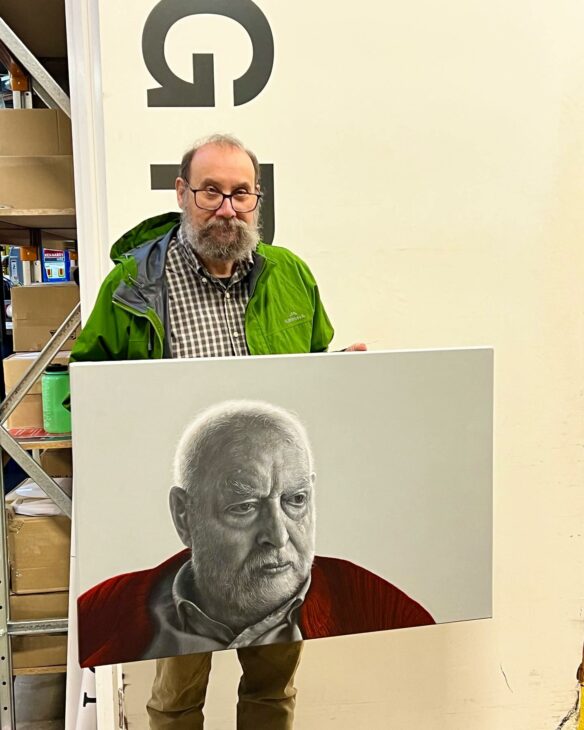
(2) GOOD LUCK! When Nick Stathopoulos delivered this year’s Archibald Prize entry to the Art Gallery of New South Wales, they posted a snapshot on Facebook. The 10-time Ditmar Award winner won the prize in 2017.
(3) SMALL WONDERS #11. Issue 11 of Small Wonders, the magazine for science fiction and fantasy flash fiction and poetry, is now available on virtual newsstands here. Co-editors Cislyn Smith and Stephen Granade bring a mix of flash fiction and poetry from authors and poets who are familiar to SFF readers as well as those publishing their first-ever piece with them.
The Issue 11 Table of Contents and release dates on the Small Wonders website:
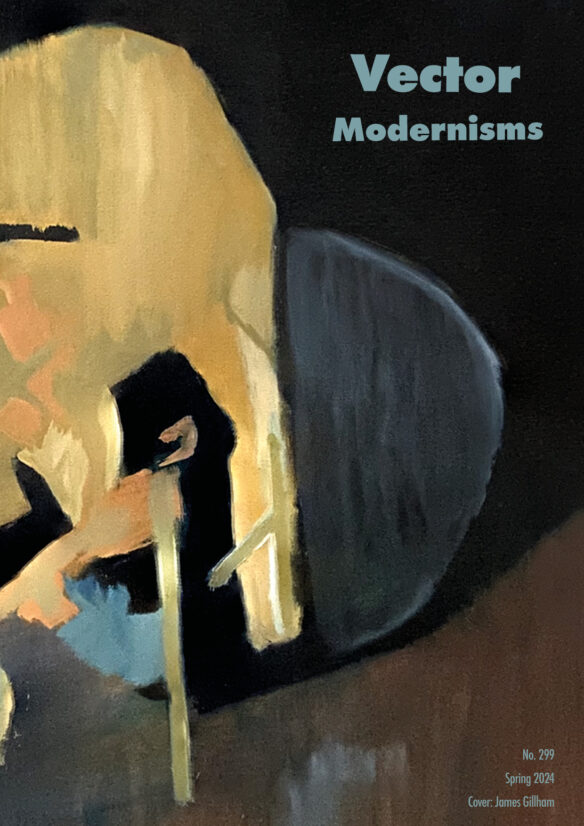
- Cover Art:”Meywa Sowen” by M. A. Del Rosario
- “Celestial Bodies” (fiction) by Mar Vincent (6 May)
- “Music of the Seraphim” (poem) by Angel Leal (8 May)
- “What You Sow” (fiction) by Holly Schofield (10 May)
- “Eloīse” (fiction) by Albert Chu (13 May)
- “Kannaki Contemplates” (poem) by Tehnuka (15 May)
- “Up From Out of Clay” (fiction) by Eris Young (17 May)
- “Unbending My Bones” (fiction) by Sierra Branham (20 May)
- “Swan’s Song” (poem) by Colleen Anderson (22 May)
- “The Stars That Fall” (fiction) by Samantha Murray (24 May)
Subscriptions are available at the magazine’s store the magazine’s store, Patreon, and Weightless Books.
(4) SOFT SF. If only reading social media was always this much fun: Premee Mohamed at Bluesky.
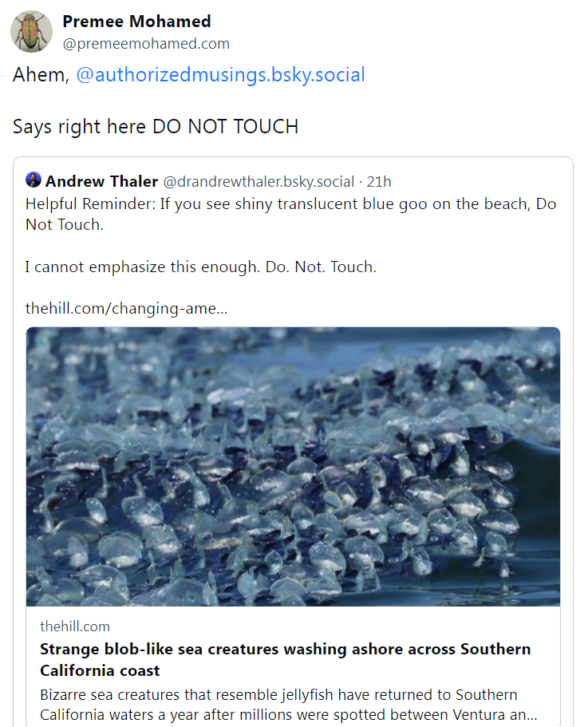
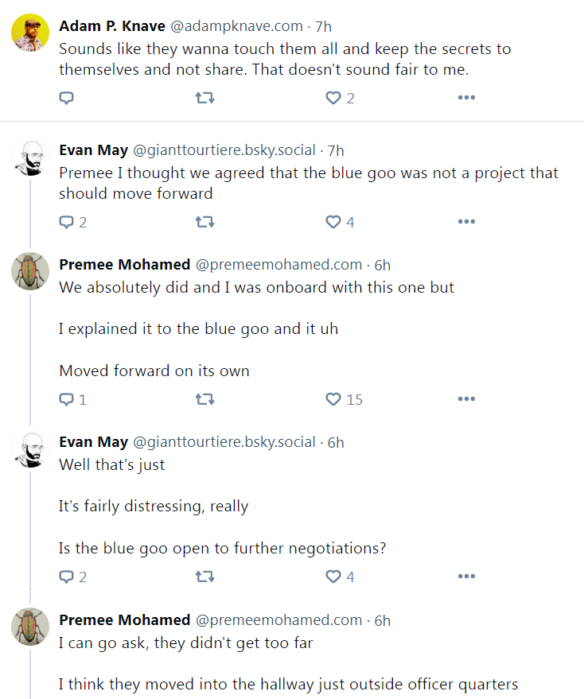
(5) AMAZING STORIES WANTS WHAT IT’S OWED. Steve Davidson is trying to get NBC to pay attention – and pay the money they’ve owed Amazing Stories since 2020. He’s asking anyone who’s willing to signal boost the statement he posted on Facebook.

This is VERY important and I would appreciate reader’s doing two things (if they agree and are comfortable doing so):
First – share this as far and wide as you can. You are granted permission to copy the original text, in its entirety and without alteration, in order to share it elsewhere.
Second – if you are a professional in the field and support this effort, I would like to hear from you personally via PM.
OK – here goes:
Last week I was informed by NBC representatives that I would have a communication from them regarding my missing payments on Tuesday (April 30) of this week.
That email was in response to a query I sent to them regarding this non-payment issue.
In the email, I stated that in the past, the only way(s) in which it seemed that I was able to get any action out of them was to go public with the issue.
Twice previously I had to engage in such actions in order to get breaches of the contract cured through renegotiation.
Major Hollywood personalities and production entities were embarrassed, upset and angered at the time by my accurate and truthful statements.
Tuesday has come and gone with nary a whisper.
I (and by extension, Amazing Stories) have been owed contractually negotiated fees since October of 2020.
Read that date carefully. Later this year, non-payment will have gone on for FOUR years.
While the funds owing are not great by Hollywood standards, they are great by Amazing Stories’ standards and affect its ability to pay authors and artists and others appropriate amounts. The absence of those funds has also negatively affected Amazing’s ability to promote and market its offerings as well.
I informed NBC representatives that if I did not hear back from them (with progress) when they had promised to do so, I would be launching a crowd funding campaign to see if we could raise the missing dollars elsewhere.
I also informed them that, out of necessity, that crowd funding effort would have to explain the entire history of my dealings with NBC (since 2015).
Not included in my email to NBC representatives was my additional intention to encourage NBC to voluntarily give up the rights I licensed to them.
When the contract was in breach (and NBC notified of termination – a notice that they also did not respond to until after I had gone public) I contacted several production studios with the idea of licensing them to do a show under that name.
Several responded in the affirmative, even to the point of discussing a production partnership, in which Amazing Stories would have production credit and direct creative input into the show (after I pitched them the idea that I would be seeking Science Fiction authors with script writing experience to create episodes, as well as to script existing classics of the genre), but that they could not move forward until the “legal encumbrances” had been settled.
The point being that, if free, the name could be used to (attempt) to produce a television show that would have great respect for the genre, would involve contemporary authors with proven story telling and script writing chops, would have ties to the magazine version and, obviously, the greater public footprint that a television show would bring.
(Some may be familiar with the radio shows Dimension X and X Minus 1, where episodes were based on short stories drawn from the magazines of the era. This is what we believe we could do with television.)
I will be forwarding a copy of this FB post to my contacts at NBC (again, who promised response by yesterday which was not forthcoming) and will begin putting together the crowd funding effort that I hope my friends and fellow fans here and elsewhere will support, either by contributing or helping to spread the word.
That effort will be seeking funds to support the legal action of terminating the licensing agreement.
Initial filings in pursuit of that goal are expected to cost approximately 15 to 20k. Some or all of those funds may be recoverable, depending upon a legal ruling.
AGAIN. It is important for this statement to gain wide distribution if it going to have the desired effect. The crowd funding campaign will include additional details and suggestions as to how folks can help advance this effort, but starting here on FB will give it a boost.
Thank you.
“I can’t be ignored. I won’t be ghosted. I can no longer be bargained with. I feel no remorse or fear. And I absolutely will not stop, ever, until this matter is settled to my satisfaction!”
(6) TENTACULUM #4 IS A FREE DOWNLOAD. The special Weird West issue of The Tentaculum is now available for all to download for free.
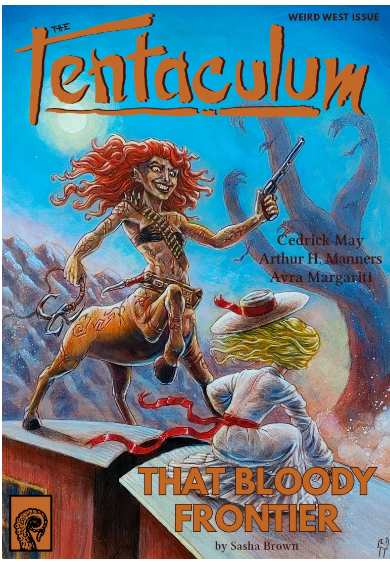
Featuring short fiction from Cedrick May, Arthur H. Manners, Sasha Brown, and Avra Margariti. This issue also includes nonfiction from Cedrick May and returning contributor Bobby Derie.
Edited by Cameron Howard and designed by Braulio Tellez. Cover and story illustrations by Tristan Tolhurst.
(7) TODAY’S BIRTHDAY.
[Written by Cat Eldridge.]
Born May 1, 1946 — Joanna Lumley, 78. Quick, tell me who appeared as a member of The Avengers, the real Avengers who have class, not the comic ones, was in a Bond film, and was Doctor Who as well. Now that would be the woman with the full name of Dame Joanna Lamond Lumley.
Her first genre role was a very minor one as it was essentially in the background as an English girl as she would be credited in On Her Majesty’s Secret Service.
I certainly don’t remember her there but I confess I’ve only seen it once I think.

(She’ll have a very minor role in the horror film Tam-Lin shock will get repackaged as The Ballad of Tam-Lin, The Devil’s Widow and The Devil’s Woman as well. I doubt it bears but the faintest resemblance to the actual ballad.
Her first significant genre role was on The New Avengers as Purdey, a former Royal Ballet member who said her high kicks were from her training there (a dubious claim). (And yes, Patrick Macnee was back as Steed.) Along with Mike Gambit as played by Gareth Hunt who had appeared in the Doctor Who’s “Planet of the Spiders”, that was the team on the New Avengers.
It lasted but two seasons and twenty-six episodes. Yes, I loved it. The chemistry between the three of them was excellent, perhaps better than it had been Steed and some of his solo partners.
Her second genre role was in Sapphire & Steel. She played Sapphire and David McCallum was Steel. It was considered a supernatural series. I’ve not seen it though I should watch it on YouTube as it legally up there courtesy of Shout Factory which is the company that now has the distribution license for it, so you see the first episode here.
She’s appeared in two Pink Panther films, Trail of the Pink Panther as Marie Jouvet and Curse of the Pink Panther as Countess Chandra. I’m amazed how many of those films there have been!
She voiced Aunt Spiker in James and the Giant Peach. Likewise, she’s Madame Everglot in Tim Burton’s Corpse Bride.
Finally, she played Doctor Who in The Curse of Fatal Death, a Doctor Who special made for the 1999 Red Nose Day charity telethon. It was Stephen Moffat’s first Who script. She was simply The Female Doctor. I’d like to link to the copies on YouTube but I’m absolutely sure they’re all bootlegs so please don’t offer up links to them.
(8) COMICS SECTION.
- Close to Home gives a kaiju directions.
- Frank and Ernest is about pet cuisine.
- Mannequin on the Moon remembers the poiuyt. But do you?
- Moderately Confused is about growing things.
- Shoe multitasks.
- Speedbump might be a variation on a Hitchcock film.
(9) HE-MAN HAS APPOINTMENT WITH THE BIG SCREEN. “’Masters of the Universe’ Finally Hitting Theaters Summer 2026” reveals Deadline. We predict Cora Buhlert will buy a ticket to see it!
The power of Greyskull is happening on June 5, 2026 when Amazon MGM Studios’ and Mattel Films’ finally bring their live-action reboot of Masters of the Universe to theaters.
As Deadline first told you, Bumblebee filmmaker Travis Knight is directing off Chris Butler’s screenplay (the initial draft written by David Callaham, and Aaron and Adam Nee). Mattel Films’ Robbie Brenner, and Escape Artists’ Todd Black, Jason Blumenthal, and Steve Tisch are producing.
The movie follows ten-year-old Prince Adam who crashed to Earth in a spaceship and was separated from his magical Power Sword—the only link to his home on Eternia. After tracking it down almost two decades later, Prince Adam is whisked back across space to defend his home planet against the evil forces of Skeletor. But to defeat such a powerful villain, Prince Adam will first need to uncover the mysteries of his past and become He-Man: the most powerful man in the Universe….
(10) CALL HER AGENT. Inverse is listening as “5 Years Later, Billie Lourd Pitches the Star Wars Spinoff We Need Right Now”.
…Lourd first appeared as Resistance Lieutenant Kaydel Ko Connix in The Force Awakens, and has only become more involved in the franchise since. Following Fisher’s passing in 2017, Lourd has become the “keeper” of Princess Leia, standing in for a younger version of the character in a Rise of Skywalker flashback. Returning to that galaxy far away has been a “difficult” experience for Lourd, but nowadays, the actress is keen to reprise her role as Connix.
“I would do anything to come back to any Star Wars franchise. I am absolutely available,” Lourd tells Inverse. “Getting to play Connix was such a gift, and to get to do it again would just be insane.”…
(11) THREE-BODY SCIENCE. [Item by Steven French.] “The science of 3 Body Problem: what’s fact and what’s fiction?” “Nature spoke to the sci-fi program’s adviser and two other researchers about the portrayal of PhD scientists and their technologies.”
…An alien civilization spying on humans using quantum entanglement. A planet chaotically orbiting three stars. Nanofibres capable of slicing through Earth’s hardest substance, diamond. Despite being chock-full of hardcore science, 3 Body Problem, a television series released on 21 March by the streaming service Netflix, has been a hit with audiences. So far, it has spent five weeks straight in Netflix’s list of the top-three programs viewed globally.
The story follows five young scientists who studied together at the University of Oxford, UK, as they grapple with mysterious deaths, particle-physics gone awry and aliens called the San-Ti who have their sights set on Earth. But how much of the science in the sci-fi epic, based on the award-winning book trilogy Remembrance of Earth’s Past by the Chinese writer Cixin Liu, reflects reality, and how much is wishful thinking? To find out, Nature spoke to three real-world scientists.…
(12) NOT ONLY IN WASHINGTON. “Is Alien Abduction Insurance a Thing in Washington State?” asks KPQ.
…Before we get into Washington’s take on the subject, it’s worth mentioning that this peculiar form of insurance coverage is associated with the Saint Lawrence Agency in Altamonte Springs, Florida.
Founded in 1987, this agency is famous for being the pioneering provider of alien abduction insurance policies. Over the years, the agency has made headlines and garnered both support and skepticism for its alien abduction policy.
The Saint Lawrence Agency reports to have sold thousands of these policies worldwide.
The policy costs $19.99 and pays out 10 million dollars if you get abducted. It’s important to note that, you’ll need an alien signature to verify your claims….
Newsweek read the fine print.
…The alien abduction scheme says it provides $10 million compensation in the event the policyholder is beamed up. It covers medical issues (all outpatient psychiatric care), sarcasm coverage (immediate family members only) and double indemnity coverage to the sum of $20 million in the event aliens insist on conjugal visits or the extraterrestrial encounter results in offspring.
St. Lawrence told WFLA last month his business has sold upwards of 6,000 policies since 1987. He says there have been two claims since the company formation—and only one big payout. The catch is in the fine print: cash is paid in installments of $1 per year for 10 million years….
(13) CALLS X-FILES SCENE “CRINGEY”. File 770 readers may be interested in this thumbnail self-retrospective of Gillian Anderson’s career produced by Vanity Fair. Of particular interest, of course, will be the first segment discussing The X-Files. But one of her other roles covered (as the psychiatrist in Hannibal) is at least genre adjacent. “Gillian Anderson Rewatches The X-Files, Sex Education, Scoop & More”.
(14) SHELL GAMES. Here is a cute stop motion video featuring a crossover of Masters of the Universe and Teenage Mutant Ninja Turtles.
[Thanks to Cat Eldridge, SF Concatenation’s Jonathan Cowie, Steven French, Cora Buhlert, Stephen Granade, Teddy Harvia, Kathy Sullivan, Mike Kennedy, Andrew Porter, John King Tarpinian, and Chris Barkley for some of these stories. Title credit belongs to File 770 contributing editor of the day Andrew (not Werdna).]